

AM Edition: Here are the top 10 economics articles on LiveNews.co.nz for April 21, 2026 – Full Text
International cooperation in crisis? Behind budget cuts, a crisis of legitimacy
April 21, 2026
Source: French to English Tester Published on: 2026-04-20
Source: The Conversation – in French– By Vincent Pradier Goeting, Doctor in management sciences, University Paris 1 Panthéon-Sorbonne
In 2025, official development assistance experienced its sharpest contraction ever recorded. But reducing the current situation to a matter of budget volumes would miss the essential point. What international cooperation is going through is above all a political and paradigmatic crisis – a multidimensional crisis that, revealingly, affects Western NGOs first and foremost today.
The figures published by the Organisation for Economic Co-operation and Development (OECD)In April 2026 are of rare brutality. Official development assistance (ODA) from member countries of the Development Assistance Committee (DAC) fell in 2025 by 23.1% in real terms, the sharpest annual contraction ever recorded since the indicator’s creation in 1969. Volumes have returned to their 2015 level, thus wiping out ten years of progress and, with them, part of the commitments made at the time of the adoption ofthe 2030 Agenda. According to the OECD itself, a new drop of nearly 6% is anticipated for 2026.
This historic drop is largely attributable to a single political decision:dismantling of the United States Agency for International Development(USAID), engaged as early as January 2025 by the second Trump administration. According to the OECD,US ODA was cut by more than half in one year (-56.9%), which constitutes the largest reduction ever recorded by a donor country. This American decision alone accounts for three-quarters of the global decrease in ODA in 2025. It has, in turn, accelerated the downward adjustments already initiated by other major donors – Germany, United Kingdom, Japan, and France. For the first time since 1995,These four countries simultaneously reduced their ODA for two consecutive years.
France is thus participating in this movement. After a reduction of 11% in 2023 and an additional cut of 13% in 2024, the French budget allocated to international solidarity has been subject, since the beginning of 2024, to five consecutive cuts. According to theestimations of Coordination SUD, the national platform of French NGOs, French ODA could be reduced by 58% in two years – and up to 64% for the budget lines of the Ministry for Europe and Foreign Affairs that directly fund NGOs. The goal of reaching 0.7% of gross national income in 2025, set out in theAugust 2021 law, by default of being officially abandoned, seems to become a distant horizon.
A crisis that is not only financial
It would be tempting, faced with this data, to conclude a “funding crisis” in international cooperation. However, such analysis would be insufficient. What strikes one, as one observes the succession of cuts, is the regularity with which they are politically decided, and the weakness of the resistance they encounter in the public sphere — including when, as is the case in France,66% of the population declares support for international solidarity action.
This paradox – apopular support for the very principle of solidarity, but a growing rejection of the organizations that embody it – deserves to be taken seriously. It is partly due to themanagerializationand to thebureaucratizationprogressives of a distant sector, as it became professionalized, from the militant anchorage from which it historically drew its legitimacy. It especially opens the way for what Félicien Fauryappointeda form ofnegative politicization– the one that fuels populist rhetoric by portraying NGOs as technocratic, disconnected actors, or even accomplices of a system they were supposed to be the watchdogs of.
In other words, it is not the budgetary decision itself that is in question. It is itspolitical feasibility. For decades, ODA has simultaneously fulfilledthree functionsA: a humanitarian and development role undertaken; a geopolitical role, discreet but real; and a function of democratic legitimization for donor states, particularly in the Western space. These three functions are today particularlyput in difficulty. In a growing number of countries, international solidarity is no longer seen as a valuable political good – it has become, in certain segments of the public debate, an argumentagainstthe governments that practice it.
The crisis is therefore primarily that of aframework of legitimization. It primarily affects Western NGOs, whose organizational model ishistorically backed by this framework.
NGOs caught in triple contestation
French international solidarity NGOs, whose combined resourceshad experienceda growth of 43% between 2016 and 2020,see todaytheir economic models falter, especially in thehumanitarian sector. ODA routed through civil society organizations represented 27 billion dollars (more than 22.9 billion euros) globally in 2024, or 12.9% of bilateral ODA – a figure down by 2.3%. Restructurings are multiplying, thealso layoff plans.
But the budget contraction is only one aspect of the problem. NGOsWestern– as I had analyzed in aprevious article– are caught in a triple contestation that makes their repositioning particularly delicate.
In the South, first, where some statesclaim a renewed sovereigntyon aid flows and intervention methods. The ongoing reconfigurations in West Africa, notably in Mali and Burkina Faso, are the most visible illustration of this,but the dynamic is broader. It is accompanied by a word ofincreasingly structuredof local organizations that refuse to be merely subcontractors and carry an epistemic critique of the very categories with which development has been conceived.
In the North, then, through two opposing critics who,although not symmetrical, converging in their effects. On one side, a criticismpopulistwhich contests the very principle of an international solidarity financed by public funds. On the other hand, acritiquedecolonialwhich questions the power relations that perpetuate aid and the forms ofcolonialitythat it conveys. These two critiques, from opposite directions, together contribute to the erosion of the public legitimacy of NGOs. The first, more aggressive, manifests as a direct offensive against the very associative freedoms themselves: several international solidarity NGOs – from SOS Méditerranée to La Cimade, including France Terre d’Asile –were subject to obstacles, threats of withdrawal of subsidies or attempts to exclude from public contracts, in the name of an alleged breach ofpolitical neutrality.
Inside the organizations themselves, finally, where employees challenge an inequality that has become difficult to justify: the one that separates, within the same organization, staff recruited locally in thecountry officesfrom the Souths and their counterparts in Western headquarters – in terms of salaries, career prospects, but also recognition of knowledge and experience. Since the Black Lives Matter movement in 2020 and several public scandals, there has also been a voice raised by racialized staff within the Western headquarters themselves on organizational cultures and dominant representations. This has been documented notably by the reports of Peace Direct (“Time to decolonise aid”) and thework of the British International Development Committee, this internal double critique now constitutes one of the most structured — and the most difficult to absorb — challenges faced by thesector has been confronted.
What the private sector will not be able to do
In this context, part of the institutional discourse has taken refuge in a promise: that of the private sector asnew engine of development financing. Philanthropy,blended finance, impact obligations, public-private partnerships. The underlying idea is that a hybrid financial architecture could offset the gradual withdrawal of public funding.
One thing, however, must be said clearly: the private sector will not replace ODA in volume. This is not a political hypothesis, it is an arithmetical reality.
The 32 major philanthropic foundationswho report their data to the OECDmobilized 11.7 billion dollars in 2023, or about 5% of the total ODA from DAC countries. Funds mobilized by the private sectorviaMixed financing mechanisms, although growing, are mainly concentrated on areas where an economic model is viable—that is, not on contexts of extreme fragility nor on global public goods, which remain entirely dependent on public solidarity.
Above all, these instruments operate atransformation of grammaraid. They gradually replace a logic of return on investment with a logic of rights or general interest, steer priorities towards solvable contexts, and shift the center of gravity of the decision towards actors whose goals are not (always) those of solidarity.
Towards a deterioration or a rebuilding of the sector?
What are the prospects? Three trajectories, which can be combined, seem conceivable today for the aid system.
The first is that of adegraded continuityÂ: The current model persists, on life support, more fragmented and increasingly dependent on geopolitically oriented private funding. Western NGOs survive there, but at the cost of a gradual reduction in their transformative capacity. This is, in the short term, the most likely scenario.
The second is that of ageopolitical restructuringalready partially committed. Aid flows from non-DAC countries reporting their data to the OECD rose from $1.1 billion in 2000 to $17.7 billion in 2022 – a sixteen-fold increase over two decades. China has committed $4 billion (€3.4 billion) to its South-South Cooperation Fund since 2015. South-South cooperation does not replace Western ODA in volume, but it is gradually building an alternative architecture, based on different assumed norms – non-conditionality, reciprocity, non-interference – which directly compete with those of the Western model.
The third, more demanding, would be that of apluriversal refoundationA: the emergence of a new framework of legitimization, based on the recognition of situated knowledge, the co-construction of responses, and the questioning of historical power asymmetries. It requires, on the part of Western NGOs, the ability to break free from certain certainties—certainties that their own teams, especially in intervention areas, are already questioning. It also requires public actors capable of reinvesting in a political, and not only technical, conception of international solidarity.
It is only under this condition that one can speak, not of apost-ODA worldsuffered, but from a truly reorganized cooperation system. The question, fundamentally, is no longer whether the current model can be saved in its form. It is whether, collectively, the organizations ofinternational solidarity – in the broad sense – are capable of thinking about it and building another one.

Vincent Pradier Goeting does not work for, does not advise, does not hold shares, does not receive funds from an organization that could benefit from this article, and has declared no other affiliation than his research institution.
–ref. International cooperation in crisis? Behind the budget cuts, a crisis of legitimacy –https://theconversation.com/international-cooperation-in-crisis-behind-the-budget-cuts-a-crisis-of-legitimacy-280948
Back to index · Read original article
Investing in art… then in artists: the new collaborations of companies
April 21, 2026
Source: French to English Tester Published on: 2026-04-20
Source: The Conversation – France (in French)– By Thomas Blonski, Assistant Professor in Strategy and Entrepreneurship, ICN Business School
Long considered an investment or a branding tool, art now occupies a more strategic place within companies. From collecting to residency, the artist is gradually becoming a full organizational partner. This is how a new collaborative economy is taking shape.
At the turn of the 2000s, many Western companies began buying works of art. Tax incentives, image improvement, asset diversification: “art as an investment” seemed natural. Twenty years later, a more discreet evolution is underway. Companies no longer invest only in works, but also in artists.
From aSurvey based on 23 interviewsconducted with leaders, artists, and intermediaries (galleries, specialized organizations), we sought to understand this gradual shift: how does one move from purchasing a work to organizing an artist residency, and then to creativity training programs?
From the work to the partnership
The sponsorship laws adopted at the beginning of the 21st centuryeThe century played a triggering role. In France, it is theAillagon law of 2003, with equivalents atUnited Kingdom(2000), inGermany(2000), but also inItaly(2000) and other European countries. The tax benefits encouraged companies that had no direct connection with the art world to build collections, support exhibitions, or finance institutions.
Also to read:
Contemporary art, a language and a method for thinking about an improbable future
In this context, artistic investment is conceived according to a dual logic. On one hand, it is an asset: some studies show that art can serve as a tool for asset diversification for a company, even if some researchers, such asMandelas well asLindenberg and Oosterlinck, show that returns are uncertain and difficult to anticipate. On the other hand, the work produces a symbolic effect, as it strengthens the brand image, signals a cultural commitment, and positions the company in a universe of prestige.
But very quickly, a realization becomes clear to the leaders interviewed: buying a work and hanging it in an entrance hall is not enough. “Level zero is putting a work on the wall,” sums up an intermediary. “If we do that, we might as well go further.”
A logic of “while we’re at it”
This “might as well go further” is at the heart of the observed dynamic. We have called it the logic of “while we’re at it” (might as well). Since the company invests in art, it might as well exploit all its potential opportunistically.
After its initial investment in sponsorship, the company indeed discovers that it now has access to a network: artists, gallery owners, exhibition curators, collectors. The relationships formed around the purchase of an artwork open up other possibilities. Why not create a contemporary art prize? Why not organize an artist residency within the headquarters?
Beyond heritage
This is how they multiply, including in sectors far removed from the cultural world, such as, for example,the automobile,real estate,or even wines and spirits), business awards, partnerships with museum institutions, or residency programs.
The objective is no longer solely patrimonial. It becomes relational and symbolic: gaining legitimacy in the “art worlds,” according to the sociologist’s expressionHoward Becker, and strengthen the brand’s cultural credibility.
Art as an organizational experience
A second shift then takes place. In contact with the artists, companies discover something other than artworks: ways of working. Residencies, initially designed as image or sponsorship operations, become spaces of interaction between artists and employees. Workshops are organized, collaborative projects are born. Teams are confronted with uncertainty, experimentation, with forms of creation that escape managerial routines.
Some leaders explicitly describe this shift. The artist is no longer just the one who produces a work, but the one who can convey an approach to work, creativity, or problem-solving.
At this stage, new forms of intermediation are emerging. To the traditional galleries are added hybrid structures, for exampleMona Lisa FactorywhereViarte, capable of translating artistic language into organizational objectives, such as creativity, team cohesion, or innovation. The initial investment in art then transforms into an organizational investment in the artist.
From buyer to actor
What this trajectory reveals is a sequence of rationalities. Initially, the logic is primarily financial: benefiting from a favorable tax framework and, possibly, from an asset appreciation. Very quickly, a symbolic rationality is added, since art confers prestige, distinction, a form of symbolic capital. Finally, an organizational rationality emerges: the aesthetic experience is converted into collective learning, managerial resource, and an internal transformation tool.
This process is neither linear nor planned from the outset. It is progressive and cumulative. Each step paves the way for the next. Because the company bought a work, it met an artist; because it met an artist, it imagined a residency; because it organized a residency, it considered a training program.
Build reputation
This evolution is not neutral for artists. Receiving a corporate award, undertaking a residency, or participating in a training program adds an additional line to a résumé. Companies thus become full-fledged actors in artistic trajectories, alongside galleries, museums, and public institutions.
They contribute to the construction of reputation and the circulation of artists. In some cases, contractual collaborations with companies are even perceived as more transparent and more financially secure than certain relationships within the art world.
Less an achievement, the “art as investment” appears as an entry point into this universe. What begins as an asset purchase is transformed, through successive adjustments, into an organizational partnership.
A new collaborative economy
This dynamic contributes to the emergence of a specific collaborative economy, linking artists, companies, and specialized intermediaries. It blurs the traditional boundaries between patronage, the art market, and management.
One question remains open: how far can this logic go? By constantly integrating the artist into the organization, does the risk of reducing art to a mere managerial tool really exist? Or, conversely, do these collaborations genuinely help to redefine the relationships between creation and business?
Far from the image of simple instrumentalization, this research shows that the relationship between companies and artists has become denser, more reflective, and more structuring than it was at the beginning of the 2000s. The artwork is no longer just hung on the wall. It opens the door to another way of thinking about the organization.

The authors do not work for, do not advise, do not hold shares, do not receive funds from any organization that could benefit from this article, and have declared no other affiliation than their research institution.
–ref. Investing in art… then in artists: the new collaborations of companies –https://theconversation.com/investing-in-art-then-in-artists-the-new-collaborations-of-companies-277303
Back to index · Read original article
Generative AI, the first cognitive revolution in the history of work
April 21, 2026
Source: French to English Tester Published on: 2026-04-20
Source: The Conversation – in French– By Hugo Spring-Ragain, PhD student in economics / mathematical economics, Center for Diplomatic and Strategic Studies (CEDS)
Artificial intelligence does not so much destroy jobs as it profoundly changes the skills required to perform them. From this confusion between jobs and skills, errors may arise in policies supporting ongoing transformations.
Each major technological wave has produced its share of contradictory predictions about employment. Artificial intelligence (AI) is no exception. But before knowing how many jobs AI will create or destroy, we need to agree on what it actually automates. The answer requires distinguishing three notions that public debate regularly confuses: employment, skill, and task.
The great waves of automation have followed a remarkably stable logic over two centuries: steam, electricity, and industrial robotics have displaced repetitive physical tasks and spared non-routine cognitive work. This empirical regularity has beenformalized by Autor, Levy, and Murnanesince 2003 under the name “task polarization hypothesis.”
A persistent illusion
Automation erodes intermediate jobs, those of skilled blue-collar workers and office employees performing routine tasks, but spares the two extremes. On one hand, non-routine manual tasks, such as plumbing or caregiving, on the other, non-routine cognitive tasks, such as analysis, consulting, or expert writing. The latter constituted the core of skilled tertiary professions, and the conviction was firmly established that they would remain out of reach.
Also to read:
Why AI is forcing companies to rethink the value of work
This conviction was based on a conceptual confusion that must be cleared up first and foremost. It was not the job of a lawyer or financial analyst that was protected, but a set of specific tasks that made up this job and which had until now resisted automation. The distinction between these three levels is fundamental.
A job designates a position held within an organization, with a contract, a salary, and a job description. A skill is a cognitive or technical ability that can be applied in various professional contexts. A task is a specific, definable action, for which it is possible to assess whether or not it can be automated at a given cost. It is at this third level that the ongoing transformation truly takes place, and it is precisely this level that the public debate ignores.
Rupture in the long history of industrial capitalism
Generative AI represents a breakthrough in this long history. For the first time since industrialization, qualified cognitive tasks such as writing, document analysis, synthesis, and production of first drafts are directly exposed.Eloundou, Manning, Mishkin and Rockestimate that about 80% of the active U.S. workforce could see at least 10% of their tasks affected by large language models, and that this exposure increases with salary level. This is the exact opposite pattern observed in all previous waves.
The analytical framework developed byAcemoglu and Restrepoallows to go further. Their model distinguishes two opposing effects produced by any wave of automation:
-
The displacement effect, first: workers lose tasks to the benefit of the machine, which mechanically reduces the demand for labor and weighs on the wages of the affected groups;
-
The reintegration effect, then: automation produces new tasks where human value is decisive, generating compensatory demand.
The long history of industrial capitalism can be read as a succession of these two effects, the second generally ending up compensating for the first.
The case of translation allows us to see very concretely how displacement and reintegration combine. Generative AI can produce a first draft in another language in a few seconds, which shifts part of the work previously done by human translators to the machine. But this automation simultaneously reintegrates other tasks or enhances their importance, such as checking for misunderstandings, adapting to the cultural context, harmonizing terminology, quality control, and final validation.
Potential imbalance
What is worrying with generative AI is the potential imbalance between these two dynamics. The shift is happening at a speed that labor markets and training institutions struggle to absorb, while reintegration still largely remains to be built.
However, the most important phenomenon is not sectoral, but it is internal to the professions themselves. In its“Employment Outlook”, the OECDhighlights that the professions most exposed to generative AI are precisely those with a high cognitive density: finance, law, consulting, higher education. Unlike previous waves that affected rural areas and industrial regions, the exposure is now stronger in large metropolitan areas and among highly skilled workers, an unprecedented geographical and social reversal.
Redistribute tasks
This reversal concretely takes place at the level of the task.
In the same position of financial analyst or legal advisor, some tasks are shifting to AI (producing an executive summary, generating an initial contract analysis, synthesizing a literature review), while others are mechanically gaining value: defining the relevant analytical framework, assessing the quality of automated reasoning, detecting factual errors in an output, assuming legal or ethical responsibility for a decision. These are not jobs that disappear. They are bundles of tasks that are redistributed between humans and machines, transforming from within what an employer expects from a qualified employee.
This redistribution of tasks has a direct impact on the skills that will truly be valued in the coming years, and it overturns some of the usual assumptions about professional training.
Train workers to use AI instrumentally, to master a tool, to writepromptsEffective, mastering an interface is useful in the short term, but it is insufficient if the skill truly required tomorrow is not to produce with AI, but to supervise and critique what it produces.
A training challenge
However, effectively supervising an AI output requires exactly what short and technical trainings struggle to develop: a solid general knowledge that allows detecting a fundamental error, an argumentative ability to evaluate the coherence of a reasoning, a knowledge of cognitive biases to identify the blind spots of an automated analysis. These are skills thateducational sciences group under the term metacompetencesTo learn to learn, to exercise critical judgment, to mobilize knowledge in unprecedented situations.
The paradox then becomes the following. As AI automates routine knowledge tasks, it precisely values what generalist training and humanities courses have long cultivated and what debates on employability have tended to disregard in favor of more immediately measurable technical skills.
Not out of nostalgia for the humanities, but out of pure economic logic. If the machine produces the text, the analysis and the synthesis, the marginal value of the human lies in their ability to judge whether this text is true, whether this analysis is relevant in light of the real context, whether this synthesis serves the pursued objective.

Hugo Spring-Ragain does not work for, advise, own shares in, or receive funds from any organization that could benefit from this article, and has declared no other affiliations than his research institution.
–ref. Generative AI, the first cognitive revolution in the history of work –https://theconversation.com/lia-generative-premiere-revolution-cognitive-de-lhistoire-du-travail-279911
Back to index · Read original article
Is there too much talk about entrepreneurship? The case of the French press
April 21, 2026
Source: French to English Tester Published on: 2026-04-20
Source: The Conversation – France (in French)– By Gaël Gueguen, Professor of Strategy and Entrepreneurship, TBS Education
The representation of entrepreneurs in the French press has changed significantly since the beginning of the 21st century. Both in the quantity of articles and in the nature of journalistic narratives. We have studied these developments to better understand the driving forces behind “entrepreneurialism,” this current of thought that regards entrepreneurship as a remedy for society’s problems.
Entrepreneurship has become a mainstream topic, it has even turned into a spectacle. On M6, during prime time hours, the show“Who wants to be my partner?”allows project holders to find investors. A long time ago, in 1986, businessman Bernard Tapie had already combined business creation and television with the show“Ambitions”on TF1 to show the face of a bolder France, “enthusiastic and generous.”
When the President of the Republic Emmanuel Macron mentions the“French start-up nation”In 2017, its objective is to present entrepreneurship as a means to positively transform a country by enabling individuals to be actors of these changes.
From the managerial model to the entrepreneurial model
Economists David Audretsch and Roy Thurik hypothesized that, since the last quarter of the 20th century, Western countries have shifted from a managerial model, which values large enterprises (private or public), to aentrepreneurial model, enhancing individual actions and the“Small is Beautiful“, from the title of economist Ernst Schumacher’s book. If we wanted to caricature, entrepreneurship is a dynamic bearing benefits and the entrepreneur an inspiring figure.
But the highlighting of the successes of theSilicon Valley, young tech startups, unicorns ordecacorns(these start-ups valued at more than one billion or ten billion dollars) cannot obscure thedangersof an abusive schematization around the imagery of start-ups and entrepreneurship. Indeed, entrepreneurship is a complex and multifaceted process, and should not be considered a miracle. A research trend has thus developed for acritical approach to entrepreneurship.
Also to read:
Macron’s 25 unicorns, a dangerous fascination?
Illustrating this model change, entrepreneurship has enjoyed strong media exposure for about thirty years. This enthusiasm goes beyond the simple economic sphere. In the artificial intelligence sector, the media exposure of Mistral AI and that of its co-founderArthur Mensch, just like the story surrounding Demis Hassabis and DeepMind, are recent examples of this exposure.
“Entrepreneurialism” or the entrepreneurial ideology
The conceptof “entrepreneurship”appears to us as relevant to study this trend. It is an ideology that no longer sees entrepreneurship as a simple economic activity, but as a universal solution to society’s ills. Simply put, it is good to undertake and everyone can undertake; let us remember Emmanuel Macron’s statement on X:
It is accepted that the media (specialized or mainstream) play a central role in the construction of representations. The media act as witnesses and actors of a country’s culture. Sociological studies, for example thoseby Edward Herman and Noam Chomsky, remind that the media directs the public’s attention. Even if they do not directly dictate what to think, they define the topics that should be considered important.
Regarding entrepreneurship, media coverage is regularly criticized for its uniform, excessively positive, even heroic character, which showcases success figures, often male andfar removed from the daily reality of entrepreneurs.
Shaping the collective imagination of entrepreneurship
Starting from this observation,we conducted researchin order to have an overall view of how the generalist press treats the subject of entrepreneurship over a long period. Two major questions motivated us. How has the discourse on entrepreneurship evolved at the beginning of the 21st century? And, in what way do the different newspapers, according to their editorial line, shape the collective imagination around the notion of entrepreneurship?
To answer these questions, we studied the coverage of entrepreneurship in the five main French national general daily newspapers (le Monde,le Figaro,Libération,la Croixandl’Humanité) over a period from 2001 to 2022. By analyzing more than 6,000 articles, all containing the term “entrepreneurship,” using textual analysis methods, our results allow us to identify a major transformation: the shift from a macro representation, focused on the economy and politics, to a micro representation, oriented towards the individual, their journey, and their lived experience. This shift reflects greater heterogeneity in the treatment of entrepreneurship and contributes to a broader dissemination of “entrepreneurialism” in French culture.
Our results also reveal that the volume of articles dealing with entrepreneurship has progressively increased, rising from about a hundred per year at the beginning of the 2000s to a peak of over 500 articles in 2017, an election year, before experiencing a slight decrease. Newspapers leaning right or center (le Figaroandle Monde) produce the majority of content on the subject.
Macro and micro representations
Themacrorepresentationis predominant in left-wing newspapers (l’HumanitéandLibération) and was majority during the first decade of observation (2001-2012). Entrepreneurship is considered there globally, impersonally, and institutionally as a system. It is addressed from the perspective of public action, economic growth, fiscal measures orlinked to employment. It is also found in the political debate, particularly during the various presidential campaigns. Furthermore, reflections on entrepreneurial ideology, capitalism, and the economic system are associated with it.
Themicrorepresentationis more supported by a right-wing newspaper such asLe Figaroand has grown significantly, becoming the majority during the most recent period (2018-2022). It is a more embodied entrepreneurship, because it concerns theconcrete experiencesactors of entrepreneurship. This representation is frequently found in articles dealing with higher education or technological innovation in the startup world. It will consider the careers of entrepreneurs in biographical form, often to recountsuccess stories. Entrepreneurship is approached from the perspective of life path, family, aspirations, but also the places where entrepreneurship takes place. Microrepresentation therefore humanizes the entrepreneur.
In the press, a clear shift in the representation of the entrepreneur
The temporal evolution of the results shows a clear shift. In the early 2000s, the press spoke about entrepreneurship mainly as an economic policy tool or as a subject of ideological debate. Gradually, the discourse shifted towards narrative and individual experience. We are witnessing the normalization of the figure of the entrepreneur, who is no longer just an economic statistic but becomes a familiar character, whose dreams, failures, and family environment are recounted.
We are observing an increasing diversity of topics covered. For example, newspapers located in the center, such asle Mondeandla Croix, present the most diverse approach, navigating between economic, social, and human aspects. On the right,le Figaroremains more focused on the managerial and biographical aspects. Meanwhile, on the left,l’HumanitéandLibérationfavor somepolitical and societal angles.
These results confirm that entrepreneurship is now a social fact, permeating the economy, politics, society, and education sections of newspapers. By moving from an abstract discourse on government policies to stories about life projects, we believe the press contributes to normalizing the idea that entrepreneurship is a possible, even desirable, option for everyone.
It is impossible to say whether there is too much talk about entrepreneurship, but we can affirm that its treatment by the press is more heterogeneous. It is in this sense that we conclude a rise of “entrepreneurialism.”

Gaël Gueguen does not work for, does not advise, does not hold shares in, and does not receive funds from any organization that could benefit from this article, and has declared no other affiliation than his research institution.
–ref. Is there too much talk about entrepreneurship? The case of the French press –https://theconversation.com/do-we-talk-too-much-about-entrepreneurship-the-case-of-the-french-press-276643
Back to index · Read original article
Talking about the beauty of businesses? Not so absurd after all!
April 21, 2026
Source: French to English Tester Published on: 2026-04-20
Source: The Conversation – France (in French)– By Pierre-Jean Benghozi, Professor of Economics and Management, École Polytechnique
A company is said to be performing, profitable… and sometimes that it is toxic or dangerous. But it is rarer to make an aesthetic judgment. And yet, some companies are “more beautiful” than others.
This article is published as part of a partnership withFrench Management Review,who celebrated his 50th birthday in 2025.
How not to be struck by the seduction and the feeling of “formal beauty” exerted today—on analysts, economists, managers, and observers—by new technologies, unprecedented business models of platforms, the extended organizational forms of certain NGOs or mission-driven companies, rapidly growing companies or those able to reinvent themselves, and Open Innovation ecosystems built with stakeholders and by mobilizing consumers’ own production?
Recalling that these organizations are seen from an aesthetic perspective captures a dimension usually poorly taken into account by management studies. This is because the rise of rationalization starting from the industrial revolutions has created a decoupling that now seems natural between beauty on one side, and performance and rationality on the other.
The divide is not self-evident, however. This is proven in one of the sciences that appears to be the coldest and most logical: mathematics. No one is surprised that the quality of a proof is judged not only by its correctness, but also by its simplicity, brilliance, and “elegance.”
Also to read:
The crisis forces every company to reinvent its business model
An aesthetic question
For nearly half a century, the aesthetics of organizations has thus been a rapidly expanding field of research, which has been the subject, worldwide, of numerous articles and several special issues of major management journals. This work quickly went beyond merely highlighting a neglected aspect – the perceived beauty and/or ugliness of a company – by broadening and enriching the way organizations are accounted for.
Also to read:
These start-ups that “play pinball” to refine their business model
Beyond their mere performance, these constitute complex and formal structures, which must be analyzed as a set of elements (resources, actors, skills, etc.) connected by multiple relationships (management procedures, hierarchy, evaluation, financial dependence, commercial exchanges, technical dependence…) between different groups of actors.
In this perspective, the same objective leads everywhere to infinitely varied production structures: from large bureaucratic organizations to small structures formed in a mannerad hocfor the realization of a project. In this context, the organizational forms that appear in companies as well as in markets can be very different, both in their efficiency and performance, of course, but also in the vision, understanding — or even the appeal — through which they spontaneously present themselves.
A stylistic evolution
Beyond the characterization of this or that organization, the aesthetic approach also encourages questioning the succession of their forms. Reading a stylistic evolution highlights their different hidden dimensions. For organizations, like works of art, articulate with all the sociopolitical and cultural registers of social reality: emotion and the sensitive character of the reception of productions and engagement in work (as in the visual arts), simplicity and impact of shaping a creation in cooperation (as in architecture and cinema), importance of expressiveness in interpersonal interactions (as shown by theater and live performance).
At a time of fascination with artificial intelligence, the detour through aesthetics allows, beyond that, to question the interaction between technology and modes of production, by comparing the formal appeal of technical solutions with their structural and economic impacts.
While creativity and innovation now have an omnipresent place and role in organizational strategies (they were, moreover, the subject of the latest Nobel Prize in Economics), the detour through aesthetic theories allows for a better understanding of the tensions they generate: on the one hand, a vision of creativity involving the questioning of existing solutions, and on the other hand, the necessity, in order to impose itself and be recognized, to largely conform to the standards, norms, or practices in place.
A double movement
There is thus a double movement: the pioneering companies in the adoption of new management methods (think of the Gafam, Airbnb, and companieslow costsuch as EasyJet or Ryanair) rely on existing markets and frameworks, but then themselves become managerial models influencing emerging forms of organizations or ecosystems, just as avant-garde artists inspire currents or artistic schools.
Such movements are impossible to explain with a purely descriptive and classificatory approach. In artistic matters, the capacity for renewing aesthetic forms is decisive: the beautiful and the modern explicitly arise from this novelty. In terms of management, thinking about the evolution of managerial styles also involves considering how certain fundamentals, such as performance or optimization ofprocess, regularly redefine themselves in new forms of organization or action that appeal under the influence of entrepreneurs, researchers, or consultants.
No form can be given as beautiful outside the exercise of each individual’s subjectivity… just as judgments of performance, profitability, and cost evaluation do not exist in absolute terms, but are always linked to the position and objectives of the actors who carry them. The judgment of beauty lies both in the eyes of the artists who produce and in the eyes of the spectators or consumers who receive it.
The question of aesthetics thus makes it possible to reconsider, in the approach to organizations, an alternative between contingent subjectivity and intrinsic objectivity that crosses the issues of management but goes back to the origins of aesthetic philosophies, and which Kant himself had encountered.

The authors do not work for, do not advise, do not hold shares in, do not receive funds from an organization that could benefit from this article, and have declared no affiliations other than their research institution.
–ref. Talking about the beauty of companies? Not so absurd after all! –https://theconversation.com/talking-about-the-beauty-of-businesses-not-so-absurd-after-all-280177
Back to index · Read original article
AI, Lego, and Rap: Iran’s New Weapons Against Trump and Netanyahu
April 21, 2026
Source: French to English Tester Published on: 2026-04-19
Source: The Conversation – France in French (3)– By Arnaud Mercier, Professor of Information and Communication at the French Press Institute (University Paris-Panthéon-Assas), University Paris-Panthéon-Assas

Shortly after the start of the war in Iran, numerous videos generated by artificial intelligence were published on social networks by accounts close to the Tehran regime. Drawn from the Lego universe, combined with a rap text and edited like music videos, they have a very specific goal: to expose the propaganda of the Iranian regime with sarcasm and in an attractive way, and to discredit its American and Israeli adversaries. Analysis of a communication tool that borrows many codes from Western pop culture.
In all wars, the belligerents engage in propaganda operations to enhance their own side and discredit the opponent, while seeking to support the morale of their population and maintain its mobilization. Sometimes, these propaganda operations take the form of speeches and images that primarily act as counter-propaganda, responding to the arguments and imagery of the adversary in order to neutralize their possible effects on their own opinion or on international public opinion.
In this game, the Islamic Republic of Iran shows itself to be very active and efficient. It supports a small network of activists who publish brief videos online generated by artificial intelligence that ridicule the Trump and Netanyahu administrations through animations of… Lego figurines. As we have already shown,AI becomes a key asset for visual contestation.
A preexisting use of Lego to denounce the war
Replicating Lego pieces by AI is relatively simple. Result: many images using this device circulate on the Internet for humorous or critical purposes. The association of the Lego universe with the denunciation of war is part of these uses.
Thus, the destruction of Gaza by Israeli bombings gave rise to the generation of images of Lego boxes, made up of shattered pieces meant to represent the ruins of Gaza, these montages being used bothby supporters of Israel to humiliate the Palestiniansor by defenders of the latter to protest against the actions of the Netanyahu government.
Similarly, the sarcasm targeting Donald Trump’s ambition to appropriate Greenland also involved the use of Lego imagery, which is all the more ironic since the company was born in Denmark, which exercises its guardianship over this Arctic territory.
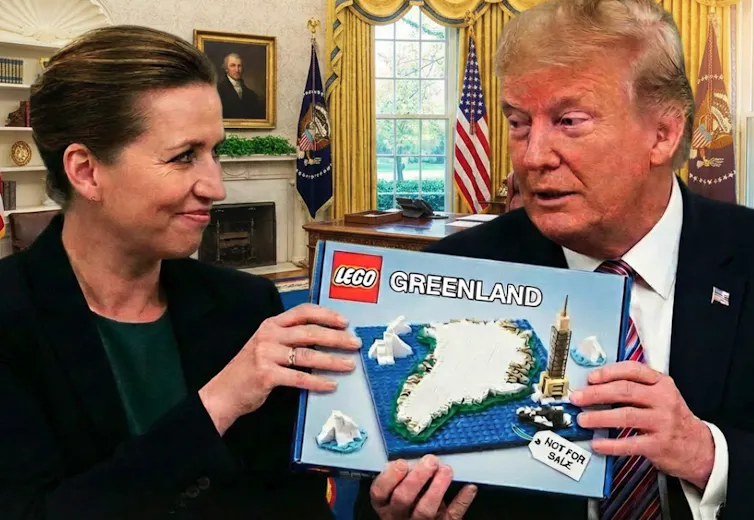
Account X Piraten_Saar
Lego rap version videos to gain virality
Internet culture is both amemetic cultureand a mimetic culture. Mimetic, because the success conditions of a message partly rely on its prior and recognizable cultural grounding, especially when it comes to content with a humorous or sarcastic intent. The “LOL” culture (an English acronym for “laughing out loud”) consists of winks, allusions, overlaps between current events and older references, and fusions of cultural references that do not spontaneously go together, or even clash.
Also to read:
Ukraine: the meme war
The use of already known references to comment on the news aboutsocial networksthen helps to gain visibility, and catches the eye better in an economy of attention that is always volatile. Taking ownership of existing imagery, which already circulates according to a logic,described by Limor Shifman, remake, parody, imitation (of memes, then), increase the potential for virality. Lego figurines universally known as children’s toys, the animated Legos from mainstream films (The Lego movie, in 2014, was asuccess at the global box office, Lego as a humorous resource, are just as many references already circulating on the Internet and make it an effective memetic resource.
Added to this is the mimetic culture, which means that the initial success inspires other creators who see in a meme and its references an exploitable formula. This mimetic work can be seen in recent times, since following the strong visibility gained by the first Iranian Lego counter-propaganda content, which appeared at the end of March, other creators (anonymous and therefore not necessarily Iranian) also produce Lego videos denouncing the military adventurism of Donald Trump and the Israeli prime minister. They are notably recognizable by the fact that the figurines are not always animated, and by the portrayal of Trump which does not have exactly the same face as in the Iranian videos.
One thing is certain, using very well-known popular figurines guarantees the reception of this message among people who might be attracted by these images, whereas they would have spontaneously fled any classic Iranian propaganda message.
Furthermore, the soundtrack accompanying these videos is always rap, again AI-generated, with lyrics that are virulent and humiliating for Donald Trump and his Israeli ally, which constitutes a counter-discourse well in line with the brutal, unsophisticated, and vulgar phrasing of Donald Trump himself and appropriates the practice ofpunchlinesof rap. Moreover, the use of toys allows showing the violence of war while bypassing the restrictions imposed on these images by social networks.
A well-designed tool for counter-propaganda
Two Iranian propaganda groups sign their works, circulated since the end of March, at a daily rate:Persiaboi & Explosive News. TheBBC intervieweda representative of the second group. The latter admits to having the Iranian state as a “client” and considers it “honorable to work for the homeland.” He also explains that his team atExplosive Mediahas fewer than ten people and uses Lego-style graphics “because it’s a universal language.” On X, the accounts of Iranian and Russian state media regularly share them, which allows reaching millions of views.
This work is very well thought out since it closely follows current events, recycling images that have circulated through news channels worldwide, either to highlight them better or to challenge them if they go against Tehran’s interests. This counter-propaganda indeed responds promptly—often within a few hours—to speeches given or events that have occurred. The aim is to try to nip in the bud an American-Israeli rhetoric that could spread and convince public opinion, by offering an alternative narrative, another way of seeing the facts, of interpreting the situation.
In the following two examples, we see that the image of an American Awacs plane bombed on a Saudi base is part of the Lego imagery in several videos. They are seeking true realism in the depiction of the damage caused to the fuselage.
In the same spirit, Iranian propaganda stagedMohammed Qalibaf, one of the new strongmen of the IR, during his flight to Islamabad to meet J. D. Vance who came to negotiate an outcome to the conflict on behalf of Donald Trump: photos of the children killed in thebombing of their school in Minab on February 28had been placed on the passenger seats of his plane, as well as bloodstained and damaged schoolbags. This macabre staging is taken up at the beginning of aLego video.

The most blatant counter-narrative is found in the video made by PersiaBoi, published on April 7, 2026, and entitled“Uranium heist. Dead of night”. With these synthetic images, the video runs counter to the heroic narrative of the operation to rescue an American aviator stranded in enemy territory.
Far from the success loudly staged by the Trump administration, this short clip denounces against a rap background a “failed operation, $600 million wasted”. The operation would have been, according to the authors of the video, an (failed) attempt to recover Iranian enriched uranium: “They said it was a rescue. But it was a heist, a uranium heist”: “They say it was a rescue operation, but it was a heist, a uranium heist.”
Donald Trump, the main target of this Lego propaganda
In all war propagandas, one of the obsessions is to discredit one’s enemies and especially their leader. Donald Trump is therefore particularly targeted. Beyond attacks on his failings as a war leader — he is depicted as immature, cowardly, and a liar — Iranian propaganda recycles a whole series of criticisms that have long been directed at him, notably by his American political opponents. Such an approach is likely to delight his many detractors around the world, including some of those who are nonetheless hostile to the mullahs’ regime.
Donald Trump is presented as a “loser”: he is supposedly losing the war, so he experiences panicked fear, materialized by beads of sweat on his face and by a worried or horrified look. He would therefore still be ready to retreat. This is the exploitation of the famous TACO figure:Trump always Chickens Out(“Trump always chickens out”) is the label American political opponents stick on him. And, ultimately, he would be defeated, and we show him burning or agonizing in the emergency room, with petroleum in an IV drip.
His lack of credibility is also denounced by invoking the figure of the clown:
… but also that of the compulsive liar, spreader of fake news.

Iran, avenger of the martyr children…
This undermining of Donald Trump’s and the American army’s reputation — who are said to be bogged down in Iran — is accompanied by an attempt to ennoble the regime of the mullahs, who present themselves as defenders of martyred children. Included are the little girls from the Minab school, destroyed by an American missile, as well as references to the teenage girls caught in the nets of Jeffrey Epstein and his accomplices. The heroic defense of Iran is thus portrayed as a way to avenge the memory of these girls with tragic fates.
Once again, internal narratives within American political life are recycled by the Iranians to try to rally opponents of Trump to their cause. This is how, in several videos, memorial inscriptions are drawn on Iranian missiles ready to be launched against American forces.

… and unifying the victims of America
To conclude on the incredible wealth of Western references carried by these twenty or so videos posted online (and sometimescensored by the platforms), it is also necessary to point out the presence of references, globally known, to archetypes of anti-Americanism. In these videos, the Iranians seek to rally to their cause all those who have historical grievances against the United States of America. A video published in early April byExplosive Newsprovides a historical overview of the populations that have good reasons to bear ill will towards America.
Under the title“one vengeance for all”mobilized are figurines of feathered Indians, chained African slaves, a Vietnamese family, Japanese victims of the nuclear bomb, Iraqi prisoners of Abu Ghraib, children of Gaza, little girls from Epstein Island. Iran would be their vengeful arm, triggering a series of spectacular destructions: the White House is in ruins, the letters of Hollywood Hill are on fire, the Statue of Liberty collapses, the aircraft carrier Gerald Ford explodes, the 1-dollar bill burns.
The regime that has justmassacre at least 30,000 of its citizensfor having had the misfortune to claim their freedom therefore has the nerve to present himself as the repairer of what he calls historical injustices.
The recycling of antisemitic motifs
To complete this overview of the main aspects of this original counter-propaganda, it is necessary to highlight the antisemitic nature of several depictions produced by a regime that advocates for the disappearance of the State of Israel. These videos point to the responsibility of the Israeli prime minister in Trump’s alignment with the bombings in Iran. They repeatedly use the cliché of the Jew who pulls the strings, the Jew puppeteer who manipulates the world, directly inspired himself by the devil. This nauseating imagery can be found in the history of Slavic (notably Serbian) or Nazi antisemitic iconography.
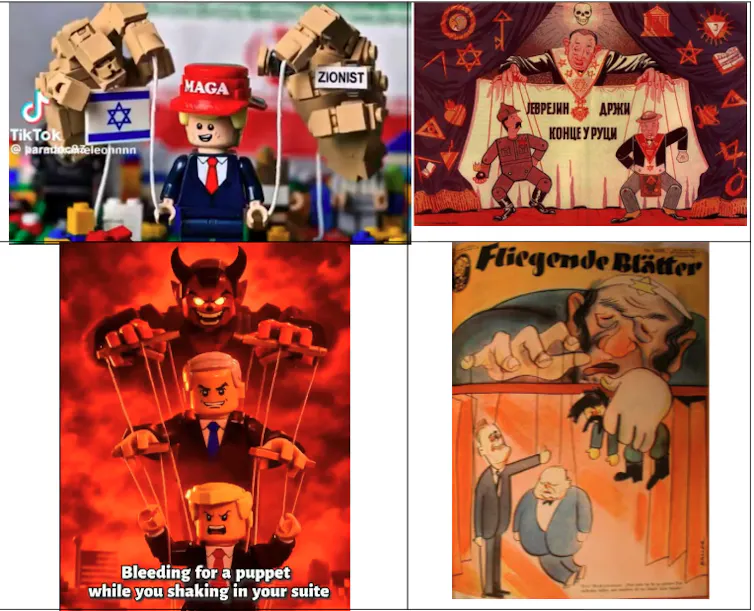
Trump and Netanyahu act under the control of the devil (in his classic Christian representation, red and with horns) and Moloch, in his original Jewish representation but bearing Judaic symbols that make him an anti-Semitic marker. Knowing that the Bible associates the worship of Moloch, practiced among the Canaanites in antiquity, with child sacrifice.
In one of the videos, these diabolical and repulsive figures end up being sacrificed thanks to the supposedly purifying action of Iran. Such iconography also reconnects with the official rhetoric of the Iranian regime, which systematically calls America the “Great Satan” and Israel the “Little Satan.”
Let us add, to conclude, that these videos place Iran on the side of modernity and mastery of AI content generation. This nation of engineers presents itself as capable of producingad libitum, and in a hyper-reactive way, counter-propaganda videos in response to the armed assaults and the communication power of the Americano-Israeli forces.

Arnaud Mercier received funding from the European Commission.
–ref. AI, Lego and rap: Iran’s new weapons against Trump and Netanyahu –https://theconversation.com/lia-lego-and-rap-the-new-weapons-of-iran-against-trump-and-netanyahu-280607
Back to index · Read original article