

Source: French to English Tester Published on: 2026-04-08
Source: The Conversation – France in French (3)– By Jean Lacroix, Associate Professor, Université Paris-Saclay
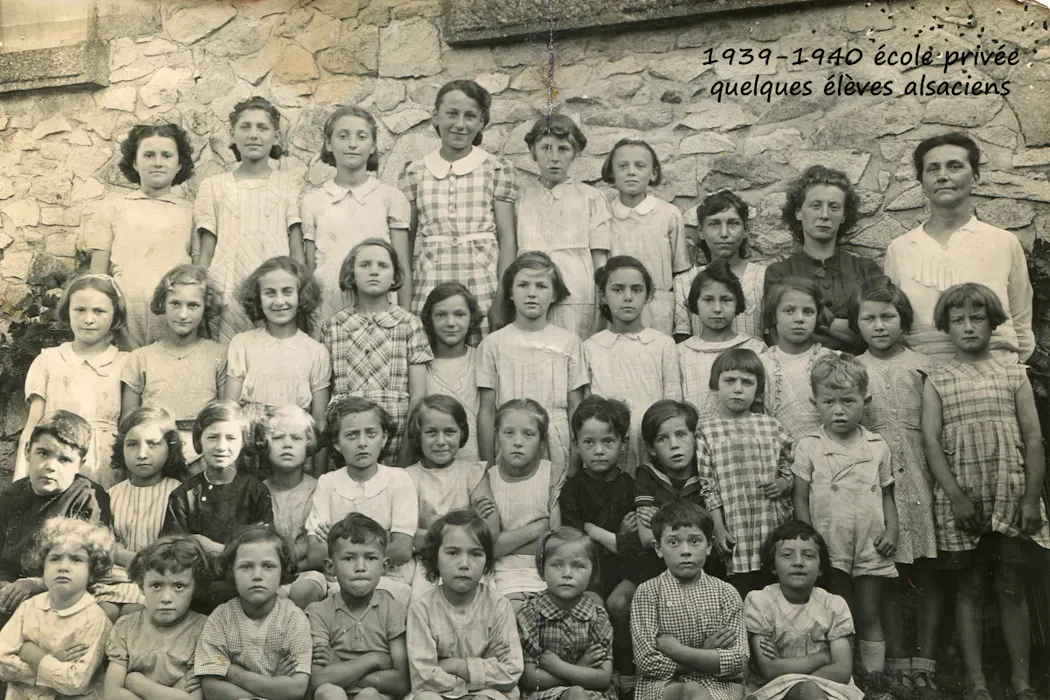
Official website of the city of Isle
For just under a year, between autumn 1939 and summer 1940, a great many Alsatians from Bas-Rhin lived in Haute-Vienne after leaving their region, which had become a war zone. A recent study focuses on this forced cohabitation and the effect it may have had on the electoral behavior of the hosts after the conflict.
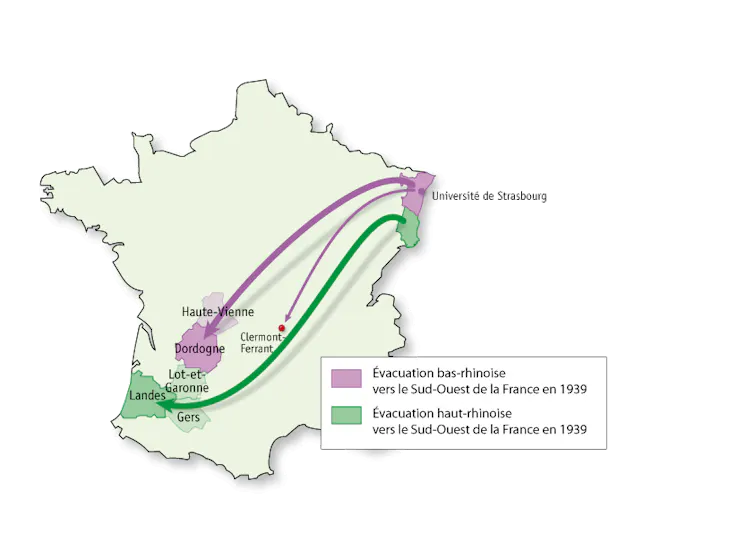
In the autumn of 1939, France goes to war against Germany, but the conflict does not only break out on the front lines. It also begins in the train stations, town halls, and villages in the interior of the country. Indeed, as early as 1933, the State hadprepared the evacuation of border populations in case of conflict with Germany. Hundreds of thousands of civilians then leave the northeast of France from the very beginning of the conflict.
This evacuation is based on a rigorous organization. Civilians are allowed to take 30 kg of luggage and must leave behind non-essential belongings. The evacuation plan has included for several years a precise route, guiding evacuees from northeastern France from their original municipalities to their host municipalities. In the evacuated departments, the evacuation of the “front zone,” the area located between the Maginot line and the German border, must precede that of the “rear zone,” located just beyond the Maginot line.
Residents of Bas-Rhin are being sent more than 700 kilometers away from their homes, to Haute-Vienne. The services of the Haute-Vienne prefecture had planned to distribute Alsatian refugees fairly within its department, so that each of its municipalities would host a number of refugees equivalent to about one third of its population. However, some municipalities must host refugees from the forward zone, while others must host refugees from the rear zone. Yet, the evacuation of only the forward zone already brings about 60,000 refugees to Haute-Vienne.
From then on, the prefect of Haute-Vienne protested and the Vice-President of the Council of Ministers, Camille Chautemps, agreed to stop the evacuation to Haute-Vienne. This change to the initial plan contradicts the will of the prefect of Haute-Vienne to distribute the refugees fairly among the municipalities of his administration.
Our studyshows that the municipalities designated to receive refugees from the previous zone ultimately received, on average, an additional population equivalent to 22.8% of their initial population compared to other municipalities. Some municipalities in Haute-Vienne even welcomed more than 85% of their population in refugees. In this context, the unequal distribution of the refugee influx among municipalities was purely by chance and was not due to,as in other cases, to the characteristics of the host municipalities.
This significant difference in refugee flows, and these random differences in flows, allow for a precise study of the impact of these refugees on their hosts.
Meeting between two Frances
How to analyze this contact between the hosts and the refugees from Bas-Rhin?The contact theory developed by the American psychologist Gordon W. Allport (1954)mentions four dimensions that promote positive contact between groups. Contacts between groups are facilitated if both groups (1) share an equivalent social status; (2) share a common goal; (3) cooperate on different tasks; and (4) the contact is endorsed by the authorities. The contact between Alsatian refugees and their hosts in Haut-Vienne seems to meet all of these criteria.
What if Nexon was told to me
The authorities are hastening to ask the local populations to give the best possible welcome to the Alsatian refugees. The context, and the national unity it requires, provide every assurance that the hosts will welcome the Alsatian refugees with open arms.The logistics of reception mobilizes the local populations. Several testimonies attest to positive exchanges between the hosts and the Alsatian refugees. This was the case during the Christmas party of 1939, when theHaut-Viennois invite Alsatian refugees to share a moment with them.
Despite these signs of positive contact, the arrival of the Alsatians highlights the differences between the hosts, “French from the interior,” and their guests. The Alsatian refugees, mostly,speak a local dialect close to German, which earns them the nickname of“ya-ya”.
The differences between refugees and hosts go far beyond the language barrier alone. Historically, the Limousin is secular, while the Bas-Rhin is rather religious, particularly Protestant. Haute-Vienne is also a rural area, which contrasts with the urban development of the Bas-Rhin. All these differences are reflected in the pre-war electoral behaviors:according to electoral statistics, Haute-Vienne ranks among the most left-wing areas in the country between 1928 and 1936. This is not the case for Bas-Rhin, which rather places in the middle of the table.
In the end, the contact between Haut-Viennois and Bas-Rhinois will be short-lived. Following the French military defeat,the Rethondes armistice signed on June 22, 1940demands the repatriation of evacuated populations. A large majority of evacuated Alsatians therefore, from the summer of 1940, take the reverse route of that of autumn 1939. Even though the contact between these two Frances was brief, it was a poignant experience for therefugees as well as guests.
The consequences of a meeting: the vote in Haute-Vienne in the post-war period
In order to better understand how hosting Alsatian refugees impacted their hosts,our studyis interested in a local specificity: the left-wing vote. If contact with refugees has left its mark on the inhabitants, this can influence the vote in three ways. Firstly, contact can directly affect the vote of hosts exposed to the consequences of the war, notably economically. Secondly, contact can allow an exchange of values between hosts and refugees, on average more to the right; the share of left-wing votes may therefore decrease in municipalities that have welcomed the most refugees. Thirdly, contact, by revealing differences with the more right-leaning Alsatian voters, may have locally increased the success of the left.
It seems that this third mechanism prevailed after the war. Municipalities that received the most refugees voted more to the left than others after the conflict. A 10 percentage point increase in the share of evacuees increased, on average, the share of votes in favor of the left at the end of the 1940s by 2 points. The effect peaks immediately after the war, then diminishes in the 1950s. This redistribution of votes to the left partly stems from a repudiation of thePopular Republican Movement (MRP), a party often associated with its leaders of Alsatian origin. These results do not suggest a diffuse electoral shift, but a reconfiguration of the relationship between local and national levels in the ballots.
We also observe that the municipalities which hosted the most Alsatian refugees focused, after the war, on the local social fabric, notably by creating associations for this purpose. Finally, we observe that this reinforcement of the left occurred where the Alsatian refugees differed the most from their hosts. This was the case when refugees came from municipalities where the proportion of Protestants was higher, or when rural Haut-Viennois hosted urban Bas-Rhinois, or conversely when urban Haut-Viennois hosted rural Bas-Rhinois.
The contact between these two Frances during the war therefore reinforced regional particularisms in terms of electoral behavior. Contact between different groups does not necessarily homogenize behaviors. In post-conflict societies, these particularisms are one of the challenges to be addressed in rebuilding the country. The accommodation of Alsatian and Mosellan refugees is now oftencelebrated in the former host municipalities. It therefore seems that this shared history, which may once have accentuated political differences, now constitutes a bridge between municipalities more than 700 kilometers apart from each other.

Jean Lacroix received funding from the National Research Agency (ANR).
Ricardo Pique does not work for, advise, hold shares in, or receive funds from any organization that could benefit from this article, and has declared no other affiliation than his research organization.
–ref. The Alsatians evacuated in 1939: the consequences of a forced encounter between two Frances –https://theconversation.com/the-evacuated-alsatians-of-1939-the-consequences-of-a-forced-encounter-between-two-frances-279228