

Source: French to English Tester Published on: 2026-04-08
Source: The Conversation – France in French (2)– By Victor Gysembergh, Research Director at CNRS, Sorbonne University
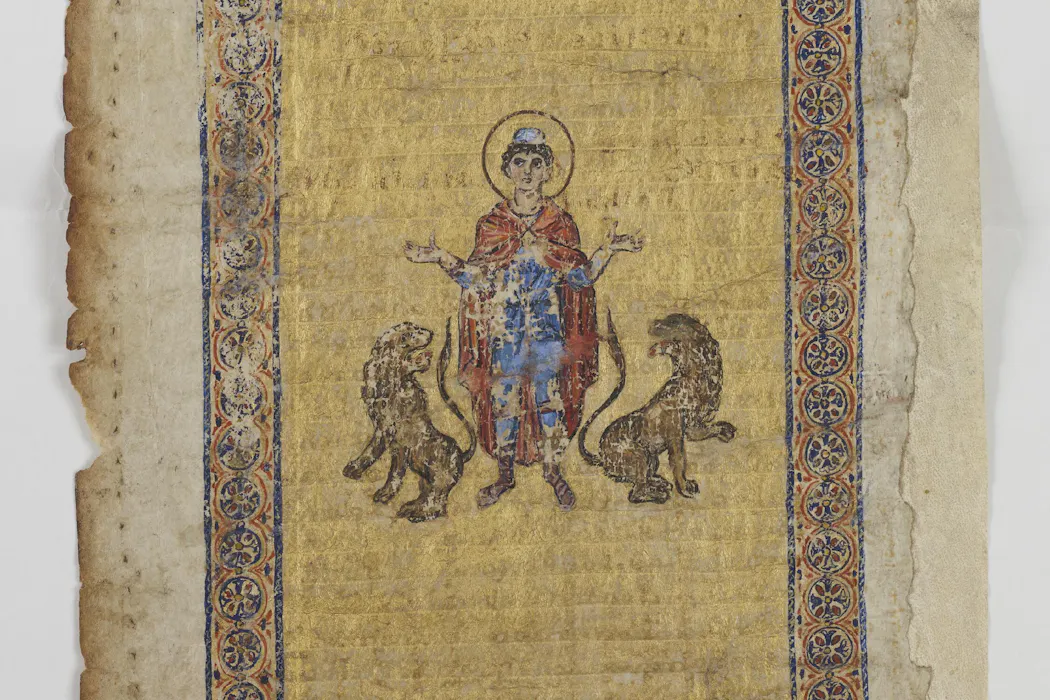
It was thought lost forever: a page from Archimedes’ palimpsest has just been found at the Museum of Fine Arts in Blois, in Loir-et-Cher. The researcher who identified this leaf from the 10th-century manuscript compiling the geometer’s treatises recounts his discovery by a fortunate coincidence (combined with a good memory) and suggests ways to find two other still missing leaves.
On March 9, 2026, the CNRShas announcedthat I had identified, in the reserves of the Blois Museum of Fine Arts, aleaf from the Archimedes palimpsestconsidered lost. I would like to return here to this story and what it reveals: in the silence of public and private collections, with massive digitization, how many treasures remain invisible, for lack of having been searched for?
The Archimedes palimpsest is an 11th-century manuscript that gathers seven treatises by the Syracusan geometer – includingthe Method of mechanical theorems, the only text in which he explains how he found his results before proving them. Heir, like many ancient texts, to an unknown chain of copies going back to the lost originals of Archimedes (3rd century BCE), it is the oldest preserved exemplar of his texts and, for some, the only witness. In 1229, somemonks erased this treasure– probably using a pumice stone – to rewrite a prayer book there. The parchment, made in this case from goat or sheep skin, was expensive (this single codex contained the equivalent of about fifty animals). This is how palimpsests are born, from the Greekpalimpsests(“scratched again”).

Archimedespalimpsest.org
1906: the first rediscovery
It is the Danish philologist Johan Ludvig Heiberg whorediscovered the textof Archimedes in Constantinople in 1906 by deciphering the erased text with the naked eye, then photographing the manuscript under white and ultraviolet light. The discovery made the front page ofNew York Times. His photographs, now kept at the Royal Library of Denmark, as well as their decipherment by Heiberg, remained for a long time the only documentary trace of the codex, as the palimpsest disappeared shortly after.
It resurfaced only several decades later, in a French private collection, before being sold at auction at Christie’s in 1998 for two million dollars.

Archimedespalimpsest.net
The new owner entrusted it to the Walters Art Museum in Baltimore, United States, where, in the early 2000s, somemultispectral imaging experiments– involving photographing the manuscript under different wavelengths of light (visible, ultraviolet, infrared, then X-rays) to extract complementary information invisible to the naked eye – allowed much better reading of Archimedes’ treatises, and the discovery of texts that no human eye had read for centuries – including a commentary onCategoriesfrom Aristotle and a speech by the orator Hyperides. But three sheets among the 177 listed by Heiberg had meanwhile disappeared. Since then, they were considered lost forever.
An office joke that lets you find a treasure
In October 2025, I was discussing with colleagues the fact that Blois had long housed part of the royal libraries of France. As a game, I threw out: “Let’s see if there is a palimpsest in Blois.” I entered the words into Arca, the digital library of the Institute for Research and History of Texts. An entry appeared: a parchment at the Museum of Fine Arts of Blois, inventory 73.7.52.
Looking at the digitized images, something in the handwriting struck me. It’s a professional deformity: years spent frequenting ancient manuscripts develop a kind of involuntary visual memory, like recognizing a song from the first few seconds. Moreover, one side bore a geometric figure. I deciphered the readable text: a passage from theOn the sphere and the cylinder. I took out Heiberg’s photographs. The comparison was unequivocal. The handwriting, the figures, the text itself: everything matched. I had before me folio 123 of Archimedes’ palimpsest.
What the page says – and what it hides
The sheet contains propositions 39 to 41 from the first book of the treatise. One side is readable; the other is covered with an illumination depicting the prophet Daniel between two lions. This was likely executed around 1942.At the instigation of its ownerSalomon Guerson, in a desperate attempt to increase its value to sell it in order to escape anti-Semitic persecutions.

Blois Museum of Fine Arts, Inv. 73.7.52/IRHT-CNRS

Blois Museum of Fine Arts, Inv. 73.7.52/IRHT-CNRS
Modern science knows how to look through these obstacles. In the coming months, I hope to conduct a campaign of multispectral imaging followed by X-ray fluorescence mapping – a technique that detects metallic residues of ancient ink beneath opaque layers, without damaging the parchment. These methods, much more effective than in the early 2000s, could also allow us to reread passages of the palimpsest that remained illegible during the Baltimore campaign.
Two sheets are still missing
The three missing leaflets haveprobably been cutin France around 1942. If one of them survived in a museum’s reserves and was able to be identified in a few seconds of digital research, the other two may very well have followed comparable trajectories.
The sheet I recognized had been bequeathed to the museum in 1973 by the collector André Frank (it is unknown how he acquired it) and had not been identified for what it was. The other two sheets may be in a library, a museum, a private collection – in France or in neighboring countries. Greek parchments with, on one side, several layers of text and perhaps also geometric figures and illuminations, on the other. Perhaps exactly what you possess?
The possible help from collectors
Ancient manuscripts, especially palimpsests, are rare and precious. But digitization does not damage them, and on the contrary increases their value by revealing their contents. It allows a reproduction to be deposited in an accessible database.
The Blois sheet was found because André Frank had bequeathed it to the museum, and because the institution had cataloged and digitized it – without even knowing what it possessed. Without this sharing infrastructure, my research in Arca would have yielded nothing.
The parchments are also fragile: humidity, temperature variations, acidic materials can erase in a few decades what twenty centuries have preserved. The IRHT-CNRS, the BNF, the National Archives, or the ERC PALAI project team, which I am responsible for, can provide free advice to any collector wishing to protect their belongings.
The essential support of researchers
It would be unfair to place the responsibility for dormant treasures solely on collectors. Thousands of institutions (municipal libraries, provincial museums, ecclesiastical archives, university collections) preserve manuscripts that no one has looked at for far too long. The reasons for this under-exploration are understandable: pressure to publish, increasing specialization, difficulty in funding exploratory research. One does not submit an ANR project for needle-in-a-haystack research.
And yet, it is precisely this type of research – patient, exploratory, based on curiosity without a defined goal – that produces the most unexpected discoveries. Spending a few hours a week exploring digital catalogs and writing to curators of little-consulted collections is not time wasted.
We do not know what we have. The digitization of public collections is a silent revolution (but it stops at the doors of private collections). Archimedes’ work has survived through a series of fortunate accidents: meticulous copyists, an attentive Danish philologist, a museum that unknowingly preserved a fragment of genius. At every link, someone made the right choice — or chance worked in our favor. Today, we no longer need chance. All that is missing is the will. And sometimes, a phone call.
To report a palimpsest or ask for conservation advice, write to: cnrs-palai@cnrs.fr.

Victor Gysembergh received funding from Sorbonne University, the City of Paris, and the European Union (ERC grant PALAI, No. 101170952).
–ref. Archimedes Palimpsest: how a lost page resurfaced in Blois –https://theconversation.com/palimpseste-darchimede-comment-une-page-perdue-a-refait-surface-a-blois-279261