

Source: French to English Tester Published on: 2026-04-08
Source: The Conversation – France in French (3)– By Sophie Cras, Senior Lecturer in the history of the modern worlds, contemporary world history, art and music, University Paris 1 Panthéon-Sorbonne
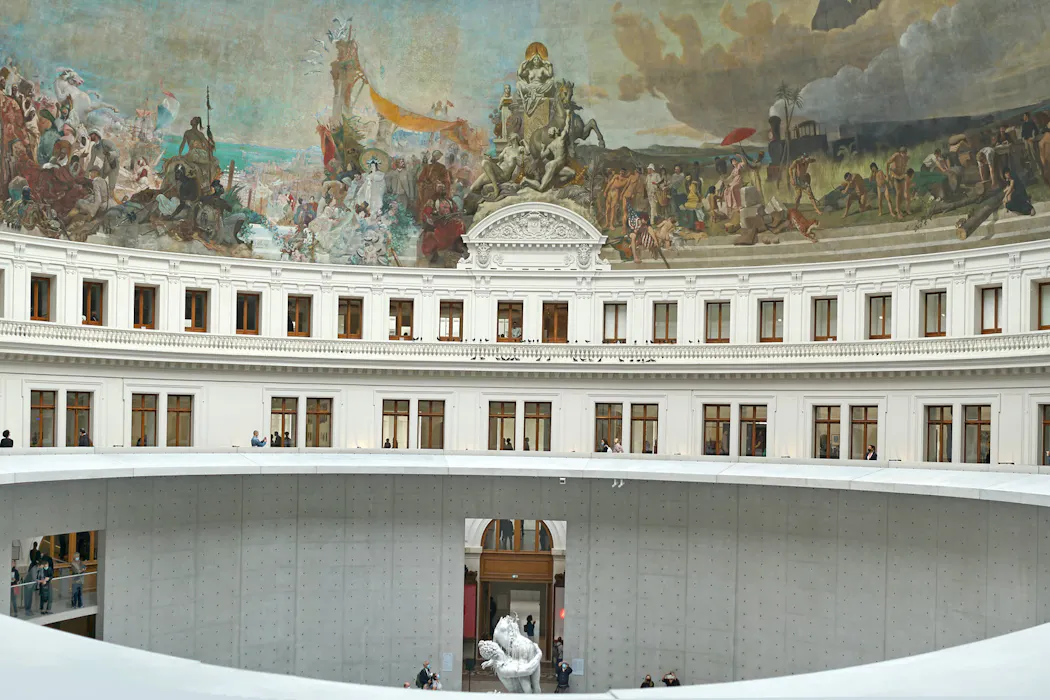
Jean-Pierre Dalbéra/Flickr,CC BY-NC
At the end of the 19th century, as trade globalized, a new form of institution appeared: the commercial museum. In Paris, the Bourse de commerce — today transformed into a contemporary art museum — formerly exhibited someraw materialsand manufactured products. In his work,the capitalist eye, which has just been published by Flammarion editions, Sophie Cras, associate professor of contemporary art history at the University Paris 1 Panthéon-Sorbonne, examines the role of the museum as an instrument of commercial and colonial policy.
Like a huge eye of cast iron and glass, the dome filters the light that bathes the circular hall of the Paris Stock Exchange. It animates the large mural painting decorating the lower part of the dome with a beam of shadows, and plays with reflections on the showcases, also original, that mark the perimeter of the hall.
Since entrepreneur François Pinault took over and restored the 18th and 19th-century building to exhibit his contemporary art collection, a concrete cylinder designed by Tadao Ando doubles the roundness of the space, emphasizing the historic glass dome with a contemporary gesture. This architectural eye reminds us that, long before these places became a museum, long before the wholesale trade and auction sales of agricultural products ceased here to make way for works of art, the Bourse de commerce was already dedicated to the gaze. It even housed a museum. A museum unlike any other: a commercial museum.
A commercial museum. The expression sounds almost like an oxymoron to today’s ears. However, this was not the case at the end of the 19th century: the commercial museum was then, in museographic terminology, a well-established category—and very popular. In itsPrinciples of Museum Administration, published in 1885, museologist George Brown Goode thus distinguished six types of museums: “A. art museums; B. historical museums; C. anthropological museums; D. natural history museums; E. technological museums; F. commercial museums.” He continued with a rather intriguing definition:
“The commercial museum is dedicated to raw materials and manufactured goods likely to be sold; to markets, modes of commercial distribution, prices, as well as supply and demand of goods.”
What could economic phenomena such as prices, supply and demand, or commercial distribution possibly be doing in a museum? Answering this question requires going back in time, reconnecting with an era when neither “museum” nor “economics” had exactly the meaning they are given today. At that time, economics was not yet synonymous with abstraction and mathematical formalization, but could be conceived as a “collection” science, whose knowledge, based on the observation of objects, found in the museum the ideal place for development, dissemination, and even practical application. Then, the museum was not necessarily understood through an aesthetic and heritage lens but often appeared as an economic technology, an instrument of commercial policy. The productive, commercial, and financial practices of capitalism relied on particular ways of seeing, practiced in the museum and cultivated in daily professional life. This is what I call the “capitalist eye.”
One way to see
Talking about the “capitalist eye” exposes one to three misunderstandings that I would like to address right away. The first would be to reduce to sight a process that in reality mobilized many other senses, in particular touch and taste, but also a plurality of actions carried out in the museum: not only seeing, but reading and discussing, handling, experimenting, calculating. The second would be to understand this expression as a personification of capitalism, which, like an all-powerful being, would be capable of “seeing.”
My intention is the opposite: in the terms of the historianPierre Rosanvallon, I consider that “capitalism is only the resultant of concrete economic and social practices”. Borrowing fromperiod eyedear toMichael Baxandall, the capitalist eye actually refers to the eye of the capitalists, the visual skills and habits of the actors who were at the heart of the capitalist socio-economic system.
The third misunderstanding would be to essentialize and dehistoricize capitalism and the form of perception that accompanies it. On the contrary, the perspective I describe corresponds to a relatively narrow and historically well-defined phase of capitalism, which began before it and continues after its disappearance. This phase falls at the very end of what Pierre François and Claire Lemercier, in their periodization of capitalism, call the “age of commerce,” which according to them extends from the late 17th century to around the 1880s. Far from today’s outdated conceptions of an “industrial revolution” based on mechanized factory production, this first age of capitalism is embodied, until the end of the 19th century, in the powerful figure of the merchant, who profits from the organization of long-distance trade, extends credit, and places orders with manufacturers throughcomplex subcontracting chains.
Production is still little standardized; knowledge of goods and markets is then key: it is precisely these visual skills of the trader that commercial museums intend to rationalize. Because they are created at the moment when the world is gradually shifting into the “age of the factory,” a new phase of capitalism marked by the standardization and massification of production in large units based on different distribution channels, these museums will quickly become obsolete. The title of this book,the capitalist eye, must therefore be understood as the abbreviated version of what one might call, to paraphrase Fredric Jameson, “the sensory logic of capitalists in the age of late commerce.”
The museum seems to me, as writtenBenoît de L’Estoile, a privileged observatory to understand “the way in which welet’s seethe world in which we live”, for within it, the ordering of the visual relationship to objects is deliberately and explicitly epistemic. By using sparse and scattered textual and iconographic sources, this book strives to restore a practice of looking tied to a way of experiencing the world – a gaze, I said, intimately mixed with touch, taste, laboratory experimentation, reading texts and numbers, and calculation.
It is within the material thickness of the display devices, at the intersection of scientific, aesthetic, and practical considerations, that the museum’s ability to produce and transmit knowledge for visitors is located, in an encounter that is not only visual but engages all the senses of abody in motion. The museum, writtenCharlotte Klonk, is a “space of experience.” This investigation, conducted very close to the objects and their modes of appearance, thus seeks to offer a more situated and concrete history of capitalism.
By writing this book, I hope to reframe this peculiarity – commercial museums – within the history of museums, economics, and colonization, from which they are triply absent. I would like to show that in the era that concerns me, the museum was willingly conceived as a fully-fledged political and economic instrument; that it could be oriented towards the future and action, rather than contemplation of the past; that museum collections did not necessarily derive their value from beauty, preciousness, rarity, or historical testimony, but rather from the commercial potential they represented; that they were sometimes made not to be preserved, but to be handled, destroyed, and constantly renewed.
I would also like to qualify a history of economic thought often written as the triumph of an abstract and mathematically formalized neo-classical economy. My approach is in line with researchers who, likeMarion Fourcade, refuse to take for granteda priorithe categories of “economy” and “economists,” and instead aim to “examine the historical conditions that contributed to crystallizing the very idea of what economy is,” paying attention to practices as much as to texts, and to practitioners as well as to academics.
Commercial museums were indeed, like the chambers of commerce with which they were often associated, spaces for meetings between scholars and publicists, merchants and manufacturers, elected officials and administrators. At this intersection, they allow us to identify alternative currents of thought to the dominant economic discipline, variously articulated with it, outlining a more complex and heterogeneous panorama of economic knowledge, and also less teleological.
The commercial sciences practiced at the museum present themselves as a missing link between the “science of commerce” of the 18th centuryeA century rediscovered byArnaud Orain, and the “colonial sciences” of whichPierre Singaraveloustudied the development and institutionalization from the end of the 19th century. They help to understand the centrality of economists in the constitution and promotion of knowledge ofimperialism and colonization, contrary to the long-held belief that the liberalism of economists would have made themanti-colonialists.
In fact, commercial museums have their place in the history of imperialism and colonization, of which they were tools. Economic historians have noted the low weight of colonial imports and exports in the trade balance of metropolitan nations untilFirst World Warat least. It is with full awareness of these statistics (which they were often responsible for producing themselves) and in the hope of reversing them that those responsible for commercial museums worked. The unfinished and partly illusory nature of the enterprise of commercial exploitation of the colonies does not diminish the reality of the instruments that were concretely implemented to serve it – colonial commercial museums were among them.
Their economical museography exposes, without embellishment, the relentless program of economic domination that imperial metropolises had set for themselves. Commercial museums fit seamlessly at the intersection of the history of colonization, since they contributed very concretely to the colonial economic enterprise, and of colonialism, in the sense that they promoted and legitimized colonial ideology. This book suggests that they gradually shifted from one to the other, from the economic to the symbolic, without presuming, moreover, that they were more effective as tools of colonial propaganda than as instruments of trade development.
The history of commercial museums is written under a double horizon of failure: the failure of a museal project which, despite the ambitions and resources deployed, systematically disappoints expectations and ends up being completely abandoned; the failure of an economic project, that of the “development” of the colonies, which results in a profound gap between bombastic rhetoric and facts, and relies on scientific practices that quickly became obsolete. However, we must not let our awareness of failure discredit the historical phenomenon in advance, or turn it into a mistake to demystify.
Let us, on the contrary, strive to take seriously the projects and knowledge that drove the actors, however absurd, vain, and harmful they may seem to us. Let us forget that we know the end of history, and dive into the practice of what the museums of capitalist eye once were.

Sophie Cras received funding from the scientific policy of the University Paris 1 and the Humboldt Foundation.
–ref. Commercial museums: a forgotten history of capitalism –https://theconversation.com/commercial-museums-a-forgotten-history-of-capitalism-279393