

Source: French to English Tester Published on: 2026-04-08
Source: The Conversation – France in French (3)– By Catherine Pélage, Professor of Latin American Literatures and Cultures, Director of the Dominican Cultural Studies Chair Sisters Mirabal, University of Orléans
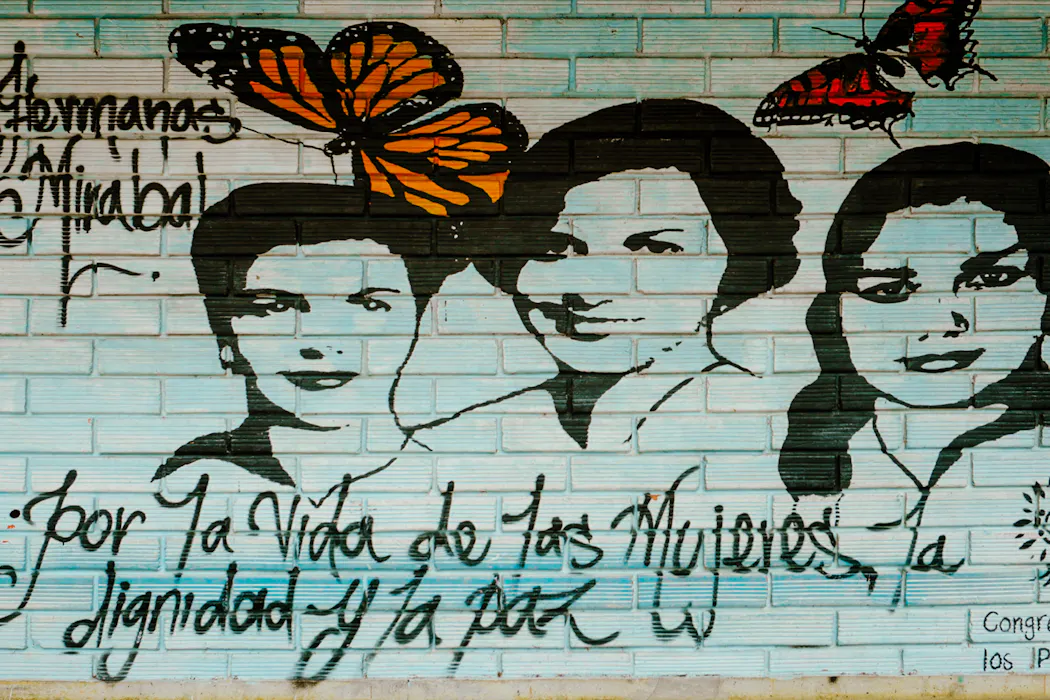
In 1930, Rafael Leónidas Trujillo seized power in the Dominican Republic. He established a brutal regime there that lasted more than thirty years. In response to this violence, opposition movements formed. Among these figures were the Mirabal sisters: Patria, Minerva, and María Teresa. On November 25, 1960, as they were returning from Puerto Plata where they had visited their imprisoned husbands, the three sisters were assassinated.The Mirabal Sisters, the eternal flight of the butterflies, by Catherine Pélage, professor of Latin American literatures and cultures at the University of Orléans and director of the Dominican cultural studies Chair Sœurs Mirabal, which has just been published by Regain de lecture, is the first biography in French dedicated to them. Excerpts.
Concerts, shows, conferences, debates, film screenings, colloquiums: every year in France, November 25th is marked with conviction. The day is dedicated to the fight against sexist and sexual violence. The date is firmly established, schools, towns, and regions mobilize, participating in a dynamic driven by the United Nations, which proclaimed November 25th in 1999 as the International Day for the Elimination of Violence Against Women. While the day is well identified, its origin is much less so. Official websites sometimes mention that the date was chosen in honor of the Mirabal sisters. But who are they?
A quick search on the Internet takes us to the Caribbean, to the Dominican Republic, revealing three magnificent faces: Patria, Minerva, and María Teresa look at us with determination. A few lines sometimes specify that they were assassinated on November 25, 1960, by order of the dictator Rafael Leónidas Trujillo. Continuing the search, numerous photos appear, taken from their family’s albums: Patria, dressed in a white dress, smiles, standing in a very beautiful garden. Minerva, behind the wheel of a car and accompanied by a friend, joyfully waves to the photographer. The very young María Teresa gazes radiantly at the camera, her face adorned with two very long braids.
The photos follow one another; they are retrospectively moving. Shots from their wedding: Patria marries Pedrito, the little girl crouched in front of them is none other than María Teresa, their bridesmaid. Minerva and Manolo look at each other lovingly. María Teresa and Leandro exchange their champagne glasses. Other photos reveal Minerva’s pride as she receives her law degree or the solemnity of María Teresa who has just obtained her baccalaureate. We also discover the sisters with their children, their parents, their friends. All these images are of rare intensity. The three sisters embody beauty, youth, elegance, love, and family unity.
The contrast is striking between these portraits that mark happy events of seemingly trouble-free lives and what one deduces: a political commitment, persecution, an assassination of unspeakable brutality. From then on, the question becomes more pressing: who were the Mirabal sisters?
A closer study of the family album presented to us reveals the presence of a fourth sister, Adela, known as Dedé. We observe her with her sisters, happy beside her eldest son. Then we see her aging: she is the only sister who survived the atrocity of the Trujillo dictatorship. In later photos, she stands firmly amidst many young people: her three children and the six children of her sisters. Thanks to her, we keep a vivid memory of her three sisters through the portraits she sketched. Thanks to her words, we glimpse the committed paths of her three assassinated sisters.
By continuing the investigation, arriving to us from the Dominican Republic or, to a lesser extent, the United States, are paintings, murals, poems, songs, films, reports, testimonies: a proliferation of representations, words, writtings that express a collective will to pay tribute to them. On the other hand, books devoted to the Trujillo dictatorship tend to mention the three sisters in a few lines that recall: that they were political opponents, that they were assassinated on the dictator’s orders, that this crime precipitated Trujillo’s fall.
The big ideas are there; however, it is hard to find information that allows us to determine their historical significance and why they are currently considered national heroines. Other works, many of which are testimonies from their close ones, are very rich and carry an extremely strong emotional charge, so much so that one comes away from the readings with the unsettling impression of knowing the three sisters. Paradoxically, very few academic studies are found.
Outside of the Dominican Republic, it is difficult to obtain books about them. Yet, whenever there is an opportunity in France to tell their story, it arouses admiration, a deep empathy, and always the same question: how is it possible that we do not know here the History of the Mirabal sisters? It is this question, which I asked myself the first time I heard about the sisters, that is at the origin of the book we offer.
During my first trip to Saint-Domingue, I was in the bookstore La Trinitaria, located in the historic district of the city. While I was asking for reading recommendations, specifying that I had a particular interest in female writers and women in History, Virtudes Uribe, a specialist in Dominican books, offered me a coffee, invited me to sit in one of the rocking chairs where visitors sit, then spoke to me about the Mirabal sisters and the novelIn the Time of the Butterfliesthat the Dominican-American writer Julia Álvarez had dedicated to them. The bookseller spoke emotionally about these resistants to the bloody regime of Rafael Leónidas Trujillo. I was deeply moved by the main outlines of the history I was discovering. I immediately wondered why, although I had long worked on women in Latin America, I had never heard of Minerva, Patria, and María Teresa.
Why, then, when in 1999 the UN had set November 25 as the International Day for the Elimination of Violence Against Women in their honor, were these heroines of the recent history of the Dominican Republic not better known beyond the borders? How was it possible to pay tribute to them every November 25 without knowing it? From that moment was born the desire to reconstruct their trajectory, to understand their political and historical dimension, to know how their story circulated from the half-island where they are from to the UN.
It imposed itself, as an evidence and a necessity, the writing of a book that would reconstruct their story in its historical and human dimension, bringing to light what I discovered throughout my research: their resistance and the feminine heroism that characterizes, in a different way, each of the four sisters. Adela was not assassinated, she certainly did not engage politically, but she survived the atrocity, devoted her life to children and to the memory of her sisters. It is largely thanks to her that the memory of Minerva, Patria, and María Teresa is so strong. Therefore, we will not speak, as is often the case, of the three but of the four Mirabal sisters united by an indestructible sisterhood.
This book is the result of very strong relationships woven during research stays in the Dominican Republic that allowed me to establish fruitful collaborations with researchers, artists, cultural mediators, to gather testimonies, to discover memorial sites dedicated to the Mirabal sisters, and to consult documents and works unavailable in Europe. One of the greatest gifts that this research gave me was the privilege of forging ties with the descendants of the Mirabal sisters. Their welcome, their transmission, their philosophy of life directly inspired by the struggles of their mothers, aunts, and grandmothers, allowed me to understand the vastness of the legacy left by, left to us by, those who were so justly nicknamed, in secrecy, the Butterflies.
This book has also been nourished by the dynamism of the Dominican Cultural Studies Chair Sœurs Mirabal, which I direct at the University of Orléans. This Chair was established thanks to the support of the University of Orléans and the Embassy of the Dominican Republic in France, whom I warmly thank. A new bridge between our two countries has thus been created, at the heart of which are the Mirabal sisters.
This reflection was also built through interactions with my students from the Spanish Studies department at the University of Orléans. During the classes or seminars dedicated to the sisters, their emotions, questions, and observations were invaluable.
This work was composed with the participation in documentary research by Sandrine Lucas, who was herself my student. She is passionate about the Dominican Republic and was the first, in our Spanish department, to write a master’s thesis devoted to the Mirabal sisters. Her writing, very innovative, focused on their literary representations. Having become a Spanish teacher, she has never stopped researching this subject, which led her to the Dominican Republic following in the footsteps of the heroines. Every year she carries out ambitious projects with her students. Associating Sandrine with this work was obvious since, like me, she is driven by a desire to pass on the history of the Mirabal sisters.
Julia Álvarez agreed to write the prologue of our book. It is a great honor and immense joy. We admire her not only for her talent as a novelist but also for her willingness to share the culture of her country of origin and her determination to powerfully bring the story of the Mirabal sisters to light. Her novelIn the Time of the Butterflies(In the time of the butterflies) published in 1994 played a fundamental role in spreading, on an international level, the History of the Mirabal sisters. It is often the first reading recommendation you receive whenever Minerva, Patria, María Teresa, and Adela are mentioned. As Julia Álvarez so well writes in our book, “las Mariposas” become the Butterflies.
With this beautiful “sponsorship,” we invite you to follow in the footsteps of the Mirabal sisters. The hypothesis we put forward here is that their History must be considered by crossing two types of violence inherent to the society in which they lived: that suffered by women and that which fell upon political opponents. Both in their trajectory and in the reception of their story, issues of gender and politics are inseparably linked. Our journey will focus first on these “Four powerful women.” This expression, inspired by the novel ofMarie Ndiayein its hymn to courage and resilience, will lead us to plunge into the horror of Trujillo’s dictatorship to understand the fate of the sisters, which tragically fits into the History of their country.
We will then see how their human qualities made a confrontation with the dictator inevitable, hence their struggle and a growing assertion of their opposition to tyranny. Their assassination was heavy with consequences: its national impact and the circulation of their story in America means that, as the poet Carmen Natalia writes,“they fell to become eternal.”. It is therefore the birth, the flight, and the persistence of the Butterflies that we will reconsider here.

Catherine Pélage does not work, advise, own shares, or receive funds from any organization that could benefit from this article, and has declared no other affiliations apart from her research institution.
–ref. In the Footsteps of the Mirabal Sisters –https://theconversation.com/on-the-trail-of-the-mirabal-sisters-278340