

Summary of defence and geopolitical posts for April 2, 2026.
Iran’s attacks drone on, with the U.S. at risk of losing the war
April 1, 2026
Source: MIL-OSI-Submissions-English
Source: The Conversation – Canada – By Michael J. Armstrong, Associate Professor, Operations Research, Brock University
The United States and Israel have repeatedly boasted about airstrikes in their current war with Iran. In Week 1, they claimed the destruction of 75 per cent of Iran’s missile launchers. By Week 2, they had reduced Iranian missile fire by 90 per cent and said the war was “already won in many ways.”
And yet, Iran keeps damaging refineries and blocking tankers from crossing the Strait of Hormuz.
The country has certainly suffered many tactical losses. But its missiles and drones have been strategically successful.
Iran so far has launched at least 5,400 such projectiles. Surprisingly, less than a tenth of them have targeted Israel, its traditional rival.
Missiles over Israel
Israel faced about 450 Iranian missile attacks during the war’s first four weeks. The rate of fire fell rapidly after the first weekend but has never halted.
Some missiles carry several hundred kilograms of explosives, enough to destroy an entire building. The rest instead dispense dozens of cluster bombs over wide areas. Those are less powerful but still lethal.
Israel’s long-range Arrow interceptors engage the missiles first. Its mid-range David’s Sling and short-range Iron Dome interceptors provide backup. (The country’s Iron Beam lasers are not being used.) Together, they’ve reportedly intercepted 92 per cent of incoming missiles.
But interceptors sometimes miss. And their supply is limited. Consequently, at least nine large warheads and 150 cluster bombs have hit populated areas.
These numbers imply that almost all Iranian missiles are accurate enough to need interception. By contrast, during Israel’s earlier conflicts with Gaza in 2008, 2011 and 2014, less than a third of incoming rockets were so accurate.
Meanwhile, more than 90 per cent of Iran’s missiles and drones have targeted Arab countries in the Persian Gulf.
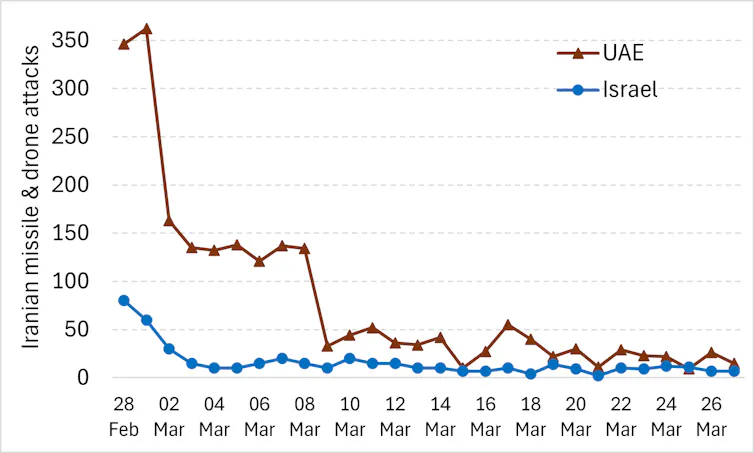
Published news reports, CC BY
Drones across the Persian Gulf
Saudi Arabia, Jordan, Iraq, Kuwait, Bahrain, Qatar, Oman and the United Arab Emirates (UAE) collectively reported around 4,900 Iranian attacks during the first four weeks. Only one fifth were missiles: the rest were drones.
These countries have stated they are neutral in the war. However, they do have defence agreements with the U.S., and some host American military facilities.
These countries defend themselves using weapons like the U.S.-made Patriot and Israeli-made SPYDER interceptors. Drone experts from Ukraine now advise the defenders too.
For example, the UAE reported attacks by 1,835 drones, 378 ballistic missiles and 15 cruise missiles. As of March 10, it claimed to have intercepted 94 per cent of the drones and 99 per cent of the missiles.
The deadliness of these attacks has varied.
Continuing lethality
In Israel, Iranian missiles have killed 20 people, implying roughly 4.1 deaths per hundred missiles arriving.
That’s less than the 5.1 the country saw during its 2025 war with Iran. But it’s four to 40 times higher than the rates it suffered from rockets in earlier Gaza and Lebanon conflicts.
In the Persian Gulf, Iranian projectiles have killed at least 15 civilians, 13 U.S. soldiers and seven merchant sailors.
There were about 0.6 deaths per hundred Iranian attacks in Kuwait, Bahrain and the UAE combined. That’s much lower than Israel’s rate, presumably because those countries were attacked by drones and short-range missiles carrying smaller warheads.
Interestingly, although the quantity of Iranian attacks fell after the first week, their lethality did not. Death rates per projectile in Arab countries showed little change week-to-week. In Israel, the rates were highest in Week 3.
In fact, Iranian missiles keep hitting precise targets, like U.S. military aircraft parked beside runways.
This implies Iran’s government has recovered from its initial surprise. It’s likely benefiting from Russian intelligence and Chinese technology too.
Tactical U.S. vs strategic Iran
So, U.S. and Israeli warplanes have bombed thousands of targets, killed thousands of civilians, and slowed Iran’s missile fire. But they haven’t stopped it.
That’s not surprising. Airstrikes alone didn’t stop rocket fire during Israel’s previous conflicts in Gaza and Lebanon. Ground invasions were needed for that.
U.S. President Donald Trump can post jingoistic mashup videos and “bullshit” about having “militarily won” the war in Iran. But he hasn’t achieved strategic outcomes like “unconditional surrender” from Iran or regime change there.
By contrast, Iran’s missiles have been strategically effective. They’ve damaged Persian Gulf refineries and halted tanker traffic. They’ve forced Trump to relax sanctions on Russian and Iranian oil, and on Belarusian fertilizer. And they’ve shown Arab monarchies that U.S. defence agreements have limited value.
Trump recently, and inadvertently, admitted this weakness. While discussing Iran’s closure of the Strait of Hormuz, he said “it would be great if we could do something, but they have to open it.”
This strategic failure despite tactical success is reminiscent of the Vietnam War. U.S. units had overwhelming firepower as they killed enemy soldiers. But body counts by themselves indicated little about strategic progress.
Some historians rank that war as the second worst U.S. foreign policy decision ever. The 2003 invasion of Iraq was ranked the worst.
Trump talks about being the greatest U.S. president in history. So, perhaps his Iran war will make him the new leader on that policy failure list.

Michael J. Armstrong does not work for, consult, own shares in or receive funding from any company or organisation that would benefit from this article, and has disclosed no relevant affiliations beyond their academic appointment.
– ref. Iran’s attacks drone on, with the U.S. at risk of losing the war – https://theconversation.com/irans-attacks-drone-on-with-the-u-s-at-risk-of-losing-the-war-279295
Back to index · Read original article
Bobi Wine’s decision to flee Uganda points to a shrinking landscape for opposition politics
April 1, 2026
Source: MIL-OSI-Submissions-English
Source: The Conversation – Africa (2) – By Kristof Titeca, Professor in International Development, University of Antwerp
Bobi Wine’s escape from Uganda is not just a striking episode in itself, it also offers insight into the current state of the opposition – particularly his National Unity Platform party – and into the divergences within the Yoweri Museveni regime.
The Ugandan opposition leader had been in hiding for almost two months after the January 2026 presidential election, which Museveni won by 72%. Wine came second with 25% of the vote. Museveni, 81, has been in power since 1986.
Wine, born Robert Kyagulanyi, entered formal politics in 2017 when he won a parliamentary by-election.
He soon emerged as one of the leaders of the People Power movement, a loose, generationally charged mobilisation built around the slogan “People Power, Our Power”. It took shape in the aftermath of protests against the removal of presidential age limits in 2018. At the time, the opposition appeared largely exhausted and unlikely to unseat the regime. Bobi Wine and People Power therefore brought a new energy to Uganda’s opposition.
People Power later formalised into the National Unity Platform party, which Wine used to vie for the presidency in 2021. He secured about 35% of the presidential vote against Museveni’s 59%. National Unity Platform became the largest opposition force in parliament with 57 seats.
These results also highlighted the constraints of electoral politics in the face of extensive repression.
This is a pattern that would again become apparent in the 2026 elections.
As several human rights organisations noted, the 2026 elections took place in an environment marked by widespread repression and intimidation.
After the vote, Wine went into hiding. He posted photos and videos seemingly from Kampala, triggering roadblocks and searches across the capital city. On 18 March 2026, he resurfaced in the United States.
I have researched Ugandan politics for over 20 years, and recently published an article analysing the structural challenges Wine’s political party faces in Uganda’s authoritarian context.
Drawing on this work, my reading is that Wine’s escape reveals controlled tensions within Museveni’s regime, where different factions appear to disagree on how to handle the opposition – without signalling a full split. At the same time, it exposes a deeper dilemma for Wine and his party: how to balance international advocacy with maintaining grassroots legitimacy at home.
This moment matters because it highlights the structural constraints facing opposition politics in Uganda, and raises questions about whether meaningful political change can occur within the current system.
Frictions within the regime
The contrasting approaches within the Museveni regime are illustrated by events that followed the 2026 election. In the weeks following the vote, defence force chief Muhoozi Kainerugaba (Museveni’s son) issued a series of unusually explicit statements about Wine.
In a now-deleted tweet, he claimed that 22 members of the National Unity Platform – whom he labelled “terrorists” – had been killed. He added that he was praying that the next death would be Wine’s.
On 26 January, the defence chief escalated this rhetoric, stating that he wanted Wine “dead or alive”. These statements built on earlier threats, including about beheading Wine.
Taken together, they amount to sustained violent threats directed at the main opposition leader.
Read more:
Uganda’s autocratic political system is failing its people – and threatens the region
Set against this, however, is the fact that Wine was able to evade capture for nearly two months and ultimately leave the country.
It emerged that he did so with assistance from high-level state and security officials.
The same sources and regime insiders reported that intelligence services had informed Museveni about Wine’s whereabouts. The president chose not to act upon this information.
Taken together, these events suggest differences within the regime between factions in the security services, or more broadly between Muhoozi and other centres of power. Potentially even within the first family itself.
But these differences should not be overstated.
The episode does not indicate an open or consolidated split. Criticism of Muhoozi within the regime remains tightly constrained.
What this suggests is a regime where disagreements are contained within narrow limits. Wine’s escape, therefore, points less to a rupture than to an ongoing negotiation over power and strategy within the ruling elite.
And this is becoming increasingly important in light of the anticipated transition beyond Museveni.
Tensions within Wine’s party
Wine’s political strength has always come from where he came from.
He was rooted in the ghetto, and more broadly among urban youth who had long been mobilised by opposition politics but rarely felt represented by it.
Earlier figures like Kizza Besigye could appeal to this group, but Wine embodied it. He spoke the same language and made politics feel accessible to people often treated as outsiders.
That sense of authenticity was central to the early momentum of People Power. It also mattered that Wine broke with a long-standing pattern in Ugandan politics: he did not come from the western region, the core of the ruling elite.
But this “outsider” appeal has become harder to sustain over time. As People Power turned into a political party, and as Wine himself became more embedded in formal politics and international networks, parts of that original base began to feel that something had shifted.
What once felt like a movement of “one of us” increasingly risks being seen as something closer to the political establishment it set out to challenge.
As my research shows, this is not unusual. It is a core dilemma when protest movements turn into parties, especially under repression.
The social media backlash to Wine’s appearance in the United States needs to be read through that lens.
It not only echoes criticism from Museveni that Wine is an “agent of foreign interests”, but also from within the opposition where some radical voices argue that he should have stayed and faced the regime, even if that meant prison. Besigye, for instance, is facing treason charges after he was abducted and extradited from Kenya in 2024.
This criticism echoes a longstanding divide within opposition politics in Uganda: should opposition leaders embody defiance on the ground, or navigate politics through institutional spaces?
Read more:
The making and breaking of Uganda: an interview with scholar Mahmood Mamdani
Being in the US reinforces a growing perception that Wine is becoming more distant from the people who carried the risks on the ground.
If the party cannot connect its international advocacy and diaspora support back to the everyday struggles of its supporters in Uganda, this episode will likely deepen the feeling that the party has become more of the same.
What role remains for Wine?
There is an uncomfortable reality here. Wine serves a function for the regime. His presence helps maintain the appearance of political competition, particularly within the international community.
Wine now faces a choice. Engaging in electoral politics risks reinforcing the system he seeks to challenge. Stepping outside it risks isolation, repression or loss of political relevance.
How he navigates this tension will shape not only his political trajectory, but also that of his party.

Kristof Titeca does not work for, consult, own shares in or receive funding from any company or organisation that would benefit from this article, and has disclosed no relevant affiliations beyond their academic appointment.
– ref. Bobi Wine’s decision to flee Uganda points to a shrinking landscape for opposition politics – https://theconversation.com/bobi-wines-decision-to-flee-uganda-points-to-a-shrinking-landscape-for-opposition-politics-279475
Back to index · Read original article
Aux États-Unis, la forte mobilisation des organisations religieuses contre les actions de l’ICE
April 1, 2026
Source: MIL-OSI-Submissions-French
Source: The Conversation – in French – By Blandine Chelini-Pont, Professeur des Universités en histoire contemporaine et relations internationales, Aix-Marseille Université (AMU)
Aux États-Unis, de plus en plus d’institutions religieuses se mobilisent pour protester contre les opérations de l’Immigration and Customs Enforcement (ICE), dont l’objectif premier est de procéder à l’expulsion des supposés « millions de migrants clandestins » présents sur le sol du pays. Entre les recours juridiques, la mise en place de réseaux d’alertes ou encore l’aménagement des églises en espaces de refuge, elles jouent un véritable rôle dans la défense des sans-papiers.
Alors que de nombreuses Églises chrétiennes ont ouvertement fait part de leur opposition à la guerre déclenchée contre l’Iran le 28 février dernier, on observe depuis plusieurs mois que de plus en plus de responsables religieux américains contestent l’action des agents fédéraux de l’Immigration and Customs Enforcement (ICE).
Loin d’être une réaction conjoncturelle, cette mobilisation s’est intensifiée tout au long de l’année 2025, au fur et à mesure que l’ICE se déployait sur l’ensemble du territoire et outrepassait son périmètre administratif et pénal. L’agence fédérale est normalement chargée de s’occuper des infractions au droit de l’immigration (personnes sans papiers et en situation irrégulière), des processus de reconduite aux frontières (rétention, expulsion) et, aussi, des enquêtes sur les filières criminelles transnationales impliquant des étrangers (traite humaine, blanchiment d’argent, fraude documentaire, narcotrafic, armes). Or elle a commencé à agir en négligeant aussi bien les procédures qui l’encadrent que son obligation de coopérer avec les autorités et les juridictions locales.
Ses agents de terrain – dont les effectifs ont doublé et devraient tripler sur les trois années à venir – se sont transformés en véritable milice armée agissant en toute impunité pour faire du chiffre.
Cette évolution, perçue comme une dérive régressive par de nombreux responsables religieux, alimente une critique morale qui aboutit à la remise en cause de l’ensemble des dispositifs légaux relatifs à la lutte contre l’immigration clandestine. La mobilisation, fortement portée par l’Église catholique, s’élargit en un véritable réseau interchrétien et interreligieux qui entre désormais directement en interaction avec le champ politique et judiciaire.
Mobilisation catholique
Tandis que le pape Léon XIV, lui-même américain, ne mâchait pas ses mots en dénonçant le virage en cours et en appelant à plus d’humanité aux États-Unis, la mobilisation s’est incarnée d’abord dans l’engagement de figures épiscopales majeures, telles que le cardinal Joseph Tobin, archevêque de Newark, véritable porte-voix de la dignité des migrants. Les diocèses des régions frontalières, aux fortes populations hispaniques, ont été particulièrement sensibilisés (n’oublions pas que la majeure partie des personnes arrêtées et expulsées par l’ICE sont originaires d’Amérique latine).
Des évêques du Nouveau-Mexique, comme Mgr John Wester de Santa Fe ou Mgr Peter Baldacchino de Las Cruces, se sont fait entendre, de même que, au Texas, Mgr Mark J. Seitz, d’El Paso, qui a explicitement appelé les agents de l’ICE à refuser d’exécuter des ordres injustes, s’inquiétant que « la frontière (soit) désormais partout ».
L’archevêque Gustavo García-Siller de San Antonio est allé plus loin. Il a dénoncé un système devenu « une industrie » honteuse, structuré autour d’intérêts économiques, notamment à travers les centres de détention privés. En effet, le budget de l’ICE est passé d’environ 9,7 milliards de dollars (8,4 milliards d’euros) en 2025 à plus de 11 milliards de dollars (9,5 milliards d’euros) en 2026. Un plan pluriannuel, voté en octobre dernier, atteint plus de 60 milliards d’euros. Avec l’augmentation des effectifs de ses agents, ce budget colossal doit permettre l’extension massive des capacités de détention, estimée à 33 milliards d’euros.
L’évêque Mario Dorsonville, ancien auxiliaire de Washington, responsable des questions migratoires et aujourd’hui décédé, avait insisté de son côté en 2024 sur la responsabilité morale de l’Église à dénoncer la criminalisation des migrants. Les propos qu’il avait tenus restent, aujourd’hui, une sorte de référence pour les catholiques américains.
À Chicago, le cardinal Blase Cupich a également dénoncé les atteintes par l’ICE à la liberté religieuse des personnes interpellées, soulignant que les autorités fédérales entravaient de manière tout à fait illégale l’action pastorale et interdisaient les visites et l’exercice du culte aux personnes en détention.
À New York, le cardinal Timothy Dolan, pourtant estimé proche du gouvernement actuel, est devenu un détracteur régulier de ses politiques d’immigration.
Sur le terrain, un réseau dense d’acteurs religieux et laïcs s’est mis en place. Les jésuites y sont particulièrement présents à travers des figures comme le père Christopher Collins ou le père James Martin, qui articulent action pastorale, plaidoyer médiatique et engagement politique.
Des organisations comme le Jesuit Refugee Service USA, en lien avec les pays d’Amérique centrale, les Catholic Charities ou encore le NETWORK Lobby for Catholic Social Justice, lancent des actions en justice contre l’ICE au nom des personnes « enlevées ». L’action de ces structures permet de transformer une indignation morale en capacité d’action organisée.
Mobilisation interchrétienne et interreligieuse
Bien d’autres Églises américaines se font également entendre. L’Église épiscopalienne, sous l’impulsion de figures comme Michael Curry (ancien primat) et d’évêques diocésains comme John Harvey Taylor (Los Angeles), s’engage fortement contre les politiques de détention et les « raids ». Plus de 150 évêques épiscopaliens ont signé des déclarations communes dénonçant les pratiques de l’ICE.
Dans le monde luthérien, l’Evangelical Lutheran Church in America (ELCA), dirigée par Yehiel Curry, s’implique aussi, à travers ses synodes locaux, notamment dans le Minnesota (où se trouve Minneapolis, la ville où des agents de l’ICE ont abattu en janvier Renee Good et Alex Pretti) où Curry est en poste et où les luthériens sont nombreux. Leurs responsables ont eux aussi participé à des actions judiciaires pour garantir l’accès pastoral aux migrants détenus.
L’United Church of Christ, historiquement engagée dans les luttes pour les droits civiques, la Presbyterian Church (USA) ou encore la United Methodist Church prennent les mêmes positions publiques et soutiennent les mêmes réseaux d’accueil. Au final, on assiste à une convergence interchrétienne de la mobilisation, avec l’organisation de très nombreuses actions et manifestations communes.
La convergence dépasse enfin le cadre chrétien pour s’inscrire dans une dynamique interreligieuse. Des organisations musulmanes comme le Council on American-Islamic Relations (CAIR), ainsi que des réseaux juifs progressistes comme l’HIAS (Hebrew Immigrant Aid Society), accompagnent les coalitions religieuses de défense des migrants.
Dans certaines villes comme Chicago, Los Angeles ou Minneapolis, ces coalitions interconfessionnelles organisent des formations aux droits des personnes migrantes. Cela renforce la légitimité de la mobilisation, en la fondant sur des principes communs positifs de dignité humaine et de justice. Surtout, cette mobilisation empêche les leaders évangéliques soutenant l’ICE de monopoliser l’espace médiatique.
Une continuation du mouvement Black Lives Matter
La notion de « résistance morale » structure profondément cette mobilisation. Elle renvoie à une tradition historique de contestation de l’injustice légale, héritée notamment des mouvements abolitionnistes et des droits civiques. Elle se manifeste à la fois dans les discours – éditoriaux, sermons, déclarations publiques – et dans les pratiques. Elle transforme les acteurs religieux en « entrepreneurs moraux », capables de contester la légitimité d’une politique publique au nom de principes supérieurs.
Cela a récemment été le cas avec l’engagement des Églises dans le mouvement Black Lives Matter (BLM), contre le racisme systémique et la violence policière. Des figures religieuses comme le révérend William J. Barber II ou le révérend Al Sharpton se sont trouvés aux premiers rangs lors des mobilisations BLM. Les églises ont servi de lieux de rassemblement, d’organisation et de légitimation morale.
De la même manière, sur la question migratoire, les églises deviennent des espaces de refuge, de coordination et de contestation. La différence des publics concernés n’est d’ailleurs pas si « éloignée », puisqu’un préjugé raciste s’exprime fortement derrière la traque des sans-papiers, les agents de l’ICE pratiquant systématiquement le « délit de faciès ».
La mobilisation actuelle en faveur des sans-papiers a approfondi le maillage interchrétien et interconfessionnel, entamé dans le mouvement BLM. Elle ajoute, aux manifestations de rue, les actions de terrain disséminées, incluant recours juridiques et procédures institutionnelles.
Des paroisses, des églises et des réseaux associatifs ont mis en place des dispositifs d’accueil, parfois dans le cadre du mouvement des « sanctuary churches ». Des organisations, comme United We Dream ou Faith in Action, collaborent avec des communautés religieuses pour organiser des réseaux d’alerte en cas de raids. Des bénévoles accompagnent les migrants dans leurs démarches juridiques, financent des avocats et assurent une présence dans les centres de détention.
Ces actions traduisent le passage d’une mobilisation morale à une véritable infrastructure de solidarité, capable de répondre concrètement à la logique d’expansion territoriale de l’ICE.
Impact politique
La mobilisation religieuse anti-ICE entre aussi directement en interaction avec le champ politique. En février 2026, un groupe de 44 représentants démocrates – dont la plupart sont catholiques – mené par Rosa DeLauro du Connecticut, et incluant des figures comme Nancy Pelosi, Joaquin Castro ou James McGovern – s’est publiquement opposé à l’expansion de l’ICE. Leur déclaration a explicitement mobilisé des arguments moraux et religieux, dénonçant une politique incompatible avec la dignité humaine.
De la sorte, même si la Chambre des représentants, où les républicains sont à peine majoritaires (218 sièges contre 214), a voté, fin mars l’intégration de l’ICE dans le budget du Departement of Homeland Security – le ministère dont dépend l’ICE –, les arguments des démocrates, qui dénoncent l’absence de contrôle des recrues à tous les niveaux, le surarmement « effrayant » et les salaires disproportionnés, ont porté au Sénat. Bien qu’à majorité républicain (53 sièges contre 47), ce dernier a voté le budget du DHS sans y inclure le financement de l’ICE. À ce jour, le budget 2026 de l’ICE est bloqué, même si la loi exceptionnelle votée en juillet 2025, le One Big Beautiful Bill Act, continue de lui assurer un financement faramineux.
Enfin, il faut souligner que si plusieurs figures conservatrices, comme le speaker républicain de la Chambre Mike Johnson, tentent de justifier les politiques migratoires par des références bibliques, d’autres semblent hésiter. Ainsi, le vice-président J. D. Vance, qui affiche volontiers son catholicisme, a dans un premier temps raillé les évêques qui s’indignaient des coupes totales de subventions fédérales pour les associations de terrain, les traitant en substance de grippe-sous grincheux, avant de s’en excuser, reconnaissant le caractère excessif de ses propos. Même s’il manifeste pour l’instant un solide optimisme sur les performances de l’ICE, il pourrait tenter d’infléchir sa position, tout comme il cherche à le faire (et à le faire savoir) à propos de la guerre en Iran…

Blandine Chelini-Pont ne travaille pas, ne conseille pas, ne possède pas de parts, ne reçoit pas de fonds d’une organisation qui pourrait tirer profit de cet article, et n’a déclaré aucune autre affiliation que son organisme de recherche.
– ref. Aux États-Unis, la forte mobilisation des organisations religieuses contre les actions de l’ICE – https://theconversation.com/aux-etats-unis-la-forte-mobilisation-des-organisations-religieuses-contre-les-actions-de-lice-279380
Back to index · Read original article
Trump risks falling in to the ‘asymmetric resolve’ trap in Iran − just as presidents before him did elsewhere
April 1, 2026
Source: MIL-OSI-Submissions-English
Source: The Conversation – Global Perspectives – By Charles Walldorf, Professor of Politics and International Affairs, Wake Forest University
Little has seemingly gone as Washington planned in the war against Iran.
The Iranian people have not risen up, one hard-line leader has been replaced by another, Iranian missiles and drones keep hitting targets across the Middle East, Iran closed the Strait of Hormuz, driving oil and gas prices up worldwide, and in sharp contrast to Trump’s demand for “unconditional surrender,” Tehran has rejected a 15-point U.S. plan for a ceasefire.
So how did things go so wrong?
As a scholar who researches U.S. forever wars, I believe the answer is simple: Trump, like other U.S. presidents before him, has fallen into what I call the trap of asymmetric resolve. In short, this occurs when a stronger power with less determination to fight starts a military conflict with a far weaker state that has near boundless determination to prevail. Victory for the strong becomes tough, even close to impossible.
When it comes to Iran, the Islamic Republic wants – and needs – victory more than the United States. Unlike the U.S., the Iranian government’s very existence is on the line. And that gives Tehran many more incentives – and in many cases very effective countermeasures – through which to fight on.
The trap of asymmetric resolve
Typically, in asymmetric wars the stronger side does not face the same potential for regime death as the weaker side. In short, it has less on the line. And this can lead to lesser resolve, making it hard to sustain the costs of war required to defeat the weaker, more determined rival.
Such dynamics have played out in conflicts dating back to at least the sixth century B.C., when a massive Persian army under Darius I was checked by a much smaller, determined Scythian military, leading in the end to a humiliating Persian retreat.
For the U.S. in the modern era, wars of asymmetric resolve have likewise not been kind.
In the Vietnam War, an estimated 1.1 million North Vietnamese civilians and Viet Cong fighters died compared to 58,000 U.S. troops. Yet, the U.S. proved no match for the North’s resolve. After eight years of brutal war, the U.S. gave up, cut a deal, withdrew and watched North Vietnam roll to victory over the South.
In 2001, the U.S. unseated the Taliban in Afghanistan, set up a new government and built a large Afghan army supported by U.S. firepower. Over the next 20 years, the remnants of the Taliban lost about 84,000 fighters compared to around 2,400 U.S. troops, yet the U.S. ultimately sued for peace, cut a deal and left. The Taliban immediately returned to power.
Many other great powers have fallen into this same trap – and at times in the same countries. Despite far fewer casualties than the Afghan resistance, the mighty Soviet Union suffered a humiliating defeat in its nine-year war in Afghanistan during the 1980s. The same happened to the French in Vietnam and Algeria after World War II.
Asymmetric resolve in the Iran war
A similar asymmetry is now playing out in Iran.
Unlike 2025’s 12-day war that largely targeted Iranian military installations, including its nuclear sites, Trump and the Israelis are now directly threatening the survival of the Iranian government. Killing the supreme leader, a slew of other powerful figures, and encouraging a popular uprising made this crystal clear.
Tehran is responding as it said it would were its survival to be at stake. Prior to the current war, Iran warned it would retaliate against Israel, Arab Gulf nations and U.S. bases across the region, as well as largely close the Straight of Hormuz to commercial traffic.
In short, it is going all-in to cause as much pain as it can to the U.S. and its interests.
Iran has suffered the disproportionate number of loses in the current war, both in terms of human casualties and depleted weaponry. As of mid-March, there have been upward of 5,000 Iranian military casualties and more than 1,500 Iranian civilian deaths, compared to 13 dead U.S. service members.
Yet, Tehran isn’t backing down, saying on March 10, “We will determine when the war ends.”
Such Iranian resolve seemingly confounds Trump. Before the war, he wondered why Iran wouldn’t cave to his demands, and he has since conceded that regime change – seemingly a major U.S. goal at the war’s onset – is now a “very big hurdle.”
This conflicts with how Iran was being presented to the American public prior to the war. Secretary of State Marco Rubio said in January that “Iran is probably weaker than it’s ever been.” It has no ballistic missiles capable of hitting the U.S. homeland, a decimated nuclear program and fewer allies than ever across the Middle East.
No wonder a Marist poll from March 6 found that 55% of Americans viewed Iran as a minor threat or no threat at all.
With Iran proving resilient, American public opinion on the war has been definitively negative. This aspect of war resolve can be especially challenging for democracies, where a disgruntled public can vote leaders out of power.
Fading or low U.S. public support for war was likewise a primary driver in past U.S. asymmetric quagmires.
Indeed, the Iran war is more unpopular than just about any other U.S. war since World War II, with polling consistently finding around 60% of Americans in opposition.
For Iran, as a nondemocracy there are far less reliable figures to compare this to on its side. Before the war, the government faced a major public crisis with widespread protests, but for many reasons – including its brutal crackdown and a potential “rally around the flag” effect – Iranian public opinion has proved far less salient.
What’s next?
The Trump administration is attempting to mitigate the impact that asymmetrical resolve has by saying the length and scope of the operation will remain limited.
To reassure the public and calm financial markets, Trump keeps promising a short war and delaying bigger strikes to give space for negotiations that he, not the Iranians, says are ongoing.
History suggests that once faced with a smaller military power showing greater resolve, the larger power has two trajectories. It can succumb to the hubris of power and escalate, such as was the case in Vietnam, Iraq and Afghanistan. Or it can wind down the conflict in an attempt to save face.
Often in the past, leaders of a stronger side opt for the first option of escalation. They just can’t escape thinking that a little more force here or there wins the conflict. President Barack Obama wrongly thought a surge of 30,000 additional U.S. troops into Afghanistan would bring the Taliban to their knees.
Despite signs that he wants out of the Iran war, Trump could still fall to the hubris of power. More U.S. troops are on the way to the Gulf, and B-52 bombers have been flying over Iran for the first time.
As Korea, Vietnam, Iraq and Afghanistan show, following hubris into escalation against a determined foe like Iran will probably come at great cost to the U.S.
The other option – that of winding down the war – is still available to Trump.
And Trump has gone down this route before. He signed a deal in 2020 with the Taliban to end the war in Afghanistan rather than surge more troops in. And just last year, Trump declared victory and walked away from an air war in Yemen when he realized ground forces would be required to overcome the resolve of the Houthis.
The U.S. president could try the same with Iran – saying the job is done then walking away, or entering real, sustained negotiations to end the war. Either way, he’ll need to give something up, such as unfettered access through Hormuz or sanctions relief.
Trump likely won’t like that. But polling suggests Americans will take it. After all, who wants another Vietnam?

Charles Walldorf is a Senior Fellow at Defense Priorities.
– ref. Trump risks falling in to the ‘asymmetric resolve’ trap in Iran − just as presidents before him did elsewhere – https://theconversation.com/trump-risks-falling-in-to-the-asymmetric-resolve-trap-in-iran-just-as-presidents-before-him-did-elsewhere-279374
Back to index · Read original article
How Taiwan came to dominate the global chip industry
April 1, 2026
Source: MIL-OSI-Submissions-English
Source: The Conversation – UK – By Robyn Klingler-Vidra, Vice Dean, Global Engagement | Associate Professor in Political Economy and Entrepreneurship, King’s College London
One firm, Taiwan Semiconductor Manufacturing Company (TSMC), produces more than 90% of the world’s most advanced semiconductor chips. These chips are essential for smartphones, artificial intelligence, high-performance computing and cutting-edge military systems.
Taiwan’s dominance of advanced chips acts as a chokepoint for the global economy. Days or weeks without their manufacturing would affect the supply and price of numerous products around the world. This is comparable to how the current disruption to shipping in the Persian Gulf due to the Iran war is affecting oil-dependent markets globally.
Taiwanese semiconductor manufacturing supremacy has transformed the island nation into what I have described in my research as a “niche superpower”. It wields outsized global influence by commanding a strategically indispensable industry.
Taiwan did not stumble into this position. In the 1970s, Taiwanese technocrats recognised that the nation could not immediately compete at the world’s electronics frontier. One of them was Kwoh-Ting Li, then minister of economic affairs, who is often referred to as the “father of Taiwan’s economic miracle”.
At that time, Taiwan lacked the financial capital and technological skills to compete with industry leaders such as Japan and the US. So rather than trying to dominate the entire semiconductor industry from design through to production, Taiwanese policymakers focused on building capabilities in precision manufacturing. This is the most operationally demanding part of the semiconductor value chain.
Established in 1973 by the Taiwanese government, the Industrial Technology Research Institute carefully acquired semiconductor process technology through licensing agreements with the now defunct US firm Radio Corporation of America (RCA). It then trained a generation of Taiwanese engineers.

jackpress / Shutterstock
The pivotal moment came in 1987, when Morris Chang established TSMC. Chang, a US-trained engineer who had spent decades at American semiconductor multinational Texas Instruments, devised what is now known as the “pure-play foundry” model.
Rather than designing and manufacturing its own branded chips, this meant that TSMC would manufacture chips for other firms. This strategic choice was transformative because it reassured American and European semiconductor companies that TSMC would not compete with them. It allowed major tech firms such as Qualcomm and later Nvidia to outsource chip production to Taiwan without fear of intellectual property leakage or strategic rivalry.
The Taiwanese semiconductor industry grew within the Hsinchu Science Park, a major industrial cluster south of the Taiwanese capital of Taipei. By the early 1990s, Hsinchu Park hosted more than 140 chip manufacturing firms and employed around 30,000 workers. The strength of the cluster attracted legions of Taiwanese engineers back from the US, helping Taiwan become the global leader in the production of advanced semiconductors.
The ‘silicon shield’
Taiwan’s semiconductor dominance has played an overt role in protecting the island from its existential threat – a Chinese invasion. This phenomenon was explicitly named in 2021 in an article published in Foreign Affairs magazine, where the former Taiwanese president, Tsai Ing-wen, argued that Taiwan’s semiconductor industry acts as a “silicon shield”.
The dependence of the global economy on Taiwanese-made advanced chips, she argued, means the disruption caused by a Chinese invasion would trigger catastrophic global economic consequences. Taiwan’s allies would thus be compelled to come to its defence.
In recent years, Taiwan’s silicon shield has come under threat. Following the start of US export restrictions on advanced chipmaking equipment to China in 2020, Beijing has accelerated its efforts to build indigenous capacity in chip manufacturing. It has significantly increased investment in its semiconductor industry.
Semiconductors were the underperformer in the Made in China 2025 strategy, through which Chinese leadership aimed to transform their nation into a high-tech manufacturing superpower. China fell short of its goals for the localisation of semiconductor production and global market share, missing targets by the 2025 deadline.
However, Chinese chip manufacturers like HiSilicon and Semiconductor Manufacturing International Corporation have been gaining momentum. A proposal by 13 Chinese chip industry executives in March outlined aims to increase self-sufficiency to 80% by 2030. China’s semiconductor self-sufficiency is currently around 33%.
At the same time, Washington is pushing to bring semiconductor manufacturing back onshore. Biden-era initiatives such as the Chips and Science Act offered incentives for TSMC’s sprawling manufacturing facility in Arizona, which opened in 2022 as part of US efforts to boost domestic chip production.
These incentives for TSMC included up to US$6.6 billion (£5 billion) in direct investment and significant tax credits. TSMC committed an initial US$65 billion to the plan, with the Trump administration announcing in March 2025 that the company would boost its US investment by a further US$100 billion.
Elon Musk also recently announced plans for advanced chip facilities in Texas for his two companies, Tesla and SpaceX. In light of Musk’s concerns that companies like TSMC are not producing the volume of chips his companies need, the so-called “Terafab” venture aims to consolidate every stage of the semiconductor production process under one roof and is expected to cost in the range of US$25 billion. Other companies investing in chip fabrication in the US include Micron, Texas Instruments and Intel.
Despite US and Chinese efforts, replicating Taiwan’s manufacturing ecosystem is difficult. It requires not only capital and equipment, but also knowledge that has been accumulated over decades as well as dense supplier networks and an unparalleled engineering workforce.
TSMC has struggled to hire talent in Arizona, and has resorted to flying thousands of workers in from Taiwan in a bid to improve the skills of locals. And while TSMC is now producing semiconductors at the cutting edge of 2-nanometre scale, the Chinese self-sufficiency goals aim to have “entirely domestically produced equipment” for the less sophisticated 7-nanometre and 14-nanometre generations of chips.
The difference between 2nm and 7nm chips is significant – a 45% increase in performance while using 75% less power. The narrower chips are used for advanced processes such as cutting-edge AI, while the wider ones are used in a broader range of electronics, like smartphones, desktop processors and automobiles.
Taiwan’s semiconductor story is ultimately one of strategic foresight. By choosing manufacturing over design, embedding itself within US-led technological networks and cultivating world-class process expertise, Taiwan transformed structural vulnerability into structural power.
Through its semiconductor dominance, Taiwan stands out as the quintessential niche superpower. But history shows that superpower status, including in niches, is never permanent. The technological frontier moves, rivals learn and allies hedge.
For Taiwan, remaining indispensable to the global economy will require not only staying ahead technologically. It will also require carefully orchestrating the political, financial and human capital foundations that made its silicon shield possible in the first place.

Robyn Klingler-Vidra received a research grant from the Chiang Ching-kuo Foundation between 2019 and 2023. The grant funded research on the educational and professional background of north-east Asia’s innovation policy leaders across the post-war period. The study was published in World Development in April 2025 and is available here: https://www.sciencedirect.com/science/article/pii/S0305750X25000646.
– ref. How Taiwan came to dominate the global chip industry – https://theconversation.com/how-taiwan-came-to-dominate-the-global-chip-industry-276939
Back to index · Read original article
Federal election observers once played a key role in securing voting rights for all − but times have changed
April 1, 2026
Source: MIL-OSI-Submissions-English
Source: The Conversation – USA – By Allison Mashell Mitchell, Assistant Professor of Civil Rights Studies, University of Notre Dame

President Donald Trump appeared on former Deputy FBI Director Dan Bongino’s podcast in February 2026, where he stated: “The Republicans should say, ‘We want to take over, we should take over the voting.’ The Republicans ought to nationalize the voting.”
Trump’s call to nationalize elections, to transfer the constitutionally mandated control of elections from local to federal authorities, drew bipartisan opposition and added to Democratic fears that the president may attempt to interfere with upcoming midterm elections.
Despite Trump’s call to “nationalize the voting,” the U.S. Constitution clearly notes that states run elections – not the federal government.
The federal government, however, has a role to play in national elections – as an observer. Federal observation ensures that Americans cast their votes on election day without reprisal.
Initially dispatched to deter voter discrimination against Black Americans after passage of the Voting Rights Act of 1965, election observers ensured that those qualified to vote could do so without trouble.
But with its 2013 ruling in the Shelby County v. Holder case, the U.S. Supreme Court changed the federal government’s relationship to the election process. The ruling significantly weakened the federal govenment’s ability to send federal observers to the polls.
As a scholar of civil rights and voting rights, I know that federal oversight during elections has always been a valued part of the electoral process, even when subject to criticism.
Yet, this current moment, with the Trump administration’s efforts to cast doubt on the legitimacy of the 2026 midterms, feels different. What I have noticed recently is how the public’s thinking has shifted about the federal oversight of elections. Where once it was largely welcomed as an ensurer of fairness and proper procedures, now it is seen as a misuse of authority.
Establishment of federal observers
The key contribution of the Voting Rights Act that Americans are typically taught about in school is its abolition of racial discrimination in voting. The measure put a stop to poll taxes and literacy tests, which had disproportionately reduced Black voter registration.
But the act also created the type of federal observation of elections that is most familiar to Americans today.
The measure allows the Department of Justice to deploy federal observers to polling stations. That deployment can happen through a court order or by requirement to places with documented histories of voter suppression. The latter was determined by a section of the Voting Rights Act that also details the guidelines for which places merit that designation.

AP Photo
Federal observers take notes, often beside poll monitors, and document potential unlawful practices by poll workers.
Unlike monitors, federal observers are stationed inside polling stations. They keep notes on the tallying of votes and verify those thrown out. And where the Justice Department requires the permission from respective districts to send monitors, federal observers are sent by the U.S. attorney general and do not require the same permission.
Historically, observers were also charged with registering voters at polling stations and local registrars’ offices with the specific goal of assisting disenfranchised minorities.
Perception of federal observers
Determined to maintain Jim Crow laws that enforced racial segregation, several Southern Democrats opposed the Voting Rights Act.
Some Americans also criticized the act as government overreach. And they castigated the U.S. attorney general in 1965 when he dispatched federal registrars to the South following the passing of the measure, and when he sent federal observers to the South for the 1966 congressional elections.
Despite this opposition to federal observers, and just months after the Voting Rights Act’s passage, the U.S. Commission on Civil Rights wrote that federal observers received “praise from registration workers and the (voter registration) applicants.”
Within a few years of the act, roughly 1 million Black Southerners had registered to vote. Over time, federal election observers began to focus less on registering voters, practically phasing out this practice by the 1980s, and serving only as observers.
The change
Over the decades, conservative politicians, as they gained more seats in Congress and state legislatures, developed new strategies – they filed lawsuits, rearranged voting districts – to circumvent what they argued was federal overreach in the election process. These changes helped them gain political influence and promoted their philosophy of states’ rights. They were successful.
The increase in conservative political influence gave way to an increasingly conservative Supreme Court. This was reflected in the U.S. Supreme Court’s 5-4 ruling in Shelby County v. Holder.
In that ruling, the court struck down the section in the Voting Rights Act outlining the guidelines for deciding whether a county or state needed federal oversight. With no guidelines to follow, the federal government removed most of its oversight.
After the court’s ruling, several states – Texas, Alabama and Mississippi, for example – made rapid changes to the voting process. Those included new voter ID laws, the purging of voter registration rolls and gerrymandering. These changes have resulted in further voter disenfranchisement, disproportionately effecting Black and Hispanic voters.
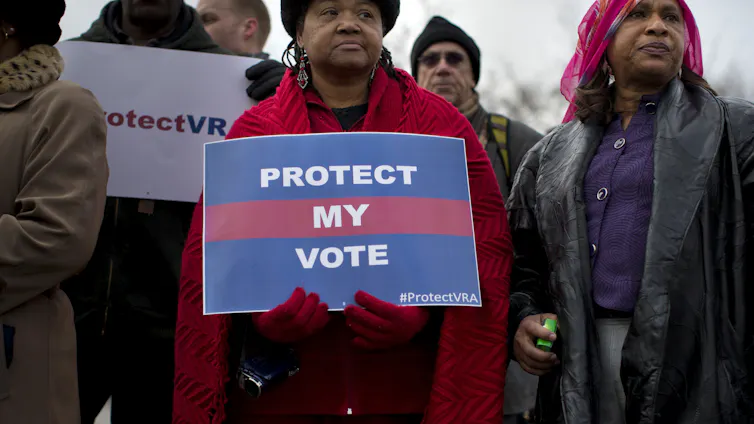
AP Photo/Evan Vucci
The Voting Rights Act guidelines had also helped determine where to send federal observers. With this section revoked, the federal government’s ability to send federal observers, in the way it had done for roughly 50 years, also disappeared.
The Justice Department sent federal observers to five states during the 2016 presidential election, compared to 23 states during the 2012 presidential election.
Since Shelby, disagreements over federal oversight persist and the role of federal observers has changed.
In 2024, the Justice Department announced it planned to send out 86 monitors on Election Day, the most federal monitors in two decades, due to concerns of possible partisan interference in elections. Some Republican-led states threatened to ban them from the polls.
To send out federal observers, the Justice Department needs a court order. But during the 2024 elections, courts determined that only four states needed federal observer oversight.
Redefining federal observers
During the Civil Rights Movement, federal election observers were the strongest line of defense to ensure fair voting.
Recently, however, the federal government’s election focus – such as attempting to require voters to provide documentary proof of U.S. citizenship when registering to vote – has shifted to what it says is voter fraud and accusations of cheating.
Still, one thing has remained certain. Federal observers are important. Their history, even now as they are less prevalent, can inform how we discuss the federal government’s role in elections.

Allison Mashell Mitchell does not work for, consult, own shares in or receive funding from any company or organization that would benefit from this article, and has disclosed no relevant affiliations beyond their academic appointment.
– ref. Federal election observers once played a key role in securing voting rights for all − but times have changed – https://theconversation.com/federal-election-observers-once-played-a-key-role-in-securing-voting-rights-for-all-but-times-have-changed-275991
Back to index · Read original article
Why Iran targeted Amazon data centers and what that does – and doesn’t – change about warfare
April 1, 2026
Source: MIL-OSI-Submissions-English
Source: The Conversation – USA – By Dennis Murphy, Ph.D. Student of International Affairs, Georgia Institute of Technology
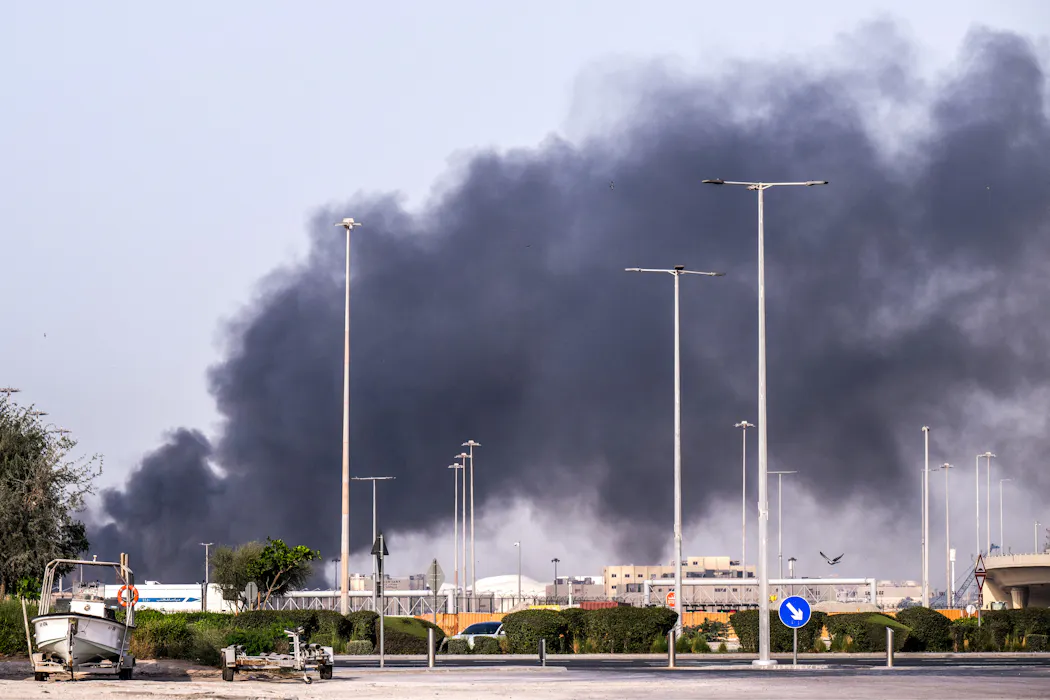
Before dawn on March 1, 2026, Iranian Shahed drones struck two Amazon Web Services data centers in the United Arab Emirates. A third commercial data center in Bahrain was hit, though it is less clear whether it was deliberately targeted. Iran has also indicated that it considers commercial data centers to be targets.
This is the first time that a country has deliberately targeted commercial data centers during wartime. Data centers have been targets of espionage and cyberattacks in the past, notably when Ukrainian hackers destroyed data stored in a Russian military-affiliated data center in 2024. This, however, was a physical attack. Drones damaged buildings.
Advances in artificial intelligence have increased the importance of data centers. The U.S. military, in particular, has made great use of AI systems for decision support in its attacks on Iran and Venezuela. Given how important data centers are, Iranian forces could be targeting the infrastructure Iran’s leaders believe is supporting strikes on Iran.
It is not altogether clear that these particular data centers were used by the U.S. military. Instead, the attacks may have been part of a broader effort to punish the United Arab Emirates for its ties with the U.S.
In my experience as a Ph.D. candidate at Georgia Tech studying how technology drives changes in international security, I don’t think the attacks signal any significant change in the nature of warfare. But they are forcing nations to recognize that data centers are targets of war – even if they don’t directly support military operations.
Data centers and the cloud
The United States military is increasingly incorporating advanced AI capabilities into its decision support systems. From the operation to capture Venezuelan President Nicolás Maduro to supporting military strikes against Iran, the U.S. has been using AI, especially Anthropic’s Claude, for intelligence analysis and operational support.
AI is unlocking faster ways to carry out operations in war, but the AI tools the military often uses are not located on a plane or ship. When a service member uses Claude, the computing infrastructure that powers the model and its analysis usually goes to a secure Amazon Web Services cloud that hosts secret government data and software tools.
Commercial data centers are where the cloud lives. The next time you pull up Netflix and watch your favorite shows, you are likely streaming the programming from a data center, possibly AWS. When AWS data centers go down, outages affect all sorts of entertainment, news and government functions.
With AI as a driver of economic growth, data centers are key forms of infrastructure. They ensure that AI can continue to run, as well as much of the underlying internet that governments and industry rely on. When Iran attacked the UAE’s data centers, it caused widespread disruption to the local banking system.
Commercial data centers enable most of the technology that runs the modern world, including AI systems. Disrupting them is key to disrupting the military and society of a country. Given that AWS provides and operates many of the commercial data centers where the cloud lives, it is likely that its data centers will continue to be targeted in conflict.
Going after US allies
Researchers at Just Security noted on March 12, 2026, that the United States requires cloud-computing service providers to store government and military data within the U.S. or on Department of Defense bases: “Moving such data to Amazon data centers in the Gulf region would require special authorization; we are unaware if that has been granted.”
Nevertheless, Iran’s Islamic Revolutionary Guard Corps claimed the strikes were against data centers supporting “the enemy’s” military and intelligence activities. And 10 days after the initial attack on the data centers, an Iranian news agency claimed that major tech company data centers and other physical assets in the region were considered “enemy technology infrastructure.”
Instead of military reasons, Iran may well have targeted the UAE to rattle the global economy and garner attention. Given the prominence of the Gulf as a major recipient of U.S. technological investment, the attack may also have been a symbolic one aimed at the heart of U.S.-Gulf cooperation. AI infrastructure such as commercial data centers is a growing part of U.S. leadership in the region, and this war could jeopardize the future of AI infrastructure in the Gulf.

Giuseppe CACACE/AFP via Getty Images
Growing importance, easy targets
Though data centers are increasingly important for national security, the economy and society at large, it can be tempting to suggest these strikes represent a fundamental shift in the nature of war. While that is a possibility, it is important to remember that Iran launched thousands of missiles and drones at targets in the UAE. Though the vast majority were intercepted, the two that struck data centers are a small portion of the ones that got through to civilian targets in UAE territory, including strikes on airports and hotels.
The relative vulnerability of commercial data centers – they are large, relatively fragile and lack dedicated air defenses – suggests that the ones in the UAE may have been targets of opportunity or convenience. In other words, they were hit because they could be hit.
Nevertheless, it seems likely that as the use of AI tools and other cloud-based resources continues to grow in importance for countries around the world, commercial data centers will be targets in future conflicts.

Dennis Murphy is affiliated with Georgia Tech, the Georgia Tech Research Institute, the RAND Corporation, the Notre Dame International Security Center, and the Astra Fellowship. He previously was affiliated with Lawrence Livermore National Lab, Marine Corps University, and the Cambridge University ERA Fellowship.
– ref. Why Iran targeted Amazon data centers and what that does – and doesn’t – change about warfare – https://theconversation.com/why-iran-targeted-amazon-data-centers-and-what-that-does-and-doesnt-change-about-warfare-278642
Back to index · Read original article
How Taiwan is viewing the Iran war – and what it reveals about US credibility
April 1, 2026
Source: MIL-OSI-Submissions-English
Source: The Conversation – Global Perspectives – By Bonnie Yushih Liao, Assistant Professor of Diplomacy & International Relations, Tamkang University
The United States and Israeli strikes on Iran have become increasingly concerning for the world due to the risks of further escalation and the impact on energy markets.
In Taiwan, however, the focus has shifted in a different direction.
Rather than treating the war as geographically distant, Taiwanese political leaders and analysts are viewing it as a real-time indicator of how the United States operates under strategic pressure.
The key question is less about whether the United States would act if a conflict with China were to break out in the Indo-Pacific region, and more about how it would manage competing pressures if multiple crises unfolded at once.
A test of limits, not intentions
There is growing recognition in Taiwan that US resources are not unlimited.
The Middle East war has caused energy prices to fluctuate and stoked fears of rising inflation in the United States, demonstrating the domestic costs of military operations.
US President Donald Trump’s approval ratings have also taken a hit, with some in his own party now questioning his rationale for going to war.
Some reports have indicated US supplies of interceptor missiles are running low. The US military has, for example, had to move some THAAD missile interceptors from South Korea to the Middle East. The US has also struggled to defend against Iran’s use of asymmetrical fighting tactics.
This has direct implications for the deterrence Washington has long maintained in the Indo-Pacific. This deterrence depends not only on US war-fighting capability, but on the expectation this capability will remain intact under strain.
Conflicts elsewhere may not weaken the US resolve to intervene if China were to invade or pressure Taiwan in some fashion. But they can drain American resources and influence where these items are prioritised.
Shifting thresholds for the use of force
The US has also framed its strikes on Iran as a “preventive” action aimed at mitigating a future threat rather than responding to an imminent attack. This raises broader questions about the changing threshold for the use of force in the Indo-Pacific.
For Taiwan, this is not an abstract notion. If the threshold for military action is lowered from imminent threat to potential risk, the strategic environment becomes less predictable in the Indo-Pacific.
This broadens the range of circumstances under which force by the United States may be justified.
The speed with which the Trump administration has acted in Iran has also increased uncertainty for regional partners like Japan and South Korea in assessing when and how the United States would act against China.
The US’ NATO partners weren’t told about the Iran strikes before they happened. This could make Japan and South Korea similarly worried about a lack of communication on potential US actions over Taiwan.
Wars rarely follow anticipated pathways
The Iran war has also raised broader questions about how the United States adapts as crises evolve.
Much of the discussion around Taiwan has traditionally centred on the possibility of a large-scale Chinese invasion. However, recent developments suggest escalation may be less linear than this.
Rather than following a single, predictable pathway, conflicts can develop through a sequence of smaller decisions, the ambiguity over signals sent by an adversary, or rapidly changing political conditions.
This has contributed to a shift in strategic discussion in Taiwan. Recent defence policy debates and security forums have increasingly examined scenarios in which China pressured Taiwan with grey-zone tactics, blockades and incremental escalatory moves, rather than focusing solely on full-scale invasion.
As a result, attention is shifting to how such pressure might build over time – through cyber operations, maritime restrictions or limited military actions – and possibly spiral out of control.
The current crisis in the Strait of Hormuz has been watched closely in Taiwan as an example of how disruption of a strategic chokepoint can quickly impact the world. This raises questions about whether similar dynamics could emerge in the Taiwan Strait, and how prepared external actors – including the US – would be to respond.
The US has also been unable to prevent the Iran war from spilling over into the Persian Gulf states. This raises questions about whether a war over Taiwan could be contained or produce wider regional effects.
The risk of misinterpretation
For Taiwan, the most immediate challenge comes from how China interprets US actions in Iran. If Beijing concludes that diminishing military resources or domestic pressures would limit the US’ ability to wage a sustained conflict in the Indo-Pacific, it may reassess the risks of applying coercive pressure on Taiwan.
This does not imply immediate conflict is likely over Taiwan. However, it increases the likelihood that China would try to pressure or coerce Taiwan just below the threshold of full-scale war.
History suggests that escalation is often shaped by how situations are interpreted by adversaries, rather than by clear shifts in power. When states believe conditions are more favourable than they actually are, the risk of misjudgement increases.
For Taiwan, the challenge is therefore not only to assess developments in the Middle East, but to ensure that its own position is not misunderstood. This involves:
- maintaining credible defensive capabilities
- reinforcing internal cohesion against possible threats
- signalling clearly that any attempt at coercion would face robust resistance.
Deterrence depends not only on what a country can do, but what others believe it will do — and whether those beliefs discourage risk-taking.

Bonnie Yushih Liao does not work for, consult, own shares in or receive funding from any company or organisation that would benefit from this article, and has disclosed no relevant affiliations beyond their academic appointment.
– ref. How Taiwan is viewing the Iran war – and what it reveals about US credibility – https://theconversation.com/how-taiwan-is-viewing-the-iran-war-and-what-it-reveals-about-us-credibility-279102
Back to index · Read original article