

AM Edition: Here are the top 10 energy articles on LiveNews.co.nz for April 2, 2026 – Full Text
How Sweden’s communal laundries shield renters from rising energy bills
April 1, 2026
Source: MIL-OSI-Submissions-English
Source: The Conversation – UK – By Tullia Jack, Associate Professor, Service Studies, Lund University

People in many parts of the world are worried about rocketing energy bills as the conflict in the Gulf continues. But for the majority of renters in Sweden’s apartment blocks, this is not so much of an immediate concern.
Part of the reason for this is that many buildings have communal laundries where washing machines and dryers (as well as water and heating) are provided and the cost is included in the rent.
In Sweden, nearly one third of all water and energy is consumed domestically, with two thirds of this through activities relating to cleanliness. Electricity for washing and drying clothes also accounts for a substantial share of residential electricity use.
Communal laundries are one of Sweden’s environmental success stories. They began as part of the post-war million homes project, when modern apartment blocks were equipped with shared tvättstugor (laundry rooms) instead of individual residents having to buy their own machines. These rooms usually have a handful of semi-industrial washing machines, dryers and drying rooms serving an entire building. Access is through a communal booking system, and use is free to residents of the building. That set-up is efficient because it means share use of generally high-quality machines which encourages people to use full loads of washing.
I live in the Swedish city of Lund. Since I met my husband 11 years ago he’s been the go-to person for laundry, and takes the loads down to the communal room. For our family, using this facility is convenient because someone else takes care of maintenance and servicing of the machines and we don’t pay extra for washing clothes. It’s all included in the rent, which is negotiated for the building annually.
Tvättstugor rose to prominence during the Swedish government’s widespread building programme of the 1960s and 1970s, as part of a commitment to improving living conditions and creating a fairer society.
Clean running water, reasonably priced central heating and access to a laundry were part of a broader social project: raising living standards collectively, through shared infrastructure. This often meant that shared facilities such as laundry rooms and heating were included in the rent at no extra cost. This means that many people living in apartment blocks dotted around many Swedish cities don’t have to worry about too much about hikes in energy costs for washing, or heating, if, as expected, household energy prices rise this summer, due to the conflict in the Gulf.
Around 51% of Sweden’s housing is in these apartment blocks (2.3 million homes). And a survey of tenants in Sweden in 2020 found that around 53% have access to the tvättstuga.
How communal laundries save resources
If each household in Sweden had its own appliances, the material stock of machines – and future waste – would escalate quickly. A tvättstuga, by contrast, can serve dozens of residences with just a few semi-industrial machines that are built to last, maintained professionally and replaced strategically. It is a denser, leaner way of organising cleanliness.
Shared laundry spaces change how often we wash. Interviews and time-use data suggest that people with easy access to their own machine tend to wash more frequently, with smaller loads. If the washing machine is in the next room and energy and water are relatively cheap, it is tempting to wash “just in case”, or to avoid the minor inconvenience of airing clothes or dabbing away a single stain. When you have to book a slot, carry clothes down to the basement and work within a fixed time window, the calculation shifts. People batch their washing, fill machines properly and think twice before throwing something in after a single wear.
Communal laundries also make technological improvement easier. Upgrading a handful of machines in a shared space is far more straightforward than relying on hundreds of individual households to replace old appliances. Shared infrastructure can be a powerful lever: change the system once, and many people benefit.
But tvättstugor are also social spaces. Where I live the laundry room doubles as a small community centre. There’s a children’s book swap, a noticeboard with local events, and a steady trickle of neighbourly encounters. My husband has his gang of dads that he sees there every Sunday. They chat while folding, sharing tips about laundry liquid and life. Negotiations over booking times, cleaning lint filters and wiping benches are not always idyllic – there are passive-aggressive notes and the odd conflict – but they are also a form of everyday democracy. We learn, in a very concrete way, how to share resources, negotiate conflict, respect common rules and live together.
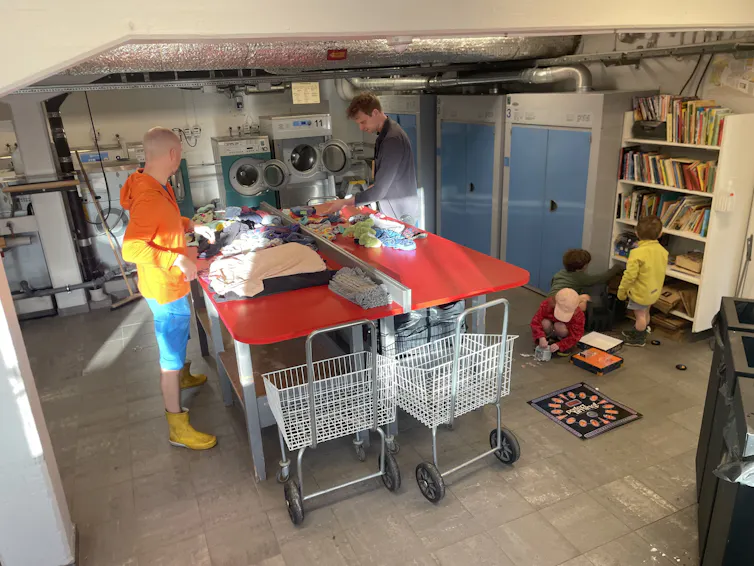
Tullia Jack, CC BY
Despite the environmental and social benefits, communal laundries are disappearing from new housing schemes. Many municipal housing companies are not including tvättstugor in new builds. This is a shame because it’s not possible to solve the energy crisis individually.
We need shared infrastructures – from tvättstugor to public transport to district heating (a centralised heating system that distributes heat to a range of buildings). Sweden shows how these facilities can work in practice: these shared laundry rooms spread costs, reduce waste and nudge people towards sufficiency. Just as importantly, they give us a reason to meet, compromise and practice our negotiation skills. This can help us build the solidarity needed to tackle the climate crisis.

Tullia Jack receives funding from Formas, grant number 2024-02280.
– ref. How Sweden’s communal laundries shield renters from rising energy bills – https://theconversation.com/how-swedens-communal-laundries-shield-renters-from-rising-energy-bills-279415
Back to index · Read original article
Why a second global shipping chokepoint could soon live up to its name as the ‘Gate of Tears’
April 1, 2026
Source: MIL-OSI-Submissions-English
Source: The Conversation – Global Perspectives – By Flavio Macau, Associate Dean – School of Business and Law, Edith Cowan University

If you’d never heard of the Strait of Hormuz before, you probably have by now. Iran’s effective closure of the waterway, which usually carries about 20% of the world’s oil and gas, has put severe pressure on the global economy.
Now, some analysts are warning a new flashpoint could emerge: the Bab el-Mandeb Strait.
That’s because on March 28, the Houthis, a military group that controls large parts of northern Yemen and is aligned with Iran, entered the war, launching missiles towards Israel for the first time since the war with Iran began.
Yemen is situated on one side of the strait, and the Houthis have previously attacked shipping in the Red Sea, causing major disruption in late 2023 and 2024.
Bloomberg now reports Iran has approached the Houthis to prepare for a similar campaign.
Here’s why all eyes will be back on the Houthis, Bab el-Mandeb and the Red Sea, and what disruption of a second major chokepoint could mean for the world economy.
What is the Bab el-Mandeb Strait?
The Bab el-Mandeb Strait is about 30 kilometres wide at its narrowest point. It is situated between Yemen on the Arabian Peninsula to the northeast and Eritrea and Djibouti in Africa on the west.
Its name literally means “Gate of Tears” in Arabic, after its famously treacherous sailing conditions.
It has become so important because, along with the Suez Canal in Egypt, it allows ships to transit directly between the Mediterranean Sea and the Indian Ocean by passing through the Red Sea and the Gulf of Aden.
Before the Suez Canal’s opening in the 19th century, ships had to travel all the way around the southern tip of Africa to join these two points.
An oil tanker leaving Saudi Arabia to go to the Netherlands, for example, only has to travel 12,000 kilometres if it goes via the Red Sea, compared with more than 20,000 kilometres going south around Africa.
As you’d expect, that’s much faster too. According to the US Energy Information Administration (EIA), a trip between the Arabian Sea and the Netherlands that takes 34 days the long way around is shortened to just 19 days.
What passes through it?
In normal times, as much as 14% of global maritime trade goes through the Bab el-Mandeb Strait.
Detailed data on what passes through the Bab el-Mandeb Strait is somewhat limited. But fossil fuels are a major component.
The International Energy Agency (IEA) estimates that in 2025 about 4.2 million barrels of crude oil and petroleum liquids crossed the Bab al-Mandeb Strait per day. That’s about 5% of global production.
Given most ships use the Suez Canal as well, official data from the Suez Canal Authority allow us to paint a detailed picture of Red Sea shipping.
In the final quarter of 2025, about 40% of the 3,426 ships passing through the Suez Canal transported fossil fuels: (1,330 oil tankers, 88 liquefied natural gas (LNG) ships).
Bulk and general cargo made up another 40% (1,339 ships), typically transporting agricultural commodities such as corn, wheat and soybeans, and also coal and iron ore. Container ships made about 13% of the traffic (459 ships).
Notably, total traffic through the Red Sea has declined considerably since Houthi attacks on shipping in late 2023 and 2024, even though these attacks have largely stopped.
Can the strait be closed?
The Bab el-Mandeb Strait can’t be “closed” entirely. Its narrowest point is still a considerably wide waterway. And unlike the Strait of Hormuz, the Bab el-Mandeb Strait is not a “cul-de-sac”, where the passage is closed at one end with only one way out. Ships can still exit to the Mediterranean via the Suez Canal.
That’s little comfort for those bound for Asia, which would then have to round Africa to do so, adding weeks to the journey.
Notably, Saudi Arabia had already built a “Plan B” to avoid the Strait of Hormuz, called the East-West pipeline. This pipeline connects Abqaiq in the north with Yanbu on the Red Sea, and had already begun pumping oil at almost full capacity in response to the conflict.
But oil bound for Asia from this new exit point still has to pass through Bab el-Mandeb to avoid the long way around, meaning it could be disrupted.
We’ve been here before
To get a sense of how the Houthis could disrupt shipping again, we can look to the most recent Red Sea crisis.
According to the International Maritime Organization (IMO), 67 incidents were recorded between November 2023 and September 2024. Some ships only suffered minor equipment damage. But others faced severe fires, flooding and structural damage after being hit by missiles or drones.
However, there have been relatively few attacks since 2024. And the strait was never totally “closed” per se: some ships continued to pass through throughout the crisis.
The mere threat of attacks
These same tactics would probably apply today. But for shipping companies, the mere threat of attacks may be enough to slow or restrict shipping. There are significant risks to civilian crew, who face a threat to life.
Adding to this, insurance costs could become prohibitive enough to close the route in practical terms. Back in 2024, insurance costs were about 0.6% of the value of the cargo on a ship. After the Red Sea crisis, this rose as high as 2%.
The effective closure of both the Strait of Hormuz and Bab el-Mandeb at the same time would be severely disruptive to global supply chains and the global economy.

Flavio Macau does not work for, consult, own shares in or receive funding from any company or organisation that would benefit from this article, and has disclosed no relevant affiliations beyond their academic appointment.
– ref. Why a second global shipping chokepoint could soon live up to its name as the ‘Gate of Tears’ – https://theconversation.com/why-a-second-global-shipping-chokepoint-could-soon-live-up-to-its-name-as-the-gate-of-tears-279548
Back to index · Read original article
Could a solar storm derail the Artemis II mission?
April 1, 2026
Source: MIL-OSI-Submissions-English
Source: The Conversation – UK – By Clive Dyer, Visiting Professor, Surrey Space Centre, University of Surrey
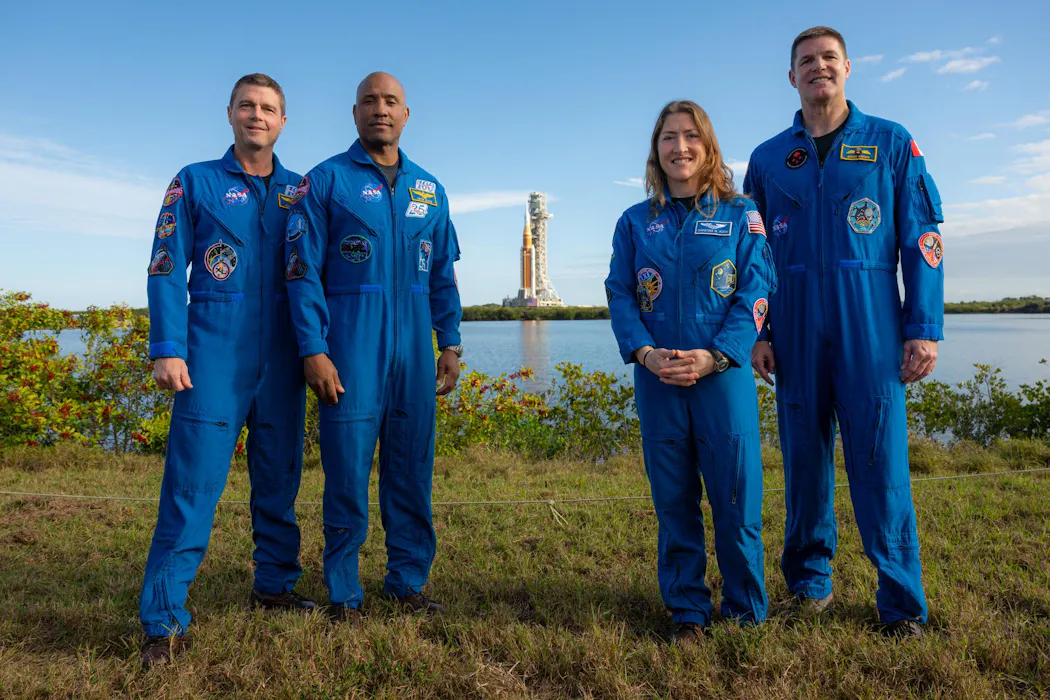
Every mission to deep space is fraught with danger. A hardware failure during launch, an equipment malfunction far from Earth, or a small space rock hitting the vehicle are all scenarios astronauts will train for.
As humans set off for the Moon for the first time in more than 50 years, one persistent threat they face is from solar radiation.
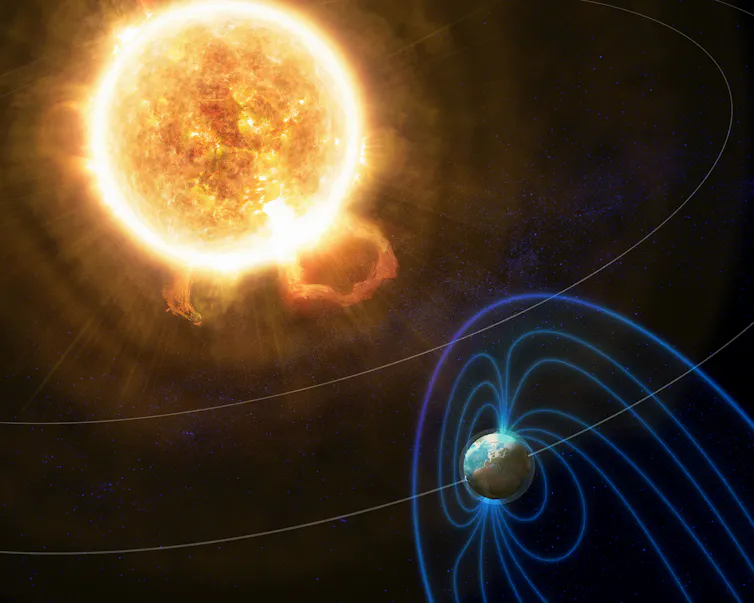
Intense bursts of radiation from the Sun, known as solar particle events, can endanger the lives of space travellers, particularly those venturing beyond low Earth orbit (LEO). During these events, high speed, charged particles stream out from the Sun and into space.
Exposure to these particles could lead to radiation sickness or, in the worst cases, prove fatal. On space stations and other crewed vehicles travelling in LEO, astronauts are afforded a high degree of protection by the magnetic bubble surrounding Earth (the magnetosphere).
But in interplanetary space, where Artemis II is headed, humans are much more exposed to outpourings of solar radiation.
The Sun’s magnetic activity fluctuates on a cycle lasting roughly 11 years. During this cycle, sunspots (areas of reduced temperature caused by intense magnetic fields) can cause eruptions known as flares, as well as solar particle events. These rise and fall in frequency with the solar cycle.

Noaa
The current solar cycle reached its maximum, when the Sun is generally at its most active, in 2024 and is now in a slowly declining phase leading to the minimum, when the Sun is quietest. The current cycle should reach the minimum in 2031.
Not all solar cycles are the same and the current one has been rather undistinguished in terms of activity, as was the previous cycle that reached maximum in 2014. Recently, however, the Sun woke from its slumber.
On November 11 2025, a large solar particle event increased ground level radiation by about 145% for two hours, as measured by the University of Surrey’s neutron monitor at the Met Office station at Lerwick, Shetland.
Esa
This was also detected by University of Surrey SAIRA (Smart Atmospheric Ionising Radiation) monitors installed on two transatlantic flights and on rapid response meteorological balloon flights at Lerwick, Cambourne and near Utrecht in the Netherlands.
Work is in hand to unscramble this complex event to determine the radiation increases worldwide using the University of Surrey computer model MAIRE (Model for Atmospheric Ionising Radiation Effects). This calculates radiation levels at aviation altitudes for normal atmospheric conditions, as well as for enhanced radiation events caused by increased solar activity.
Three immediate research papers are in production to describe the radiation monitors and their calibration, to summarise the flight data and to compare the data with available models.
A close call
The solar particle event on November 11 2025 serves to tell us that, whatever the probabilities might be, the Sun can always take us by surprise.
To underline the importance of such events for deep space missions, let’s rewind the clock to 1972. At the time, the Sun was in a similar declining phase in its 11-year cycle as we are today. Then, between August 2 and August 11 1972, the Sun unleashed one of the largest solar particle events of the space age.
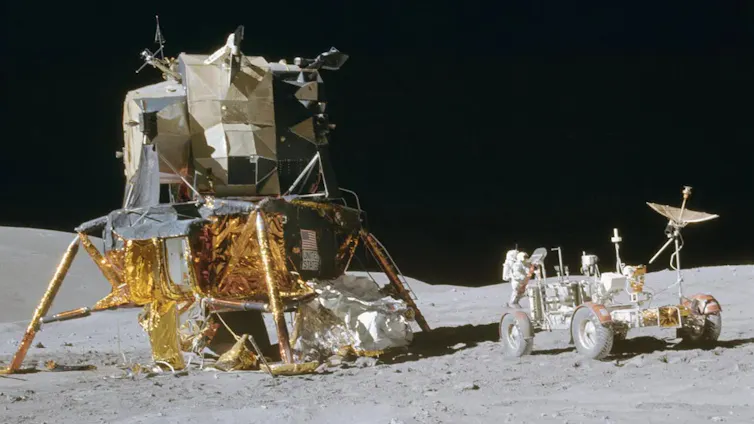
Nasa / Charles M. Duke Jr
This gigantic release of charged particles from the Sun occurred in between the Apollo 16 (April 1972) and Apollo 17 (December 1972) missions to the Moon.
This event was much bigger than the one in November 2025 – by a factor of 40. If it had taken place while astronauts were in space, the radiation dose could have caused severe illness or even have been fatal.
The Apollo crews had a lucky escape. But the solar particle event made an impact on on Earth. The ensuing geomagnetic storm is thought to have caused 4,000 US-laid mines to spontaneously detonate in Hanoi harbour during the Vietnam war, causing confusion and alarm on both sides.
Nasa
There are ways to prepare for similar events in future. The most dangerous aspect of this radiation is its high energy component, which can penetrate shielding on spacecraft. The Surrey Space Centre Space Environment & Protection team are currently working on a detector, called the High Energy Proton instrument, that definitively measures this high energy component of solar particle radiation.
It does this through the light flashes emitted when the particles transit a transparent medium at velocities exceeding the speed of light. Astronauts often report seeing such flashes of light, even with their eyes closed, that can be caused by solar particles or high-energy cosmic rays passing through the retina or optic nerve.
Read more:
Why has it taken so long to return to the Moon?
Advance warning
The University of Surrey radiation detectors could now fly on a lunar orbiting mission towards the end of the decade. On this mission, they will characterise the danger to lunar bases as well as to the Earth. Nasa is planning to spend US$20 billion (£15 billion) on a base at the south pole of the Moon. A separate outpost is planned by China and Russia.
Radiation warning systems can give astronauts the time they need to retreat to storm shelters within a base or spacecraft where increased and specially designed shielding is used.
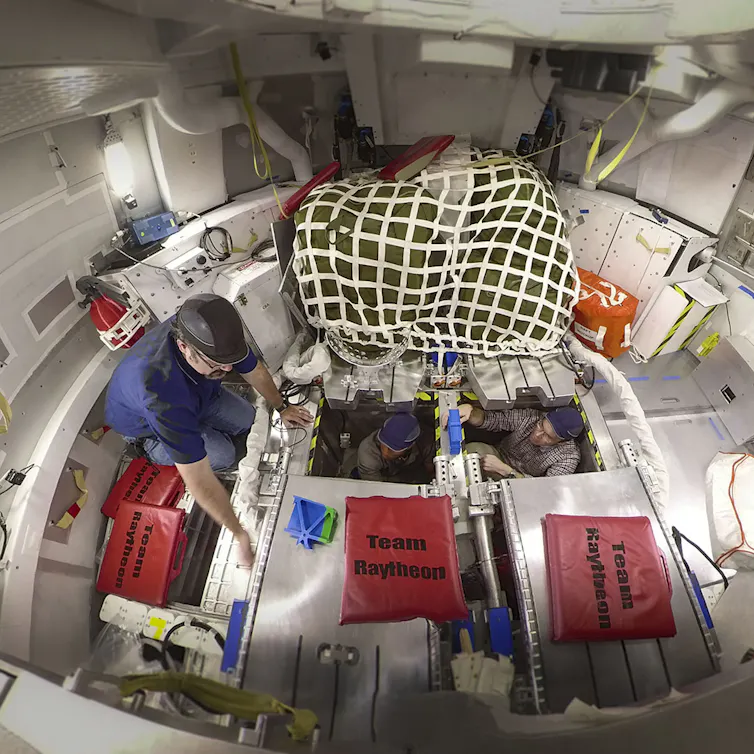
Nasa
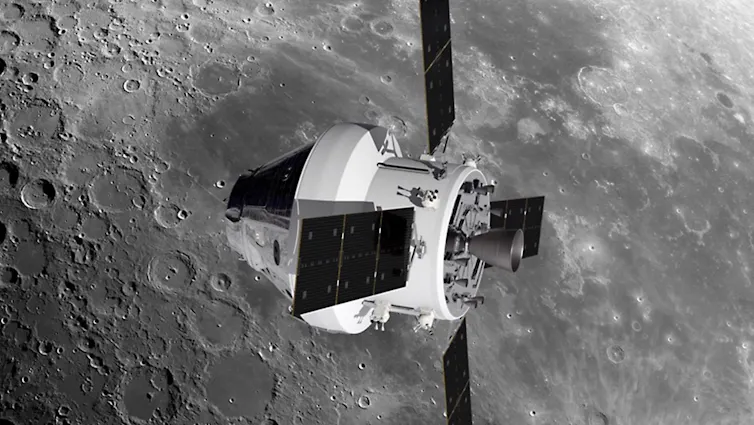
If astronauts travelling in Orion – the spacecraft used on Artemis II – receive advance word of a solar storm, they are instructed to get into storage lockers in the floor of the spacecraft. This places the crew next to Orion’s heat shield, making this area one of the most protected parts of the vehicle.
Warning systems can also help on Earth. During periods of high solar radiation, controllers could instruct aircraft to fly at lower altitudes and latitudes – and in extreme cases remain grounded.
Computing revolution
One big difference between the Apollo and Artemis missions is in the rapid development of microelectronics since the 1960s and 70s. This has led to trillion-fold increases in computer memory density and thousand-fold improvements in speed.
The Apollo computers were pioneering, but struggled to cope with the workload as Neil Armstrong and Edwin “Buzz” Aldrin descended to the lunar surface during the Apollo 11 mission in 1969. However, there is a downside to this as the technology packed into modern spacecraft is vulnerable to radiation.
Read more:
Heat shield safety concerns raise stakes for Nasa’s Artemis II Moon mission
The charge depositions from individual particles often exceed the amount required to change the state of the computer memory bits. In some cases it could destroy the device. It is now arguable whether the greater hazard from solar particle events is to astronaut health or to the flight electronics aboard spacecraft.
In 1972, the Apollo astronauts were very lucky. In this new age of exploration, when so many nations have designs on travel to deep space, we can’t afford to leave astronaut safety to the whims of fortune.

Clive Dyer does not work for, consult, own shares in or receive funding from any company or organisation that would benefit from this article, and has disclosed no relevant affiliations beyond their academic appointment.
– ref. Could a solar storm derail the Artemis II mission? – https://theconversation.com/could-a-solar-storm-derail-the-artemis-ii-mission-279613
Back to index · Read original article
Queen bumblebees can breathe underwater — for days. We discovered how
April 1, 2026
Source: MIL-OSI-Submissions-English
Source: The Conversation – Canada – By Sabrina Rondeau, Postdoctoral Researcher in Pollinator Ecology, L’Université d’Ottawa/University of Ottawa

In most bumblebee species, the queens spend their winters buried underground in a tiny cavity the size of a grape. For six to nine months, they enter a deep sleep-like state called diapause, waiting for spring.
As climate change brings more intense rainfall in many regions, these overwintering queens face increasing risks of unstable underground conditions, including flooding.
It’s a good thing, then, that these insects can survive days underwater without drowning. Remarkably, our new research reveals they achieve this through a process of continually breathing while submerged for up to eight days.
It began with a lab accident
We initially discovered that overwintering bumblebee queens can survive submersion due to an accident.
During an experiment at the University of Guelph, some of the tubes in which queens were overwintering in the lab refrigerator inadvertently filled with water.
Initially, we assumed the queens had died. But after emptying out the water, they began to move and soon recovered. This suggested that bumblebee queens might be able to survive submersion.

(Charles-Antoine Darveau)
So, we designed a follow-up experiment involving 143 common eastern bumblebee queens (Bombus impatiens).
This confirmed it was no fluke: the queens withstood complete submersion for up to a week.
This raised an intriguing question: how can this terrestrial insect pollinator survive underwater? Answering it required a different approach — we needed to study their physiology.
The heart of the colony
The queen is the heart of a bumblebee colony and its only chance of producing the next generation. While we often hear the buzz of workers visiting flowers during the summer, queens are rarely seen. They spend much of the season inside the nest, laying eggs that will become workers and, later in the summer, males and new queens.
When winter comes, most members of the colony die and only the newly produced queens survive. After mating, these new queens disperse and burrow underground, each settling into a tiny cavity where they enter diapause.
When spring finally returns, the queens that survived their long underground sleep emerge from their burrows and begin the important task of founding a new colony.
Read more:
Worker honey bees can sense infections in their queen, leading to revolt
Breathing underwater
To understand how these queens can survive submersion, we studied their breathing and metabolism in our lab at the University of Ottawa.
During diapause, queens are already in extreme energy-saving mode. The energy they need to stay alive (known as their metabolic rate) drops by more than 99 per cent. When submerged, energy needs drop even further. With such tiny oxygen demands, underwater breathing becomes possible.
But how did we determine whether queens are actually breathing underwater? One way is by measuring the gases exchanged with the surrounding water. We did this and the results were striking: queens continuously consumed oxygen and released carbon dioxide underwater throughout an eight-day period of submersion.
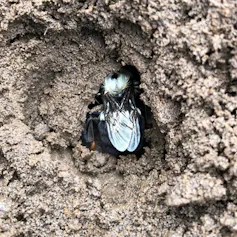
(Sabrina Rondeau)
Many aquatic insects use a simple trick to breathe underwater. A thin layer of air clings to their body, allowing them to use their normal air-breathing system — the tracheal system. Oxygen from the surrounding water slowly diffuses into this air layer. Bumblebee queens likely rely on the same mechanism.
Still, underwater respiration alone does not fully meet the queen’s energy needs. To bridge the gap, queens also produce some energy through anaerobic metabolism — a process that does not require oxygen. This pathway produces lactic acid, which we detected in queens during submersion.
These physiological tricks allow queens to survive underwater, but come at a cost. After resurfacing, queens spend several days recovering, using far more energy than they would have if they had never taken the plunge.
Read more:
Below freezing but still moving: How salamanders stay active in winter
An unexpected resilience
Bumblebee queens spend the winters alone, buried underground and relying on stored energy to survive until spring. Their ability to tolerate days of submersion — and even breathe underwater — reveals an unexpected resilience to one of the hazards of life below ground.
This matters because bumblebee colonies depend entirely on the survival of overwintering queens. If a queen dies during winter, the colony she would have founded the following spring will never exist.
This ability to survive submersion could play an important — and previously overlooked — role in the resilience of threatened bumblebee populations.
Even in terms of familiar and comparatively well-studied insects like bumblebees, there is still so much to learn about the surprising ways they cope with environmental challenges.

Sabrina Rondeau received funding from the Natural Sciences and Engineering Research Council of Canada, the Fonds de recherche du Québec—Nature et technologies and the Weston Family Foundation.
Charles-Antoine Darveau receives funding from the Natural Sciences and Engineering Research Council Discovery Grants program.
Nigel Raine receives funding from the Natural Sciences and Engineering Research Council, the Horizon Europe ProPollSoil project, the Canada Foundation for Innovation Innovation Fund, the Ontario Ministry of Agriculture, Food and Agribusiness, the Canadian Wildlife Federation and the Weston Family Foundation.
– ref. Queen bumblebees can breathe underwater — for days. We discovered how – https://theconversation.com/queen-bumblebees-can-breathe-underwater-for-days-we-discovered-how-278175
Back to index · Read original article
Is yo-yo dieting bad for you? Here’s what the latest research shows
April 1, 2026
Source: MIL-OSI-Submissions-English
Source: The Conversation – UK – By Adam Collins, Associate Professor of Nutrition, University of Surrey

The only thing harder than losing weight is keeping it off. Many people who lose weight find themselves stuck in the cycle of “yo-yo dieting” – losing weight and gaining it all (and sometimes more) back again.
Research on yo-yo dieting has long indicated it can be harmful for your health. But a recent paper has now suggested yo-yo dieting might not be as unhealthy as we’ve been led to believe.
This recent paper, published in BMC Medicine, presents the findings of two separate weight loss trials that were conducted five years apart.
The first trial (trial 1) looked at 278 participants who were overweight or obese. Participants were randomised to follow either a low-fat or low-carb Mediterranean diet – either with or without exercise. All participants lost a comparable amount of weight at the end of the 18-month trial. But those who incorporated exercise achieved the biggest decrease in visceral fat (a dangerous type of fat that is stored around the organs).
The second trial (trial 2) was conducted five years later. Similar to trial 1, the 294 participants followed a Mediterrean-style diet for 18 months. But this time, one group ate a diet very high in polyphenol-rich foods (naturally-occurring plant compounds which have been linked to health benefits such as lower risk of chronic disease). The second group ate a normal Mediterranean diet, while the third group followed normal healthy diet guidelines.
While both Mediterrnanean diet groups lost weight and saw improvements in their overall health, the polyphenol group lost more visceral fat.
A unique aspect of trial 2 was that it included around 80 participants from trial 1. Some of these participants weighed more than they did at the start of the first trial. Such weight recidivism is common following weight loss. This is due to various biological and physiological functions that reduce metabolism and increase hunger, causing people to regain weight and store fat.
The authors compared the people who rejoined the research project against their health and weight status at the start of trial 1. They assessed body weight and other aspects of health – including body fat and blood sugar levels. Despite the re-joiners weighing around the same (if not more) than they did at the start of trial 1, they had lower levels of abdominal fat and visceral fat five years later.
Their metabolic health was also better than it was at the start of the first trial, based their blood lipid (fat) levels, cardiovascular health and blood sugar control.
On the surface, this appears to be good news – suggesting participants retained some of the health benefits of the weight they lost the first time around, despite regaining the weight.
Yet, the results suggest that the very adaptations which helped the re-joiners stay healthy despite regaining weight could potentially have repercussions later. To understand why this is the case requires a grasp of how the body responds to a calorie deficit.
Weight loss and body fat
Our fat stores (known as adipose tissue) serve as our main energy (calorie) buffer when there’s no food to provide that fuel. These stores are sacrificed to cover the energy shortfall, causing fat cells to shrink. Visceral fat is the first to go, followed by the more beneficial fat cell stores.
But when people stop dieting, the body puts priority on regaining lost fat. Indeed, our body replenishes fat stores far more quickly than it does muscle or protein stores. More importantly, in response to this shrinkage, the body compensates by making more fat cells. It does this to help the body better cope the next time there’s a fuel crisis.

Spectral-Design/ Shutterstock
So dieting literally makes you fatter in the long run. But thankfully, this will most likely be healthier subcutaneous fat (in the hips, thighs, buttocks and torso) instead of around the organs as harmful visceral fat.
So even though you’ll be carrying excess weight, you’ll experience fewer of the metabolic issues caused by unwanted visceral fat – such as insulin resistance and high cholesterol, which elevate your risk of cardiovascular disease and diabetes.
But with the higher capacity to store fat comes the risk of overshooting your original weight. This may also have implications for yo-yo dieting.
The weight loss cycle
In the paper, the re-joiners who took part in trial 2 did manage to lose weight again. But, on average, they lost slightly less than the trial’s first-timers. That said, when all of the participants from trial 2 were followed up five years later, the re-joiners from trial 1 had regained less, too. They had also retained more of the health benefits of losing weight.
Taking stock of the whole weight-loss journey, it appears that those who regained weight and then joined trial 2 are at a comparable place at the end of ten years to those who just did trial 1.
But there are a few caveats to the trial’s findings.
First, the paper only examined body fat. It didn’t provide any information on lean tissue (such as muscle). This is important, as when we lose weight we lose both fat and muscle. Given muscle’s importance for a healthy metabolism, a lack of muscle could result in even greater weight gain.
Read more:
Weight loss: why you don’t just lose fat when you’re on a diet
It’s also not clear whether regaining weight changes the nature of muscle tissue. There are two key types of muscle fibre. Type 1 is smaller and more efficient at burning fat. Type 2 is larger, faster and more powerful – important for explosive exercise.
If an overall loss of muscle results in muscle fibres changing from type 1 to type 2, this could increase risk of health problems – including sarcopenic obesity and earlier onset of age-related health issues associated with muscle loss.
Overall, the paper shows us that weight loss is still beneficial for your health – even if it requires a few attempts to get to your goal weight. But to avoid potentially gaining more weight the second time around, it’s key to establish good diet and lifestyle changes that are sustainable long-term.

Adam Collins is affiliated with Form Nutrition Ltd as consultant Head of Nutrition
– ref. Is yo-yo dieting bad for you? Here’s what the latest research shows – https://theconversation.com/is-yo-yo-dieting-bad-for-you-heres-what-the-latest-research-shows-278932
Back to index · Read original article
How Taiwan is viewing the Iran war – and what it reveals about US credibility
April 1, 2026
Source: MIL-OSI-Submissions-English
Source: The Conversation – Global Perspectives – By Bonnie Yushih Liao, Assistant Professor of Diplomacy & International Relations, Tamkang University
The United States and Israeli strikes on Iran have become increasingly concerning for the world due to the risks of further escalation and the impact on energy markets.
In Taiwan, however, the focus has shifted in a different direction.
Rather than treating the war as geographically distant, Taiwanese political leaders and analysts are viewing it as a real-time indicator of how the United States operates under strategic pressure.
The key question is less about whether the United States would act if a conflict with China were to break out in the Indo-Pacific region, and more about how it would manage competing pressures if multiple crises unfolded at once.
A test of limits, not intentions
There is growing recognition in Taiwan that US resources are not unlimited.
The Middle East war has caused energy prices to fluctuate and stoked fears of rising inflation in the United States, demonstrating the domestic costs of military operations.
US President Donald Trump’s approval ratings have also taken a hit, with some in his own party now questioning his rationale for going to war.
Some reports have indicated US supplies of interceptor missiles are running low. The US military has, for example, had to move some THAAD missile interceptors from South Korea to the Middle East. The US has also struggled to defend against Iran’s use of asymmetrical fighting tactics.
This has direct implications for the deterrence Washington has long maintained in the Indo-Pacific. This deterrence depends not only on US war-fighting capability, but on the expectation this capability will remain intact under strain.
Conflicts elsewhere may not weaken the US resolve to intervene if China were to invade or pressure Taiwan in some fashion. But they can drain American resources and influence where these items are prioritised.
Shifting thresholds for the use of force
The US has also framed its strikes on Iran as a “preventive” action aimed at mitigating a future threat rather than responding to an imminent attack. This raises broader questions about the changing threshold for the use of force in the Indo-Pacific.
For Taiwan, this is not an abstract notion. If the threshold for military action is lowered from imminent threat to potential risk, the strategic environment becomes less predictable in the Indo-Pacific.
This broadens the range of circumstances under which force by the United States may be justified.
The speed with which the Trump administration has acted in Iran has also increased uncertainty for regional partners like Japan and South Korea in assessing when and how the United States would act against China.
The US’ NATO partners weren’t told about the Iran strikes before they happened. This could make Japan and South Korea similarly worried about a lack of communication on potential US actions over Taiwan.
Wars rarely follow anticipated pathways
The Iran war has also raised broader questions about how the United States adapts as crises evolve.
Much of the discussion around Taiwan has traditionally centred on the possibility of a large-scale Chinese invasion. However, recent developments suggest escalation may be less linear than this.
Rather than following a single, predictable pathway, conflicts can develop through a sequence of smaller decisions, the ambiguity over signals sent by an adversary, or rapidly changing political conditions.
This has contributed to a shift in strategic discussion in Taiwan. Recent defence policy debates and security forums have increasingly examined scenarios in which China pressured Taiwan with grey-zone tactics, blockades and incremental escalatory moves, rather than focusing solely on full-scale invasion.
As a result, attention is shifting to how such pressure might build over time – through cyber operations, maritime restrictions or limited military actions – and possibly spiral out of control.
The current crisis in the Strait of Hormuz has been watched closely in Taiwan as an example of how disruption of a strategic chokepoint can quickly impact the world. This raises questions about whether similar dynamics could emerge in the Taiwan Strait, and how prepared external actors – including the US – would be to respond.
The US has also been unable to prevent the Iran war from spilling over into the Persian Gulf states. This raises questions about whether a war over Taiwan could be contained or produce wider regional effects.
The risk of misinterpretation
For Taiwan, the most immediate challenge comes from how China interprets US actions in Iran. If Beijing concludes that diminishing military resources or domestic pressures would limit the US’ ability to wage a sustained conflict in the Indo-Pacific, it may reassess the risks of applying coercive pressure on Taiwan.
This does not imply immediate conflict is likely over Taiwan. However, it increases the likelihood that China would try to pressure or coerce Taiwan just below the threshold of full-scale war.
History suggests that escalation is often shaped by how situations are interpreted by adversaries, rather than by clear shifts in power. When states believe conditions are more favourable than they actually are, the risk of misjudgement increases.
For Taiwan, the challenge is therefore not only to assess developments in the Middle East, but to ensure that its own position is not misunderstood. This involves:
- maintaining credible defensive capabilities
- reinforcing internal cohesion against possible threats
- signalling clearly that any attempt at coercion would face robust resistance.
Deterrence depends not only on what a country can do, but what others believe it will do — and whether those beliefs discourage risk-taking.

Bonnie Yushih Liao does not work for, consult, own shares in or receive funding from any company or organisation that would benefit from this article, and has disclosed no relevant affiliations beyond their academic appointment.
– ref. How Taiwan is viewing the Iran war – and what it reveals about US credibility – https://theconversation.com/how-taiwan-is-viewing-the-iran-war-and-what-it-reveals-about-us-credibility-279102
Back to index · Read original article
How to build a digital ‘twin’ of the human brain – what existing models overlook
April 1, 2026
Source: MIL-OSI-Submissions-English
Source: The Conversation – UK – By Andrea Luppi, Senior Research Associate, Department of Psychiatry, University of Oxford
The potential to create personalised digital “twins” of your brain and body is a hot topic in neuroscience and medicine today. These computer models are designed to simulate how parts of your brain interact, and how the brain may respond to stimulation, disease or medication.
The extraordinary complexity of the brain’s billions of neurons makes this a very difficult task, of course, even in the era of AI and big data. Until now, whole-brain models have struggled to capture what makes each brain unique.
People’s brains are all wired slightly differently, so everyone has a unique network of neural connections that represents a kind of “brain fingerprint”.
However, most so-called brain twins are currently more like distant cousins. Their performance is barely any closer to the real thing than if the model were using the wiring diagram of a random stranger.
This matters because digital twins are increasingly proposed as tools for testing treatments by computer simulation, before applying them to real people. If these models fail to capture fundamental principles of each patient’s unique brain organisation, their predictions won’t be personalised – and in worst cases could be misleading.
In our latest study, published in Nature Neuroscience, we show that realistic digital brain twins require something that many existing models overlook: competition between the brain’s different systems.
Our findings suggest that without competition, digital twins risk being overly generic, missing out on what makes you “you”.
Excess of cooperation
The human brain is never static. The ebb and flow of its activity can be mapped non-invasively using neuroimaging methods such as functional MRI. A computer model can be built from this, specific to that person and simulating how the regions of their brain interact. This is the idea of the digital twin.
The brain is often described as a highly cooperative system. Yet everyday experiences such as focusing attention or switching between tasks tells us intuitively that brain systems compete for limited resources. Our brains cannot do everything at once, and not all regions can be active together all the time.
Despite this, the vast majority of brain simulations over the past 20 years have not taken these competitive interactions between regions into account. Rather, they have “forced” neighbouring regions to cooperate. This can push the simulated brain into overly synchronised states that are rarely seen in real brains.
In a large comparative study of humans, macaque monkeys and mice, our international team of researchers used non-invasive brain activity recordings to show that the most realistic whole-brain models not only require cooperative interactions within specialised brain circuits, but long-range competitive interactions between different circuits.
To achieve this, we compared two types of brain model: one in which all interactions between brain regions were cooperative, and another in which regions could either excite or suppress each other’s activity. In humans, monkeys and mice, the models that included competitive interactions consistently outperformed cooperative-only models.
Using a large-scale analysis of over 14,000 neuroimaging studies, we found that spontaneous activity in the competitive models more faithfully reflected known cognitive circuits, such as those involved in attention or memory. This suggests competition is crucial for enabling the brain to flexibly activate appropriate combinations of regions – a hallmark of intelligent behaviour.
Visual summary of our study:

Luppi et al/Nature Neuroscience, CC BY
We concluded that competitive interactions act as a stabilising force, allowing different brain systems to take turns in shaping the direction of the brain’s ebbs and flows without interference or distraction. This ability to avoid runaway activity may also contribute to the remarkable energy-efficiency of the mammalian brain, which is many orders of magnitude more efficient than modern AI systems.
Crucially, models with competitive interactions were not only more accurate but also more individual-specific. This means they were better at capturing the unique brain fingerprint that distinguishes one person’s brain from another’s.
No longer lost in translation?
The fact that our findings hold across humans and other mammals suggests they reflect fundamental principles of how intelligent systems work. In each case, we found models with competitive interactions generated brain activity patterns that closely resembled those associated with real cognitive processes.
This could have major implications for translational neuroscience. Animal models are routinely used to test treatments before human trials, yet differences between species often limit how well these results translate. Around 90% of treatments for neuropsychiatric disorders are “lost in translation”, failing in human clinical trials after showing promise in animal trials.
Combining brain imaging data from human patients with whole-brain modelling could radically change this. A framework that works across species would provide a powerful bridge between basic research and clinical application.
If someone needs intervention in the brain, for example due to epilepsy or a tumour, their digital twin could be used to explore how the patient’s brain activity would change when stimulated with different levels of drugs or electrical impulses. This might significantly improve on existing trial-and-error approaches with real patients, and thus provide better treatments.
The general principles of brain organisation across species also offer a path for understanding how to shape the next generation of artificial intelligence. In the not-too-distant future, we may be able to construct digital twins that are more faithful in reproducing the salient features of the human brain – and potentially, AI models that are more faithful to the human mind.

Andrea Luppi receives funding from the Wellcome Trust, St John’s College, Cambridge, and the Canadian Institutes of Health Research.
Gustavo Deco receives funding from the European Regional Development Fund, EU ERC Synergy Horizon Europe, and the Department of Research and Universities of the Generalitat of Catalunya.
Morten L. Kringelbach has received research funding from Pettit, Carlsberg and Cillo Foundations as well the ERC. Deco and Kringelbach are the authors of Whole-brain Modelling: Cartography of the Dynamics of Mind. This open-access title is available at https://hedonia.kringelbach.org/whole-brain-modelling/
– ref. How to build a digital ‘twin’ of the human brain – what existing models overlook – https://theconversation.com/how-to-build-a-digital-twin-of-the-human-brain-what-existing-models-overlook-279681
Back to index · Read original article
Home or away? Why planning a sustainable holiday is about more than swapping planes for trains
April 1, 2026
Source: MIL-OSI-Submissions-English
Source: The Conversation – UK – By Sarah Barfield Marks, PhD Researcher, Department of Psychology, University of Bath
As we emerge from a relentlessly gloomy winter in the UK, many are itching for a holiday in the sun. For some that means seeking warmer climates abroad and hopping on a plane to get there.
But as climate change brings wetter winters to the UK, flying for holidays is fuelling rapidly rising aviation emissions. And addressing this not only needs a shift towards climate-friendly travel but a reimagining of where holidays take place.
For years we’ve been sold the promise of guilt-free flying through green technologies such as sustainable aviation fuels and carbon offsetting from polluting airlines.
But all come with significant limitations and none are ready to deliver the emissions reductions we need within the time we have. Ultimately, without curbing demand, current climate policies will not deliver any major emissions reductions in aviation. That makes it more important to reduce how much we fly.
In the UK, aviation is set to become the largest emitting sector by 2040 and this rise is being driven primarily by leisure travel. This includes vacations and visiting family or friends with the majority of departing passengers flying for holidays.
Beyond switching planes for trains
The good news is the growth in aviation emissions isn’t being caused by your annual holiday to Spain. Most flights are taken by a relatively small number flying several times a year, with 70% of flights taken by just 15% of people. This group is also more likely to take frequent short-haul flights which could be replaced by train. Shifting the behaviour of this elite group (from planes to trains) would have a significant impact on cutting emissions.
Trains are significantly better for the climate compared to flying, with a single flight from London to Berlin clocking up the same amount of carbon as 11 trips by train.
As a researcher focusing on how to promote flight-free holidays to reduce aviation emissions, I used to find this reassuring. We didn’t necessarily need to change where we went for holidays. We just needed to get frequent flyers on trains instead of planes.
But, sadly, it itsn’t that simple. Recent research has found the majority of UK aviation emissions actually come from long-haul leisure flights. So even if all flights on routes that could be completed by rail in under 24 hours were replaced, this would only address around 14% of UK aviation emissions.
Reducing aviation emissions therefore requires not only getting frequent flyers to shift from planes to trains, but asking wider questions about where people want to go and why.
Rethinking what a ‘proper’ holiday looks like
Reducing demand for flying isn’t just a structural challenge addressing cheap flights and expensive trains, but also a social one. Five minutes scrolling on Instagram bombards you with bucket list destinations and influencers implying a life well lived is a passport full of stamps.
Since the rise of budget airlines in the 1990s, flying for holidays has become increasingly normalised socially, despite largely remaining something only a relatively wealthy few do regularly. And the pull isn’t just about cost and convenience.
Research shows if cost and time weren’t an issue, people say they would fly more. Flying has become a means to an end in reaching the exotic, unfamiliar and – crucially for British people – the sun.
Tourists associate distance with novelty, contributing to domestic holidays being less popular than those abroad. There’s almost a hierarchy of destinations where places furthest away and more novel feel more desirable. My ongoing research on how people talk about holidays reflects this – some questioned whether the UK even counts as a holiday.
I have found that holidays in far-away places seemed to impress participants more than those spent in the UK and Europe, often with responses such as “wow” and “amazing”. Destinations further afield were referred to as “grand”, “swanky”, “extravagant” and “big”, contrasting with the language used when discussing holidays closer to home with “only”, “little” and “just”. In this way, the places we visit on holiday act as social currency in conversations. Being well travelled grants us cultural capital, the accumulated knowledge and experience of the world signalling social status.
But ideas of a good holiday are open to change. In one survey, half of the respondents said they flew less because they knew someone who had given up flying due to climate change. So social influence works in both directions.
Some, for example those part of the slow travel movement, are already resisting the idea that closer destinations are somehow lesser. Participants in our ongoing research described planning trips around where they can feasibly get to by train, making the journey part of the holiday or foregrounding quality time with loved ones over the destination.
This isn’t about giving up holidays abroad and foregoing the sun, especially if you’re only flying to a European destination once or twice a year. Structural change, like fairer pricing and better rail connections, is also essential (and long overdue) if people are to make changes.
Even taking the train from London to Edinburgh costs on average 60% more than flying and this will persist until airlines are taxed fairly and train tickets are made the same price or cheaper than plane tickets. These are policies which the public supports.
So as we look ahead to summer it’s worth asking if what we’re actually longing for – whether it be warmth, rest, adventure, quality time, cultural interest or a change of scenery – really requires a long-haul flight (or lots of short-haul flights). A sustainable holiday starts with asking that question before deciding where to go.

Sarah Barfield Marks does not work for, consult, own shares in or receive funding from any company or organisation that would benefit from this article, and has disclosed no relevant affiliations beyond their academic appointment.
– ref. Home or away? Why planning a sustainable holiday is about more than swapping planes for trains – https://theconversation.com/home-or-away-why-planning-a-sustainable-holiday-is-about-more-than-swapping-planes-for-trains-277802
Back to index · Read original article
Bobi Wine’s decision to flee Uganda points to a shrinking landscape for opposition politics
April 1, 2026
Source: MIL-OSI-Submissions-English
Source: The Conversation – Africa (2) – By Kristof Titeca, Professor in International Development, University of Antwerp
Bobi Wine’s escape from Uganda is not just a striking episode in itself, it also offers insight into the current state of the opposition – particularly his National Unity Platform party – and into the divergences within the Yoweri Museveni regime.
The Ugandan opposition leader had been in hiding for almost two months after the January 2026 presidential election, which Museveni won by 72%. Wine came second with 25% of the vote. Museveni, 81, has been in power since 1986.
Wine, born Robert Kyagulanyi, entered formal politics in 2017 when he won a parliamentary by-election.
He soon emerged as one of the leaders of the People Power movement, a loose, generationally charged mobilisation built around the slogan “People Power, Our Power”. It took shape in the aftermath of protests against the removal of presidential age limits in 2018. At the time, the opposition appeared largely exhausted and unlikely to unseat the regime. Bobi Wine and People Power therefore brought a new energy to Uganda’s opposition.
People Power later formalised into the National Unity Platform party, which Wine used to vie for the presidency in 2021. He secured about 35% of the presidential vote against Museveni’s 59%. National Unity Platform became the largest opposition force in parliament with 57 seats.
These results also highlighted the constraints of electoral politics in the face of extensive repression.
This is a pattern that would again become apparent in the 2026 elections.
As several human rights organisations noted, the 2026 elections took place in an environment marked by widespread repression and intimidation.
After the vote, Wine went into hiding. He posted photos and videos seemingly from Kampala, triggering roadblocks and searches across the capital city. On 18 March 2026, he resurfaced in the United States.
I have researched Ugandan politics for over 20 years, and recently published an article analysing the structural challenges Wine’s political party faces in Uganda’s authoritarian context.
Drawing on this work, my reading is that Wine’s escape reveals controlled tensions within Museveni’s regime, where different factions appear to disagree on how to handle the opposition – without signalling a full split. At the same time, it exposes a deeper dilemma for Wine and his party: how to balance international advocacy with maintaining grassroots legitimacy at home.
This moment matters because it highlights the structural constraints facing opposition politics in Uganda, and raises questions about whether meaningful political change can occur within the current system.
Frictions within the regime
The contrasting approaches within the Museveni regime are illustrated by events that followed the 2026 election. In the weeks following the vote, defence force chief Muhoozi Kainerugaba (Museveni’s son) issued a series of unusually explicit statements about Wine.
In a now-deleted tweet, he claimed that 22 members of the National Unity Platform – whom he labelled “terrorists” – had been killed. He added that he was praying that the next death would be Wine’s.
On 26 January, the defence chief escalated this rhetoric, stating that he wanted Wine “dead or alive”. These statements built on earlier threats, including about beheading Wine.
Taken together, they amount to sustained violent threats directed at the main opposition leader.
Read more:
Uganda’s autocratic political system is failing its people – and threatens the region
Set against this, however, is the fact that Wine was able to evade capture for nearly two months and ultimately leave the country.
It emerged that he did so with assistance from high-level state and security officials.
The same sources and regime insiders reported that intelligence services had informed Museveni about Wine’s whereabouts. The president chose not to act upon this information.
Taken together, these events suggest differences within the regime between factions in the security services, or more broadly between Muhoozi and other centres of power. Potentially even within the first family itself.
But these differences should not be overstated.
The episode does not indicate an open or consolidated split. Criticism of Muhoozi within the regime remains tightly constrained.
What this suggests is a regime where disagreements are contained within narrow limits. Wine’s escape, therefore, points less to a rupture than to an ongoing negotiation over power and strategy within the ruling elite.
And this is becoming increasingly important in light of the anticipated transition beyond Museveni.
Tensions within Wine’s party
Wine’s political strength has always come from where he came from.
He was rooted in the ghetto, and more broadly among urban youth who had long been mobilised by opposition politics but rarely felt represented by it.
Earlier figures like Kizza Besigye could appeal to this group, but Wine embodied it. He spoke the same language and made politics feel accessible to people often treated as outsiders.
That sense of authenticity was central to the early momentum of People Power. It also mattered that Wine broke with a long-standing pattern in Ugandan politics: he did not come from the western region, the core of the ruling elite.
But this “outsider” appeal has become harder to sustain over time. As People Power turned into a political party, and as Wine himself became more embedded in formal politics and international networks, parts of that original base began to feel that something had shifted.
What once felt like a movement of “one of us” increasingly risks being seen as something closer to the political establishment it set out to challenge.
As my research shows, this is not unusual. It is a core dilemma when protest movements turn into parties, especially under repression.
The social media backlash to Wine’s appearance in the United States needs to be read through that lens.
It not only echoes criticism from Museveni that Wine is an “agent of foreign interests”, but also from within the opposition where some radical voices argue that he should have stayed and faced the regime, even if that meant prison. Besigye, for instance, is facing treason charges after he was abducted and extradited from Kenya in 2024.
This criticism echoes a longstanding divide within opposition politics in Uganda: should opposition leaders embody defiance on the ground, or navigate politics through institutional spaces?
Read more:
The making and breaking of Uganda: an interview with scholar Mahmood Mamdani
Being in the US reinforces a growing perception that Wine is becoming more distant from the people who carried the risks on the ground.
If the party cannot connect its international advocacy and diaspora support back to the everyday struggles of its supporters in Uganda, this episode will likely deepen the feeling that the party has become more of the same.
What role remains for Wine?
There is an uncomfortable reality here. Wine serves a function for the regime. His presence helps maintain the appearance of political competition, particularly within the international community.
Wine now faces a choice. Engaging in electoral politics risks reinforcing the system he seeks to challenge. Stepping outside it risks isolation, repression or loss of political relevance.
How he navigates this tension will shape not only his political trajectory, but also that of his party.

Kristof Titeca does not work for, consult, own shares in or receive funding from any company or organisation that would benefit from this article, and has disclosed no relevant affiliations beyond their academic appointment.
– ref. Bobi Wine’s decision to flee Uganda points to a shrinking landscape for opposition politics – https://theconversation.com/bobi-wines-decision-to-flee-uganda-points-to-a-shrinking-landscape-for-opposition-politics-279475
Back to index · Read original article
Décoloniser notre rapport aux animaux pour inventer un nouveau rapport au monde
April 1, 2026
Source: MIL-OSI-Submissions-French
Source: The Conversation – France in French (2) – By Cédric Sueur, Professeur des Universités en éthologie, primatologie et éthique animale, Université de Strasbourg
L’humain s’est placé au-dessus de toutes les autres espèces animales. Comment changer notre relation avec elles pour sortir d’une logique de domination et aller vers des formes de coexistence et de coopération ?
Chaque année, des milliards d’animaux sont élevés, transportés et abattus pour répondre aux besoins alimentaires, scientifiques ou industriels des sociétés humaines. Cette utilisation intensive du vivant pose une double question. Elle est d’abord éthique, car elle implique la souffrance et la mise à mort d’êtres vivants sensibles. Elle est aussi environnementale et sanitaire : la déforestation pour l’élevage intensif, la pollution conséquente et la proximité accrue entre espèces favorisent les déséquilibres écologiques et l’émergence de maladies.
Le concept de One Health (une seule santé) et la crise du Covid-19 rappellent que la santé humaine dépend étroitement de celle des animaux et des écosystèmes. Ces crises ne sont pas indépendantes. Elles révèlent un même rapport au vivant, fondé sur l’exploitation et la mise à distance physique et émotionnelle. Comprendre ce rapport est une condition nécessaire pour le transformer.
Une domination héritée : spécisme et colonisation
Les recherches en éthologie ont profondément renouvelé notre regard sur les animaux. De nombreuses espèces manifestent des émotions, des capacités d’apprentissage, des formes de coopération et des relations sociales complexes. Chez certains primates, mais aussi chez des éléphants, des corvidés ou des cétacés, on observe des comportements qui suggèrent des formes de conscience, d’empathie, de culture et de deuil.

Cédric Sueur, Alexandre Bonnefoy, Fourni par l’auteur
Pourquoi, malgré ces connaissances, continuons-nous à exploiter les animaux à grande échelle ? Une partie de la réponse tient à notre héritage culturel. Les sociétés occidentales modernes se sont construites sur une séparation entre l’humain et le reste du vivant, associée à une hiérarchisation qui place l’homme au sommet.
Le concept de « spécisme », inventé par Richard Ryder en 1970, désigne cette discrimination fondée sur l’espèce. Il conduit à considérer que les intérêts des humains priment systématiquement sur ceux des autres êtres qui souffrent tout autant. Dans sa structure, ce mécanisme n’est pas sans analogie avec le racisme ou le sexisme : il repose sur une différence érigée en critère de domination.

Fourni par l’auteur
Le spécisme décrit cependant avant tout une attitude morale, un biais cognitif et éthique dans la manière dont nous évaluons les intérêts des différentes espèces. La notion de « colonisation animale », que je développe dans Décoloniser notre rapport aux animaux (Odile Jacob, 2026), cherche à aller plus loin en désignant les structures concrètes qui organisent et perpétuent cette domination.
Là où le spécisme interroge les représentations, la colonisation animale pointe les dispositifs institutionnels, économiques et culturels qui les rendent opératoires : les animaux sont appropriés, contrôlés, transformés en ressources économiques et symboliques. Le droit les protège partiellement en tant qu’êtres vivants sensibles, tout en les maintenant dans le régime des biens. L’économie en fait des marchandises et tend à invisibiliser les violences qui leur sont infligées. Ces dimensions se renforcent mutuellement et stabilisent un système de domination qui dépasse la seule question des représentations pour s’incarner dans des pratiques, des lois et des rapports de pouvoir.
D’autres ontologies du vivant
Cette manière de penser n’est pourtant pas universelle. De nombreuses sociétés non occidentales, comme les Achuar d’Amazonie, les aborigènes d’Australie ou les Japonais, envisagent les relations entre humains et non-humains autrement. Plutôt que de séparer radicalement les êtres, elles insistent sur les continuités, les interdépendances et les relations.
Les travaux de l’anthropologie, en particulier de Philippe Descola (les Lances du crépuscule, 1993) ou de Bruno Latour (Enquête sur les modes d’existence, 2012), ont ainsi montré l’existence de différentes « ontologies », c’est-à-dire des manières de définir et de se représenter ce qui existe et comment les êtres sont liés. Ces sociétés ou ethnies sont, par exemple, animistes et attribuent aux animaux une intériorité – autrement dit une vie intérieure faite d’intentions, d’émotions, de perceptions et de subjectivité propre, comparable à celle que nous reconnaissons aux humains – ou les considèrent comme des partenaires inscrits dans des réseaux de relations.

Cédric Sueur, Fourni par l’auteur
Sans idéaliser ces perspectives, elles offrent des ressources pour sortir d’une vision strictement utilitariste du vivant. Elles invitent à penser une coexistence fondée non sur la domination, mais sur la réciprocité et l’attention aux interdépendances.
Transformer nos pratiques quotidiennes
Décoloniser notre rapport aux animaux suppose d’abord de transformer nos pratiques les plus ordinaires. L’alimentation constitue un levier central : réduire la consommation de produits animaux permet de limiter à la fois la souffrance animale et l’impact environnemental.
Au-delà, il s’agit de repenser la manière dont nous partageons les espaces. L’urbanisation a longtemps exclu les autres espèces. Une approche « zooinclusive » développée par la chercheuse Émilie Dardenne propose au contraire d’intégrer leurs besoins dans la conception des villes : favoriser la présence d’oiseaux, d’insectes ou de petits mammifères, aménager des continuités écologiques ou encore adapter les bâtiments pour accueillir d’autres formes de vie.
Cette approche trouve déjà des traductions concrètes. Certaines villes européennes, comme Vienne, Bruxelles ou Londres, ont ainsi intégré des nichoirs et des gîtes à chauves-souris dans les façades de bâtiments rénovés. D’autres ont aménagé des passages fauniques sous les axes routiers pour permettre les déplacements des mammifères sauvages, ou encore maintenu des toitures végétalisées favorisant la biodiversité des pollinisateurs. À Singapour, la politique des « corridors verts » cherche explicitement à reconnecter des fragments d’habitats naturels au sein du tissu urbain. En France, la trame verte et bleue, inscrite dans la législation depuis le Grenelle de l’environnement, constitue une tentative institutionnelle d’intégrer ces continuités écologiques à l’échelle du territoire.
Ces transformations ne relèvent pas seulement de choix individuels, mais aussi de décisions collectives en matière d’aménagement et de politiques publiques.
Repenser la conservation de la faune sauvage
La protection des animaux sauvages s’inscrit souvent dans une logique de gestion : il s’agit de réguler, contrôler, parfois éliminer certaines populations jugées problématiques. Les carnivores sont particulièrement visés. En France, le loup cristallise les tensions entre éleveurs et défenseurs de la nature depuis son retour naturel dans les Alpes dans les années 1990. En Afrique, le lion fait l’objet de conflits similaires : lorsqu’il s’attaque au bétail des communautés rurales, il est perçu comme une menace directe pour la survie économique des familles, ce qui conduit à des empoisonnements ou des abattages, parfois tolérés voire encouragés par les autorités locales.
Les grands herbivores ne sont pas épargnés : en Afrique australe et orientale, les éléphants, dont les populations se sont reconstituées dans certaines zones protégées, provoquent des destructions massives de cultures, écrasent des habitations, tuent des êtres humains. Ces conflits humains-éléphants poussent des communautés à réclamer des abattages, voire à tolérer le braconnage comme seule réponse à une menace perçue comme existentielle. Le braconnage lui-même, souvent présenté uniquement sous l’angle criminel, s’alimente parfois de cette exaspération locale, même s’il est également structuré par des réseaux internationaux aux enjeux économiques considérables. Cette approche gestionnaire prolonge, sous d’autres formes, une relation de domination du vivant, ce que l’historien Guillaume Blanc nomme un nouveau colonialisme vert : des décisions prises depuis l’extérieur, au nom de la nature, sans tenir compte des réalités vécues par les populations locales.

Cédric Sueur, Fourni par l’auteur
Décoloniser la conservation consiste à reconnaître davantage l’autonomie des animaux, leur « souveraineté sauvage », comme la définissent les philosophes Donaldson et Kymlicka, et à respecter leurs habitats. Cela implique de passer d’une logique de contrôle à une logique de coexistence, en cherchant des formes de médiation entre les intérêts humains et non humains. Des initiatives de terrain, comme le projet Cibel dans la forêt du bassin du Congo, montrent qu’il est possible de concilier activités humaines et présence de la faune sauvage, à condition d’accepter la complexité de ces relations.
Décoloniser les sciences
La science elle-même n’échappe pas à ces enjeux. Les animaux y sont souvent considérés comme des objets d’étude ou des modèles expérimentaux. Intégrer leur « agentivité animale », c’est-à-dire leur capacité à agir et à influencer les situations, conduit à repenser les protocoles de recherche vers une coopération humain – non humain plutôt que vers des sacrifices animaux.
En primatologie, par exemple, certaines approches cherchent à limiter les contraintes imposées aux animaux et à mieux prendre en compte leurs comportements spontanés. Lancée par l’éthologue Tetsuro Matsuzawa, cette approche d’observation participante est une collaboration humanimale. Plus largement, le développement de méthodes alternatives permet de réduire le recours à l’expérimentation animale. Décoloniser les sciences ne signifie pas renoncer à la recherche, mais en interroger les présupposés et les finalités des utilisations animales.

Cédric Sueur, Fourni par l’auteur
L’expérimentation animale constitue un point de tension majeur. Si certains travaux sont justifiés par des enjeux de santé, d’autres apparaissent plus discutables au regard des souffrances infligées. Des outils comme le « cube de Bateson » proposent d’évaluer les recherches en fonction de leurs bénéfices attendus, de leur probabilité de réussite et des dommages causés aux animaux. Mais dans la pratique, la réflexion éthique reste souvent limitée. Décoloniser l’expérimentation suppose de renforcer ces exigences, de développer des alternatives et de questionner la légitimité même de certaines recherches.
Vers une coexistence
Décoloniser notre rapport aux animaux, c’est finalement transformer en profondeur notre manière d’habiter le monde. Il ne s’agit pas de supprimer toute relation avec eux, mais de sortir d’une logique de domination pour aller vers des formes de coexistence et de coopération, ce qui est nommé le « capital animal ». Les animaux ne sont plus de simples matériaux pour manger ou se vêtir, mais sont des aides sociales, des passeurs culturels (ils nous transmettent des informations sur notre environnement) et des managers écosystémiques (ils nous aident à gérer nos écosystèmes).
Ce changement est à la fois éthique, écologique et politique. Il implique de reconnaître que les humains ne sont pas extérieurs au vivant, mais en font partie. Dans un contexte de crises multiples, repenser nos relations avec les autres espèces apparaît non comme un luxe, mais comme une nécessité pour la survie de tous dont l’humanité.

Cédric Sueur est l’auteur de l’ouvrage « Décoloniser notre rapport aux animaux » publié aux Editions Odile Jacob dont l’article fait mention.
– ref. Décoloniser notre rapport aux animaux pour inventer un nouveau rapport au monde – https://theconversation.com/decoloniser-notre-rapport-aux-animaux-pour-inventer-un-nouveau-rapport-au-monde-279056
Back to index · Read original article