

Source: French to English Tester Published on: 2026-04-22
Source: The Conversation – in French– By James Clark, Professor of Medieval History, University of Exeter
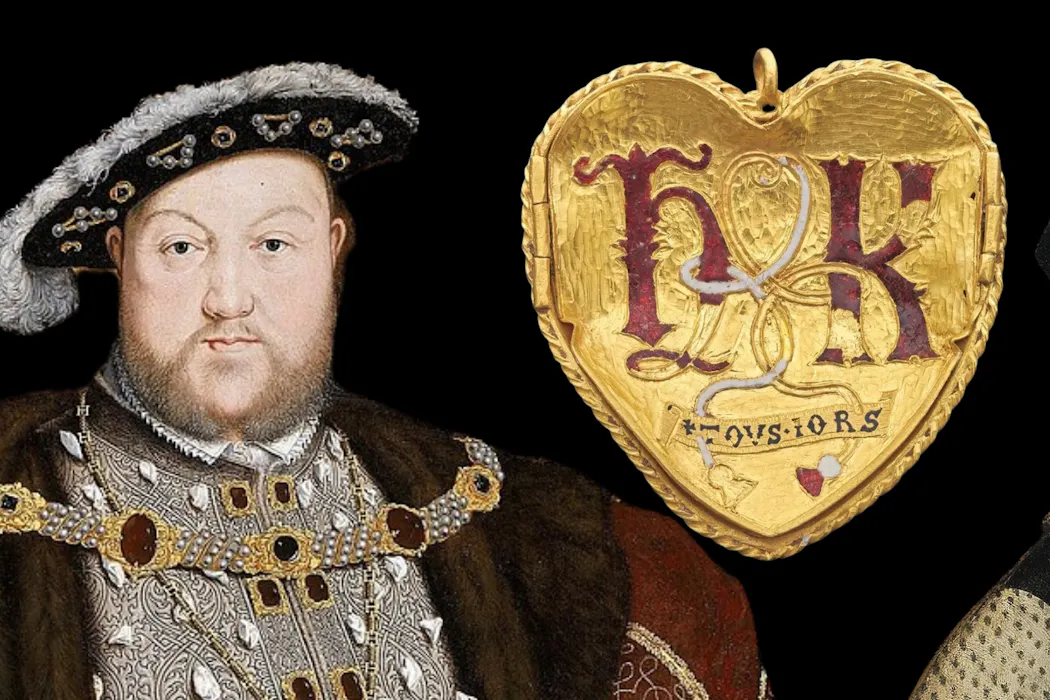
A heart-shaped medallion bearing the initials of Henry VIII and Catherine of Aragon has just entered the collections of the British Museum. Beyond its exceptional value, this jewel could shed light on the early, still happy years of a marriage that would upheave the religious history of England.
Henry VIII, King of England and Ireland from 1509 to 1547, is not remembered in history as a loving husband. Indeed, any English schoolchild can recite the unfortunate fate of most of his six wives thanks to the rhyme, “Divorced, beheaded, died, divorced, beheaded, survived” (‘Divorced, beheaded, died, divorced, beheaded, survived’). But while the end of her relationships is famous, much less is known about Henry when he was in love.
Today, arare jewel, discovered by an amateur using a metal detector and acquired by the British Museum for the national collections, could lead us to reconsider the brutal reputation of the king.
The jewel
The jewel is a heart-shaped locket, crafted in gold and decorated with red enamel, attached to a solid gold chain. On its face are the letters H and K, intertwined with the stems of a Tudor rose and a pomegranate, symbol of Catherine’s Spanish royal family. It is therefore reasonable to deduce that this remarkable jewel was directly linked to Henry and his first wife, Catherine of Aragon.
Catherine was at the heart of Henry’s first divorce, and undoubtedly the most sensational one, the one that precipitated England’s break with the Roman papacy and the religious transformation we now call the Reformation. In many respects, Catherine was also the wife who endured the king’s personal cruelty most harshly. Although she was not executed, she was practically placed under house arrest, and spent much of that time separated from her only surviving child, Mary Tudor.
If this jewel indeed belonged to Henri and Catherine, it could constitute a precious clue to a completely different moment of their relationship—and reveal a facet of the king’s character that his conduct, otherwise sadly famous, has completely overshadowed.
At the end of the Middle Ages and the Renaissance, monograms – that is, the interlacing of the initials of two people – were often created to symbolize a personal bond, a marriage, an engagement, or even a secret affair. Below the interlaced letters of the medallion is the word “Alwa(y)s» – a natural choice for a vow between lovers. Here, the letters very likely refer to Henri and Catherine.
The decorations of the medallion confirm this royal connection. The symbol of the pomegranate made its entry into English public life after the union of the two families through Henry’s marriage. The decorations of the king and queen’s coronation, barely two weeks after the wedding, combined the Tudor rose with golden pomegranates. Onewood engravingpublished to mark the event under the titleA Joyful Meditation to All Englandshowed Henri and Catherine receiving their crowns under a double canopy formed by the flower and the fruit.
The accounts of textiles ordered for the royal household mention dozens of different pieces – upholstery tapestries, wall hangings, and liveries worn by the servants – all prominently adorned with the rose and the pomegranate in their decoration.
Motifs of devotion
The decoration of the heart-shaped pendant is echoed in a wide variety of objects described in the inventories of Henri’s household. Notably, it includes the description of a crimson satin purse, a silver comb case, and a footed cup, all marked in the same manner for the king and his queen. These lists also mention several necklaces – designated by the archaic termcarkeynes– adorned with heart-shaped pendants. One of them, blue in color, also bears the inscription “H K”.
Henry spent considerable sums on furniture and sumptuous showpieces, custom-made, but jewelry was his greatest passion. Theinventoriesof her jewelry and precious tableware (art objects in gold, vermeil, and silver) established shortly after her death in January 1547 list nearly 4,000 individual pieces.

Thyssen-Bornemisza Museum
This Tudor heart-shaped pendant is a striking example of this level of investment. The medallion itself is crafted from 24-carat gold; the wide chain found with it is heavy and long – over 40 centimeters. Together, they represent 317 grams of precious metal. It is therefore not surprising that the British Museum acquired it for3.5 million pounds(a little more than 4 million euros).
The accounts of his wardrobe – which record the purchase of decorative items for the royal household – clearly show that Henry was personally interested in the materials and design of many of these objects. Somejewelry designs made by Hans Holbein, the German artist active at the court of Henry in the 1530s and early 1540s, may come from a collection of models intended to guide or illustrate the evolution of the king’s tastes. He bought or commissioned these pieces not only for his own household but also as gifts—often given at New Year’s—to members of his family or favorites of the court.
This could very well be the origin of the heart-shaped pendant. Since its discovery, it has often been associated with the grand festivity organized by Henri in Pas-de-Calais in 1520, the famousField of the Golden Cloth. Henri, Catherine and their court staged a ceremonial meeting there with the King of France, François Ier. Many objects from the royal residences and chapels were then transported across the English Channel to decorate the canvas palace and the tents erected for the occasion.
A personal message
But I am convinced that the message conveyed by this jewel is not political, but deeply personal. This “Always” seems to be the expression of a deep and sincere attachment. Another hypothesis,put forward by the British Museum itself, is that the pendant may have been made to mark the engagement, in October 1518, of Catherine’s only surviving child, Princess Mary, then 2 years old, with the heir to the French throne, Francis of France, who was 8 months old.
But, considering the presence of objects with a very similar design in the royal household shortly after the marriage and coronation, it is possible that this pendant actually dates back to the early years of the relationship between Henry and Catherine. At first, the queen and king were inseparable. Five months after the wedding, she was pregnant. She was pregnant again each year from 1510 to 1513. One of these pregnancies resulted in the birth of a son, named Henry, in January 1511. He lived for just under 2 months.
At the end of the summer of that same year, the king and queen undertook a tour through the Thames Valley, then as far as theWest Midlands, which ended at Warwick. It is in a field ofWarwickshirethat amateur prospector Charlie Clarke uncovered the heart-shaped pendant in 2019.
Could it be that a piece of jewelry given to Catherine on the occasion of the birth of Henry’s long-awaited male heir was taken along with the royal entourage – as so many of their personal jewels were – during that trip to Warwickshire? This hypothesis gives the locket a meaning that then holds not only romanticism but also tragedy. Perhaps, indeed, Catherine then parted with a gift that was already, in a way, aremember that you must dieof his missing son.

James Clark received funding from UKRI-AHRC.
–ref. The discovery of a heart-shaped medallion could change our view of the cruel Henry VIII –https://theconversation.com/the-discovery-of-a-heart-shaped-medallion-could-change-our-view-of-the-cruel-henry-viii-277046