

Source: French to English Tester Published on: 2026-04-22
Source: The Conversation – France in French (3)– By Romélien Colavitti, Professor of Public Law, University of Tours
R. A. Colavitti,Provided by the author
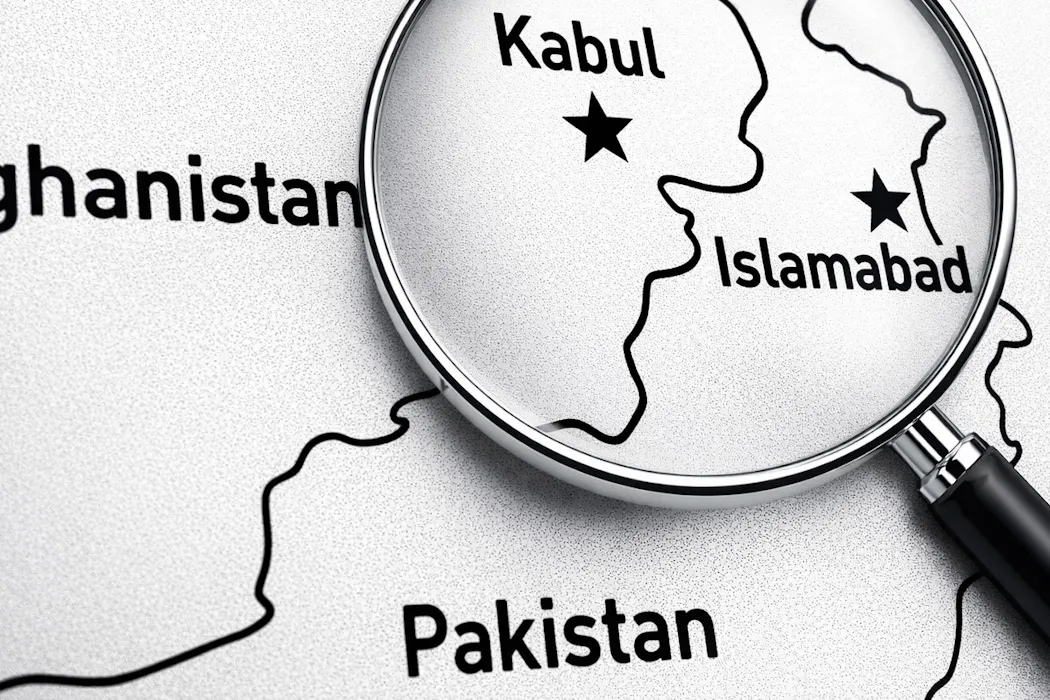
The war that broke out on February 21, 2026, between Afghanistan and Pakistan is part of a long-standing conflict, whose main roots date back to the colonial era and the delimitation in 1893 of the common border, the famous “Durand Line.”
In the 19th century, the“Grand Jeu”oppose in Central Asia the Russian Empire, whose control extends to the former Turkestan – in Turkmen, Uzbek, and Tajik lands – to the British Crown, whose western frontier of the British Raj (British India) includes the Indus River, in present-day Pakistan.
Between these two areas, the Emirate of Afghanistan was already a sovereign state, partly tribal, multi-ethnic with a Pashtun majority, and multi-confessional with a Sunni Muslim majority.
A buffer zone between the Russian Empire and British Raj
For the British, Afghanistan represented a buffer zone against the risk of Russian expansionism. They therefore tried to seize it by force on three occasions: between 1839 and 1842, between 1878 and 1880, and then between May and August 1919.
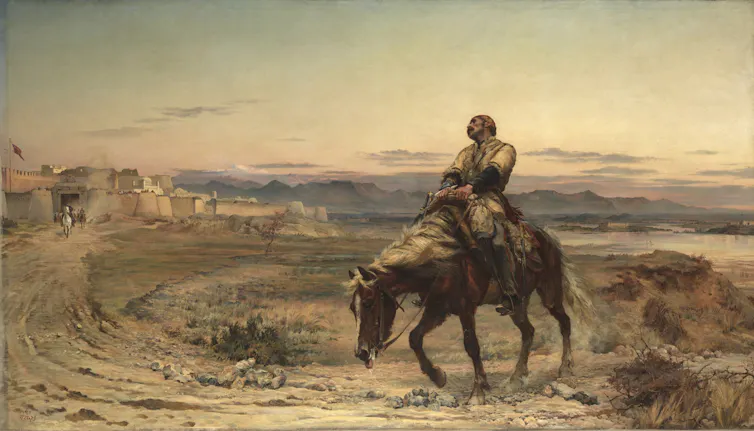
The first war (1839-1842) was won by the Afghans under the leadership of Dost Mohammed Khan following theBattle of Gandamak, in January 1842. The British troops engaged, along with their Indian auxiliaries, were decimated. Only Doctor William Brydon, army surgeon, survived and managed to escape on horseback to report his account to the authorities stationed at Jalalabad, in Nangarhar province.
The second war (1878-1880) was the war of revenge. TheBerlin CongressJuly 1878 was marked by a diplomatic power struggle between the Russian Empire and the British Crown to control the Balkans and the eastern access to the Mediterranean. Following this, with a view to maintaining influence in Central Asia, Russian emissaries were sent to Kabul to Sher Ali Khan (the son of Dost Mohammed Khan), which prompted an immediate reaction from Lord Lytton, the British Viceroy of India, who feared a Russo-Afghan collusion. In September 1878, Lytton sent his own diplomatic mission led by Neville BowlesChamberlainIn Kabul, but it was blocked by the Afghan forces in theKhyber Pass. The emir, mourning the recent death of his young son Prince Abdullah Jan, did not intend to offend the Russians by hosting a British delegation he perceived as colonialist.
Lytton then issued an ultimatum: Afghanistan had to accept hosting his representation before November 1878, otherwise he would launch an offensive. With no response within this deadline, the conflict broke out and, this time, the British won. They then gained control of Peshawar (in the Pashtun area) andQuetta(in Baluchistan), at the borders of the respective territories of the belligerents. This advantage was formalized by theTreaty of Gandamak, signed on May 26, 1879, by Louis Cavagnari, British representative, and Mohammad Yaqub Khan (the son of Sher Ali Khan, deceased at Mazar-e-Sharif during his flight toward the Russian border).
Two months later, in July 1879, Cavagnari had settled as the permanent representative in Kabul. But the Bala Hissar (“Castle on High”), the seat of the British embassy, was quickly besieged and then set on fire by Afghan mutineers demanding their pay, on September 3, 1879. Cavagnari and his entire delegation were assassinated.
Lytton’s reaction was swift. British troops, led by Frederick Roberts, then took Kabul. Mohammad Yaqub Khan abdicated on October 12, 1879, and went into exile in India.
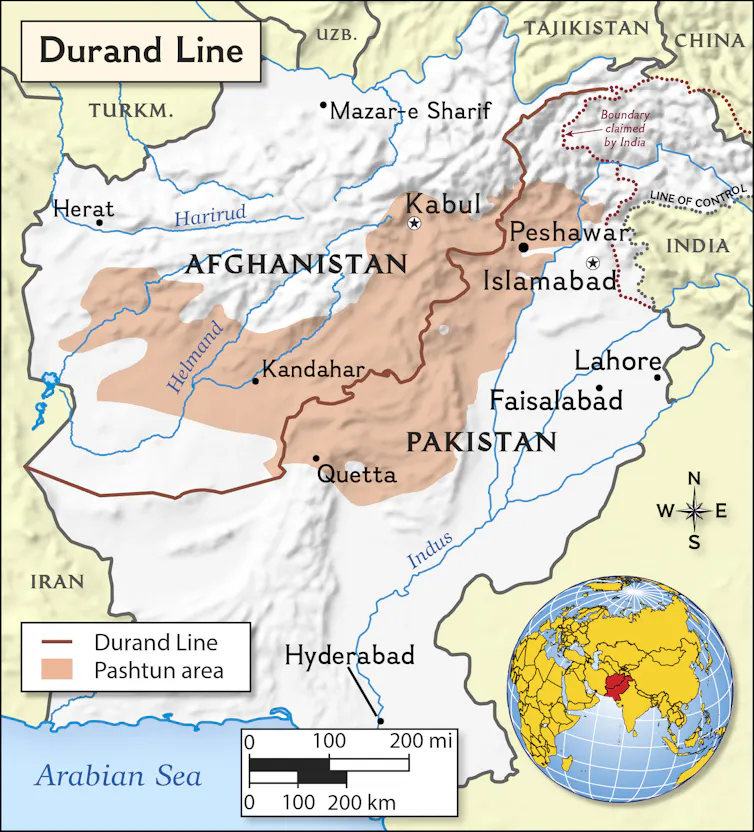
A civil war under military occupation ensued, and the British supported the rise to power of Abdur Rahman Khan (nephew of Sher Ali Khan). He indeed agreed to abandon his foreign policy in exchange for the withdrawal of troops and guarantees to maintain control over internal affairs. It was in this context that Afghanistan and the British Raj were separated by a 2,430-kilometer border, under the bilateral agreement of November 12, 1893, concluded between the emir and Sir Henry Mortimer Durand: the famous“Durand line”, which still separates Afghanistan from Pakistan today, was established. It permanently divided the Pashtun populations in the north and, to a lesser extent, the Baloch in the south into two.
National Geographic
The Third Anglo-Afghan War, between May and August 1919, was triggered by the Afghan plan to regain territorial control of the tribal regions. Initially limited to the village of Bagh (in the region ofAbbottabad), this project threatened to quickly spread to Peshawar where Amanullah Khan, who was then leading Afghanistan, hoped for a popular uprising.
The British regained extended control of the border and bombarded Kabul but, fearing another quagmire in the aftermath of the First World War, they quickly concluded theRawalpindi Armistice Treaty, on August 8, 1919, and amended it on November 22, 1921. They then recognized Afghan sovereignty within the limits of the Durand Line and renounced extending their territorial control. A popular uprising inWaziristan(British side) did nothing: the border was now untouchable.
She will survive thepartition of India in 1947as well as at theproclamation of the Republic of Pakistan in 1956, and will impose itself on international recognition. From this painful history will emerge two diametrically opposed conceptions of the border.
For Afghanistan, a “border-crossing”
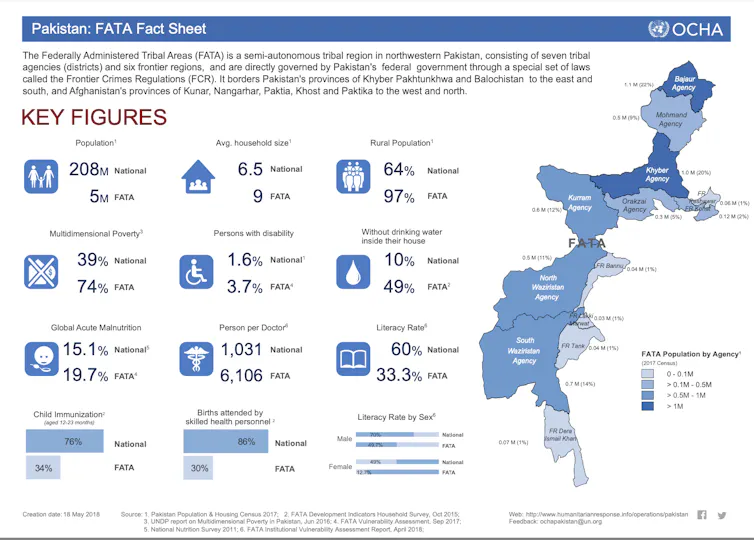
From the Afghan point of view, the Pashtun tribal areas under Pakistani federal administration, known as the Federally Administered Tribal Areas (FATA), grouped around seven “agencies” (Bajaur, Khyber, Kurram, Mohmand, Orakzai, North Waziristan, and South Waziristan) and attached since 2018 to the Khyber Pakhtunkhwa province, lie in the natural extension of the national territory and constitute a mandatory passage on the Kabul-Jalalabad-Peshawar axis.
OCHA
Despite the length of the border, official crossing points are rare, with the transit of people often being informal (such as in Ghulam Khan in North Waziristan, Angoor Adda in South Waziristan, or Karlachi in the Kurram agency). In Balochistan, the large cities are few and the territories relatively arid: Chaman (in Pakistan), a neighboring city of Spin Boldak (on the Afghan side, in Kandahar province), is the main border post in this area.
But it is Torkham, to the north, in the Khyber Pass, that is by far the most frequented by trucks and travelers. It is thus a vital trade route for Afghanistan. The region is mountainous: the road traffic route is winding, while the pedestrian passage of traditional caravans takes place nearby. The crossing of the border byrail transport is no longer allowed, the line, now obsolete, dating from 1925.
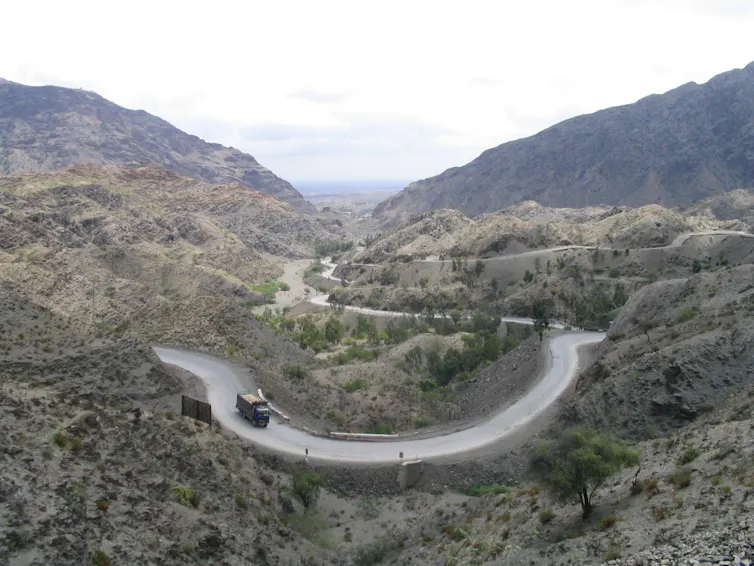
James Mollison/Wikipedia,CC BY-ND
InThe Way of the World(1963), the Geneva travel writer Nicolas Bouvier thus recounts his passage through these places on December 5, 1954:
“After a year and a half of travel, I reached the foot of the pass. The light touched the base of the Suleiman mountains and the Afghan customs outpost drowned in a cluster of willows that shone like scales in the sun. No uniforms on the road blocked by a light wooden gate. Climbed up to the office. I stepped over the goats lying on the threshold and passed through the door. The post smelled of thyme, arnica, and buzzed with wasps. The blue gleam of revolvers hung against the wall had a lot of cheerfulness. Sitting upright at a table behind a bottle of purple ink, an officer faced me. His eyes […] were closed. With every breath, I heard the new leather of his belt creak. He was sleeping. Probably an Uzbek from Bactria, as foreign as I was here. I left my passport on the table and went to lunch. I was not in a hurry. One is not when it comes to leaving a country like this.”
Since then, and along the entire border, road freight transport has been operating daily, the Afghan economy being particularly dependent on trade with its neighbor.
For Pakistan, a “border-barrier”
On the Pakistani side, the border has been subject to increased controls and periodic closures (on the occasion of the break in diplomatic relations between the two states in the 1960s or during the Soviet invasion of Afghanistan in the 1980s) as well as temporary reopenings (during the first Taliban takeover in Afghanistan in the 1990s), until becoming an increasingly difficult barrier to cross.
In the aftermath of September 11, 2001, the Pakistani government sought to prevent the infiltration of Al-Qaeda fighters and Taliban members fleeing the Western coalition’s offensive from entering its territory. In 2003, then again in 2006-2007 and in 2008, bilateral diplomatic tensions accompanied by endemic clashes led to the temporary closure of the strategic border posts of Chaman and Torkham, the implementation of biometric controls, and the construction of sections of militarily controlled barriers.
While the fight against terrorism was presented as the main objective, it was also about Islamabad preventing drug trafficking and, in a less openly stated manner, stopping the influx of Afghan displaced persons fleeing the war between the Western coalition and the Taliban, or even facilitating their forced return.
After the withdrawal of Western troops from Afghanistan and the Taliban’s takeover during the summer of 2021, the tension continued to increase until the declaration of a“open war” by Khawaja Asif, the Pakistani Defense Minister, on February 26, 2026. The issue involves the Pakistani Taliban from the Tehrik-e Taliban Pakistan (TTP) movement, supported by the Afghan Taliban and terrorists fromThe Islamic State in Khorasan, IS-K. A suicide attack claimed by the Islamic State (IS) and then attributed by Pakistan to the TTP and IS-K, on February 6, 2026, targeted the Khadija Tul Kubra Shiite mosque in Tarlai Kalan, southeast of Islamabad, and caused more than thirty deaths.
In retaliation, starting from February 21, 2026, Pakistan bombed several sites reputed to harbor terrorist factions, notably in the Nangarhar province. After Afghanistan in turn attacked border posts, Pakistan then launched, on February 26, 2026, the operation “Ghazab Lil-Haq” (“Just Fury”), striking Kabul the following day by air, as well as Kandahar, the residence of the Taliban spiritual leader, Mullah Haibatullah Akhundzada, and the provinces of Nangarhar, Paktia, Paktika, and Laghman. Since then, exchanges of fire have not ceased.
If the official targets are entrenched TTP camps, the United Nations Assistance Mission in Afghanistan (UNAMA) and non-governmental organizations (notably Amnesty International) have recorded several hundred deaths (combatants and civilians) and thousands of displaced persons. Onehits a rehabilitation center for drug addicts (within the premises of the former Phoenix camp) in Kabul, on March 16, 2026, would thus have caused 143 deaths, to which are added the 76 civilian victims already recorded in Afghanistan. This strike would have been carried out in reaction to the deaths of four civilians the day before in the Bajaur district, and of a child on March 8 in North Waziristan, after mortar fire from Afghanistan.
The Chinese mediation opened in Urumqi (Xinjiang) in early April, afterthe one conducted by Qatar, Turkey, and Saudi Arabia, hints at a possible dialogue, despite the fragility of the situation on the ground. Meanwhile, this border conflict, with deep historical roots, continues to plunge Afghan civilians into serioushumanitarian crisis they have been suffering since the Taliban returned to power.

Romélien Colavitti is an assessor at the National Court of Asylum Law. The statements made in this article are personal and do not represent the institution.
–ref. The border, the historic epicenter of the conflict between Afghanistan and Pakistan –https://theconversation.com/the-border-historical-epicenter-of-the-conflict-between-afghanistan-and-pakistan-280865