

Source: French to English Tester Published on: 2026-04-22
Source: The Conversation – in French– By Joëlle Rollo-Koster, Professor of Medieval History, University of Rhode Island
Behind the controversy between President Trump and Pope Leo XIV lies an old question: who can speak in the name of God, and who sets the limits of power?
In the United States, the concern caused by the verbal escalation between President Donald Trump and Pope Leo XIV is spreading at a remarkable speed, fromNew York Timesto theDaily Beastand even to local television channels. Since the beginning of the war in Iran, the pope has repeatedly called for peace in the Middle East, stating that“God does not bless any conflict”and warns against“The illusion of omnipotence”which fuels the war.
On April 12, 2026,in a long post on his social network, Donald Trump mocked Leon XIV, describing him as “WEAK in the face of crime and disastrous in foreign policy” and urging him to “focus on being a great pope, not a politician.” On his Truth Social account, a portrait of the U.S. president, created by AI, where he appears, similar to Christ, healing a man, waswas published then deleted.
At the heart of this public quarrel lies an age-old question: can a religious leader challenge political power, particularly that of the leader of one of the most powerful countries in the world?
As amedieval historianhaving led the publishing of theCambridge History of the Papacy(not translated into French), I cannot help but see a familiar pattern there.
For many, Donald Trump’s outburst against Pope Leo XIV is shocking. But conflicts between popes and rulers are not an anomaly: they constitute a lasting feature of Western history. Whenever political leadersclothe their power with a sacred languageor that religious leaderspublicly denounce political violence, they replay debates that are over a millennium old.
These clashes are not only symbolic: they concern the question of who holds ultimate authority over humans, over souls — and, ultimately, over history itself.
Two closely linked powers
From its earliest centuries, Christianity is closely linked to politics. The Roman Emperor Constantine Ielauthorizes the practice in the Empire in 313. He then presides over theCouncil of Nicaea, a major theological assembly, blurring the boundary between political power and spiritual authority.
In the 5th century, Pope Gelasius IerHe proposes a competing vision: the world would be governed by two powers, priestly and royal. Ultimately, he argues, spiritual authority prevails over political power, because it promises eternal salvation. Gelasius’s theory does not resolve the tension between the two, but it establishes asustainable frameworkfor Christian political thought.
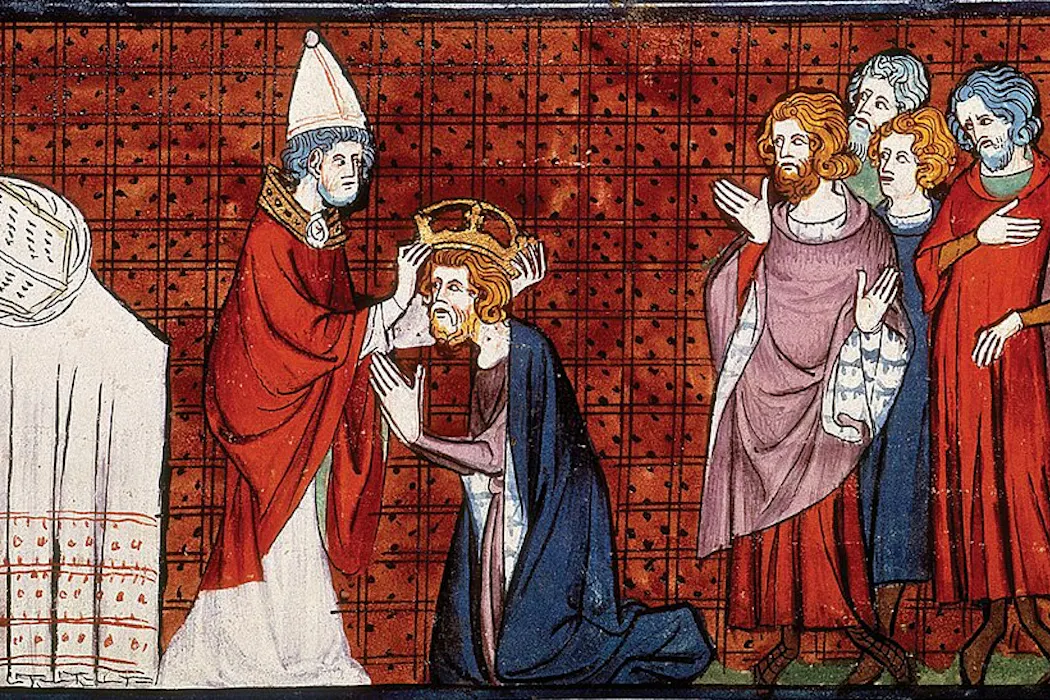
The relationship between these two powers underwent a decisive turning point in the year 800, when Pope Leo III crowned Charlemagne emperor on Christmas Day. This act was not merely ceremonial: it implied that imperial authority in the Westcomes from the Churchand that political legitimacy requires the approval of the pope.
This coronation follows years of political instability in Rome and an increasing dependence of the papacy on the Franks for its military protection. After his election in 795, Leo III was attacked by his opponents and took refuge at Charlemagne’s court. The king returned to Rome by his side and reaffirmed his legitimacy there. In return, Leo III crowned Charlemagne. By this gesture, he asserted his own role as maker of emperors while Charlemagne acquired a sacred aura.
This moment profoundly reconfigures medieval political theology. It encourages sovereigns to see themselves as the guarantors of both political order and religious orthodoxy, while the popes shift from the role of spiritual advisors to that of actors engaged in secular government.
This results in a paradox: the kings invoke Godto sanctify the conquest, like Charlemagne during his brutal wars against the Saxons, but, at the same time, the Church intendscontain the violence, encouraging just wars and threatening violent behaviors with spiritual sanctions.
The Investiture Controversy
In the 11th century, however, the papacy increasingly sought to free itself from secular domination. In particular, the popes wanted to appoint the bishops themselves, rather than leaving it to the nobility or the king.
This conflict breaks out with theInvestiture Controversy, one of the most decisive clashes of the Middle Ages, and lays essential foundations for theMagna Carta, first text to subject royal power to the law. These two episodes answer the same fundamental question: who has the right to confer authority, and what limits are imposed on political power?

Philip Van Ness Myers/ReneeWrites via Wikimedia Commons,CC BY
It is not merely a question of ecclesiastical administration, but indeed of thesovereignty itself. The bishops are large landowners and leading political actors; controlling their appointment amounts to controlling their wealth, their loyalty, and the government. By seeking to appoint the bishops, the popes assert that spiritual authority belongs exclusively to the Church, challenging the idea that kings exercise unlimited power. This is a decisive attempt to separate spiritual legitimacy from royal control and to impose moral constraints on sovereigns who claim divine authority.
The Investiture Controversy lasted for several decades. Finally, in 1122, Pope Calixtus II and Emperor Henry Vsign the Concordat of Worms.
The agreement recognizes the pope’s right to appoint bishops and to confer upon them their spiritual authority. The emperor, on his side, “invests” them with their “temporalities”: that is to say, the temporal powers attached to their office, such as lands, incomes, jurisdiction, and powers of coercion.
Containing the king’s power
A century later, theMagna Cartapursues a parallel objective.
Its immediate context is found in the conflict surrounding the new Archbishop of Canterbury, whom Pope Innocent III had appointed in 1207. King John Lackland opposed this, prompting the pope to excommunicate him.and to cast a ban on England, which means that the English can no longer participate in the sacraments of the Church.
To ease tensions, King John in 1213 handed over the kingdom of England to Pope Innocent III, transforming the country into a papal fief. In exchange, he obtained papal approval to wage war against France. But this arrangement sparked deep anger among the English barons, who now found themselves subject not only to their king but also to the authority of the Holy Father.Bouvines(1214), Jean faces the rebellious barons on his own territory.
The result is thereMagna Carta, the “Great Charter”. Imposed on the king by the force of arms, it asserts thathe himself is subject to the law. It limits royal authority in matters of taxation, justice, and punishment, and notably proclaims that no free man can be imprisoned or deprived of his rights without a legal judgment.
John Lackland then appeals to Pope Innocent III, who cancels the charter shortly after its promulgation. Despite this setback, theMagna Cartasurvived: Jean’s son, Henry III, thereprinted several times, its final version being implemented in 1225.
Take a step back
By this historical measure, the confrontation between Donald Trump and Pope Leo XIV appears less surprising. When a president employs sacred language or imagesto justify the violence, and that a popeanswers by denying any divine endorsement, they are reenacting a confrontation as old as medieval Christianity: who can speak in the name of God, and who can set limits to power?
The medieval world did not resolve this tension, but it learned to live with it by fragmenting authority: first between the Church and the crown, then between the sovereigns and the law. What worries today is the ease with which modern leaders still resort to religious language to escape the constraints and the apparent fragility of the institutions meant to contain them.

Joëlle Rollo-Koster does not work for, advise, hold shares in, or receive funds from any organization that might benefit from this article, and has declared no affiliations other than her research institution.
–ref. The exchange of barbs between Donald Trump and Pope Leo XIV, a new episode in a millennia-old quarrel between sacred power and secular power –https://theconversation.com/the-weapon-passing-between-donald-trump-and-pope-leo-xiv-new-episode-of-a-millennial-controversy-between-sacred-power-and-secular-power-280831