

AM Edition: Here are the top 10 energy articles on LiveNews.co.nz for April 22, 2026 – Full Text
The end of oil? As fuel shocks cascade, 53 nations gather to plan a fossil fuel phaseout
April 22, 2026
Source: MIL-OSI-Submissions-English
Source: The Conversation – Global Perspectives – By Wesley Morgan, Research Associate, Institute for Climate Risk and Response, UNSW Sydney

US President Donald Trump is a longtime climate denier and oil industry ally, who sums up his own energy policy as “drill, baby, drill”. Yet he is doing more than almost anyone to speed up the global shift from fossil fuels to clean energy and electric vehicles (EVs).
After the US and Israel struck Iran in late February, Tehran closed the Strait of Hormuz and triggered the largest disruption of oil supply in history.
Ironically for Trump and his oil industry donors, this crisis may be an irreversible tipping point for clean energy. For years, fossil fuel advocates spruiked oil, gas and coal as “reliable” energy. That narrative has been reversed. Fossil fuels have become expensive and unreliable, while renewables are cheap, reliable and secure.
For the first time ever, more than 50 nations will gather next week in Colombia to hash out how to wind down and end their dependence on coal, oil and gas. The history-making conference was planned before the Iran war. But this year’s energy crisis has greatly raised the stakes.
The oil crisis is real
Iran’s closure of the narrow Strait of Hormuz stopped oil tankers reaching their destinations. But that wasn’t all. More than 60 gas and oil sites have been damaged in the conflict so far. Even if a durable ceasefire is reached, these impacts will reverberate for months and years to come.
Around 80% of the trapped crude oil was destined for the Asia-Pacific. Faced with dwindling supply, the region’s governments are implementing emergency measures such as sending workers home, banning government travel, rationing fuel and cutting school hours.
The problem is especially bad in the Pacific. Many island nations use diesel for power generation. In response, leaders declared a regional emergency.
Fuel import bills were already a major burden for Pacific nations, leading to efforts to switch to local renewables. Fuel bills could rise by A$933 million in Fiji (nearly three times the healthcare budget).

Mark Direen/Pexels, CC BY-NC-ND
Scrambling for energy
When energy supplies are disrupted, leaders have three options: find alternate supplies, reduce use or switch to alternatives. In the very short term, countries aim to shore up supply, just as Australian Prime Minister Anthony Albanese did last week in Malaysia.
Countries have also moved to reduce use. This can have lasting effects. During the Middle East oil shocks of the 1970s, oil prices tripled and then doubled again. Authorities responded by improving energy productivity to do more with less. The world’s final oil demand per capita peaked in 1979 and has never recovered.
But the real difference from half a century ago is that fossil fuel alternatives are ready for prime time. Since the 1970s, the price of solar panels has fallen 99.9%, while the cost of wind has fallen 91% since 1984. Battery prices have fallen 99% since 1991.
This means it’s now viable for many nations to switch to these alternatives.
The European Union will accelerate electrification, after its fossil fuel bill increased more than $36 billion since February. France has doubled state aid to help households switch to EVs and electrify home heating. Import-dependent South Korea gets 70% of its crude oil through the Strait of Hormuz. It now plans to double renewables capacity within four years.
Electric vehicles at the tipping point?
This year’s oil shock shows signs of creating an unplanned social tipping point – a threshold for self-propelling change beyond which systems shift from one state to another. Climate scientists warn of climate tipping points which amplify feedback and accelerate warming. But social scientists also point to positive tipping points – collective action that rapidly accelerates climate action.
The rush to EVs is a case in point. In Australia, petrol prices surged almost 50% in March, and diesel more than 70%. It’s no surprise new EV sales are at an all-time high, while secondhand EV sales more than doubled last month.
Australia’s 1.3 million hybrid and battery electric vehicles avoid almost 15 million litres of petrol and diesel use every week.
The rush to electric transport is global. Most new Chinese cars are powered by batteries, not oil. Battery electric vehicles outsold petrol cars for the first time in Europe in January.
A conference to quit fossil fuels
The routine burning of coal, oil and gas is the primary driver of the climate crisis. The world’s highest court last year made clear nations have obligations to stop burning fossil fuels.
But fossil fuels have barely been mentioned in 30 years of global climate negotiations, due in part to blocking efforts by big fossil fuel exporters and lobbyists.
Frustrated by slow progress, a coalition of nations has bypassed global climate talks to discuss how to actually phase out fossil fuels.
The first of these summits will take place next week. More than 50 nations will gather in Santa Marta, Colombia, to discuss a potential standalone treaty to manage fossil-fuel phaseout while protecting workers and financial systems.
Colombian Environment Minister Irene Vélez Torres says it comes at the “best possible moment”, as the oil crisis focuses global attention on fossil fuel dependency.
If next week’s summit produces real momentum to wean off fossil fuels amid the energy crisis, we might look back at it as a social tipping point where early adopters move in earnest – and make it easier for the rest of the world to follow.

Wesley Morgan is a fellow with the Climate Council of Australia
Ben Newell receives funding from the Australian Research Council.
– ref. The end of oil? As fuel shocks cascade, 53 nations gather to plan a fossil fuel phaseout – https://theconversation.com/the-end-of-oil-as-fuel-shocks-cascade-53-nations-gather-to-plan-a-fossil-fuel-phaseout-280263
Back to index · Read original article
Want to cut your energy bills? Here’s how five experts are doing it
April 22, 2026
Source: The Conversation – UK

Rising prices are putting pressure on people to try and use less energy. But what are the most effective ways of cutting bills? We asked five experts for their practical advice.
1. Insulate your home
Upgrading loft insulation to current standards, typically 27–30cm thick for mineral wool, improves energy efficiency, comfort and long-term cost savings. It acts as a thermal barrier, as up to 25% of a home’s heat can escape through an uninsulated roof. Installing cavity wall insulation in older homes improves efficiency by reducing heat loss through walls by up to 35%.
Using draught excluders, keeping internal doors closed on cold days, and installing a smart energy controller also help retain warmth and optimise energy use. All these measures can help lower heating bills, maintain warmer indoor temperatures, reduce draughts, minimise condensation, and improve a home’s energy performance certificate rating.
The cheapest energy is the energy we do not use. That’s why the International Energy Agency describes energy efficiency as the “first fuel”. Buildings account for around 30% of global energy demand, so homes are a critical part of both affordability and energy security.
In the UK, 420,600 energy-efficiency measures were installed in 2024 through government support schemes. There is clearly strong demand for more measures like this.
Farooq Sher is a senior lecturer in sustainable energy engineering

irin-k/Shutterstock
2. Go fully electric
Almost everything in our house is now electric, including our heating, cooking and car. This makes environmental sense because electricity can easily be generated from low-emission sources, whereas gas, petrol and diesel can only really come from extracting and refining fossil fuels. In the UK, we generate electricity from a range of sources including solar, wind, tidal, and from burning gas.
Currently, close to 50% of the electricity on the national grid is from renewable sources. Providing heat from a heat pump has about 70% lower greenhouse gas emissions, compared with heat from a gas boiler.
As well as reducing emissions, electrification can reduce bills. Our heat pump replaced an old and relatively inefficient gas boiler, and our annual heating bill has fallen by about 10%. Though electricity is more expensive than gas, heat pumps can reduce bills because for every unit of electrical power they consume, they deliver between two and four times that in heat.
A well-designed and carefully installed system will improve performance. We upgraded our insulation at the same time, and in winter closed off the spare room completely. An added bonus of full electrification is that there’s no need to pay a gas standing charge, which can save about £128 per year.
Another thing to consider is using materials that reduce need for heating – for instance, double glazing. And try to minimise your demand for energy as much as possible, then install the smallest system which meets that demand. We’ve found that doing all of this leads to a warmer, nicer and cheaper home.
Stuart Walker is a research fellow in sustainabilty assessment

Wozzie/Shutterstock
3. Increase your energy payments
The conflict in the Gulf is just the latest shock to the energy supply chain. And the tricky thing with supply chains is disruption takes time to be felt. Even if a peace deal sticks, consumers and businesses can still expect higher prices to ripple through the energy market for months.
As such, think about the behavioural economics of what’s known as “intertemporal choice” – your spending over time. People often excessively discount the future and focus on the present when choosing how to spend money. This is known as “present bias”.
Today, there are widespread expectations of higher energy prices, but (for now) they remain around pre-war prices. In the future – when the war is over – there will be widespread expectations of lower prices, but the current disruptions will still be rippling through the system. This mismatch between expectations and reality could leave people with a nasty surprise when their bill comes through.
So, pay it forward. Don’t fall into the trap of present bias. If you can, increase your energy bill payments today. Economists call this “smoothing out” your consumption. When higher bills bite, you’ll be (psychologically) better off for it.
Stuart Mills is a lecturer in economics
4. Sort out any draughts
In our home, we have removed the fireplace, blocked it completely and insulated inside it to cut out draughts. As it is now not so draughty, the heating isn’t required as much and we’re not losing heat through the chimney stack.
This has improved indoor air quality, partly because we no longer have to dispose of ashes and don’t have to do extra cleaning after fires. This is an indirect saving that some may not realise.
Another benefit is that we’re not exposing ourselves to particulate air pollution that results from open or stove-based fires. Home heating contributes significantly to urban air quality, and my motivation has been to improve both indoor and outdoor air quality.
I’m also not storing or buying and transporting fuel – another cost saving. I have bought a cargo ebike to commute to work, carrying my children and their belongings. It also has a bread basket on the front, which is fantastic for shopping and carrying bags. This has cut my short car trips.
We are fortunate to live in an area with good cycling infrastructure. I am aware these choices are not an option for everyone, especially those in rented or temporary accommodation.
Yvonne Ryan is an associate professor in environmental science
5. Crack on with home improvements
A good way to protect yourself against rising bills next winter is to crack on now with projects to make your home more energy efficient. One option is to stop the heat you have paid for escaping through your windows and doors.
The Energy Saving Trust estimates that upgrading your windows could save up to £140 a year. But research has shown that, while households frequently research the options and get quotes, they often stall at the final decision on a project and fail to go ahead.
One reason for this is over-reacting to “sludge” – the barriers that increase uncertainty and effort, such as difficulty finding information and contractors. This can overwhelm our understanding of the benefits of going ahead, leaving us stuck with the status quo.
But the good news is, it is perfectly possible to override these behavioural biases. Rising and volatile fuel bills may be the nudge we need to do that.
Jonquil Lowe is a visiting academic in economics

Stuart Walker receives funding from the Grantham Foundation for the Protection of the Environment. He is affiliated with Hope Valley Climate Action.
Farooq Sher, Jonquil Lowe, Stuart Mills, and Yvonne Ryan do not work for, consult, own shares in or receive funding from any company or organisation that would benefit from this article, and have disclosed no relevant affiliations beyond their academic appointment.
Back to index · Read original article
China’s Africa strategy is shifting and Iran conflict will speed it up
April 22, 2026
Source: The Conversation – Africa [2]
The global geoeconomic volatility wrought by the second Donald Trump US presidency and hostilities in the Middle East make the shift in China’s Africa strategy even more important for China and for Africa.
China’s Africa strategy started to shift in 2019, towards investment. It is anchored in Hunan Province.
The “Hunan Model” emerged because the “Angola Model” (building infrastructure and extracting resources) faced sustainability hurdles. Given the vulnerability of African countries to shocks, they often struggle to keep up with mounting debt repayments. The other factor was China’s changing domestic needs.
Traditional trade partnership and growth corridors were also under increasing contestation and subject to high trade barriers.
Under these pressures, Beijing selected Hunan Province to become its “project implementation unit” for a new era of trade and development between China and Africa.
The model has become more important since formal approval of the China-Africa Economic and Trade Deep Cooperation Pilot Zone in early 2024 and the growth of the China-Africa Economic and Trade Exhibition since launch in 2019.
It seeks to deepen and bring greater balance to China-Africa trade and industrial integration. It is also at the heart of efforts to overcome the three main barriers to African development – shortages of capital, skilled labour and infrastructure – while offering China a secure and growing supply of resources.
Based on years of study of China-Africa trade relations, I argue that the tensions in the Middle East and the economic disruptions they have caused globally will speed up China’s thrust towards renewables and the electrification of its economy. It will also accelerate its push for new markets. This has implications for Africa.
Hunan Province is central to green transportation and to construction, heavy industry and minerals processing. It is also central to China’s economic relations with Africa.
What Hunan is all about
At the centre of the Hunan Model sit two national policy initiatives:
-
the China-Africa Economic and Trade Deep Cooperation Pilot Zone. This is a logistics, trade and investment system designed to integrate Chinese and African supply chains and economic development.
Hunan Province’s capital, Changsha, is home to China’s third-largest wholesale market, the Gaoqiao Grand Market. It is the primary distribution hub for non-commodity African imports landing in and near Changsha and passing through “green lanes” that fast-track African exports into China.
The market has a permanent trade facilitation hall where African countries market their goods directly and which provides other trade services.
The Hunan Model also has three functional areas to support trade between land-locked Hunan and the world, with an emphasis on Africa:
-
Changsha Free Trade Airport Zone, a national airfreight hub. It has new routes, such as the Changsha-Addis Ababa cargo line launched in 2022.
-
Yueyang Chenglingji Port connects Hunan’s heavy industries (timber, machinery) to the sea via the Yangtze River.
-
Changsha Jinxia Economic Zone focuses on non-rail sea trade from Hunan to Guangdong and onward.
The China-Africa cooperation zone also has five “functional clusters” that drive trade, investment and industrial development between and within China and African nations. These target specific sectors where Hunan excels – and that match potential for growth and industrialisation in Africa. Construction machinery, mining equipment and precious metals processing are among them.
The China-Africa Economic and Trade Exhibition comprises the permanent exhibition hall in the zone and a series of trade expos, held in China and in Africa.
In the last few years, as I’ve detailed in a journal article, a series of China-Africa Economic and Trade Exhibition events have also begun springing up in African countries, including Kenya and Nigeria.
Impact of Middle East conflict
The importance of the Hunan Model has, arguably, been increased by the second Trump presidency and intensifying US-China trade tensions. As western markets become more restrictive, China has pivoted towards the global south with remarkable speed. Africa is no exception. In 2025, while Chinese total foreign trade grew by 3.8%, China-Africa trade surged by 17.7%.
Read more:
US trade wars with China – and how they play out in Africa
More recently, tensions in the Middle East have offered a dramatic shock to the global economy and its energy supply chains. This is likely to intensify China’s push towards renewables and electrification of its economy. It may also elevate global demand for electric vehicles, and it is Hunan Province that is home to Chinese e-vehicle giant BYD.
Given Hunan’s centrality to China’s own renewables industry, especially electric transformation and minerals processing, as well as construction, the Hunan Model can drive a new renewables-run era in China and between China and Africa too.
Read more:
China’s interests in Africa are being shaped by the race for renewable energy
In 2025, the “biggest highlight” of Changsha’s exports to Africa was the explosive growth of the “new three items”. These are lithium batteries, electric vehicles and photovoltaic products. Hunan’s exports of these items to Africa increased by 160.4%, 840.4% and 62.1% year-on-year, respectively. That’s why they have become a “new calling card” for Hunan’s exports to Africa.
Alongside electric transportation companies like BYD, Hunan Province is also home to electric railway giants like CRRC, which is at the heart of a “green” rail export surge. Moreover, in the wake of conflict in Iran, China has announced a new rare minerals research and innovation hub, to be set up in Changsha, Hunan.
Avoiding ‘Africa last’
While the Hunan model offers a focus on surmounting non-tariff barriers to trade and an industrial-focused alternative to past extraction-heavy policies, risks remain. The sheer scale of Chinese exports to Africa – up 17.7% in 2025 while African exports to China grew only 5.4% – underscores a growing trade imbalance.
African countries and sub-regions must build their own industrial supply chains, as China did with investment from earlier industrial giants.
The Hunan Model has its own research alliance of Chinese scholars and industry experts to inform its advance and progress. African nations require their own equivalent.
Shock after shock is upsetting the world economy. The Hunan Model is no longer just an experiment or a policy idea. It is driving China-Africa economic transformation. It offers potential for growth and development in China and Africa.

Lauren Johnston does not work for, consult, own shares in or receive funding from any company or organisation that would benefit from this article, and has disclosed no relevant affiliations beyond their academic appointment.
Back to index · Read original article
New federal figures reveal 1 in 3 US households struggle to pay energy bills, but the reality is likely even worse
April 22, 2026
Source: The Conversation – USA (2) [4]

Americans’ concerns about being able to afford electricity and home heating fuel are elevated since the beginning of the Iran war. But newly released nationwide data shows that even before the war began, these concerns were widespread, long-standing and getting worse faster than the data can reflect.
The new information is from preliminary reports based on the Residential Energy Consumption Survey, a representative survey of U.S. households conducted every four to five years by the U.S. Energy Information Administration. These early results show that energy insecurity, a hidden hardship defined as the inability to adequately meet household energy needs, affects millions of American households and is worsening quickly.
As a scholar who has spent years sitting in hundreds of homes around the country, hearing firsthand accounts about energy insecurity, I turn to this survey data to quantify the suffering I have witnessed up close.
The latest tranche of data was collected in 2024 and released in March 2026, but full results won’t be available for some time. The preceding survey was taken in 2020, but results weren’t finalized until August 2025.
Though that data is incomplete and slow to emerge, the picture is unambiguous: Even households once confident they could afford energy costs are at risk of falling behind on bills, making hard trade-offs to keep the lights on and living in homes they can’t afford to properly heat and cool.
A pandemic success story
The survey asks respondents whether, in the prior 12 months, they received a disconnection notice threatening to terminate their home’s electricity, gas or other fuel service because they hadn’t paid the bills. It also asks whether any of those services were in fact disconnected; whether they bought less food or skipped taking medication to be able to afford their energy bills; or whether they left their home at an unhealthy temperature because running or repairing the heating or cooling equipment would be too expensive.
The result is a portrait of a significant swath of the population that has a hard time affording housing and energy, and who adopt various coping strategies to get through.
A closer look at the data over time reveals that more Americans live with energy insecurity now than in years past. In 2024, 43.6 million American households – 32.9% of all homes – reported experiencing some form of energy insecurity. In 2015, that figure was 31.3%, and in 2020 it was 27.2%.
The lower rate in 2020 confirms that pandemic-era government policies, including cash relief payments and bans on utility shutoffs, were effective, though they were too short-lived to last through the 2024 survey data.
Recent surge hits new households
Middle-income households, those earning between $60,000 and $200,000 a year, were hit hardest by post-pandemic inflation of housing costs, food prices and interest rates on loans and mortgages. The new survey data shows that energy costs added to the squeeze.
In 2020, 20.1% of households earning between $60,000 and $100,000 reported experiencing problems affording their energy. In 2024, 32.1% of those households did – a 12 percentage point increase, more than double the overall national increase of 5.7 percentage points.
There were also racial differences. Historically, Black, Hispanic and American Indian households have been disproportionately likely to have trouble affording energy bills. And between 2020 and 2024, those households’ risk grew.
But white households’ risk climbed even more steeply: In 2020, 20.1% of white households reported trouble with energy costs. By 2024, 26.4% of them did.
Working-age adults and seniors are increasingly insecure
In 2024, higher proportions of householders under 60, and of householders with children, reported struggling to meet their home energy needs than in 2020. The similarities in these increases verify that younger, working-age households are more strained.
Yet working-age adults without children, particularly moderate-income renters, don’t have as much potential support as seniors when they fall behind on utility bills. That’s because energy assistance programs direct support toward those who have historically been the most vulnerable.
Seniors have historically been among the most protected, partly by the designs of government and corporate programs to assist with energy costs and partly because wealth usually peaks in later life. Even so, the share of older Americans experiencing energy insecurity climbed to 1 in 4 in 2024 from roughly 1 in 5 in 2020 – a sign that long-standing safeguards for older Americans are no longer making as much of a difference as they used to.
Housing in good repair is no longer enough protection
An efficient home has long been considered a solution to high energy bills. But the data shows that’s not enough anymore. People who live in well-insulated homes and those with double-pane windows saw their likelihood of energy insecurity rise by a similar amount as those who live in poorly insulated homes.
People in uninsulated homes still have the highest risk of being unable to afford their energy costs, though their risk grew more slowly than those in homes with better insulation.
And people with single-pane windows, already in a tenuous position, saw their risk of being unable to afford their energy costs rise by 7 percentage points.
Where need is greatest, help is least available
Geographically, the steepest increases in energy insecurity were found in warm-weather regions. The Southwest experienced the largest increase of any climate category – 10 percentage points – followed by the Southeast and Gulf Coast, which rose from 30.1% to 35.6%.
Though rising temperatures are increasing the need for cooling in warm-weather climates, most attention and government assistance for energy costs continue to be concentrated on the need for home heating in cold-weather states.
But even in the Northeast, where federal assistance with energy costs helps large proportions of the population, higher percentages of households had trouble affording energy costs.
A problem that has outgrown its framing
The severity of energy insecurity remains highest among the most disadvantaged Americans, which includes low-income people, renters and Black, Hispanic and American Indian households.
But the trend lines show that energy insecurity is now spreading into middle-income, white, working-age families in efficient homes in warm-weather climates – families that previously had relatively little trouble meeting their household energy needs.
The 2024 RECS data indicates that the safety net designed to address energy affordability is insufficient and does not match the regions or populations where energy insecurity is actually growing.
The Low-Income Home Energy Assistance Program, which provides money to help families pay their utility bills, was created in response to the oil crisis of the 1970s. It was built to prioritize home heating assistance – not cooling – and help for people in immediate danger of having life-preserving utilities shut off. Little has changed in its focus or funding level since its inception.
Meanwhile, the economics of household energy costs have shifted dramatically and are quickly evolving.
New wars are sustaining old energy regimes, driving price volatility through the same fossil-fuel supply chains the Low-Income Home Energy Assistance Program was designed to buffer against half a century ago. On the domestic front, meanwhile, data centers are increasing residential electricity rates. Clean energy developments that might have shielded households from price shocks have been politicized and curtailed, harming both affordability and public health.
The 2024 data – high-quality and reliable as it is – is already behind in an escalating energy affordability crisis. Many more Americans are having trouble keeping the lights, heating and cooling on in recent years, and it’s a trend that may already be worse than what the most recent data shows.

Some of Diana Hernández' funding at Columbia University includes a service agreement with a regulated utility company in New York that supports compliance with state laws regarding disadvantaged communities and community-centered capital planning efforts.
Back to index · Read original article
Will oil prices ever truly go back to ‘normal’?
April 22, 2026
Source: The Conversation – Global Perspectives
The fallout from war between the United States, Israel and Iran has dominated global oil markets. And not just because the Strait of Hormuz, which normally carries about 20% of global oil and gas, remains effectively closed to shipping traffic.
Deep uncertainty about how long the disruption will continue has added a persistent “risk premium” – an extra cost built into oil prices to account for the risk of disrupted supply.
Rising insurance costs, reduced ship traffic and longer transit routes avoiding the Middle East have all added further friction to global oil supply chains.
An optimist might say this will all be sorted out quickly and soon enough we will be back to “normal”. And oil prices have retreated back below US$100 per barrel this week, on renewed hopes of a peace deal.
But they’re still elevated. Before war broke out in the Middle East, benchmark oil prices had hovered in the range of US$70–80 a barrel since 2023. That’s near where they’ve sat, on average, in “normal” times for much of the past two decades.
But what if there is no way back to “normal”? What if the fundamental challenge now isn’t the short-term disruption in supply, but the realisation that the days of cheap oil may have come to an end?
Oil’s invisible reach
Higher oil prices have a ripple effect that typically starts at the fuel pump. Petrol, diesel and jet fuel are top of mind. Driving to work, moving goods and travelling all become more expensive.
Many fertilisers, too, are petrochemical products. That means farming around the world is exposed to a shock.
But the list of goods that rely on oil and gas goes far beyond fuel and fertiliser. According to the US Department of Energy, petrochemicals (derived from oil and gas) are involved in the manufacturing of more than 6,000 everyday products.

Polina Tankilevitch/Pexels
In many cases, this is because petrochemicals are a key input in the production of plastic. But other products on the list may be surprising, such as aspirin, dishwashing liquid, toothpaste and dyes.
Building materials used in construction warrant a special mention. Asphalt, insulation, paint, pipes, membranes, fittings and other composite materials are mostly oil byproducts. Manufacturing bricks and many ceramic products is also gas-intensive.
Add transporting it all to the construction site, and the oil crisis becomes another headwind to housing affordability.
Is this the end of cheap oil?
In 1999, an article in The Economist quoted Don Huberts, who was then head of Shell Hydrogen at oil company Royal Dutch/Shell:
The stone age did not end because the world ran out of stones, and the oil age will not end because we run out of oil.
True enough, but what about cheap oil? Can that come to an end?
The world has faced many oil shocks before, some for geopolitical reasons, others due to concerns demand would outstrip supply.
But almost every time analysts predicted the world was about to run out of oil, price hikes were met with new discoveries, technological improvements and oil substitution.
Companies such as Chevron have pioneered new techniques, such as deepwater drilling.
Extracting oil from shale through fracking unlocked new supplies, especially in the US. This helped the US become the world’s largest producer of crude oil in the late 2010s.
This time, however, production facilities across the Middle East have suffered major damage, which may take years to repair. The central question is no longer whether oil exists in the ground, but whether it can be supplied cheaply, reliably and at scale again.
Just in time vs just in case
Until 2020, global economies largely operated in “just-in-time” mode. You only take what you need, when you need it, assuming it will always be there for you. This system works efficiently – and is cheap – until something goes wrong.
Lessons from the pandemic brought back the idea of “just in case”, particularly as the war in Ukraine caused further disruption.
“Just in case” means that you keep more than you need, so if someone closes the tap, you can keep all else running. However, this creates new costs.
To keep more oil and gas than you need, you don’t just have to pay for the extra stock. Countries also have to build new storage and infrastructure, and pay more in insurance.
You refine your management to make sure it all works properly, so that the extra cost added is part of a larger contingency plan. But someone must foot this bill.
How the world will have to adapt
The end of cheap oil does not mean the end of oil use. It means higher costs embedded throughout daily life.
Pressure on governments to subsidise fuel, expand stockpiles and intervene in markets can mean larger budget deficits. Households will have less money left for non-essentials as the cost of living bites even harder.
We will adapt, as we are already beginning to see in the current crisis. There are signs people around the world are travelling less, using more public transport and electrifying cars and homes.
Industries may invest more in efficiency and green energy not out of environmental idealism, but cost necessity.
But there may still be a rocky road ahead, and we may never get back to “normal”. Adaptation does not end oil dependence; it reshapes it. The challenge is managing a world in which oil remains essential, but is no longer cheap, stable or politically neutral.

Flavio Macau does not work for, consult, own shares in or receive funding from any company or organisation that would benefit from this article, and has disclosed no relevant affiliations beyond their academic appointment.
Back to index · Read original article
Forty years after the Chernobyl disaster, its legacy still resonates
April 22, 2026
Source: MIL-OSI-Submissions-English
Source: The Conversation – Canada – By David Roger Marples, Professor, Russian and East European History, University of Alberta
The explosion at the fourth reactor of the Chernobyl Nuclear Power Plant in northern Ukraine on April 26, 1986, changed the lives of thousands of Soviet citizens.
The plant was located 20 kilometres from of the Belarus border, near the confluence of the Uzh and Prypiat rivers and the Kyiv Reservoir. The area was remote, with scattered farms across a rural landscape.
Wind and rainfall dispersed the radiation to the north and northwest. The authorities evacuated the city of Prypiat, three kilometres to the north where 55,000 workers lived, 40 hours after the accident.
More than 70 officials in the Soviet Union’s ruling Communist Party fled the plant. Two operators were killed instantly, while 28 firemen and first aid workers sent to the site died of radiation sickness within three months.
Mikhail Gorbachev, the general secretary of the party’s central committee, had only been in office for six weeks at the time.
In March, he had appeared before the 27th party congress to announced “new thinking,” with watchwords “glasnost” (openness) and “perestroika” (restructuring). Nonetheless, the Soviet government’s reaction to news of the Chernobyl disaster was to stay silent for 40 hours.
On April 28, Soviet citizens heard that an accident had taken place, two people had died and a government commission had been set up to investigate.
What happened at Chernobyl?
The accident at Chernobyl occurred as a result of a safety experiment to determine power generation during a shutdown. It occurred over a holiday period with neither the plant director nor chief engineer present. To ensure the experiment’s success, operators dismantled seven mechanisms that would have safely shut down the reactor.
The graphite-moderated RBMK reactor, based on control rods, had an innate flaw unknown to the operators. It became unstable if operated at low power. When an operator lowered the power, it caused a surge that blew the roof off the reactor, spreading graphite from the core and creating a radiation cloud.
In early May, Gorbachev appeared on television but used the time to denounce “sensational” reports about mass casualties.
Members of the public in the main fallout areas of Ukraine and Belarus were desperate for information. Some 600,000 “liquidators” had the task of removing contaminated topsoil. Coal miners from the Russia and the Donbas region in eastern Ukraine constructed a shelf below the reactor to prevent it falling to the water table.
It took three years before Soviet authorities published maps detailing where radioactive cesium had fallen. The area covered most of Belarus, large areas of northern and western Ukraine, and part of southern Russia.
Thousands of liquidators died between 1986 and 1989, mostly from heart attacks. They were men in their 20s and 30s.
Thyroid cancer developed among children in Belarus by 1990, affecting more than 3,000. Ukraine placed a moratorium on building new reactors by 1990, and Chernobyl itself was shut down by 2000 with a roof (sarkofag or sarcophagus) over the damaged reactor.
Public reaction
As the scale of the disaster became clearer, anger and disillusionment grew among the population. In particular, many questioned why all the energy industries were under Moscow’s control, in ministries that had little knowledge of the local area.
In a way, Chernobyl created glasnost. Journalists wrote critiques of scientists supervising the accident’s aftermath and about the health consequences. The casualty rates far exceeded the totals publicized by the World Health Organization.
In November 1988, anti-nuclear power protests took place in Kyiv under the slogan “The Environment and Us.” Dr. Yuriy Shcherbak (later Ukraine’s ambassador to Canada) formed the Green World Association, which later became the Green Party of Ukraine. A popular movement called Rukh was founded in 1989 and focused on Ukrainian sovereignty, language and telling the truth about Chernobyl.
Both Ukraine and Belarus, however, were slow to accept political change. Party leaders did little to help overcome the aftermath of Chernobyl. A notable rift was evident in both societies between the scientific and party elite on the one hand, and activists, journalists and the general public on the other.
The aftermath of Chernobyl
In August 1986, a Soviet team arrived in Vienna to explain the causes of the accident to the International Atomic Energy Agency. Led by Soviet chemist Valery Legasov, it blamed the accident entirely on human error, ignoring more than 30 known flaws in the RBMK reactor.
On the eve of the accident’s second anniversary, Legasov committed suicide. He was demoralized by the authorities’ failure to heed his warnings about the safety of the reactor. He was likely also suffering from radiation sickness.
Anti-nuclear sentiment across the Soviet Union halted the vast program to expand atomic energy. Political movements in the Baltic States, Ukraine, Georgia and other republics coalesced, forcing the Soviet leadership to make concessions.
By 1991, Gorbachev limited glasnost and introduced the concept of a revised union of sovereign republics. Chernobyl was not the only factor in such a development, but it was a catalyst.
The plant has long been shut down and decommissioned, but its significance remains. Ukraine still depends on nuclear power for about half its energy needs. The Russian invasion saw a brief occupation of the defunct Chernobyl station and a takeover of Ukraine’s largest nuclear plant at Zaporizhzhia.
We should remember the bravery of those who fought the fire and cleaned the area. We should also remember the courage of ordinary people who defied the authorities in a quest for hard information and societal change. And we should keep the memory of the date, one of significant change in the former Soviet Union.

David Roger Marples does not work for, consult, own shares in or receive funding from any company or organisation that would benefit from this article, and has disclosed no relevant affiliations beyond their academic appointment.
– ref. Forty years after the Chernobyl disaster, its legacy still resonates – https://theconversation.com/forty-years-after-the-chernobyl-disaster-its-legacy-still-resonates-279715
Back to index · Read original article
4 ways the war in Iran has weakened the United States in the great power game
April 22, 2026
Source: The Conversation – USA [1]

“Never interrupt your enemy when he is making a mistake.”
Napoleon Bonaparte’s maxim may well have been in the minds of policymakers in Moscow and Beijing these past weeks, as the U.S. war in Iran dragged on. And now that a 14-day ceasefire between Tehran and Washington is in effect – with both sides claiming “victory” – Russian and Chinese leaders still have an opportunity to profit from what many see as America’s latest folly in the Middle East.
Throughout the weekslong conflict, China and Russia struck a delicate balance. Both declined to give Iran – seen to a varying degree as an ally of both nations – their full-throated support or sink any real costs into the conflict.
Instead, they opted for limited assistance in the form of small-scale intelligence and diplomatic support.
As a scholar of international security and great power politics I believe that is for good reason. Beijing and Moscow were fully aware that Iran could not “win” against the combined military might of the United States and Israel. Rather, Iran just needed to survive to serve the interests of Washington’s main geopolitical rivals.
Below are four ways in which the U.S. war in Iran has damaged Washington’s position in the great power rivalries of the 21st century.
1. Losing the influence war in the Middle East
As I explore in my book “Defending Frenemies,” the U.S. has long struggled to balance competing objectives in the Middle East. During the Cold War, this meant limiting the Soviet Union’s influence in the region, while contending with the development of nuclear weapons by two troublesome allies, Israel and Pakistan.
By the 2020s, the priorities in Washington were aimed at restricting the influence of the U.S.’s great power rivals – China and to a lesser degree Russia – in the Middle East.
Lintao Zhang/Pool Photo via AP
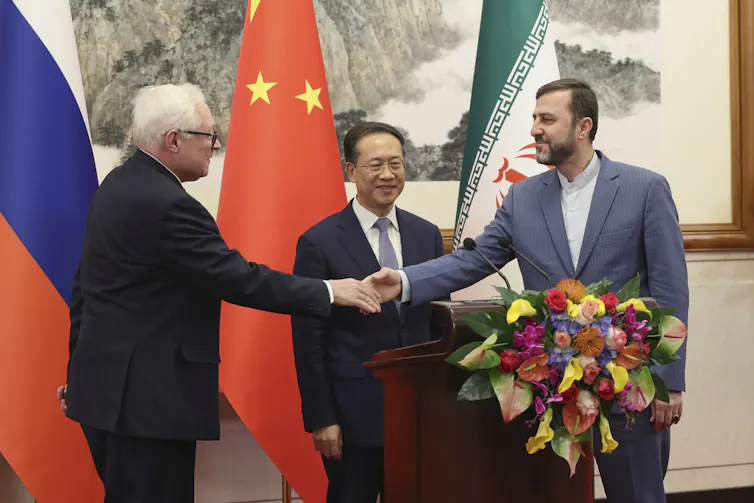
Yet under Presidents Xi Jinping and Vladimir Putin, China and Russia have sought to increase their footprint in the region through a variety of formal alliances and informal measures.
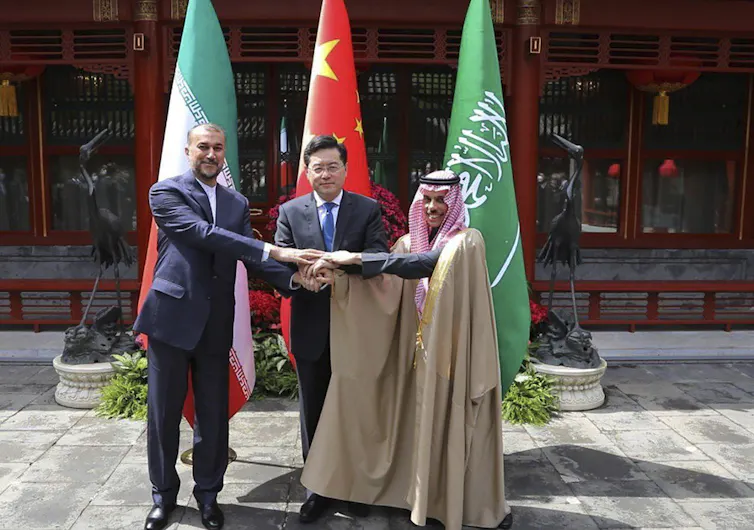
For Russia, this took the form of aligning with Iran, while also partnering with Tehran to prop up the now-ousted regime of President Bashar Assad during the Syrian civil war. Meanwhile, China increased its diplomatic profile in the Middle East, notably by acting as a mediator as Saudi Arabia and Iran restored diplomatic ties in 2023.
The irony of the latest Iran war is that it follows a period in which circumstances were unfavorable to Russian and Chinese aims of increasing their influence in the Middle East.
The fall of Assad in December 2024 deprived Russia of its one reliable ally in the region. And Trump’s May 2025 tour of the Gulf states, in which he secured major technology and economic deals with Saudi Arabia, the United Arab Emirates, Qatar and Bahrain, was aimed at countering China’s growing economic and diplomatic influence in those countries.
With Washington perceived as an increasingly unreliable protector, the Gulf states may seek greater security and economic cooperation elsewhere.
2. Taking US eyes off other strategic goals
In expanding military, diplomatic and economic ties in the Middle East, Russia and China over the past two decades were exploiting a desire by Washington to move its assets and attention away from the region following two costly wars in Iraq and Afghanistan.
Trump’s decision to wage war against Iran directly contradicts the national security strategy his administration released in November 2025. According to the strategy, the administration would prioritize the Western Hemisphere and the Indo-Pacific, while the Middle East’s importance “will recede.”
In co-launching a war in Tehran with Israel, without any prior consultation with Washington’s other allies, Trump has shown a complete disregard for their strategic and economic concerns. NATO, already riven by Trump’s repeated threats to the alliance and designs on Greenland, has now shown further signs of internal divisions.
That offers benefits for China and Russia, which have long sought to capitalize on cracks between America and its allies.
The irony, again, is that the war in Iran came as Trump’s vision of the U.S. as the hegemonic power in the Western Hemisphere was making advances. International law and legitimacy concerns aside, Washington had ousted a thorn in its side with Nicolás Maduro in Venezuela and replaced him with a more compliant leader.
3. Disproportionate economic fallout
Iran’s closure of the Strait of Hormuz, where some 20% of the world’s oil passes, was as predictable as it was destructive for U.S. interests.
But for Russia, this meant higher oil prices that boosted its war economy. It also led to the temporary but ongoing easing of U.S. sanctions, which has provided Moscow an indispensable lifeline after years of economic pressure over the war in Ukraine.
While a prolonged closure and extensive damage to oil and natural gas infrastructure in Iran and the Gulf states no doubt hurts China’s energy security and economy, these were risks Xi appears willing to accept, at least for a time.
And by building up a domestic oil reserve and diversifying energy sources to include solar, electric batteries and coal, China is far better positioned to weather a prolonged global energy crisis than the U.S. Indeed, Beijing has made strides in recent year to encourage domestic consumption as a source of economic growth, rather than be so reliant on global trade. That may have given China some protection during the global economic shock caused by the Iran war, as well as push the economy further down its own track.
The more the U.S. loses control over events in the strait, the more it loses influence in the region – especially as Iran appears to be placing restrictions on ships from unfriendly nations.
Iranian Foreign Ministry via AP
4. Loss of global leadership
Trump’s willingness to abandon talks to go to war, and the contradictory rhetoric he has employed throughout the Iran conflict, has weakened the perception of the U.S. as an honest broker.
That provides a massive soft power boost for Beijing. It was China that pressed Iran to accept the 14-day ceasefire proposal brokered by Pakistan. Indeed, China has slowly chipped away at America’s longtime status as global mediator of first resort.
Beijing has successfully mediated in the past between Iran and Saudi Arabia, and it attempted to do the same with Russia and Ukraine and Israel and the Palestinians.
In general, the Iran war adds weight to Beijing’s worldview that the U.S.-led liberal international order is over. Even if China benefited at some level from the war continuing, its decision to help broker the ceasefire shows that China is increasingly taking on the mantle of global leadership that the U.S. used to own.
And for Russia, the Iran war and the rupture between Trump and America’s NATO allies over their lack of support for it, shift world attention and U.S. involvement from the war in Ukraine.

Jeffrey Taliaferro does not work for, consult, own shares in or receive funding from any company or organization that would benefit from this article, and has disclosed no relevant affiliations beyond their academic appointment.
Back to index · Read original article
Food prices are already high in Canada. Will the Iran war make them worse?
April 22, 2026
Source: The Conversation – Canada
Food prices in Canada have been rising at a faster rate than overall inflation for the past several years. In fact, food prices are 30 per cent higher than they were a decade ago.
In the face of this pressure, consumers are increasingly worried about the impact of the war in Iran on food prices. While there is currently a ceasefire in place, it appears fragile, and oil and fertilizer prices will be slow to fall.
The conflict will undoubtedly have an impact food prices, but in the short term it will likely be fairly small. If the disruption lasts longer, we could start to see more significant price increases.
Unlike previous shocks, Iran is not a major food exporter, and no Canadian food imports pass through the Strait of Hormuz. Instead, any impact on food prices will come indirectly through rising petroleum prices driven by uncertainty around oil infrastructure in the Middle East and disruptions to the strait.
Approximately 20 per cent of the world’s oil moves through the strait, and the loss of that flow has dramatically increased fuel prices. Oil is currently trading above US$100 per barrel, up from under $60 at the end of January.
Fuel costs and food transportation
There are three main ways high oil prices can affect food prices. The first is the direct impact on the cost of moving food through the supply chain.
The United States Department of Agriculture estimates that transportation accounts for roughly 3.5 to four cents of every food dollar. This suggests that even large increases in fuel prices will not have a substantial impact on average food inflation.
Fuel is only one component of transportation costs, so increases are not reflected one-to-one on food prices. There are, however, significant differences across food categories.
Fresh fruits and vegetables are the most exposed. Transportation accounts for about eight per cent of of every food dollar for fresh fruits and vegetables — the highest share among food categories.
These products travel long distances and require refrigeration, which can be up to 30 per cent more expensive than dry freight by truck and three times more expensive than dry freight by sea.
Taking into account seasonal variation and Canada’s geography and location, transportation could represent 10 to 15 cents of every dollar spent on fresh produce this time of year. As a result, prices for imported fruits and vegetables could rise quickly in grocery stores.
These effects should moderate in spring as transport distances shorten, the weather warms and production moves closer to domestic markets. Smaller increases may also occur in other less processed foods like meat, which are heavy and also require refrigeration.
Fertilizer prices and pressure on farmers
The second mechanism is the impact of higher oil and fertilizer prices on food producers. Nitrogen fertilizer prices have risen more than 70 per cent since the start of 2026, although many farmers are partially protected in the short-term because fertilizer is often purchased in advance.
There is, however, a risk of fertilizer shortages since 25 per cent of the world’s urea flows through the Strait of Hormuz.
In practice, shortages are unlikely in Canada. Western Canada exports more than 700,000 tonnes of urea, with most of it going to the U.S., while Eastern Canada imports similar volumes from regions outside the Middle East. Prices will likely be higher, but supply constraints should be limited.
Farmers, rather than consumers, are likely to bear the brunt of higher fuel and fertilizer costs. Because commodity prices are determined by global supply and demand, farmers have limited ability to pass higher input costs down the supply chain.
Typically, crop and fertilizer prices move in tandem, allowing higher costs to be at least partially offset by higher returns. For example, the most recent fertilizer price spike followed Russia’s invasion of Ukraine, which also drove up commodity prices amid concerns about reduced wheat production from a major growing region.
In response to higher input costs, farmers may reduce fertilizer application rates or shift away from fertilizer‑intensive crops. While these adjustments can ease some pressure, crop producer margins will remain under strain unless commodity prices rise enough to offset higher energy and fertilizer costs.
Broader impacts across the food system
The third mechanism is the more diffuse effect of petroleum-based products used in food supply chains. Plastics and many chemicals are derived from petroleum, so higher oil prices will increase the cost of producing these goods.
Plastic food packaging alone represents approximately one-third of all plastic packaging in Canada. Canadians throw out more than four million tonnes of plastic waste a year, with only a small portion recycled.
Higher production costs in food processing are typically passed on to consumers through food processing and packaging. As a result, a sustained increase in oil prices will gradually scatter through the food value chain.
A muted impact on fuel prices — for now
The war in Iran will undoubtedly affect prices, particularly through higher fuel costs that are already affecting transportation and other energy-intensive sectors.
However, this may be one of the few instances in recent years where food inflation trails general inflation. The war in Ukraine had a more dramatic impact on food prices because Ukraine is a major exporter of food, and that food disappeared from the market.
By contrast, the effects of the conflict in Iran are more indirect and will take time to work through the system.
If the war in Iran persists, however, it could have profound global impacts, with most of them extending beyond food prices. The duration of the conflict is the primary consideration for what the longer-term impact will be on food prices.

The authors do not work for, consult, own shares in or receive funding from any company or organisation that would benefit from this article, and have disclosed no relevant affiliations beyond their academic appointment.
Back to index · Read original article
Using atomic nuclei could allow scientists to read time more precisely than ever – what this research could mean for future clocks
April 22, 2026
Source: The Conversation – USA [2]

Most clocks, from wristwatches to the systems that run GPS and the internet, work by tracking regular, repeating motions.
To build a clock, you need something that ticks in a perfectly repeatable way. In a pendulum clock, that tick is the regular swinging of the pendulum: back and forth, back and forth, at nearly the same rate each time.
Our team of physicists studies whether an even better kind of clock could one day be built from the atomic nucleus. Today’s best clocks already use atoms to keep extraordinarily accurate time. But in principle, a clock based on a nucleus – the tiny, dense core at the center of an atom – rather than an atom’s electrons, could keep a steadier rhythm because it would be less sensitive to environmental disturbances such as temperature changes. In our research, published in the journal Nature, we measured and interpreted a unique nuclear property of thorium-229 in a crystal that could help make such nuclear clocks possible.
Ultraprecise clocks are more than scientific curiosities. They play key roles in navigation, communications and international timekeeping. Improvements in timing accuracy can also open doors to new science.
How atomic clocks work
In an atomic clock, researchers shine a laser on a material and carefully tune the light until it triggers a specific atomic response, typically by pushing or exciting an electron from one energy level to another. They can tell this has happened because the atoms absorb the laser light most strongly when its energy is exactly right.
That absorption happens at an exquisitely precise frequency. Frequency is how often something repeats over time. For a pendulum, it is the number of back-and-forth swings each second. For light, it is the number of wave cycles that pass each second. A light wave’s frequency also determines its energy and, in the visible light range, its color.
By detecting when atoms absorb the laser light most strongly, scientists can use the laser as a metronome. Rather than counting swings, these clocks count light waves.
To ensure the tick rate stays constant and the clock remains accurate, scientists closely match the laser’s energy to the energy needed to excite an electron in an atom.
Because the electron excitation energy is set by the laws of physics, atomic clocks based on the same atom tick at the same rate everywhere in the universe – even E.T. would agree with your clock.
Using this energy to calibrate a clock, like atomic clocks do, does not come without consequence, though. If anything changes the energy of the atom, like an unaccounted for magnetic field or the temperature of the room, the clock will tick at a different rate.
Deep inside every atom is something even smaller: the nucleus. Today’s atomic clocks keep time by tracking changes in an atom’s electrons. A nuclear clock, by contrast, would use an excitation in the nucleus itself, which is far more compact.
Because a nucleus is 10,000 times smaller than an atom, it is much less sensitive to temperature, electric fields and other environmental disturbances than the electrons in an atom. That makes it an appealing candidate for an even more stable clock.
The challenge is that nature does not make such a clock easy to build. The unique property we found in our research could help.
What makes thorium-229 special?
In one exceptionally rare case, the nucleus of the element thorium-229 has a property based on its two states: a ground state and a slightly higher-energy excited state. These states represent two different configurations of the nucleus, and scientists are able to use lasers to excite the nucleus from one state to the other.

N. Hanacek/NIST
The first step was to determine exactly how much energy is needed to push the thorium-229 nucleus into its excited state. That took nearly 50 years – a feat that we and other groups accomplished in 2024. That transition occurs at an extraordinarily high frequency, about 2 quadrillion – 2 * 1015 – cycles per second.
Next, in order to ensure your laser is at the right frequency to create a clock, you have to verify that the nucleus was indeed excited. Until now, physicists thought the best way to do that was to look for the very faint flashes of light that excited nuclei usually emit.
However, there are two problems with that approach.
First, in most materials, the thorium nuclei release their energy not as light, but through a process called internal conversion, where the energy is transferred to an electron in the material instead.
Second, even when light is emitted, it is extremely hard to detect. It lies in the vacuum ultraviolet, a part of the electromagnetic spectrum that air absorbs and is difficult to observe.

Albert Bao and Grant Mitts
A different way to ‘listen’ to the nucleus
In our work, we flipped the problem around. Instead of trying to collect the light from the nucleus, we looked directly for the internal conversion electrons it produces.
We created a very thin layer – just a few dozen atoms across – of thorium dioxide on a small metal disc. A laser tuned to the right energy excited the thorium nuclei in the sample. When some of these nuclei relaxed, they transferred their energy to nearby electrons, which then could leave the surface. We use carefully arranged electric and magnetic fields to guide those electrons into a detector.
By scanning the laser across different frequencies and recording how many electrons we detected, we could measure how closely the laser energy matched the energy needed to excite the nucleus. When the two matched exactly, the signal appeared clearly in the data, revealing the precise laser frequency at which thorium-229 nuclei absorb most strongly.
We also measured how long the excited nuclear state survived in this material before relaxing, giving us a direct window into how the surrounding material influences the nucleus.
The measurement becomes much more powerful when paired with theory.
Calculations can estimate how the type of material used shifts the energy needed to excite thorium and how efficiently it converts energy from the nucleus into emitted electrons. These calculations help researchers tell apart the nucleus’s intrinsic behavior from outside effects caused by the solid around it. That understanding is crucial for designing practical nuclear clocks.
Why this approach matters
Detecting electrons instead of light has two major advantages.
First, it opens the door to studying thorium-229 in a much wider range of solid materials, including some that researchers had previously ruled out. Earlier approaches worked best only in materials where electrons were hard to knock off, which limited the options. Our method relaxes that constraint, allowing scientists to explore materials that were not practical before. That broader category of materials could make it easier to design and build future nuclear clocks.
Second, this method could enable a new type of nuclear clock that is simpler and potentially easier to miniaturize. Instead of needing sensitive light detectors, a clock based on this approach could read out time by measuring a tiny electrical current produced by the emitted electrons.
What could nuclear clocks be used for?
One day, researchers may use nuclear clocks to test whether the fundamental constants of nature truly remain constant over long periods of time, or to search for signs of new physics, such as dark matter, in the universe. More stable clocks could also improve technologies that depend on synchronized timing, such as advanced navigation systems.
Our work is an early step in that direction. It does not provide a finished clock, but it removes a practical barrier and provides a new experimental tool for studying how the thorium nucleus behaves inside solids.

Eric R. Hudson receives funding from ARO, DARPA, NIST, NSF, and RCSA.
Andrei Derevianko receives funding from NASA and National Science Foundation.
Back to index · Read original article
Iran has a powerful new tool in the Strait of Hormuz that it can leverage long after the war
April 22, 2026
Source: The Conversation – Global Perspectives
The Trump administration claims its blockade of the Strait of Hormuz is working, with nine ships complying with orders to turn around.
One of those was a Chinese-owned tanker called the Rich Starry that turned around in the Gulf of Oman on Wednesday to head back through the strait.
Iran, meanwhile, maintains it still has control over the strait and it will determine which ships transit through the crucial waterway. It also said if its ports are threatened, “no port in the Persian Gulf and the Sea of Oman will remain safe”.
No matter how the blockade plays out, Iran will be in a far better position in the long term when it comes to maintaining control over the strait – not the US.
Iran’s powerful new tool
For decades, Iran had threatened to use the Strait of Hormuz as leverage against its adversaries. It avoided doing so, however, until the current war against the United States and Israel, which it sees as existential.
Ironically, while the US and Israel aimed to weaken Iran’s nuclear and missile capabilities, the conflict has given Tehran a powerful new tool – control of the strait.
Tehran is now likely to make this control a core part of its long-term strategic thinking. In fact, Iran’s negotiators in the recent peace talks with the US had added Iranian sovereignty over the strait to their list of demands.
This leverage serves at least three key purposes.
First, it provides significant revenue potential from the tolls and transit fees it is already charging ships going through the strait.
By imposing minimal transit-related costs — estimated at around US$1 per barrel or up to US$2 million (A$2.8 million) per tanker — Iran could reportedly generate some US$600 million (A$836 million) per month from oil and another US$800 million (A$1.1 billion) per month from gas shipments.
Economists say at least 80% of the tolls would be paid by the Persian Gulf states – or as much as US$14 billion (A$20 billion) a year on oil alone.
Second, the strait functions as a security guarantee. By demonstrating its ability to disrupt a critical global energy artery, Iran has raised the cost of any future military action against it. This creates deterrence through economic risk rather than purely military means.
Third, it gives Iran geopolitical leverage, particularly with countries in the Global South. Control over the strait allows Iran to bargain with energy-dependent states, encouraging them to circumvent US sanctions on the regime and deepen economic engagement in exchange for concessions accessing the strait.
The US is now trying to neutralise Iran’s leverage over the strait. Yet, this “siege of a siege” faces clear structural limitations.
For one, Iran’s control over the strait is much easier to maintain than a US blockade in international waters. Even with allied support (which has yet to materialise), the US would struggle to restrict access to the strait for an extended period. Such an effort would be highly costly for the US military and would have significant consequences for the global economy.
In this sense, Hormuz risks becoming America’s Suez moment — a strategic chokepoint that reveals the limits of power rather than its reach.
How will China react?
But could China, which buys more than 80% of Iran’s oil, play a role in pressuring Iran to relax its control over the strait?
It has not done yet, and is unlikely to do. So far, China is blaming the US and rejecting its blockade.
In fact, China’s Foreign Ministry spokesperson Guo Jiakun used forceful language this week, calling the blockade “dangerous and irresponsible”.
Although one Chinese tanker has been turned around, others have transited through the new “tollbooth” system in recent days. This is an indication of China’s need and willingness to abide by Iran’s new rules – at least for the moment.
While China is exposed to the US blockade – about 40% of its oil imports come through the waterway – it has prepared for this moment.
It has diversified its oil imports to avoid being too reliant on any one supplier. And China is believed to have enough petroleum reserves to replace imports via the strait for up to seven months.
Still, it remains to be seen if China would support a toll system in the long term. Despite Beijing’s silence so far, some experts believe it would oppose this. China has repeatedly stressed the need to return to “normal passage” through the strait as soon as possible.
China’s expanding role in the region
China also stands to benefit from the political shifts that could come after the war.
The war has pushed the Gulf states toward a shared realisation that alignment with the US and partnership with Israel do not necessarily guarantee their security.
As a result, they may seek to diversify their relationships. This is reflected in the crown prince of Abu Dhabi’s visit to Beijing this week.
Trade between the Gulf states and China has grown significantly, with total exchanges reaching approximately US$257 billion (A$358 billion) in 2024, narrowly surpassing the Gulf’s combined trade with major Western economies.
China is also expanding its diplomatic footprint in the region, helping to mediate the agreement between Saudi Arabia and Iran in 2023 to normalise relations and playing an indirect role in the recent Pakistan talks between Iran and the US to end the war. It clearly sees a bigger role in the region in the future.
Looking ahead, Iran may seek to leverage this moment to pursue a more regionally based security framework with the Gulf states, potentially with China acting as a guarantor or facilitator. Such a development would mark a significant departure from the longstanding US role as the primary security provider in the region.

Ali Mamouri does not work for, consult, own shares in or receive funding from any company or organisation that would benefit from this article, and has disclosed no relevant affiliations beyond their academic appointment.
Back to index · Read original article