

AM Edition: Here are the top 10 economics articles on LiveNews.co.nz for April 22, 2026 – Full Text
How Trump’s repeated efforts to fire Federal Reserve Chair Powell harm the economy – and make battling inflation harder
April 22, 2026
Source: The Conversation – USA [1]

President Donald Trump has again threatened to oust Federal Reserve Chair Jerome Powell, putting at risk a keystone of good economic policy and inflation management: central bank independence.
The president said on April 15, 2026, that he would fire Powell if the Fed chair stayed on in that role after his term officially ends on May 15. Powell has said he intends to remain at the helm after that if his replacement has not yet been confirmed by the Senate. Legally, Powell is allowed to do this.
Trump has promised to fire Powell a number of times, and his Department of Justice has launched a criminal investigation into renovations at the Fed building. Trump has also tried to oust another Fed governor, Lisa Cook, over allegations of mortgage fraud. In an unprecedented video response to the investigation, Powell called it and other actions “pretexts” for Trump’s ultimate goal of getting the Fed to lower interest rates.
While Trump’s actions are seen as particularly aggressive, as political economists, we are not surprised to see politicians try to exert influence on central banks. For one thing, central banks remain part of the government bureaucracy, and independence granted to them can always be reversed – either by changing laws or backtracking on established practices.
An economic power struggle
At the heart of threats to Powell and Cook – and other moves to undermine the Fed by the Trump administration – is a power struggle.
Central banks, which are public institutions that manage a country’s currency and its monetary policy, have an extraordinary amount of power. By controlling the flow of money and credit in a country, they can affect economic growth, inflation, employment and financial stability.
These are powers that many politicians would like to control or at least manipulate. That’s because monetary policy can provide governments with economic boosts at key times, such as around elections or during periods of falling popularity.
The problem is that short-lived, politically motivated moves may be detrimental to the long-term economic well-being of a nation. They may, in other words, saddle the economy with problems further down the line.
That is why central banks across the globe tend to receive significant leeway to set interest rates independently and free from the electoral wishes of politicians.
In fact, monetary policymaking that is data-driven and technocratic, rather than politically motivated, has been seen as the gold standard of governance of national finances since the early 1990s and has largely achieved its main purpose of keeping inflation relatively low and stable.
But despite independence being seen to work, central banks over the past decade have come under increased pressure from politicians.
Trump is one recent example. In his first term as president, he criticized his own choice to head the Federal Reserve and demanded lower interest rates.
Attacks on the Fed have accelerated in Trump’s second administration. In April 2025, Trump lashed out at Powell in an online post, accusing him of being “TOO LATE AND WRONG” on interest rate cuts, while suggesting that the central banker’s “termination cannot come fast enough!” And in August, Trump took the unprecedented step of firing Cook, which a court later blocked. The Supreme Court is expected to issue a ruling in the case this year.
Moreover, the reason politicians may want to interfere in monetary policy is that low interest rates remain a potent, quick method to boost an economy. And while politicians know that there are costs to besieging an independent central bank – financial markets may react negatively, or inflation may flare up – short-term control of a powerful policy tool can prove irresistible.

AP Photo/Mark Schiefelbein
Legislating independence
If monetary policy is such a coveted policy tool, how have central banks held off politicians and stayed independent? And is this independence being eroded?
Broadly, central banks are protected by laws that offer long tenures to their leadership, allow them to focus policy primarily on inflation, and severely limit lending to the government.
Of course, such legislation cannot anticipate all future contingencies, which may open the door for political interference or for practices that break the law. And sometimes, central bankers are unceremoniously fired.
However, laws do keep politicians in line. For example, even in authoritarian countries, laws protecting central banks from political interference have helped reduce inflation and restricted central bank lending to the government.
In our own research, we have detailed the ways that laws have insulated central banks from the rest of the government, but also the recent trend of eroding this legal independence.
Politicizing appointees
Around the world, appointments to central bank leadership are political – elected politicians select candidates based on career credentials, political affiliation and, importantly, their dislike or tolerance of inflation.
But lawmakers in different countries exercise different degrees of political control.
A 2025 study shows that the large majority of central bank leaders – about 70% – are appointed by the head of government alone or with the intervention of other members of the executive branch. This ensures that the preferences of the central bank are closer to the government’s, which can boost the central bank’s legitimacy in democratic countries, but at the risk of permeability to political influence.
Alternatively, appointments can involve the legislative power or even the central bank’s own board. In the U.S., while the president nominates members of the Federal Reserve Board, the Senate can and has rejected unconventional or incompetent candidates.
Moreover, even if appointments are political, many central bankers stay in office long after the people who appointed them have been voted out. At the end of 2023, the most common length of the governors’ appointment was five years, and in 41 countries, the legal mandate was six years or longer.
And the Fed chair position has traditionally been protected by law, as Powell himself acknowledged in November 2024: “We’re not removable except for cause. We serve very long terms, seemingly endless terms. So we’re protected into law. Congress could change that law, but I don’t think there’s any danger of that.”
In the 2000s, several countries shortened the tenure of their central banks’ governors to four or five years. Sometimes, this was part of broader restrictions in central bank independence, as was the case in Iceland in 2001, Ghana in 2002 and Romania in 2004.

AP Photo/Matt Rourke
The low inflation objective
As of 2023, all but six central banks globally had low inflation as their main goal. Yet many central banks are required by law to try to achieve additional and sometimes conflicting goals, such as financial stability, full employment or support for the government’s policies.
This is the case for 38 central banks that either have the explicit dual mandate of price stability and employment or more complex goals. In Argentina, for example, the central bank’s mandate is to provide “employment and economic development with social equity.”
Conflicting objectives can open central banks to politicization. In the U.S., the Federal Reserve has a dual mandate of stable prices and maximum sustainable employment. These goals are often complementary, and economists have argued that low inflation is a prerequisite for sustainable high levels of employment.
But in times of overlapping high inflation and high unemployment, such as in the late 1970s or when the COVID-19 crisis was winding down in 2022, the Fed’s dual mandate has become active territory for political wrangling.
Since 2000, at least 23 countries have expanded the focus of their central banks beyond just inflation.
Limits on government lending
The first central banks were created to help secure finance for governments fighting wars. But today, limiting lending to governments is at the core of protecting price stability from unsustainable fiscal spending.
History is dotted with the consequences of not doing so. In the 1960s and 1970s, for example, central banks in Latin America printed money to support their governments’ spending goals. But it resulted in massive inflation while not securing growth or political stability.
Today, limits on lending are strongly associated with lower inflation in the developing world. And central banks with high levels of independence can reject a government’s financing requests or dictate the terms of loans.
Yet over the past two decades, almost 40 countries have made their central banks less able to limit central government funding. In the more extreme examples – such as in Belarus, Ecuador or even New Zealand – they have turned the central bank into a potential financier for the government.
Scapegoating central bankers
In recent years, governments have tried to influence central banks by pushing for lower interest rates, making statements criticizing bank policy or calling for meetings with central bank leadership.
At the same time, politicians have blamed the same central bankers for a number of perceived failings: not anticipating economic shocks such as the 2007-09 financial crisis; exceeding their authority with quantitative easing; or creating massive inequality or instability while trying to save the financial sector.
And since mid-2021, major central banks have struggled to keep inflation low, raising questions from populist and antidemocratic politicians about the merits of an arm’s-length relationship.
But chipping away at central bank independence, particularly in the name of lowering interest rates to boost the economy, as Trump appears to be doing by threatening to fire the Fed chair and his attempted removal of a member of the bank’s Board of Governors, is a historically sure way to high inflation.
This is an updated version of an article that was originally published on June 14, 2024.

The authors do not work for, consult, own shares in or receive funding from any company or organization that would benefit from this article, and have disclosed no relevant affiliations beyond their academic appointment.
Back to index · Read original article
Why the US military is stuck using $1 million missiles against Iran’s $20,000 drones
April 22, 2026
Source: MIL-OSI-Submissions-English
Source: The Conversation – USA – By Aaron Brynildson, Law Instructor, University of Mississippi

It may sound hard to believe, but the almost trillion-dollar U.S. military is struggling to fight cheap drones in its war with Iran.
Iran has built a simple drone, the Shahed, with a motorcycle-type engine, loaded it with explosives and successfully targeted its neighbors’ cities and power plants.
Iran has also hit U.S. military bases with these drones, including an early April 2026 attack on the U.S. Victory Base Complex in Baghdad.
The drones cost between US$20,000 and $50,000 to build. In response, the U.S. military sometimes fires missiles worth more than $1 million to shoot one down.
As a former U.S. Air Force officer and now national security scholar, I believe that math is a problem: The U.S. military for now has a $1 million answer to a $20,000 question. This math tells you almost everything you need to know about one of America’s biggest national security headaches.
And the frustrating part is that the U.S. military watched this happen in Ukraine for years. It knew the threat was coming.
The weapon that changed modern war
The Shahed isn’t impressive because it’s high-tech. It’s impressive because it isn’t.
Inspection of captured Shahed drones has found that many of their parts are made by ordinary commercial companies. That includes processors from a U.S. manufacturer, fuel pumps from a U.K. company and converters from China.
These military components aren’t hard to get. You could find similar parts in factories or farm machinery. That’s exactly what makes the Shahed so tough to deal with.
Russia, which also produces the drone, tolerates losing more than 75% of its Shahed stock because even at those loss rates, it’s winning the math battle against Ukraine. Russia or Iran don’t need every drone to hit its target. They just need to keep sending waves of them until their opponent runs out of expensive missiles to shoot back.
Ukraine, which had no choice but to learn fast, eventually figured out a better answer. Ukraine developed cheap interceptor drones that could slam into Shahed drones before they reached their targets. Each interceptor costs about $1,000 to $2,000, and Ukrainian manufacturers are producing thousands of them per month. That’s better math: a $2,000 interceptor against a $20,000 attacker.

Ukrainian military’s Strategic Communications Directorate via AP
Ukraine’s battlefield experience, as a result, has become one of the most valuable resources in the world, with American and allied forces asking Ukrainian drone experts to share their knowledge.
Why can’t the U.S. churn out a solution of its own? Because the U.S. military doesn’t have a technology problem but a bureaucracy problem.
The Pentagon’s three-legged slowdown
The U.S. Department of Defense typically can’t just buy things. It follows a long, complicated process that can take a decade or more to go from “we need something” to “here it is.” That process runs through three separate bureaucratic systems, each of which can cause years of delay.
First, someone must write a formal document, known as a requirement, that explains exactly what they need and why. A military service, such as the Air Force, for example, drafts up a requirement and routes it through an internal service review within only their branch.
Until recently, this service-vetted requirement went through a Pentagon review process, the Joint Capabilities Integration and Development System, where all joint services took a look. This process, which the Department of Defense ended in 2025, required approval from military officials.
Even though the joint requirements process was ended, implementation of a new system is far from complete, and the existing culture potentially remains. Under the old requirements process, it took over 800 days to get a requirement approved.
Second, any new program then needs money. This is handled through the planning, programming, budgeting and execution process, a budget cycle designed in 1961. Getting a new program into the budget typically takes more than two years after the requirement is approved, because the military must submit its budget request years in advance. By then, the threat has potentially already moved on.
Third, once a requirement is approved and money allocated, the program then must be developed and built. The average major defense acquisition program now takes almost 12 years from program start just to deliver an initial capability to troops in the field, according to a 2025 Government Accountability Office report.
Add it up and you get a system where the military sees a threat, begs for a solution, argues for money and waits a decade.
Why the system is built this way
The Shahed drone exposed a gap that defense experts have been warning about for years: The U.S. military is very good at building the most advanced, most expensive weapons in the world, but it struggles to build cheap, simple things fast. That is the opposite of what this new kind of warfare demands.
It would be easy, but inaccurate, to blame the military for the decade-long contract process. The real answer is more complicated.

Tom Brenner for The Washington Post via Getty Images
The Pentagon’s lengthy process was designed by the Department of Defense and Congress for a reason. Policymakers created the current system during the Cold War to combat excessive and redundant spending by the separate service branches. The system is built with checkpoints, reviews and approvals to make sure taxpayer money isn’t wasted.
Legacy military contractors also benefit from this dysfunctional process and resist change. They have the capital and know-how to wait out the predictable and stable existing contracts, while vying for new ones. These military contractors rarely need to worry about upstart contractors because they know small companies cannot survive waiting for a decade to secure funding for their prototypes.
The problem is that those rules were built for a world where the biggest threat was another superpower’s expensive jets and missiles. It wasn’t built to fight a flying bomb made from tractor parts. This type of threat requires fast innovation from lean companies, the exact companies that struggle in the current budget process.
What’s changing
There are signs of movement. In August 2025, the Pentagon killed its old requirements process entirely and replaced it with a faster, more flexible system.
However, killing the requirements process dealt with only one leg of the three-legged monster. The 1960s-era budget process that determines how money flows remains largely intact.
The most important reforms still need Congress to act, and Congress moves slowly, too. Congress has launched studies into reforming this system numerous times, with the answers being too politically difficult to implement.
Officials are expanding the use of flexible contracting tools, such as Other Transaction Authority, that let the military skip some traditional rules to get anti-drone technology faster. Yet these flexible contracting tools still represent a small slice of the Defense budget, and their effectiveness is unclear.
Ultimately, instead of using flexible contracting tools to quickly buy new prototypes, the bureaucratically easier solution could be to buy more of the expensive, already approved missiles.
This quick fix would reload the military’s stock of interceptors with existing weapons systems, which is the source of the bad math. The math would get worse and at the same time the operational imperative to find cheaper and better solutions might disappear.
So, as the Shahed keeps flying, the most powerful military in the world is still figuring out the paperwork and looking to other countries for help.

Aaron Brynildson served in the U.S. Air Force from 2016-2025.
– ref. Why the US military is stuck using $1 million missiles against Iran’s $20,000 drones – https://theconversation.com/why-the-us-military-is-stuck-using-1-million-missiles-against-irans-20-000-drones-281089
Back to index · Read original article
District school boards have become political hotbeds for book bans and more – here’s what they actually do
April 22, 2026
Source: The Conversation – USA (2) [3]

Election races for local school boards have become hotly contested in many states as they have become forums for debates over gender-identity discussions, immigrant students and even prayer at school events.
Liberal candidates largely swept school board elections on April 7, 2026, in politically contentious districts in Wisconsin, Missouri, Alaska and Oklahoma, where book bans, gender identity and prayer during school events were on the table.
Amy Lieberman, the education editor at The Conversation U.S., spoke with Carrie Sampson, a scholar of educational leadership and policy with an emphasis on school boards, to understand what school board members do and why these local elections carry weight for many parents, teachers and students.

Leonard Ortiz/MediaNews Group/Orange County Register via Getty Images
What are district school boards?
School boards are the governing organization for local school districts. There are typically anywhere from five to 21 members of a school board in a district. On average, there are seven to nine members on a school board.
Overall, there are approximately 13,000 school districts and about 90,000 local school board members in the United States.
School board members are typically elected, but sometimes they are appointed by mayors or other local or state officials. They are representatives of their local communities, as well as trustees who make governing decisions about school district budgets, hiring and other issues like a school district’s educational priorities.
School board elections typically have relatively low voter turnout. Research shows that nearly 40% of school board elections go uncontested.
The majority of school board members are unpaid, but some receive a small stipend for their work. A handful of school boards, like in Los Angeles, for example, receive a relatively large salary.
What does a school board member’s day-to-day work look like?
School boards typically meet twice a month, often to deliberate over issues such as budget or policy decisions.
One of a school board’s major jobs in most districts is hiring and firing a district superintendent, who effectively acts as the CEO of the district.
In terms of fiscal decisions, a school district administrator often presents what budget allocations should be for schools, and a school board votes to approve or disapprove that.
Most school boards create agendas and vote on a range of issues that are not particularly controversial, like whether the district will adopt an after-school program.
Why does a school board’s work matter?
School boards can make some critical decisions that impact the lives of students, parents and teachers. Many school districts are dealing with issues around school closures. Ultimately, school boards decide whether they are going to close a school in a district.
Many school districts are experiencing declining student enrollment, in part because of birth rate declines. People also have more and more school options to pick from, be it private schools, charter schools or homeschooling.
Within the past few years, school boards have also gained a lot of attention about whether they should ban particular books from districts, and whether they should ban or approve certain curriculum.
What other controversial issues have they taken on in the past few years?
Years before COVID-19, school boards in some conservative communities took on questions about which bathroom transgender students in public schools should use. Another big issue is whether schools should allow transgender students to participate on gendered sports teams.
During the pandemic, a rising number of communities began to see school boards as critical decision-makers. School boards were often making decisions about whether to close or reopen schools. They were also voting on requirements related to mask mandates or vaccines. Even people who didn’t live in certain school districts showed up at board meetings to advocate for certain COVID policies.
During the Black Lives Matter protest movement in 2020, some conservative communities started to speak out against critical race theory and their fear that it was being taught in K-12 schools. Most teachers don’t actually instruct on critical race theory.
Around this time, two major school advocacy organizations emerged nationwide: Moms for Liberty and Defending Education, formerly known as Parents Defending Education. These groups tried to elect conservative school board members to take on issues like book bans – and in some cases did so successfully.
My colleague Gabriela Lopez and I wrote a research paper in 2024 about people’s attempts to recall school board members. In 2021, we found, there was an all-time high of 545 school board members who faced recall, mostly because of mask mandates and other COVID-related issues.
Another trend was that police arrested or charged at least 59 people due to unrest at school board meetings from May 2021 through November 2022.

Paul Hennessy/SOPA Images/LightRocket via Getty Images
Are school boards taking on more controversial issues than they used to?
Every era has a point at which these controversial issues come to the school board level.
School boards made critical decisions around school desegregation in the 1950s through the 1970s. My research with colleagues on this topic shows that while many districts were legally mandated to desegregate schools, it was often school boards that voted on how these schools would be desegregated. Some school boards voted on policies that placed the burden on Black children and their families. One school board in Virginia even temporarily closed the schools completely to avoid desegregation.
Twenty to 30 years ago, many school boards faced tension over whether and how schools should teach sex ed.
Today, a lot of the political controversy about school boards is more widely known, for a few reasons. First, more communities have access to school board meetings, since many are video recorded. Second, social media has amplified what school boards do. There are also more outside organizations, such as local chapters of Moms for Liberty, that have been involved with school boards.
School boards taking on controversial issues are more likely to be in suburban and racially diverse school districts, compared to their rural or urban counterparts.
A report in 2024 found that the cost of conflict among school boards nationwide in 2023-24 was nearly $3.2 billion, when considering the amount of turnover or security needed for school board meetings.

Carrie Sampson does not work for, consult, own shares in or receive funding from any company or organization that would benefit from this article, and has disclosed no relevant affiliations beyond their academic appointment.
Back to index · Read original article
Bulgaria has adopted the euro to forget its trauma of hyperinflation
April 22, 2026
Source: French to English Tester Published on: 2026-04-20
Source: The Conversation – in French– By Dominique Torre, Professor of Economic Sciences, Côte d’Azur University

After Croatia was admitted in 2023, Bulgaria has been, since the 1stheIn January 2026, the 21st member country of the eurozone. This is the result of a long process that began with the fall of the autocratic regime of Todor Zhivkov in 1989, and following the trauma of hyperinflation at 1,058.4% in 1997. Why did this adoption take so long? With what challenges?
Sunday, April 19, 2026, the former pro-Russian Bulgarian president Roumen Radev wins the legislative elections with 130 seats out of 240 in Parliament.
He inherits a country that adopted the euro, the 1erIn February 2026. The lev – 1.95583 lev was equivalent to 1 euro – the historical currency, disappeared. The National Bank of Bulgaria (Българска народна банка) became a member of theEurosystemof the euro area.
Why this decision? Historical review from 1990 to the present.
Hyperinflation since the fall of the Berlin Wall
In 1997, Bulgaria went through a periodof hyperinflationwith a peak at 1,058.4%. In such a situation, employees are tempted to immediately convert their salary amount into foreign currency, which depreciates the domestic currency. For merchants, the situation compels them to constantly adjust prices in order to avoid the risk of selling at a loss.
Political and monetary authorities then adopt aCurrency Board, a very restrictive but effective monetary system to combat inflation. Specifically, to peg the value of the lev to another currency, such as the euro or the deutschemark.
If the result of this strategy is successful, with inflation falling to 22% in 1998, Bulgaria loses the levers of its economic policy.

World Bank
At the same time, an average growth rate that is too low and above all toovolatile(-9.12% annual GDP growth in 1992, 5.21% in 1996 or -8.40% in 1999) discourages the elites, who gradually leave the country. Between 1992 and 2001, the population falls by6%. Decision-makers resistant to expatriation are still awaiting the benefits of the European Union, which Bulgaria joined in 2007.
Despite repeated requests from the Bulgarian authorities, the European Union is delaying matters to integrate the country into the eurozone. While the quantifiable indicators – inflation level, interest rate – are not all in the green, the European Union mainly points to the artificially stable exchange rate, a necessary condition forCurrency Board. More informally, the European Union is alarmed by the instability of institutions and their difficulty in controlling – sometimes even within themselves – a worrying level of corruption.
Economic catch-up of Bulgaria
In July 2020, Bulgaria joined the European Exchange Rate Mechanism (the antechamber of the eurozone) with a target of adopting the euro in 2024. After years of hesitation, its admission was decided inJuly 2025.
Questions remain: are the institutions strong enough? Could a Bulgarian economic or financial crisis occur and undermine the Monetary Union?
The decision to join the eurozone comes down to answering the first question positively. If a crisis were to develop in Bulgaria, it is believed that the Bulgarians, supported by their neighbors, would be able to control it locally.
In 2025, Bulgaria’s 100 billion euros of gross domestic product (GDP) represent only0.7% to 0.8% of the euro area GDP, which limits the power of any potential spillover effects. Bulgaria’s real catch-up (taking inflation into account) has been very tangible since 2007: the gross domestic product per capita, evaluated at 41% of the eurozone average at the time of its admission to the European Union, now stands at67% of this average.
Passage to the euro seen from Bulgaria
The Bulgarian political class has been mostlypro-Europeanfor decades. It supported the transition to the euro, since the currency reduced transaction costs andmade banks safer, now monitored according to the standards of the European Central Bank. These latter distance Bulgaria from the situation in 1996 when more than 60% of loans were not being repaid.
In 2026, this political class wishes to attract new capital that creates jobs. As in other Central European countries, nationalism and euroscepticism are gaining ground in the Bulgarian political class. Rumen Radev, the president of the country, hasresignedlast January. After a pro-European presidency, his speech is more ambiguous:
“The definitive rupture between the Bulgarians and the political class occurred with the Parliament’s refusal to organize a referendum on the date of introduction of the European single currency. The representatives of the people denied the people their right to choose.”
Also to read:
Faced with public debt, “three” Europes and a single currency
The surveys conducted by the Bulgarian instituteAlpha Researchindicated inMay 2026that voters in favor of and against the euro are balanced — 49% for, 45.8% against. According to the latestEuropean Commission Eurobarometer, 49% of Bulgarians are opposed to the single currency in 2025. Unfavorable opinions largely prevailed in 2022, which puts into perspective the mixed impression of these figures.
Of course, consumers fear a loss of purchasing power, which always occurs marginally when a country switches to the euro. The latest experiences have shown that thisexcess inflation is limited– from 0.2% to 0.35% – and temporary.
So one can therefore think that it will be the same in Bulgaria, and that this development will be beneficial for the country.
Why has everything taken so long?
In reality, Bulgaria has come a long way.Currency Board, this monetary system which saved it from hyperinflation in 1997, is both a curiosity in a world of widespread currency floating and a trap that can close in on those who adopt it⦠when they wish to join a monetary union.
This monetary issuance system somewhat resembles what theoretically was thegold standard(a currency equivalent to a fixed weight of gold), coupled with full convertibility of banknotes into gold. The Bulgarian central bank, which in this case is called the “issuing office”, can only provide liquidity in lev in exchange for a reserve currency, initially the Deutsche Mark, then the euro, or public debt denominated in this reserve currency.
Also read:
Croatia in the eurozone, the culmination of 30 years of economic recovery
Access to liquidity in the form of leverage is becoming constrained, which mechanically reduces inflation – banks are limited in their lending, and by extension avoid a surge in prices and wages. Theacademic literatureexplains that, beyond this “disciplinary effect,” the mechanism itself generates the public’s trust who agrees to holdwithdraw, instead of converting them immediately into “strong” currencies, like the deutschemark or the euro. This is what happened at the time of the Bulgarian stabilization in 1998-1999.
This system has its limits. The discipline also applies to the State, which cannot rely on the issuing authority’s account to implement a policy ofopen market(purchase and sale of public bonds on the money market) and help it borrow at reasonable costs. The Bulgarian State thus borrows in euros on the Luxembourg market from foreign lenders (the Luxembourg stock exchange operates as a listing centre for international securities). As for the banks, they cannot rely on a“lender of last resort”in case of a setback, the issuing fund cannot play this role by definition.
Ultimately
The Bulgarians find themselves a little more connected to the rest of Europe to which they have been supplying for years theirdoctors, their researchers and other expatriate engineers. The Bulgarian state will be able to benefit from better rates in Luxembourg, which will probably remain the place of issuance of Bulgarian debt, as long as there is no sufficiently developed local market.

Transparency International
The European Central Bank will be able to act as a lender of last resort to local banks. Transfers of goods, services, and money will be streamlined to benefit exporters. These advantages could increase prices and wages, thereby limiting the deferred competitiveness of the Bulgarian economy. In any case, it will have to improve its score at the level of theinternational corruption perception index.

Dominique Torre does not work for, does not advise, does not own shares, does not receive funds from any organization that could benefit from this article, and has declared no affiliations other than their research organization.
–ref. Bulgaria adopted the euro to forget its trauma of hyperinflation –https://theconversation.com/bulgaria-adopted-the-euro-to-forget-its-hyperinflation-trauma-275754
Back to index · Read original article
Want to cut your energy bills? Here’s how five experts are doing it
April 22, 2026
Source: The Conversation – UK

Rising prices are putting pressure on people to try and use less energy. But what are the most effective ways of cutting bills? We asked five experts for their practical advice.
1. Insulate your home
Upgrading loft insulation to current standards, typically 27–30cm thick for mineral wool, improves energy efficiency, comfort and long-term cost savings. It acts as a thermal barrier, as up to 25% of a home’s heat can escape through an uninsulated roof. Installing cavity wall insulation in older homes improves efficiency by reducing heat loss through walls by up to 35%.
Using draught excluders, keeping internal doors closed on cold days, and installing a smart energy controller also help retain warmth and optimise energy use. All these measures can help lower heating bills, maintain warmer indoor temperatures, reduce draughts, minimise condensation, and improve a home’s energy performance certificate rating.
The cheapest energy is the energy we do not use. That’s why the International Energy Agency describes energy efficiency as the “first fuel”. Buildings account for around 30% of global energy demand, so homes are a critical part of both affordability and energy security.
In the UK, 420,600 energy-efficiency measures were installed in 2024 through government support schemes. There is clearly strong demand for more measures like this.
Farooq Sher is a senior lecturer in sustainable energy engineering

irin-k/Shutterstock
2. Go fully electric
Almost everything in our house is now electric, including our heating, cooking and car. This makes environmental sense because electricity can easily be generated from low-emission sources, whereas gas, petrol and diesel can only really come from extracting and refining fossil fuels. In the UK, we generate electricity from a range of sources including solar, wind, tidal, and from burning gas.
Currently, close to 50% of the electricity on the national grid is from renewable sources. Providing heat from a heat pump has about 70% lower greenhouse gas emissions, compared with heat from a gas boiler.
As well as reducing emissions, electrification can reduce bills. Our heat pump replaced an old and relatively inefficient gas boiler, and our annual heating bill has fallen by about 10%. Though electricity is more expensive than gas, heat pumps can reduce bills because for every unit of electrical power they consume, they deliver between two and four times that in heat.
A well-designed and carefully installed system will improve performance. We upgraded our insulation at the same time, and in winter closed off the spare room completely. An added bonus of full electrification is that there’s no need to pay a gas standing charge, which can save about £128 per year.
Another thing to consider is using materials that reduce need for heating – for instance, double glazing. And try to minimise your demand for energy as much as possible, then install the smallest system which meets that demand. We’ve found that doing all of this leads to a warmer, nicer and cheaper home.
Stuart Walker is a research fellow in sustainabilty assessment

Wozzie/Shutterstock
3. Increase your energy payments
The conflict in the Gulf is just the latest shock to the energy supply chain. And the tricky thing with supply chains is disruption takes time to be felt. Even if a peace deal sticks, consumers and businesses can still expect higher prices to ripple through the energy market for months.
As such, think about the behavioural economics of what’s known as “intertemporal choice” – your spending over time. People often excessively discount the future and focus on the present when choosing how to spend money. This is known as “present bias”.
Today, there are widespread expectations of higher energy prices, but (for now) they remain around pre-war prices. In the future – when the war is over – there will be widespread expectations of lower prices, but the current disruptions will still be rippling through the system. This mismatch between expectations and reality could leave people with a nasty surprise when their bill comes through.
So, pay it forward. Don’t fall into the trap of present bias. If you can, increase your energy bill payments today. Economists call this “smoothing out” your consumption. When higher bills bite, you’ll be (psychologically) better off for it.
Stuart Mills is a lecturer in economics
4. Sort out any draughts
In our home, we have removed the fireplace, blocked it completely and insulated inside it to cut out draughts. As it is now not so draughty, the heating isn’t required as much and we’re not losing heat through the chimney stack.
This has improved indoor air quality, partly because we no longer have to dispose of ashes and don’t have to do extra cleaning after fires. This is an indirect saving that some may not realise.
Another benefit is that we’re not exposing ourselves to particulate air pollution that results from open or stove-based fires. Home heating contributes significantly to urban air quality, and my motivation has been to improve both indoor and outdoor air quality.
I’m also not storing or buying and transporting fuel – another cost saving. I have bought a cargo ebike to commute to work, carrying my children and their belongings. It also has a bread basket on the front, which is fantastic for shopping and carrying bags. This has cut my short car trips.
We are fortunate to live in an area with good cycling infrastructure. I am aware these choices are not an option for everyone, especially those in rented or temporary accommodation.
Yvonne Ryan is an associate professor in environmental science
5. Crack on with home improvements
A good way to protect yourself against rising bills next winter is to crack on now with projects to make your home more energy efficient. One option is to stop the heat you have paid for escaping through your windows and doors.
The Energy Saving Trust estimates that upgrading your windows could save up to £140 a year. But research has shown that, while households frequently research the options and get quotes, they often stall at the final decision on a project and fail to go ahead.
One reason for this is over-reacting to “sludge” – the barriers that increase uncertainty and effort, such as difficulty finding information and contractors. This can overwhelm our understanding of the benefits of going ahead, leaving us stuck with the status quo.
But the good news is, it is perfectly possible to override these behavioural biases. Rising and volatile fuel bills may be the nudge we need to do that.
Jonquil Lowe is a visiting academic in economics

Stuart Walker receives funding from the Grantham Foundation for the Protection of the Environment. He is affiliated with Hope Valley Climate Action.
Farooq Sher, Jonquil Lowe, Stuart Mills, and Yvonne Ryan do not work for, consult, own shares in or receive funding from any company or organisation that would benefit from this article, and have disclosed no relevant affiliations beyond their academic appointment.
Back to index · Read original article
Algorithms don’t care: how AI worsens the double burden for Indonesia’s female gig workers
April 22, 2026
Source: The Conversation – Indonesia
Artificial intelligence is often celebrated as the future of work. It is efficient, innovative and neutral. Yet, for many women in Indonesia’s gig economy, AI feels like a source of mounting pressure.
In my recent research on female gig workers in Indonesia, I examine what I call AI colonialism. This term describes how colonial influence persists today through technology and digital systems that maintain control.
This concept captures how powerful actors use AI – often based in the Global North – to exploit workers in the Global South. Much like historical colonialism, this digital iteration relies on the extraction of data, labour and resources to cement unequal power relations.
In Indonesia, AI-driven platforms like ride-hailing and e-commerce draw on informal labour but push the risks and responsibilities back onto workers. But women pay the highest price because algorithms fail to recognise the realities of care work, safety concerns and social norms.
AI and the gendered restructuring of work
Indonesia’s labour market has long been defined by informality. Millions are working without formal contracts or social protections. Tech companies like Gojek, Grab, Maxim and Shopee didn’t formalise this workforce – they only digitised it.
Drivers are classified as partners rather than employees. This means no minimum wage, no sick pay and no maternity leave. Income is dictated entirely by completed tasks and algorithmic ratings.
For women, this structure collides with the so-called “double burden” since they are responsible for paid work and unpaid care.
Lia, a 33-year-old food delivery rider, wakes before sunrise to cook and get her children ready for school. It is only after she has cleared her domestic duties that she finally logs into the app.
“The system doesn’t know I have children,” she told me. “It only knows whether I am online.”
Platform algorithms reward constant, uninterrupted availability. Incentive schemes demand a specific number of trips within narrow time windows – a high bar for those with domestic ties.
If Lia logs off to pick up her children, she risks losing potential bonuses. If she reduces her hours due to menstrual pain or fatigue, her performance metrics drop.
Neoliberal capitalism relies on a massive amount of unpaid “invisible labour”, such as childcare and housework, but refuses to pay for it or provide a safety net for those who do it. Far from correcting this imbalance, AI systems make things worse.
When Cinthia, a female food delivery rider and a single mother of a one-year-old, fell ill and turned off her app for several days, she noticed fewer job offers upon returning. “It felt like the system punished me,” she said. “Now I’m afraid to stop working.”
The algorithm does not explicitly discriminate. However, it operates on the assumption of a worker without caregiving constraints – a norm that systematically disadvantages women.
Discrimination behind a ‘neutral’ interface
The digital economy often claims neutrality. But gender bias persists.
Yanti, a 43-year-old ride-hailing driver in Yogyakarta, regularly messages male passengers before pickup: “I am a woman driver. Is that okay?”
Many cancel immediately.
The app records cancellations. It does not record gender bias.
Because Yanti avoids working late at night for safety reasons, she misses out on rush-hour incentives. The system, however, doesn’t account for safety – it simply interprets her absence as lower productivity.
Scholars, like Virginia Eubanks, have pointed out that automated systems often mirror and amplify social inequalities rather than eliminate them.
In Indonesia’s platform economy, discrimination isn’t necessarily hard-coded. It is a byproduct of a design logic that favours efficiency over equity.
In India, women drivers also report earning less on average than their male counterparts, partly due to safety-driven choices regarding timing and route selection. The algorithm does not account for risk in its calculations. It only measures raw output.
Safety, surveillance and algorithmic discipline
For women drivers, safety is a constant negotiation.
Around 90% of the women in our focus group discussions chose food delivery because it felt safer than ride-hailing. Even so, harassment persists in delivery work.
Lia shared how a male colleague targeted her with inappropriate comments as they waited for orders. “It’s not only customers,” she said. “Sometimes it’s other drivers.”
During the COVID-19 pandemic, gig workers were labelled “essential”. Yet their income dropped dramatically by as much as 67% in early 2020. To cover the loss, many worked 13 or more hours per day.
Platforms maintained their rigid performance metrics throughout the crisis. Drivers who are forced to stop working due to illness often see their ratings decline. Health vulnerability was translated directly into an algorithmic penalty.
This reflects labour discipline through digital infrastructure: control shifting from foreman to code.
AI colonialism is more than just foreign ownership. It is about the way extractive logics are woven into everyday digital systems. Workers bear the burden of labour, data, time and risk – yet the platforms hold all the power over algorithmic governance.
Coping, solidarity and everyday resistance
Female gig workers have built dense networks of solidarity through WhatsApp and Telegram groups. They share information about policy changes, warn each other about unsafe customers and exchange strategies for navigating algorithmic shifts.
If an account becomes “gagu/silent” (receiving few orders), experienced drivers “warm it up” by temporarily boosting its activity. They lend money for fuel. They pool resources for vehicle repairs.
When someone faces harassment, others circulate the information quickly to protect fellow drivers. They visited the platform office together when a member was suspended.
Rather than waiting to be formally acknowledged as employees, these women build protection among themselves. This “solidarity over recognition” emerges from shared vulnerability as mothers, caregivers and workers in male-dominated spaces.
Their mutual aid turns care into a strategy and a form of “everyday resistance” – subtle acts that challenge dominant systems, while reflecting a distinctly feminist ethic of survival through relational solidarity.
Beyond innovation narratives
AI is not colonial by design. But when embedded in platform capitalism within unequal societies, it can reproduce colonial patterns of exploitation and loss of ownership.
If we are serious about building just digital futures, we must move beyond innovation narratives and listen to workers, especially women and vulnerable groups in the Global South.
Their stories are a vital reminder that behind every “efficient” algorithm is a human being navigating the delicate balance of survival, dignity and hope.

Suci Lestari Yuana menerima dana dari Hibah Penulisan Dosen, Fakultas Ilmu Sosial dan Ilmu Politik, Universitas Gadjah Mada
Back to index · Read original article
China’s Africa strategy is shifting and Iran conflict will speed it up
April 22, 2026
Source: The Conversation – Africa [2]
The global geoeconomic volatility wrought by the second Donald Trump US presidency and hostilities in the Middle East make the shift in China’s Africa strategy even more important for China and for Africa.
China’s Africa strategy started to shift in 2019, towards investment. It is anchored in Hunan Province.
The “Hunan Model” emerged because the “Angola Model” (building infrastructure and extracting resources) faced sustainability hurdles. Given the vulnerability of African countries to shocks, they often struggle to keep up with mounting debt repayments. The other factor was China’s changing domestic needs.
Traditional trade partnership and growth corridors were also under increasing contestation and subject to high trade barriers.
Under these pressures, Beijing selected Hunan Province to become its “project implementation unit” for a new era of trade and development between China and Africa.
The model has become more important since formal approval of the China-Africa Economic and Trade Deep Cooperation Pilot Zone in early 2024 and the growth of the China-Africa Economic and Trade Exhibition since launch in 2019.
It seeks to deepen and bring greater balance to China-Africa trade and industrial integration. It is also at the heart of efforts to overcome the three main barriers to African development – shortages of capital, skilled labour and infrastructure – while offering China a secure and growing supply of resources.
Based on years of study of China-Africa trade relations, I argue that the tensions in the Middle East and the economic disruptions they have caused globally will speed up China’s thrust towards renewables and the electrification of its economy. It will also accelerate its push for new markets. This has implications for Africa.
Hunan Province is central to green transportation and to construction, heavy industry and minerals processing. It is also central to China’s economic relations with Africa.
What Hunan is all about
At the centre of the Hunan Model sit two national policy initiatives:
-
the China-Africa Economic and Trade Deep Cooperation Pilot Zone. This is a logistics, trade and investment system designed to integrate Chinese and African supply chains and economic development.
Hunan Province’s capital, Changsha, is home to China’s third-largest wholesale market, the Gaoqiao Grand Market. It is the primary distribution hub for non-commodity African imports landing in and near Changsha and passing through “green lanes” that fast-track African exports into China.
The market has a permanent trade facilitation hall where African countries market their goods directly and which provides other trade services.
The Hunan Model also has three functional areas to support trade between land-locked Hunan and the world, with an emphasis on Africa:
-
Changsha Free Trade Airport Zone, a national airfreight hub. It has new routes, such as the Changsha-Addis Ababa cargo line launched in 2022.
-
Yueyang Chenglingji Port connects Hunan’s heavy industries (timber, machinery) to the sea via the Yangtze River.
-
Changsha Jinxia Economic Zone focuses on non-rail sea trade from Hunan to Guangdong and onward.
The China-Africa cooperation zone also has five “functional clusters” that drive trade, investment and industrial development between and within China and African nations. These target specific sectors where Hunan excels – and that match potential for growth and industrialisation in Africa. Construction machinery, mining equipment and precious metals processing are among them.
The China-Africa Economic and Trade Exhibition comprises the permanent exhibition hall in the zone and a series of trade expos, held in China and in Africa.
In the last few years, as I’ve detailed in a journal article, a series of China-Africa Economic and Trade Exhibition events have also begun springing up in African countries, including Kenya and Nigeria.
Impact of Middle East conflict
The importance of the Hunan Model has, arguably, been increased by the second Trump presidency and intensifying US-China trade tensions. As western markets become more restrictive, China has pivoted towards the global south with remarkable speed. Africa is no exception. In 2025, while Chinese total foreign trade grew by 3.8%, China-Africa trade surged by 17.7%.
Read more:
US trade wars with China – and how they play out in Africa
More recently, tensions in the Middle East have offered a dramatic shock to the global economy and its energy supply chains. This is likely to intensify China’s push towards renewables and electrification of its economy. It may also elevate global demand for electric vehicles, and it is Hunan Province that is home to Chinese e-vehicle giant BYD.
Given Hunan’s centrality to China’s own renewables industry, especially electric transformation and minerals processing, as well as construction, the Hunan Model can drive a new renewables-run era in China and between China and Africa too.
Read more:
China’s interests in Africa are being shaped by the race for renewable energy
In 2025, the “biggest highlight” of Changsha’s exports to Africa was the explosive growth of the “new three items”. These are lithium batteries, electric vehicles and photovoltaic products. Hunan’s exports of these items to Africa increased by 160.4%, 840.4% and 62.1% year-on-year, respectively. That’s why they have become a “new calling card” for Hunan’s exports to Africa.
Alongside electric transportation companies like BYD, Hunan Province is also home to electric railway giants like CRRC, which is at the heart of a “green” rail export surge. Moreover, in the wake of conflict in Iran, China has announced a new rare minerals research and innovation hub, to be set up in Changsha, Hunan.
Avoiding ‘Africa last’
While the Hunan model offers a focus on surmounting non-tariff barriers to trade and an industrial-focused alternative to past extraction-heavy policies, risks remain. The sheer scale of Chinese exports to Africa – up 17.7% in 2025 while African exports to China grew only 5.4% – underscores a growing trade imbalance.
African countries and sub-regions must build their own industrial supply chains, as China did with investment from earlier industrial giants.
The Hunan Model has its own research alliance of Chinese scholars and industry experts to inform its advance and progress. African nations require their own equivalent.
Shock after shock is upsetting the world economy. The Hunan Model is no longer just an experiment or a policy idea. It is driving China-Africa economic transformation. It offers potential for growth and development in China and Africa.

Lauren Johnston does not work for, consult, own shares in or receive funding from any company or organisation that would benefit from this article, and has disclosed no relevant affiliations beyond their academic appointment.
Back to index · Read original article
Industries most exposed to AI are not only seeing productivity gains but jobs and wage growth too
April 22, 2026
Source: The Conversation – USA [2]

Forecasts of the impact of artificial intelligence range from the apocalyptic to the utopian. An October 2025 report from Senate Democrats, for example, predicted AI will destroy millions of U.S. jobs. A couple of years earlier, consultant company McKinsey forecast AI will add trillions to the global economy, while emphasizing job losses can be mitigated by training workers to do new things.
The problem is that many of these claims are based on projections, overly simplified surveys or thought experiments rather than observed changes in the economy. That makes it hard for the public, and often policymakers, to know what to trust.
As a labor economist who studies how technology and organizational change affect productivity and well-being, I believe a better place to start is with actual data on output, employment and wages – which are all looking relatively more hopeful.
AI and jobs
In one of my new research papers with economist Andrew Johnston, we studied how exposure to generative AI affected industries across America between 2017 and 2024, using administrative data that covers nearly all employers. Our analysis covered a crucial period when generative AI use exploded, allowing us to analyze the effect within businesses and industries.
We measured AI exposure using occupation-level task data matched to each industry and state’s occupational workforce mix prior to the pandemic. A state and industry with more workers in roles requiring language processing, coding or data tasks scored higher on exposure, for example, compared with one with more plumbers and electricians.
We then took that exposure ranking by occupation and looked at changes in the standard deviation in occupational exposure, comparing that with labor market and GDP across states and industries from 2017 to 2024.
Think of a standard deviation as roughly the gap between a paramedic – whose work centers on physical assessment, emergency response and hands-on care that AI cannot easily replicate – and a public relations manager, whose work involves drafting communications, analyzing sentiment and synthesizing information that AI tools handle well. That gap in AI exposure is roughly what we’re measuring when we ask: Does being on the higher-exposure side of that divide change your industry’s trajectory?
This data allowed us to answer two questions: When AI tools became widely available following the public release of ChatGPT in late 2022, did states and industries that were more exposed to generative AI become more productive, and what happened to workers?
Our answers are more encouraging, and more nuanced, than much of the public debate suggests.
We found that industries in states that were more exposed to AI experienced faster productivity growth beginning in 2021 – before ChatGPT reached the public – driven by enterprise tools already embedded in professional workflows, including GitHub Copilot for software development, Jasper for marketing and content writing, and Microsoft’s GPT-3-powered business applications. In 2024, for example, industries whose AI exposure was one standard deviation higher saw gains of 10% in productivity, 3.9% in jobs and 4.8% in wages than comparable industries in the same state.
Those patterns suggest that, at least so far, AI has acted as a productivity-enhancing tool that boosts employment and wages rather than a simple substitute for labor.

AP Photo/Kiichiro Sato
Augmentation versus displacement
A crucial distinction in the data is between tasks where AI works with people and tasks where AI can act more independently. In sectors where AI mainly complements workers – think marketing, writing or financial analysis – our data show that employment rose by about 3.6% per standard deviation increase in exposure.
In sectors where AI can execute tasks more autonomously – including basic data processing, generating boilerplate code, or handling standardized customer interactions – we found no significant employment change, though workers in those roles saw slower wage growth.
What these findings suggest is that when AI lowers the cost of completing a task and raises worker productivity, companies expand output enough to increase their demand for labor overall — the same logic that explains why power tools didn’t eliminate construction workers.
The economic question is not whether any given task disappears. It is whether businesses and workers can reorganize fast enough to create new productive combinations. And so far, in most sectors, our evidence suggests they can.
But state policies also matter: These benefits were concentrated in the states with more efficient labor markets, meaning that the impact of generative AI on workers and the economy also depends on the types of policies and institutions of the local economy.
Importantly, these findings hold beyond occupational exposure. In additional work with co-authors at the Bureau of Economic Analysis, we found a similar effect on GDP and employment when looking at actual AI utilization — that is how often workers use AI. Drawing on the Gallup Workforce Panel, we measured workers actively using AI daily or multiple times a week. We found that each percentage-point increase in the share of frequent AI users in a state and industry is associated with roughly 0.1% to 0.2% higher real output and 0.2% to 0.4% higher employment.
To put that in context: The share of frequent AI users across all occupations rose from about 12% in mid-2024 to 26% by late 2025, a shift our estimates suggest corresponds to roughly 1.4% to 2.8% higher real output – or about 1 to 2 percentage points of annualized growth over that period.
New technologies rarely leave work untouched. But they also rarely eliminate the need for human contribution altogether. Instead, they change the composition of work, as our research shows. Some tasks shrink. Others expand. New ones emerge that were previously too costly or too hard to perform at scale. Put simply, some occupations might go away, but most of them just change.
If anything, the trends documented here are likely to strengthen rather than fade. Not only are generative AI tools rapidly improving, but also the experimentation and research and development that many workers and companies are engaging in are likely to pay large dividends. These investments – often referred to as intangible capital – tend to get unlocked a few years after a technology comes onto the scene, once complementary investments have been made.
The role of companies and managers
Whether AI leads to anxiety or adaptation for workers depends in part on what happens inside organizations. Using additional data collected over many years in the Gallup Workforce Panel covering more than 30,000 U.S. employees from 2023 to 2026, I found in a 2026 paper that workplace adoption of generative AI rose quickly over the period, with the share of workers using AI often increasing from 9% to 26%.
But the more important finding is that adoption was far more common where workers believed their organization had communicated a clear AI strategy and where employees said they trust leadership. This suggests that growing adoption and effective use of AI depends not only on the availability of the technology but on whether managers make its use clear, credible and safe.
Where that clarity exists, frequent AI use is associated with higher engagement and job satisfaction, and it even reverses the burnout penalties that appear elsewhere.
In other words, the broader economic effects of AI depend not only on how sophisticated the tools are but on whether companies and managers create environments where workers can experiment, reorganize tasks and integrate new tools into productive routines. That is, if employees do not feel the psychological safety to experiment, they are less likely to use AI, and they are especially less likely to use it for higher-value work.
That is precisely the kind of adaptation that I believe makes labor markets more resilient than the most alarmist forecasts suggest.

Christos Makridis is a senior researcher at Gallup.
Back to index · Read original article
Lebanon still fails to close the abyssal gap in its banking system
April 22, 2026
Source: French to English Tester Published on: 2026-04-21
Source: The Conversation – France in French (3)– By Nizar Atrissi, Associate Professor, IAE Paris – Sorbonne Business School; University Paris 1 Panthéon-Sorbonne

Lebanon is experiencing an unprecedented banking crisis with blocked deposits, a 98% drop in the value of the Lebanese pound, and a financial gap of 70 billion US dollars, or more than 59.4 billion euros. A “Gap Law” bill aims to establish a new framework to organize the distribution among the state, the central bank, commercial banks, and depositors. With which losers? At the heart of the debates: trust in the country’s future.
Lebanon is going through one of thethe most serious financial crisesobserved globally for several decades. With the collapse of its financial system in 2019, deposits (whose funds can be partially or fully withdrawn at any time) are largely frozen, the national currency has lost most of its value, and the economy operates under a regime of informal restrictions in the absence of a legal framework.
In this context, the adoption by the government of a“Gap Law” bill aiming to organize the allocation of banking lossesDecember 26, 2025, marks a long-awaited milestone, but raises profound questions about its ability to restore confidence.
So how can Lebanon restore this confidence in its banking system?
Financial gap equivalent to three times Lebanon’s GDP
The Lebanese financial crisis is the result of deep economic imbalances accumulated over several decades.
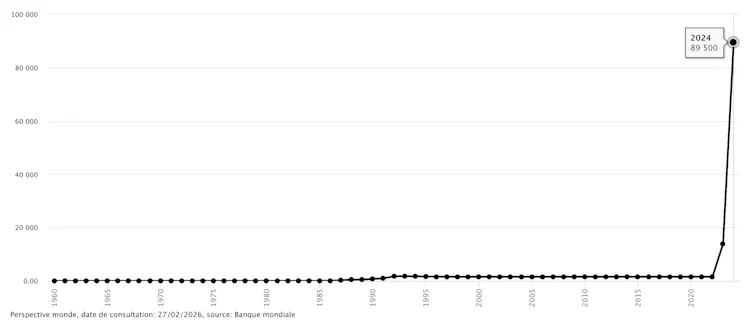
The economic model relied on massive state debt to banks, which themselves were heavily exposed to the central bank, or Banque du Liban. This system depended on continuous capital inflows, notably from the diaspora, facilitated by aexchange rate kept “artificially” fixed between the Lebanese pound and the dollar– 1,507 Lebanese pounds for one US dollar from 1997 to October 2019.
He favoredde factothe circulation of capital flows. When these flows dried up, the joint insolvency of the State, the Banque du Liban, and the banking sector became apparent, leading tosovereign default of March 2020.
University of Sherbrooke
Since then, the crisis has been managed without a legal framework for banking resolution or capital controls. Restrictions on deposits have been imposed by somecirculars of the Bank of Lebanon. At the same time, thebook collapsed on the parallel market, losing more than 98% of its value, destroying the purchasing power of Lebanese men and women.According to the IMF and other international organizations, the current “financial gap” in the banking system exceeds 70 billion dollars, more than three times theAnnual GDPof the country.
“Gap Law” on the “financial hole”
The “Gap Law” financial regularity and deposit refund billaims to establish a legal framework to address the financial losses accumulated in foreign currencies. It organizes their distribution among the State, the Banque du Liban, commercial banks, and depositors.
It provides for deposit protection up to 100,000 US dollars per depositor, with reimbursement over four years. This ceiling applies in a consolidated manner to all accounts held by the same depositor within the banking system, regardless of the number of institutions involved.
Consolidated deposits exceeding this threshold would be converted into long-term financial instruments, mainlyzero-coupon obligations(no interest until the end of the bond’s term), issued by the Banque du Liban, with maturities of ten to twenty years depending on the amount.
Also to read:
Was the economic crisis in Lebanon in 1966 caused by the United States?
The Central Council of the Banque du Liban would have broad power to determine the terms of repayment, including the possibility of accelerating maturities, without predefined criteria, while the Council of Ministers could reschedule them based on the evolution of the economic situation.
The text mentions a restructuring of the banking sector, without specifying the criteria for the viability of institutions, the methods of recapitalization, or the sequence of implementation, which are deferred to subsequent implementing texts.
Depositors on the front line
One of the most peculiar aspects of the system lies in the way losses are consolidated. Unlike thecommonly observed practices, the guarantee of deposits and the distribution of losses are not carried out by institution, but by depositor, at the level of the banking system. During the Cypriot crisis or in Iceland, the losses were quickly acknowledged, explicitly quantified, and applied within a clear institutional framework aimed at restoring confidence.
Thebanking resolution mechanismsare mainly based on a clear hierarchy of losses, where shareholders and creditors absorb the shocks before any impact on deposits, and this is done on a bank-by-bank basis.
By aggregating losses, the project does not make any differentiation between banks, regardless of their contribution to the financial collapse. This was largely fueled bycomplex financial engineering operationshaving encouraged an excessive risk-taking. Without economic criteria conditioning the allocation of losses, the system favors an overall stabilization of the system without prior treatment ofmoral hazardstemming from these practices.
A commitment in the present without foundation
The issue does not lie solely in how losses are distributed or deferred. The credibility of commitments depends on the future capacity of the economy to generate sufficient resources to honor them, which is highly uncertain. In the absence of identified sources of funding or a credible macroeconomic trajectory, repayment promises resemble conditional commitments more than firm obligations.

World Bank
International experience shows that this type of mechanism – bonds resulting from restructurings or instruments indexed to growth – can only work if it is backed by clear rules, credible governance, and minimal visibility on future flows. In Greece, Argentina or Cyprus, the real value of these instruments depended less on their face value than on theconfidencein the institutions and the underlying macroeconomic framework.
The instruments of the law therefore risk embodying a form of deferred debt, whose sustainability depends on a hypothetical recovery and uncertain political decisions.
Rely on private savings
Without clear mechanisms for accountability, prioritization of losses, substantial bank recapitalization, and defined collateral, the project places a major part of the adjustment on private savings.
This socializationex postlosses erode household wealth, reduce their future saving capacity, and do little to restore confidence. However, thetrustis at the heart of banking operations and intermediation,essentialAt the resumption of investment and economic activity.
The bill breaks with years of inaction, but the issue goes beyond the mere accounting allocation of losses, which is deeply arbitrary and opaque: it touches the heart of the trust contract between the State, the banking system, and the citizens, an indispensable condition for any sustainable economic recovery.

Nizar Atrissi does not work for, advise, own shares in, or receive funds from any organization that could benefit from this article, and has declared no other affiliation than his research institution.
–ref. Lebanon still fails to absorb the abyssal hole in its banking system –https://theconversation.com/le-liban-narrive-toujours-pas-a-resorber-le-trou-abyssal-de-son-systeme-bancaire-273401
Back to index · Read original article
4 ways the war in Iran has weakened the United States in the great power game
April 22, 2026
Source: The Conversation – USA [1]

“Never interrupt your enemy when he is making a mistake.”
Napoleon Bonaparte’s maxim may well have been in the minds of policymakers in Moscow and Beijing these past weeks, as the U.S. war in Iran dragged on. And now that a 14-day ceasefire between Tehran and Washington is in effect – with both sides claiming “victory” – Russian and Chinese leaders still have an opportunity to profit from what many see as America’s latest folly in the Middle East.
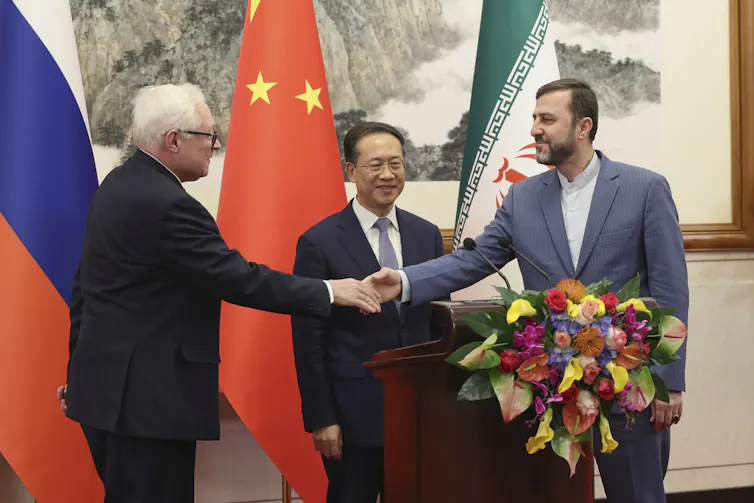
Throughout the weekslong conflict, China and Russia struck a delicate balance. Both declined to give Iran – seen to a varying degree as an ally of both nations – their full-throated support or sink any real costs into the conflict.
Instead, they opted for limited assistance in the form of small-scale intelligence and diplomatic support.
As a scholar of international security and great power politics I believe that is for good reason. Beijing and Moscow were fully aware that Iran could not “win” against the combined military might of the United States and Israel. Rather, Iran just needed to survive to serve the interests of Washington’s main geopolitical rivals.
Below are four ways in which the U.S. war in Iran has damaged Washington’s position in the great power rivalries of the 21st century.
1. Losing the influence war in the Middle East
As I explore in my book “Defending Frenemies,” the U.S. has long struggled to balance competing objectives in the Middle East. During the Cold War, this meant limiting the Soviet Union’s influence in the region, while contending with the development of nuclear weapons by two troublesome allies, Israel and Pakistan.
By the 2020s, the priorities in Washington were aimed at restricting the influence of the U.S.’s great power rivals – China and to a lesser degree Russia – in the Middle East.
Lintao Zhang/Pool Photo via AP
Yet under Presidents Xi Jinping and Vladimir Putin, China and Russia have sought to increase their footprint in the region through a variety of formal alliances and informal measures.
For Russia, this took the form of aligning with Iran, while also partnering with Tehran to prop up the now-ousted regime of President Bashar Assad during the Syrian civil war. Meanwhile, China increased its diplomatic profile in the Middle East, notably by acting as a mediator as Saudi Arabia and Iran restored diplomatic ties in 2023.
The irony of the latest Iran war is that it follows a period in which circumstances were unfavorable to Russian and Chinese aims of increasing their influence in the Middle East.
The fall of Assad in December 2024 deprived Russia of its one reliable ally in the region. And Trump’s May 2025 tour of the Gulf states, in which he secured major technology and economic deals with Saudi Arabia, the United Arab Emirates, Qatar and Bahrain, was aimed at countering China’s growing economic and diplomatic influence in those countries.
With Washington perceived as an increasingly unreliable protector, the Gulf states may seek greater security and economic cooperation elsewhere.
2. Taking US eyes off other strategic goals
In expanding military, diplomatic and economic ties in the Middle East, Russia and China over the past two decades were exploiting a desire by Washington to move its assets and attention away from the region following two costly wars in Iraq and Afghanistan.
Trump’s decision to wage war against Iran directly contradicts the national security strategy his administration released in November 2025. According to the strategy, the administration would prioritize the Western Hemisphere and the Indo-Pacific, while the Middle East’s importance “will recede.”
In co-launching a war in Tehran with Israel, without any prior consultation with Washington’s other allies, Trump has shown a complete disregard for their strategic and economic concerns. NATO, already riven by Trump’s repeated threats to the alliance and designs on Greenland, has now shown further signs of internal divisions.
That offers benefits for China and Russia, which have long sought to capitalize on cracks between America and its allies.
The irony, again, is that the war in Iran came as Trump’s vision of the U.S. as the hegemonic power in the Western Hemisphere was making advances. International law and legitimacy concerns aside, Washington had ousted a thorn in its side with Nicolás Maduro in Venezuela and replaced him with a more compliant leader.
3. Disproportionate economic fallout
Iran’s closure of the Strait of Hormuz, where some 20% of the world’s oil passes, was as predictable as it was destructive for U.S. interests.
But for Russia, this meant higher oil prices that boosted its war economy. It also led to the temporary but ongoing easing of U.S. sanctions, which has provided Moscow an indispensable lifeline after years of economic pressure over the war in Ukraine.
While a prolonged closure and extensive damage to oil and natural gas infrastructure in Iran and the Gulf states no doubt hurts China’s energy security and economy, these were risks Xi appears willing to accept, at least for a time.
And by building up a domestic oil reserve and diversifying energy sources to include solar, electric batteries and coal, China is far better positioned to weather a prolonged global energy crisis than the U.S. Indeed, Beijing has made strides in recent year to encourage domestic consumption as a source of economic growth, rather than be so reliant on global trade. That may have given China some protection during the global economic shock caused by the Iran war, as well as push the economy further down its own track.
The more the U.S. loses control over events in the strait, the more it loses influence in the region – especially as Iran appears to be placing restrictions on ships from unfriendly nations.
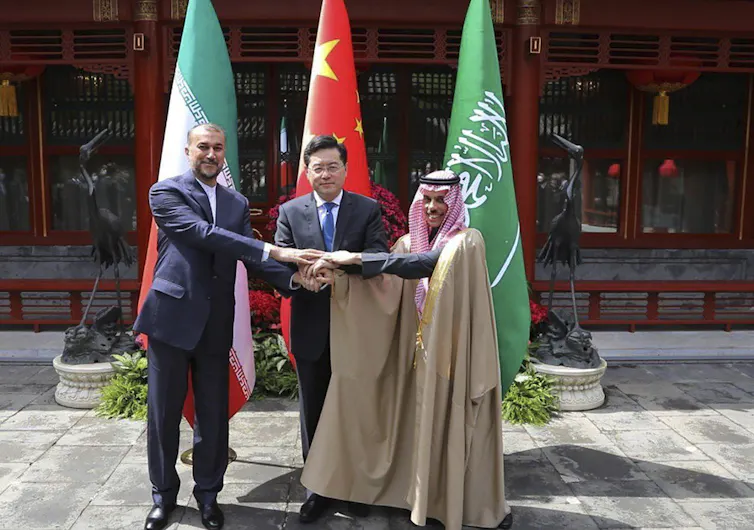
Iranian Foreign Ministry via AP
4. Loss of global leadership
Trump’s willingness to abandon talks to go to war, and the contradictory rhetoric he has employed throughout the Iran conflict, has weakened the perception of the U.S. as an honest broker.
That provides a massive soft power boost for Beijing. It was China that pressed Iran to accept the 14-day ceasefire proposal brokered by Pakistan. Indeed, China has slowly chipped away at America’s longtime status as global mediator of first resort.
Beijing has successfully mediated in the past between Iran and Saudi Arabia, and it attempted to do the same with Russia and Ukraine and Israel and the Palestinians.
In general, the Iran war adds weight to Beijing’s worldview that the U.S.-led liberal international order is over. Even if China benefited at some level from the war continuing, its decision to help broker the ceasefire shows that China is increasingly taking on the mantle of global leadership that the U.S. used to own.
And for Russia, the Iran war and the rupture between Trump and America’s NATO allies over their lack of support for it, shift world attention and U.S. involvement from the war in Ukraine.

Jeffrey Taliaferro does not work for, consult, own shares in or receive funding from any company or organization that would benefit from this article, and has disclosed no relevant affiliations beyond their academic appointment.
Back to index · Read original article