

Source: French to English Tester Published on: 2026-04-21
Source: The Conversation – France in French (3)– By Nizar Atrissi, Associate Professor, IAE Paris – Sorbonne Business School; University Paris 1 Panthéon-Sorbonne

Lebanon is experiencing an unprecedented banking crisis with blocked deposits, a 98% drop in the value of the Lebanese pound, and a financial gap of 70 billion US dollars, or more than 59.4 billion euros. A “Gap Law” bill aims to establish a new framework to organize the distribution among the state, the central bank, commercial banks, and depositors. With which losers? At the heart of the debates: trust in the country’s future.
Lebanon is going through one of thethe most serious financial crisesobserved globally for several decades. With the collapse of its financial system in 2019, deposits (whose funds can be partially or fully withdrawn at any time) are largely frozen, the national currency has lost most of its value, and the economy operates under a regime of informal restrictions in the absence of a legal framework.
In this context, the adoption by the government of a“Gap Law” bill aiming to organize the allocation of banking lossesDecember 26, 2025, marks a long-awaited milestone, but raises profound questions about its ability to restore confidence.
So how can Lebanon restore this confidence in its banking system?
Financial gap equivalent to three times Lebanon’s GDP
The Lebanese financial crisis is the result of deep economic imbalances accumulated over several decades.
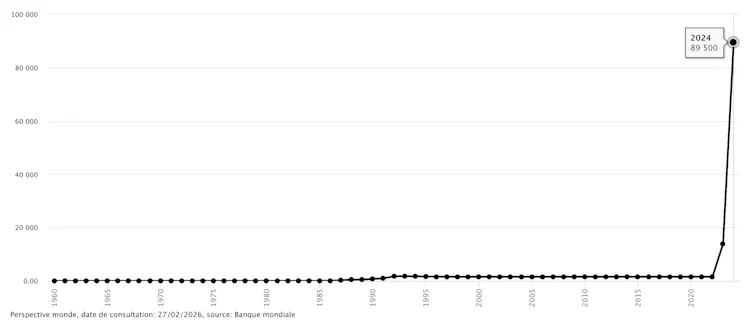
The economic model relied on massive state debt to banks, which themselves were heavily exposed to the central bank, or Banque du Liban. This system depended on continuous capital inflows, notably from the diaspora, facilitated by aexchange rate kept “artificially” fixed between the Lebanese pound and the dollar– 1,507 Lebanese pounds for one US dollar from 1997 to October 2019.
He favoredde factothe circulation of capital flows. When these flows dried up, the joint insolvency of the State, the Banque du Liban, and the banking sector became apparent, leading tosovereign default of March 2020.
University of Sherbrooke
Since then, the crisis has been managed without a legal framework for banking resolution or capital controls. Restrictions on deposits have been imposed by somecirculars of the Bank of Lebanon. At the same time, thebook collapsed on the parallel market, losing more than 98% of its value, destroying the purchasing power of Lebanese men and women.According to the IMF and other international organizations, the current “financial gap” in the banking system exceeds 70 billion dollars, more than three times theAnnual GDPof the country.
“Gap Law” on the “financial hole”
The “Gap Law” financial regularity and deposit refund billaims to establish a legal framework to address the financial losses accumulated in foreign currencies. It organizes their distribution among the State, the Banque du Liban, commercial banks, and depositors.
It provides for deposit protection up to 100,000 US dollars per depositor, with reimbursement over four years. This ceiling applies in a consolidated manner to all accounts held by the same depositor within the banking system, regardless of the number of institutions involved.
Consolidated deposits exceeding this threshold would be converted into long-term financial instruments, mainlyzero-coupon obligations(no interest until the end of the bond’s term), issued by the Banque du Liban, with maturities of ten to twenty years depending on the amount.
Also to read:
Was the economic crisis in Lebanon in 1966 caused by the United States?
The Central Council of the Banque du Liban would have broad power to determine the terms of repayment, including the possibility of accelerating maturities, without predefined criteria, while the Council of Ministers could reschedule them based on the evolution of the economic situation.
The text mentions a restructuring of the banking sector, without specifying the criteria for the viability of institutions, the methods of recapitalization, or the sequence of implementation, which are deferred to subsequent implementing texts.
Depositors on the front line
One of the most peculiar aspects of the system lies in the way losses are consolidated. Unlike thecommonly observed practices, the guarantee of deposits and the distribution of losses are not carried out by institution, but by depositor, at the level of the banking system. During the Cypriot crisis or in Iceland, the losses were quickly acknowledged, explicitly quantified, and applied within a clear institutional framework aimed at restoring confidence.
Thebanking resolution mechanismsare mainly based on a clear hierarchy of losses, where shareholders and creditors absorb the shocks before any impact on deposits, and this is done on a bank-by-bank basis.
By aggregating losses, the project does not make any differentiation between banks, regardless of their contribution to the financial collapse. This was largely fueled bycomplex financial engineering operationshaving encouraged an excessive risk-taking. Without economic criteria conditioning the allocation of losses, the system favors an overall stabilization of the system without prior treatment ofmoral hazardstemming from these practices.
A commitment in the present without foundation
The issue does not lie solely in how losses are distributed or deferred. The credibility of commitments depends on the future capacity of the economy to generate sufficient resources to honor them, which is highly uncertain. In the absence of identified sources of funding or a credible macroeconomic trajectory, repayment promises resemble conditional commitments more than firm obligations.

World Bank
International experience shows that this type of mechanism – bonds resulting from restructurings or instruments indexed to growth – can only work if it is backed by clear rules, credible governance, and minimal visibility on future flows. In Greece, Argentina or Cyprus, the real value of these instruments depended less on their face value than on theconfidencein the institutions and the underlying macroeconomic framework.
The instruments of the law therefore risk embodying a form of deferred debt, whose sustainability depends on a hypothetical recovery and uncertain political decisions.
Rely on private savings
Without clear mechanisms for accountability, prioritization of losses, substantial bank recapitalization, and defined collateral, the project places a major part of the adjustment on private savings.
This socializationex postlosses erode household wealth, reduce their future saving capacity, and do little to restore confidence. However, thetrustis at the heart of banking operations and intermediation,essentialAt the resumption of investment and economic activity.
The bill breaks with years of inaction, but the issue goes beyond the mere accounting allocation of losses, which is deeply arbitrary and opaque: it touches the heart of the trust contract between the State, the banking system, and the citizens, an indispensable condition for any sustainable economic recovery.

Nizar Atrissi does not work for, advise, own shares in, or receive funds from any organization that could benefit from this article, and has declared no other affiliation than his research institution.
–ref. Lebanon still fails to absorb the abyssal hole in its banking system –https://theconversation.com/le-liban-narrive-toujours-pas-a-resorber-le-trou-abyssal-de-son-systeme-bancaire-273401