

Source: French to English Tester Published on: 2026-04-08
Source: The Conversation – in French– By Shannon Fogg, Professor of History, Missouri University of Science and Technology
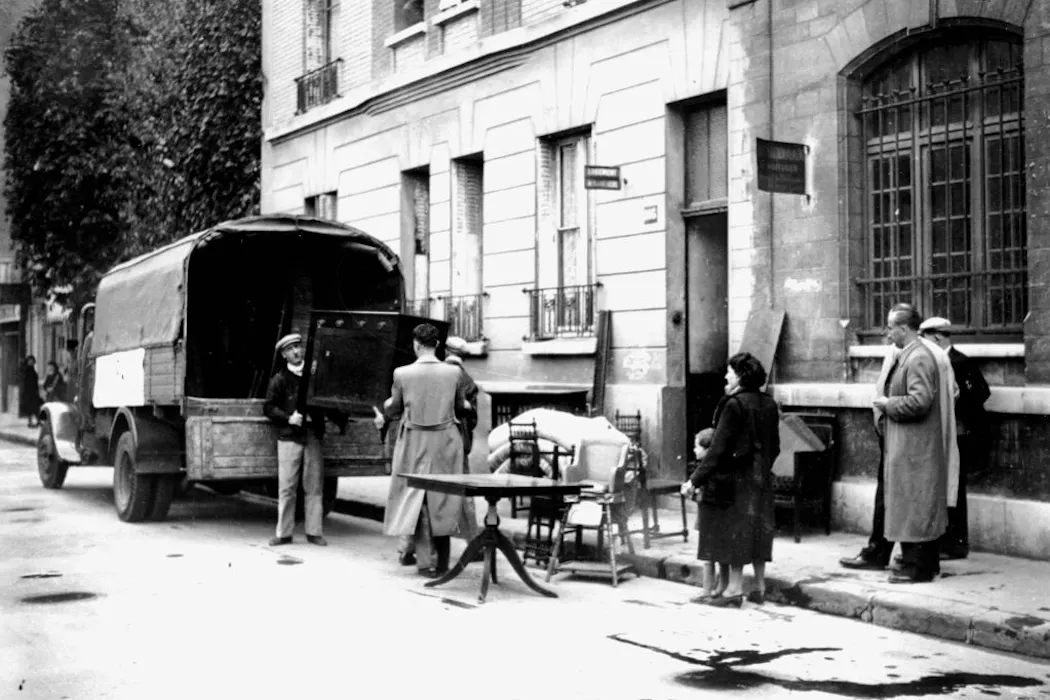
Tens of thousands of apartments belonging to Parisian Jews were looted and reassigned during the Occupation. After the war, Holocaust survivors had to face a new ordeal: reclaiming their homes and belongings amidst legal and administrative obstacles.
In 1945, an angry crowd confronted Aba Mizreh and four of his sons outside their former Parisian home. The Jewish family had taken refuge in Lyon during the Second World War, only to discover upon their return that their apartment had been looted and then relet in their absence. Despite an eviction notice, the new occupants refused to leave, and the situation escalated into a fight. After this violent confrontation, Mizrehwrote to the French governmentA:
“Am I not entitled, after having suffered so much, to recover my property? Haven’t I really paid enough for this war?”
Aba Mizreh, then aged 68, was one of160,000 Holocaust survivors in Pariswho were trying to rebuild their lives after the ravages of the Nazi occupation. Of his 11 children, five sons had fought for France and six had been deported; at least twowere murdered at Auschwitz.
He then simply wanted to recover the three-room apartment that served both as his home and as a furrier’s workshop, in order to provide for his wife and his grandchildren who had become orphans.
Inmy researchon theThe spoliation and the restitution of Jewish housing in Paris, I have noticed that questions of ownership are often neglected in studies on the Holocaust. Yet, for Jews in France, recovering their housing and furniture was essential to rebuild their lives. These issues are also crucial to understanding the lasting financial and emotional impact of the Holocaust.
These situations also reveal the limits ofState attempts to repair the past. TheFrench lawsconcerning the recovery of apartments, looted goods, and compensation for war-related damages promised equality among all victims of the conflict. In reality, they created bureaucratic obstacles andfavored the non-Jewish victims of the war. For many of those who tried to recover their property, the answer to Aba Mizreh’s question was negative: they would continue to “pay” for the war for years to come.
Looting and restitution
Paris was the largest cityunder German occupationand housed the largest Jewish population in Western Europe. Tragically, about75,000 Jews living in Francewere murdered during the Holocaust. For the 75% of theJewish population of France that survived, rebuilding their lives was a long and difficult process.
With the collaboration of French citizens, the Nazis looted more than38,000 private apartments in the capital, and up to 25,000 apartments left empty after the departure of Jewish families have beenrented to non-Jewish tenants. Social workers estimated that nearly100,000 Parisian Jewshad been expelled from their homes during the war. However, for many surviving Jews, returning home was the absolute priority.
Memoirs and oral testimonies recount these first moments of the return. As a child,Rachel Jedinaksurvived the war by living in hiding under a false identity after her parents’ arrest. She remembered her return to the family home:
“We tore off the seals from the door and entered. There was nothing left – absolutely nothing. This empty apartment – without furniture, without belongings, without photos that would have allowed us to remember those who had disappeared, to connect us to our parents – made us cry. The loss of our memories was even more painful than that of ourmaterial goods. »
Recovering and then refurbishing these apartments was both a practical necessity and a deeply emotional undertaking. Their housing provided a bed to sleep in, but also represented one of the last links with family members who disappeared during the Shoah. The extent of the losses meant that reconstruction could not be carried out without a coordinated effort from the French government.
Reparation and compensation
Two ordinances published on November 14, 1944, dealt with tenants’ rights to reoccupy their housing. Another ordinance, published on April 11, 1945, aimed to return found furniture to their original owners.
These measures, however, largely failed to meet the needs of the surviving Jews. Thehousing lawscontained exceptions thatfavored the new non-Jewish tenants, such as victims of Allied bombings or former prisoners of war. Furthermore, only some2,000 pieces of furniturewere returned to the survivors or their heirs.
As a result, many survivors had to rely on compensation to make up for their losses. Jews whose apartments had been looted could file a claim under thelaw of October 28, 1946 on war damages. But this long-awaited law turned out to be another disappointment.

Chabe01/Wikimedia,CC BY-SA
Adopted two years after the liberation of Paris, the law on war damages provided only limited compensation for personal property. Eligible victims could receive 90,000 (old) francs – that is less than9,000 eurostoday – per household in case of total loss of furniture, or half of the insured value of stolen goods.
Applicants had to fill out a four-page form and provide documents proving their nationality, family situation, legal status, and property rights, as well as testimonies attesting to the losses suffered.
If the Ministry of Reconstruction and Urban Planning approved a survivor’s application, the payment was not immediate. A sample of the 2,750 files kept atParis Archivesreveals that over 85% of applicants wrote to the government to demand faster payment.
A survivor writing to the authorities in 1948 summarized the feeling of many victims of the looting:
“I believe that we have paid our dues and suffered enough for you to at least reimburse us for part of what the Germans stole from us nearly six years ago.”
But for many, the compensation process linked to the law on war damages extended until the 1960s, highlighting the lasting economic impact of the looting committed during the war.
A persistent exclusion
Only French citizens or foreigners who fought for France could benefit from compensation under the law on war damages. Yet more than half of the Jews living in France during the Shoah were foreigners – among whom nearly100,000 refugees who recently fled Nazi violence.

German Federal Archives, Wikimedia,CC BY-SA
Arthur Deutsch was born in Vienna to Polish parents and settled in Paris in 1922, where he got married and had five children. In 1938, he filed a naturalization application, but it was not finalized before the outbreak of the war. He tried to volunteer for military service but was not mobilized.
His family fled Paris during the Exodus and ended up in Limoges (Haute-Vienne), where they were arrested in December 1940. She was then transferred toRivesaltes internment camp (Pyrénées-Orientales), where Arthur Deutsch was assigned to a Group of foreign workers for forced labor. When the family returned to Paris after the Liberation, they found their apartment completely empty.
Arthur Deutschfiled a claim for war damages compensation, which was rejected in 1952 because of his nationality. He challenged this exclusion by writing:
“If I am not French on paper, I am still French in my thoughts, because you do not spend thirty years in Paris without being assimilated, and it is not the four years of internment nor the possible refusal of my request for movable property compensation that will make me change my mind.”
As highlightedthe anthropologist Damiana Oțoiu, “the psychological harm caused by forced displacements, the confiscation of property, and the loss of social and cultural capital cannot be compensated by merereturn of propertyyears or decades after the crimes.”
But for the Holocaust survivors in Paris, recovering or replacing the stolen goods represented the possibility of living with dignity and security. The struggle for compensation and for the recognition of the persecutions they had sufferedcontinued for decadesafter the end of the war and,in some cases,is still ongoing today.

The funding for this research was provided by a Seed Grant intended for the humanities and social sciences, awarded by the Office of the Vice Chancellor for Research and Innovation of the Missouri University of Science and Technology.
–ref. A forgotten dispossession: Holocaust survivors and the difficulties in recovering their property and housing –https://theconversation.com/a-forgotten-spoliation-the-survivors-of-the-holocaust-and-the-difficulties-in-recovering-their-property-and-housing-279778