

Source: French to English Tester Published on: 2026-03-30
Source: The Conversation – France (in French)– By Emilie Ruiz, Associate Professor HDR, University of Savoie Mont Blanc
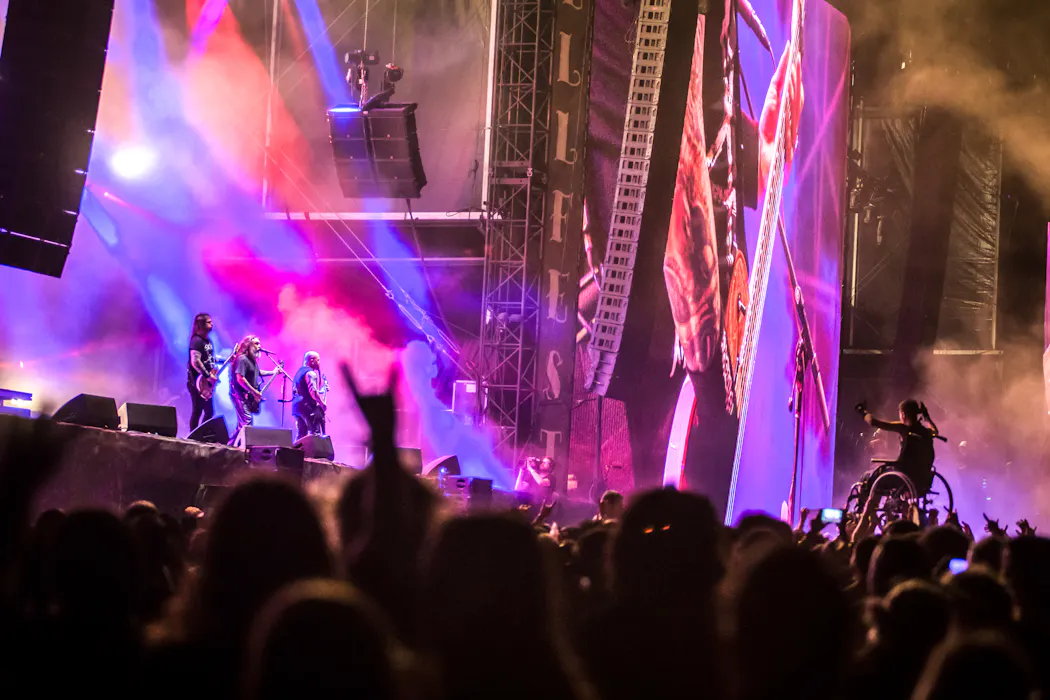
Twenty years after the 2005 law on equal rights for people with disabilities, the accessibility of cultural venues has greatly improved in France. But the actual participation of the concerned public remains limited. An experiment conducted between a family pension and Hellfest, in Loire-Atlantique, shows that inclusion is not just about technical adjustments.
One Saturday in June 2023, amidst tens of thousands of festival-goers gathered at Hellfest (Clisson, Loire-Atlantique), six residents of a group home discover for the first time one of the largest festivals in France. Some live with mental health disorders, others with physical limitations, yet all take part in a unique experience: exploring what “inclusion” truly means in a singular cultural event.This experiment, conducted with residents of the Orangerie family pension, a facility managed by the French Red Cross, invites a thorough rethinking of how cultural institutions approach disability. Despite the progress made in recent years, access to cultural life remains limited for many people with disabilities.
Taking invisible disability into account
Since the French law of 2005 on the equality of rights for disabled persons, cultural venues have significantly improved their physical accessibility: access ramps, reserved platforms, adapted signage. But a paradox remains: despite these arrangements, people with disabilitiesstill participate relatively little in cultural and associative life. If visible disability is indeed perceptible, invisible disability, particularly mental or cognitive, remains unknown to the general public. The diversity of disorders and their care hinders their full exercise of citizenship and thereforetheir participation in cultural events. The context of festivals cannot, therefore, be limited to the mere establishment of an adapted physical access.
Experience a festival differently
By relying on the expertise of professionals, volunteers, and through experimentation, the initiatives supported by Hellfest allow topropose another approach to accessibility. For example, for people with hearing impairments, vibrating vests that allow them to physically feel the vibrations of the music are offered. Some concerts are also partially translated into sign language.
These devices illustrate a simple idea: accessibility does not necessarily mean reproducing a standard experience for everyone, but rather allowing different ways to experience the same event. For the participants of the Orangerie family home, the festival experience proves to be both fascinating and unsettling. The monumental structures of the site, the sound intensity or the density of the crowd can evoke as much wonder as apprehension. But these contrasting reactions also reveal a reality often forgotten: people living with a psychosocial disability are not doomed to remain on the sidelines of these cultural experiences. They can participate fully, provided that the conditions are adapted and prepared, and thus become experts of their accessibility conditions.
Inclusion begins well before the event
For over a year, the participants prepared for their attendance with the support of their supervisor, a trained youth care worker: visits to the site while empty, participating in the festival’s Warm-Up tour, scouting accessible areas, organizing medical or logistical follow-up. This anticipation phase allowed the residents to gradually familiarize themselves with the festival environment and reduce uncertainties.
The project did not originate from an institutional decision. It was proposed by a resident during a collective meeting of the family guesthouse, then discussed and adopted by the group. In other words, the participants were not simply “included” in a system: they helped build their own participation.
An inclusion that mobilizes an entire ecosystem
Cultural inclusion rarely relies on a single actor. In this experiment, several organizations played a determining role: the family pension of the Orangerie, the French Red Cross, the association Culture du cœur, but also sponsors of the festival. Each contributes to solving part of the difficulties: financing, social support, logistics, access to tickets, or cultural mediation. This setup serves as a reminder that cultural inclusion is a collective process involving multiple organizations. It is thus fully embedded in a partnership approach, essential to social work.
This ecosystem cannot function without the key role of certain actors, capable of connecting worlds that communicate little with each other and thus making the boundaries between these actors less impermeable. Specialized educators, cultural mediators, or filmmakers familiar with social work can thus act as “boundary actors.” Their role is to translate the expectations and constraints of each environment (social institutions, cultural organizers, participants) in order to make cooperation possible.
Metal, an unexpected field
This experiment (including the documentaryMaking hell accessible testifies sincerely) invite a rethinking of public policies on cultural accessibility, which are still largely focused on the physical adaptation of infrastructure. Three avenues emerge: (1) broadening the definition of disability considered in cultural policies to better include mental or invisible disabilities, (2) financially supporting co-construction initiatives with the concerned audiences, not just material investments, and (3) training and recognizing boundary-spanners, who play an essential role in connecting the various partners.
Often associated with a radical or marginal aesthetic, metal rarely appears in debates about cultural policies. With an identity historically built around strongly committed and supportive fan communities, certain inclusion initiatives find a favorable ground to develop: they resonate with the ethos of metal identity: sharing a collective moment, beyond social or physical distinctions, like the values that shape this musical genre andcarried by certain groups such as Gojira.

The authors do not work for, do not advise, do not own shares, do not receive funds from any organization that could benefit from this article, and have declared no affiliation other than their research institution.
–ref. Disability and access to culture: when metal becomes a vector of inclusion –https://theconversation.com/disability-and-access-to-culture-when-metal-becomes-a-vector-of-inclusion-278494