

Source: French to English Tester Published on: 2026-03-30
Source: The Conversation – France in French (2)– By Noémie Combe, Researcher-teacher in fundamental mathematics at ESILV, Léonard de Vinci Pole
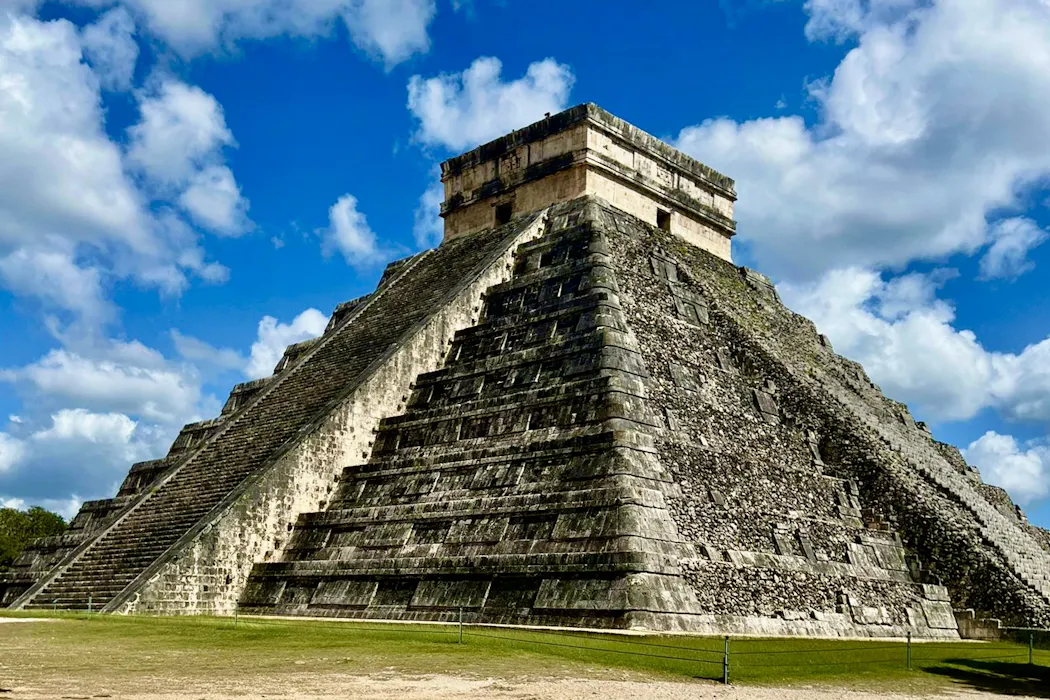
A thousand years before Europe, the Mayas were already solving complex equations. Armed with only their gaze and infinite patience, they scrutinized the sky and accurately predicted eclipses and the trajectories of the planets.
Let’s embark on a journey to ancient times. We are in the territories of present-day Mexico, Guatemala, Belize, Honduras, and El Salvador. It is in this lush setting that the Mayans built an extraordinary heritage: stunning astronomy, advanced mathematics, bold architecture, and a rich hieroglyphic script.
Thus, the Mayan cities were oriented towards the stars. In Chichén Itzá (currently in Mexico), during the equinoxes, the shadows on the El Castillo pyramid seem to animate the progression of the serpent godKukulkanalong the steps – a comparable phenomenon is observed at El Tajín.
The “codices,” their astronomical treatises, are one of the few surviving testimonies of this knowledge. The most famous is theDresden Codex. Its mystery is twofold: the enigma of its symbols – dense glyphs, columns of numbers, coded deities – and that of its destiny.
How did this manuscript from Yucatán cross the Atlantic to end up in a library in Saxony? The dominant theory is that the Spaniard Hernán Cortés (1485-1547) sent it to Europe after the conquest of Mexico, among the precious objects offered to the Madrid court. The manuscript is believed to have circulated in Europe before ending up in Vienna, where, in 1739, the director of the royal library of Dresden Johann Christian Götze bought it from an owner who considered it “incomprehensible and worthless,” unaware that he was holding one of the most sophisticated astronomical documents ever produced. Götze brought it back to Dresden, where it is still kept today.
Mars and the secret behind the number 78
Fordecipher the symbols of the codex, a detour is necessary. The Mayans counted in base 20: a dot was worth one unit, a bar five units, and a shell represented zero –concept that Europe will only adopt in the 11th century.

Dresden Codex, Princeton University Library
On the page of the Dresden Codex concerning Mars and its cycles, there is a sequence of numbers: 78, 156, 234, 312, 390, 780. Each term is a multiple of 78. It is also observed that this sequence isalmostan arithmetic sequence (a sequence such that the difference between two consecutive terms must be equal to a constant), but the last term deviates: it is equal to 10 × 78 (instead of 6 × 78).
The 78 corresponds to one tenth of the “synodic period” of Mars, that is to say the time to find the same position in the sky, as seen from Earth, namely 780 days. The Mayans had calculated it with remarkable precision: 780 days versus 779.94 days today. The first five terms mark the intermediate stages, and the last one marks the complete cycle.
The Mayan zodiac consisted of 13 constellations along the ecliptic, and Mars takes 260 days (13 × 20) to travel through it. Three complete crossings of the Mayan zodiac correspond exactly to 780 days. This period of 260 days also corresponds to the Tzolk’in, the Mayan ritual calendar, which allows the rhythm of Mars to align perfectly with the calendar. Thus, the sequence of numbers on the codex formed a celestial navigation table.
Lunar eclipses
Another page of the codex presents a new sequence of numbers: 9,360, 9,537, 9,714, 9,891, 10,039. Up to 9,891, each value increases by 177 days (9,183 + 177 = 9,360, 9,360 + 177 = 9,537, 9,537 + 177 = 9,714, 9,714 + 177 = 9,891). But here again, the last term breaks the pattern: 10,039 = 9,891 + 148, revealing a second cycle.

Dresden Codex, Princeton University Library
This is not a mistake: although the synodic period of the Moon is about 29.5 days, not every full moon results in an eclipse. The interval between two consecutive eclipses corresponds to 5 or 6 lunations (that is, 148 or 177 days).
Indeed, the Moon’s orbit is inclined by about 5°: eclipses only occur near aorbital node. The Sun passes there every 173.31 days (the eclipse season), and necessarily 5 or 6 full lunations elapse between two eclipses.
TheMayans had calculated the synodic period of the MoonAt 29.53 days, within a few seconds of the modern measurement. Some multiples coincided with eclipse seasons, allowing them to anticipate them.

Noémie Combe,Provided by the author
The Mayan mathematical system
The mathematical sophistication of the Mayas is evident even in their daily life. They instinctively practiced what is called today modular arithmetic. The principle is simple: rather than considering the value of a number, modular arithmetic only concerns itself with the remainder it leaves after division by a reference number – themodule(here, modulo 20). The Mayans, without ever using this vocabulary, precisely applied this logic, and this, long before the German mathematician Carl Friedrich Gauss (1777-1855) laid its formal foundations at the turn of the 19th century. Today, echoes of this kind of mathematics can be found in fields as contemporary as cryptography and computer security.
In modern language, these calculations are interpreted as operations in thering ♂/20♂. This notion of a ring is one of the cornerstones of contemporary mathematics, at the heart of abstract algebra at the end of the 19th century. Among its founders is the mathematician Richard Dedekind (1831–1916).
The pages of the codex still hold many areas of shadow and mystery. Who knows what secrets are still sleeping in the columns of glyphs of the codex, waiting to be unveiled?

Noémie Combe does not work for, advise, own shares in, or receive funds from an organization that could benefit from this article, and has declared no affiliation other than her research institution.
–ref. The Mayans: mathematicians who read the future in the stars?https://theconversation.com/the-maya-mathematicians-who-read-the-future-in-the-stars-278821