

Source: French to English Tester Published on: 2026-05-19
Source: The Conversation – France in French (3)– By Christian Bouquet, Researcher at LAM (Sciences-Po Bordeaux), emeritus professor of political geography, University Bordeaux Montaigne
To analyze the conflicts in the Sahel, one must start with simple arithmetic: there are more and more people, and less and less water on shrinking lands.
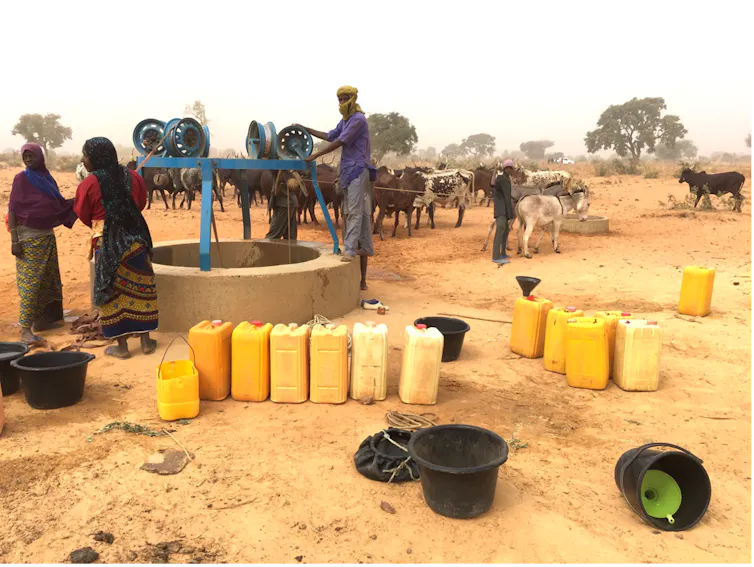
On April 25, 2026, a conflict over a well cost the lives of 42 people in the Wadi Fira province, in eastern Chad. According to authorities, it was a “dispute between two families living on this territory.” One belonged to the pastoralist communityseasonal migrant herders, the other that of the sedentary farmers. Throughout the Sahel region, wells are often places of tension, as here in Kouré, Niger:
Christian Bouquet,FAL
In this image, in the background, through the haze of the harmattan, you can see the huts of the Djermas sedentary farmers’ village. The Fulani herder’s herd is in transhumance retreat; it moves southward following the pastures, often mingling with the farmers’ cultivated fields, especially when everyone converges toward the well. Theagro-pastoral conflictsare multiplying in this region. According toInternational Crisis Group, they would have caused more than a thousand deaths and nearly 2,000 injuries between 2021 and 2024.
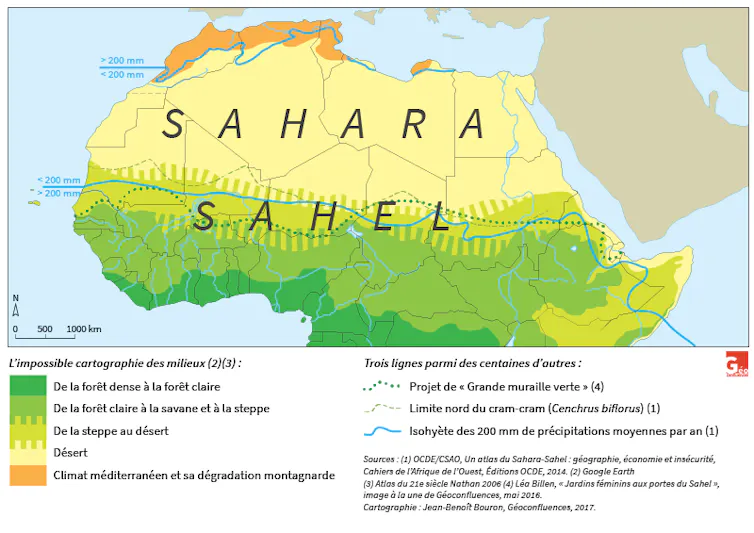
While geography is not always used for waging war, it remains very useful for better understanding these conflicts insofar as it is, by definition, a “field” discipline. Reminder: theSahelis a geographical construction. It is “the shore” of the desert, and its northern boundary (as defined byRobert Capot-Reyin 1953) is that of the cram-cram (Cenchrus biflorus) and ofthe 200 mm isohyet.
Indeed, the cram-cram, a small grass whose hooked glumes “prohibit entry to the meadow to anyone who is not shod or mounted,” does not grow if precipitation is less than 200 mm. Naturally, this rainfall limit does not concern only the cram-cram. No food crop, even the least demanding cereal—such as millet—can be grown with less than 250 mm of precipitation, preferably well-distributed and well-timed between June and September. It goes without saying that sedentary farmers know the northern limit of their settlement.
The burden of repeated droughts
For a long time, nomadic or semi-nomadic herders have mostlyplayedwith this constraint, because a good rain can always give rise to temporary pasturelands on the edges of the desert. But they then had to retreat southward and negotiate with sedentary farmers to avoid trampling their cultivated fields with their herds. Sometimes, agreements were made between them regarding animal manure or the harvesting of fruits from certain trees, such as the gum acacia, whose herders could be considered “owners” because they had planted them. This was indeed the case in the past in this eastern region of Chad, where the tragedy of April 25, 2026 occurred.
But this seemingly balanced situation that prevailed before and during colonization was gradually modified by two factors of change whose combination significantly reduced the space occupied by the two communities.
There was first the succession of droughts and, more broadly, a very noticeable worsening of precipitation since 1970, as shown in this diagram:
The consequences of this drying up of the climate also lead to another graphical representation, less often mentioned but more concrete:
Geoconfluences/Christian Bouquet
Indeed, according toMonique Mainguet, the 200 mm isohyet has migrated 250 km south since 1900. Without going as far as precisely calculating the surface area thus gained by the desert, by crossing this figure with the meridional length of the Sahel (from Mauritania to Eritrea), approximately 6,500 km, it can be noted that at least 1,500,000 km² have been lost in a few decades by the herders and farmers who still lived there in the last century.
A population that has nearly quadrupled in fifty years
And in this now smaller space, another parameter has changed: the population. It has almost quadrupled in fifty years: 135 million in 2020 (compared to less than 40 million in the 1970s), and could rise to 330 million inhabitants by 2050.
The equation is therefore worrying: when herders no longer find the grass and water that have been their millennial landmarks, when farmers vainly await the rain that once marked their seasons, they become climate migrants—although they are not recognized as such. And nothing has been planned for them in the southern zones of the Sahelian Africa. When this migration adds to the movements of internally displaced persons and refugees driven from their homes by conflicts, a profound discouragement can clearly be felt.
Moving on to the next step then becomes almost impossible. This step would consist of developing a vision for the next thirty years based on our observation: there are too many people on limited available land while (rain) water resources are decreasing.
Drawing projections over the long term
In a land-use logic, one can imagine breeders who would give up nomadism, and even semi-nomadism, to convert to a form of stall feeding, first partial then total, and imagine cultivators going to fetch water where it still exists (notably in underground aquifers), in order to produce more under more secured conditions, or even to grow fodder for those with whom they were previously in competition.
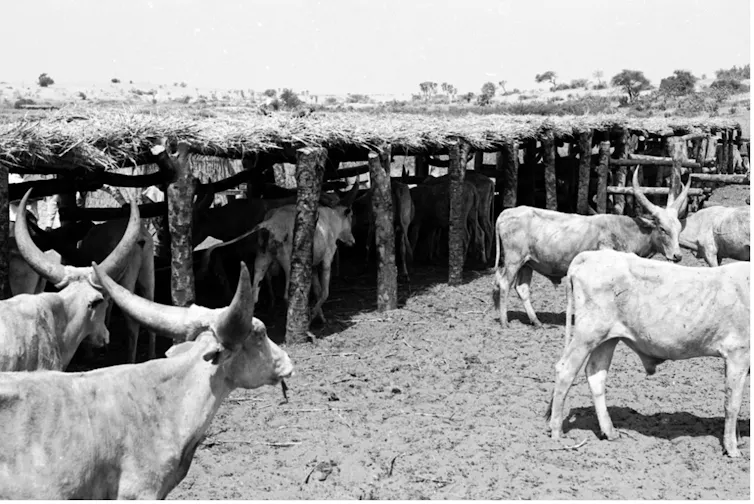
One does not dream: this formula was tested in the 1970s when the polders of Lake Chad were so promising that three harvests per year and seven to eight cuts of forage could be achieved there.Pennisetumat the same time. In this area, where rainfall rarely exceeded 250 mm, the farmers knew how to use the lake water and aquifers, and the fattening experience that had been tried in Bol had allowed cattle to gain an average of 90 kg in six months.
Since then, in this region perhaps more than elsewhere, the wind of history has swept everything away.
Christian Bouquet,FAL
It is therefore a simple arithmetic, which one should probably always start with when analyzing Sahelian conflicts, from Darfur to Mali: more people and less water on diminishing available land. Certainly, one must not overlook other factors of tension (gray areas abandoned by states, poor governance, corruption, intercommunity conflicts, armed groups, jihadism, trafficking, etc.). But one must also not confine oneself to denial for fear of stigmatizing this or that community.
One must – above all – try to make projections over the long term without fearing “ethnographic” criticism. No one can imagine a Fulani herder who has become settled, wearing rubber boots, armed with a pitchfork, and distributing hay to his cows. And yet…

Christian Bouquet does not work for, advise, own shares in, or receive funds from any organization that could benefit from this article, and has declared no other affiliation than his research institution.
–ref. In the Sahel, the difficult equation between the land, water, and the populations –https://theconversation.com/in-the-sahel-the-difficult-equation-between-land-water-and-populations-281834