

Source: The Conversation – in French– By Michael J. Benton, Professor of Vertebrate Palaeontology, University of Bristol
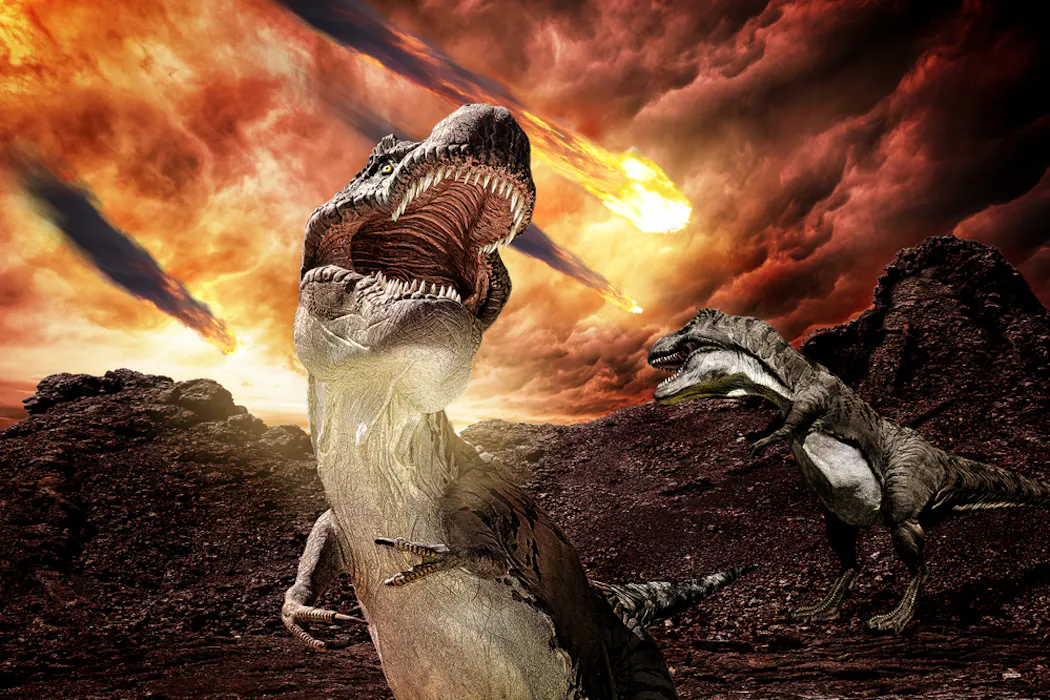
What would have happened if you had witnessed the impact of the asteroid that caused the extinction of the dinosaurs? Drawing on decades of research, two scientists reconstruct minute by minute the hours that followed the collision which disrupted the Earth 66 million years ago.
A large femaleTyrannosaurus rexadvances through the conifers of its territory, sniffing the air. She recognizes the smell of the carcass of a horned dinosaur, aTriceratops, from which it had fed the day before. It approaches and tears off a few more scraps of flesh, but the smell is foul, even to it. It then goes down to the lake to drink. Small crocodiles and turtles rush into the water at its approach, but it barely pays them any attention. What interests it more is an armored dinosaur, aAnkylosaurus, but not far from there. However, she knows that this prey will not give up easily and that she is not hungry enough to risk a fight.
What she doesn’t know is that a much greater danger is approaching. She lifts her head and sees a bright light rushing toward the ground, accompanied by faint crackling and whistling.
OurT. rexhas excellent hearing for low-frequency sounds and the vibrations that worry her. But her distress lasts only a moment. In a fraction of a second, she is reduced to ashes and her world is forever changed.
All this takes place 66 million years ago, when a gigantic asteroid struck the Earth in the region of the present-day Caribbean Sea. At the end of the Cretaceous, sea levels were then 100 to 200 meters higher than today, so the shores of the Caribbean Sea extended far inland into the American continent, over the east of Mexico and the southern United States. The impact occurred in these waters.
The event caused immediate upheavals on the planet and its atmosphere, leading to the extinction of the dinosaurs as well as about half of the other species living on Earth. But what would one have felt in the face of an impact of such magnitude? What would one have seen, heard, or smelled? And how would one have died — or survived? As specialists in meteorites and paleontology, respectively, we have reconstructed a detailed chronology of this event from decades of research. So, let’s go back in time to the very last day of the Cretaceous.
D-1 before impact
Everything is calm and this Cretaceous day unfolds like the others. In what will soon become the impact point, the climate is pleasantly warm, around 26 °C, and humid. A frequent situation at this time.
For about a week, the asteroid has only been visible at night. As the massive rock rushes straight toward Earth, it appears as a stationary star in the sky. No spectacular luminous trail: it is a rocky asteroid, not a comet.

Orla/Shutterstock
Over the last 24 hours, the bright point becomes visible in broad daylight. But it still looks like a star or a planet, simply becoming brighter and brighter in the hours before the impact.
D-Day: the impact
If you had been nearby, you would have first witnessed a brief display of light and noise. A few minutes, or even a few seconds before the impact, you would have seen the immense ball of fire, accompanied bycrackling or whistling. This characteristic noise results from a photoacoustic effect: the extremely intense light from the fireball heats the ground, which then heats the air just above it, causing pressure waves — in other words, sound.
Next comes a deafening supersonic bang, produced because the asteroid travels faster than the speed of sound. But the asteroid is so huge — probably nearly 10 kilometers in diameter — that it hits the surface before living beings near the impact zone even have time to seek shelter.
The colossal energy of the asteroid digs a crater after a series of phenomena which, together,last only a few seconds. When the asteroid hits the surface, its kinetic energy — linked to its speed — is instantly transmitted to the ground in the form of kinetic, thermal, and seismic energy. This triggers a series of shock waves that simultaneously heat and compress both the asteroid and the impacted area.
As these waves propagate, the rocks crack, shatter, and are then thrown into the air, forming a vast bowl-shaped depression — called a transient cavity — about ten seconds after the impact. Due to heat and compression, immense quantities of material melt and then vaporize, including the asteroid itself, releasing a gigantic column of incandescent vapor reaching over 10,000 kelvins (approximately 9,727 °C).
During the following seconds, the cavity continues to expand until it reaches several times the initial diameter of the asteroid. Dessimulationssuggest that about 20 seconds after impact, this transient cavity reaches at least 30 kilometers in depth — much deeper than the currently known deepest point on Earth, the Challenger Deep, located in the Mariana Trench in the Pacific Ocean, which descends to about 11 kilometers. The edges of the crater then rise to more than 20 kilometers in height, more than double the 8,900 meters of Mount Everest.
But this gigantic structure does not even last a minute before it begins to collapse. Less than three minutes after the impact, the center of the craterbounces backto form a peak several kilometers high. This ephemeral summit lasts only about two minutes before collapsing in turn into the crater.
Whether you are a dinosaur ora dung beetle, if you had been near the transient cavity, you would have been instantly incinerated by the explosion. But even at a distance of up to 2,000 kilometers from the epicenter, you would probably have been quickly killed by the thermal radiation and supersonic winds now spreading from the impact site.
Instant t + 5 minutes
Five minutes after the impact, the winds “calmed down” to reach the power of a category 5 hurricane, razing everything within about 1,500 kilometers around the impact site. Finally, everything that had not already been consumed by flames.
In this region, the atmospheric temperature now exceeds 500 kelvins (about 227 °C). It would feel like being locked in an oven, causing burns, heat strokes, and rapid death. Wood and vegetation ignite, triggering fires everywhere.
As the asteroid struck the sea, the atmosphere was also saturated with superheated water vapor, making these extremely violent winds even more deadly.
Then come the giant waves, caused by the colossal quantities of rock and water displaced by the impact. Thesemegatsunamisover 100 meters high first strike the coasts of the current Gulf of Mexico, flooding the lands before retreating, leaving behind vast amounts of debris.

FOTOKITA/Shutterstock
At this stage, the crater has almost reached its final dimensions: about 180 kilometers in diameter and 20 kilometers deep. But the impact did not just dig a gigantic hole in the Earth’s crust. All the rock and vapor displaced during the collision must fall back somewhere. Several sites in North America thus show that blocks ofdebris from the impact, sometimes the size of a meter, were projected hundreds of kilometers away.
Thus, if you had been located between 2,000 and 3,000 kilometers from the epicenter and survived the first seconds, you would probably have subsequently died from extreme heat, earthquakes, hurricanes, fires, floods caused by tsunamis, or even from fallout of molten material.
But what happens much further from the impact site? During the first five minutes following the collision, the dinosaurs roaming the Cretaceous forests in what is today China or New Zealand still notice nothing unusual.
But this will not last.
Instant t + 1 hour
At this stage, the shockwaves on land and at sea are only a minor inconvenience compared to the fire that continues to rain down from the sky. Part of the energy from the impact was transferred to the atmosphere, heating the air and dust until they became incandescent.

fluke samed/Shutterstock
One hour after the impact, a belt of dust had already encircled the globe. Deposits of solidified molten rock droplets — called impact spherules — as well as mineral grains were found inmany sites, from New Zealand in the south to Denmark in the north.
In these remote regions, you would not have been aware of the tsunamis devastating the Americas nor of the massive fires, but the sky would have already begun to darken.
D+1 Day
At present, immense tsunamis are moving eastward across the Atlantic and westward across the Pacific, entering the Indian Ocean from both sides.
Their waves still reach about 50 meters in height, causing deaths and destruction on many coasts around the globe. By comparison, the tsunami of December 26, 2004, reached up to 30 meters high.
These tsunamis kill fish and marine animals, thrown far onto the shores before being left there, just as they destroy coastal forests and drown land animals. But little by little, the waves lose their power and probably do not, on their own, cause the complete extinction of entire species.
The hurricanes have also weakened, but winds comparable to those of a tropical storm continue to stir up debris and fuel chaos in the regions affected by the tsunamis. The fiery sky also triggers fires across the planet, which in turn cast ever moresoot in the atmosphere. The trace of these gigantic fires was found in the form ofcarbon particles in the sedimentsof the K-Pg boundary — this thin layer of clay 66 million years old marking the separation between the Cretaceous and the Paleogene.
Further away, in what corresponds today to Europe and Asia, the sky continues to fill with dust and soot, just like everywhere else on Earth. Temperatures begin to drop as the sunlight is blocked. Trees and plants in general, including phytoplankton, gradually cease their activity as in winter, unable to perform photosynthesis. As for animals dependent on warm temperatures, they end up burrowing before dying.
D+1 week
The world is becoming increasingly dark. Simulations of solar radiation reaching the Earth’s surface after the impact show that after about a week, thesolar flux — that is to say the amount of heat and light received on a given surface— now represents only one thousandth of its pre-collision level. This darkness is caused by the immense quantities of dust and soot present in the atmosphere.
This continuous decrease in light is accompanied by an overall drop in temperatures of at least 5 °C at the Earth’s surface. Most dinosaurs as well as large flying and marine reptiles probably die of cold during this first week. Smaller reptiles, with a slower metabolism or a more adaptable diet, can however survive a little longer.
The cooling of the atmosphere and the thick cloud cover also cause rain. But not ordinary rain:acid rainare falling on the entire planet.
Two distinct mechanisms are at the origin of these acid rains. The first is linked to the geology of the impact region. The asteroid struck an area rich in sediments containing sulfur, which vaporized and released sulfur oxides — acidic and irritating gaseous compounds made of sulfur and oxygen — into the immense plume of plasma projected into the atmosphere.
The second mechanism comes from the very energy of the collision, powerful enough to transformnitrogen and oxygen from the air into nitrogen oxides, extremely reactive gases that can form smog.
With the drop in temperatures, the water vapor eventually condenses into droplets, while sulfur and nitrogen oxides dissolve in the water to form sulfuric acid and nitric acid. This phenomenon is enough to causea rapid drop in pH. According to thefirst models, the pH of these rains could have dropped to 1 – an acidity comparable to battery acid.
At this stage, the Earth has become a particularly hostile place. Decaying vegetation, choking smoke, and sulfurous aerosols combine to give the planet a pestilential odor. The plants and animals on land or living in shallow seas that had survived darkness and cold now succumb to corrosive acid rain and ocean acidification.
Acid rain also destroys forests by leaching essential nutrients such as calcium, magnesium, and potassium from the soil. In shallow seas, shellfish, crustaceans, and corals also die, as the acidic water gradually dissolves their calcareous structures.
D-Day +1 year
The winds have calmed, the fires have been extinguished, and the oceans have regained their tranquility. At first glance, the collision with the asteroid might seem to be only a vast scar at the bottom of the ocean. Yet, its effects continue to ravage the planet.
The atmosphere remains saturated with dust and the Sun has not shone for a year. Temperatures have continued to fall: the average temperature at the surface of the globe is now about15 °CThat of before the impact. Winter has set in on Earth.
The dinosaurs and marine reptiles that may have survived the first week of extreme cold soon die off rapidly. One year after the impact, only decomposing skeletons remain of these giants. Here and there, small animals — like rat-sized mammals or insects — hide in cracks and burrows, barely surviving thanks to their reserves and some decomposing vegetation.
In reality, this year has been catastrophic for life on Earth:more than 50% of plants have disappeared, victims of the cold and the lack of sunlight. Comparable losses affected terrestrial animals as well as species living in theacidified shallow waters.

Domenichini Giuliano/Shutterstock
While most plant groups as well as many modern groups of insects, fish, reptiles, birds, and mammals recover relatively quickly, the situation is much darker for other species.
Dinosaurs and terrestrial pterosaurs disappeared, as well as many marine reptiles, ammonites, belemnites, and rudists in the oceans. Ammonites and belemnites occupied high positions in the food chain: they therefore suffered not only from cold and ocean acidification, but also from the collapse of their food resources, notably the small marine organisms they depended on.
D+10 years
The Earth remains trapped in a relentless winter. Even though most of the sulfur has fallen from the atmosphere in the form of acid rain, dust and soot particles still persist in the sky. The average temperature at the surface of the globe remains about5 °C lowerthan before the impact.
The great oceans are not frozen, but lakes and rivers inland are covered with ice all over the world. Of course, no human beings existed yet at that time — there weren’t even any large mammals. But since only species capable of burrowing underground or living underwater survived, it is unlikely that you would have lasted that long.
The groups of plants and animals that survived — such as turtles, small crocodiles, lizards, snakes, certain ground-dwelling birds, and small mammals — then begin tocolonize the Earth. But they remain confined to a few relatively preserved areas, very far from the impact site.
In these regions, sunlight finally becomes sufficient again to allow plants and phytoplankton to resume photosynthesis. Since leaves, seeds, and plants form the basis of terrestrial and marine food chains, life slowly begins to rebuild. Little by little, life reclaims the devastated landscapes. But the ecosystems have profoundly changed, and the dinosaurs have definitively disappeared.
D+66 million years
Today, 66 million years after the impact, the scars of the collision are buried in the geological layers — and scientists are gradually beginning to decipher them. It was in 1980 that researchers, for the first time, uncovered evidence of this impact. Intheir now-classic article, the Nobel Prize-winning physicist Luis Alvarez and his coauthors describe a sudden enrichment in iridium in a thin layer of clay observed in Denmark and Italy.
Iridium is very rare in the rocks present on the surface of the Earth, because most of this element was trapped in the Earth’s core during the planet’s formation. However, it is common in meteorites. Alvarez and his colleagues concluded that the amount of iridium accumulated in these sediments was so high that it could only be explained by the impact of a gigantic meteorite.
Since scientists had observed this iridium peak only at two sites, the impact hypothesis was then rejected by many researchers. But during the 1980s, iridium peaks were identified in clay layers at an increasing number of sites — in sediments deposited on continents, in lakes, and even in oceans.
The impact hypothesis truly gained credibility when a crater dating from the right period wasdiscovered in 1991. This crater, buried under more recent rock layers but clearly visible thanks to geophysical surveys, is located half on the Yucatán Peninsula, in Mexico, and half under the sea. Since the 1990s, evidence of the impact has continued to accumulate, especially whenresearchers have confirmedthat a brutal episode of climate cooling had indeed occurred at the end of the Cretaceous.

Wikipedia,CC BY-SA
In total, it is estimated thatabout half of the plant and animal speciesliving at the end of the Cretaceous have disappeared.
It was long thought that some surviving groups — such as many plants, insects, mollusks, lizards, birds, or mammals — had passed through the catastrophe without much damage. But somedetailed studiesshow that this is not the case: all have been severely affected.
By chance or luck, enough individuals and species nevertheless managed to survive the cold and the disappearance of food resources, or were located in regions of the world less severely affected. When conditions became more favorable again, these survivors were able to quickly recolonize their former habitats, but also occupy the spaces left vacant by the disappeared groups.
One of the major consequences of the extinction of the dinosaurs – which then dominated the ecosystems as superpredators – was the rise and diversification of mammals.
When Luis Alvarez and his colleagues first described the temperature drops caused by the impact, they spoke of a “nuclear winter,” reflecting the political context of the early 1980s. Today, we would probably be more inclined to describe these effects as a form of global climate disruption — phenomena currently caused by the increase of carbon dioxide in the atmosphere, bringing floods and extreme temperature variations.
It is striking to think that without this collision with an asteroid, primates might never have reached the level of evolution that is ours today. But it is equally striking to note that modern humans are now causing some of the same atmospheric changes that led to the disappearance of our distant reptile ancestors — and which could, one day, lead to our own demise.

Monica Grady has received funding from the Leverhulme Trust under an Emeritus Fellowship as well as from the STFC. She is affiliated with The Open University, Liverpool Hope University, and the Natural History Museum.
Michael J. Benton does not work for, advise, own shares in, or receive funding from any organization that could benefit from this article, and has declared no affiliations other than his research institute.
–ref. What the end of the world caused by the asteroid that killed the dinosaurs looked like: the minute-by-minute account –https://theconversation.com/what-did-the-end-of-the-world-caused-by-the-asteroid-that-killed-the-dinosaurs-look-like-minute-by-minute-account-282791