

Source: French to English Tester Published on: 2026-04-26
Source: The Conversation – in French– By Juliette Ravaux, Senior Lecturer, Sorbonne University
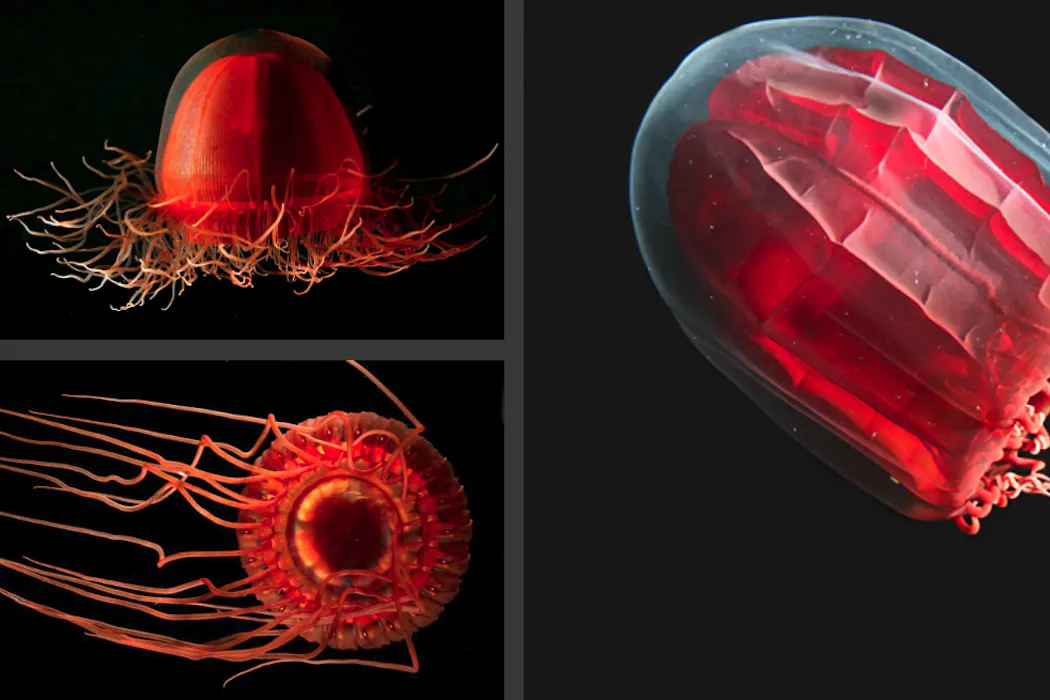
In the workSecrets of the deep ocean, just published by Quae editions, Juliette Ravaux, associate professor at Sorbonne University in animal biology, and Sébastien Duperron, professor at the National Museum of Natural History and specialist in microbial ecology, introduce us to mysterious animal species and little-known resources of the deep ocean. Their goal is to better understand this common good, in order to preserve it better. In this excerpt, these specialists show us what the curious species living in the abyss perceive, which they both observed during their dives aboard theNautile, submarine of the scientific fleet both unique… and cramped.
Life in the deep ocean comes with a range of environmental constraints, including the absence of sunlight and the scarcity of food. These two conditions alone affect essential functions of organisms such as orientation in their environment in search of food or mates, as well as metabolism, growth, and reproduction. Consequently, deep-sea species possess a vast diversity of adaptations, some of which are presented here, but many remain to be discovered!
Let’s descend on the Mid-Atlantic Ridge, more than 2,000 meters deep, near the black smokers that spew a burning fluid. There, on the walls of the hydrothermal chimneys, shrimp gather by the thousands in swarming clouds. These are blind shrimp,Rimicaris exoculata, an emblematic species of these Atlantic environments. The adults do not possess the typical stalked eyes of shrimps, which is why they have this nickname. And yet, they do have eyes, though they are difficult to recognize because they are greatly modified: they are pink V-shaped plates located on their backs. These plates do not allow them to see their environment as an image like our eyes do.
But they are very sensitive to light and detect sources of very low intensity light, invisible to the human eye. They consist of a very thick layer of photoreceptor cells, beneath which is a reflective layer of white cells that reflects light back to the photoreceptors, thereby increasing the amount of light perceived.
Thanks to these hypersensitive sensors, the shrimpsRimicarisare therefore specialized in the detection of faint light. It remains to be determined which light signals they perceive in their environment among potential sources, such as those emitted by the hydrothermal fluid in the form of thermal radiation.
Bioluminescent animals, or why it is not completely dark in the abyss
LikeRimicaris, abyssal species evolve in dark environments devoid of sunlight. However, there is another major light source: bioluminescence. Weaker than sunlight, it is only visible at night in surface waters, but it is clearly visible at depth thanks to the contrast with the black background. This light emitted by organisms reveals the presence of partners, predators, sources of food, and can also serve as defense, a lure, or camouflage. In the twilight zone, various species thus display a bioluminescent belly that makes them less visible to predators and prey located below. This counter-illumination indeed allows them to blend into the faint light coming from the surface.
Beyond 1,000 meters, bioluminescence is the main, if not the only, source of light. It appears intermittently in the form of light flashes, most often blue or green, lasting from a few tenths of a second to a few seconds. Observations conducted off the coast of New York in the 1950s reported frequencies of bioluminescent signals up to 94 flashes per minute within the photometer’s field of view at depths beyond 1,000 meters. In the 2000s, an inventory of fauna off the Californian coast, from the surface down to 3,900 meters deep, revealed that more than three quarters of individuals in the water column emit light. The oceans crackle with a silent fireworks display, and the luminous landscape of the depths appears as a black background dotted with bluish sparks.
Eyes adapted to dark landscapes
In these dark landscapes, are the animals blind? The eyes of teleost fish living in the depths are often described as “regressed” or “degenerate.” However, these eyes do indeed exist, and deep-sea fish are generally not blind, quite the opposite. The eyes of bathypelagic fish exhibit a wide variety of morphologies: they are sometimes clearly regressed, with an absent or defective retina, as in the “whale fishes” of the genusCetomimus, or on the contrary very large and developed, like those of the beaked alepocéphale (Alepocephalus rostratus).
Overall, with a few exceptions, the eyes of bathypelagic species tend to be smaller (relative to body size) than those of their mesopelagic zone relatives. However, they are perfectly functional and particularly effective at detecting brief bioluminescent flashes, thanks to two notable features: a large pupil and a retina rich in photoreceptors highly sensitive to light. The current record holder is the silver spinyfin, an abyssal species that possesses an exceptional number of pigments responsible for detecting low light, the rhodopsins. While humans have only one type of rhodopsin, the spinyfin has 38! Each of these rhodopsins would be capable of detecting a color within the range of blues and greens. This exceptional repertoire of pigments therefore allows the spinyfin to distinguish more shades of blue and green light than humans, which proves very useful for identifying different sources of bioluminescence and thus distinguishing predators from prey.
Like the direct (vision), the majority of deep-sea fish have vision limited to blue and green wavelengths. They cannot perceive other colors and are therefore colorblind! Bathypelagic fish would theoretically be able to see a bioluminescent flash at a distance of up to 100 meters in clear water. However, this distance is actually unattainable for most pelagic fish, which do not have enough energy to swim to a light source at such a distance in a short time. Thus, even if deep-sea fish can see distant flashes, they probably only react to those produced at a closer distance.
Just like bathypelagic fish, the crustaceans of these depths exhibit a great variety of eye morphologies. Here again, there are examples of eyes particularly sensitive to light and adapted to the detection of bioluminescence. The record probably goes to the large eyes of the ostracod.Gigantocypris muelleri, which have reflectors resembling car headlights and giant photoreceptors that give it impressive sensitivity to light. It is thus able to distinguish the silhouettes of prey and predators outlined against the faint light descending in the water column above it, and it can outwit the counter-illumination camouflage of bioluminescent species in the twilight zone. While it can effectively detect bioluminescence, this crustacean cannot, however, see precisely the organism producing it because its eyes have low resolution, which makes it see things blurry!
In the deep sea, there are species whose vision has adapted to perceive very low light intensities, and within a specialized range of colors, rather than to produce a sharp and detailed image of their environment.

The authors do not work for, do not advise, do not hold shares in, do not receive funds from an organization that could benefit from this article, and have declared no other affiliation than their research institution.
–ref. What the creatures of the abyss see in the dark –https://theconversation.com/what-abyss-creatures-see-in-the-dark-280281