

Source: French to English Tester Published on: 2026-04-23
Source: The Conversation – in French– By Xavier Bonnet, CNRS Research Director at UMR 7372 in biology and ecology of reptiles, Centre d’Etudes Biologiques de Chizé; La Rochelle University
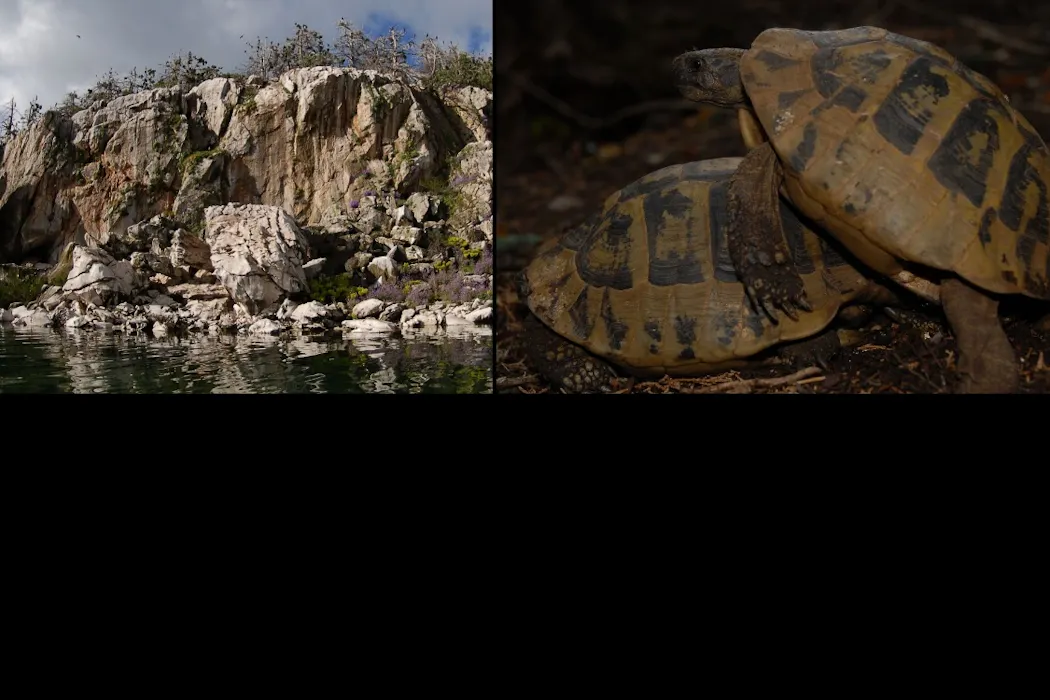
On the protected island of Golem Grad, in North Macedonia, Hermann’s tortoises are self-destructing. The cause: the brutality of the males, who exhaust the females and regularly push them off the cliffs. As a result, there are now one hundred males for a single female capable of laying eggs. This situation is the only known example of demographic suicide in the wild to date.
Large animal populations living in favorable, stable, and protected environments have no reason to go extinct. Unless a catastrophe, such as a devastating fire, the destruction of their habitat, or overexploitation, annihilates all individuals or weakens the population, making it vulnerable to diseases and other disturbances and hazards.
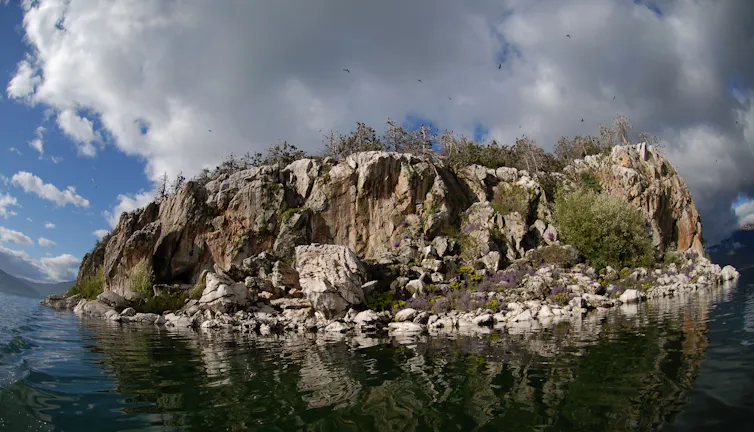
Sheltered by the steep cliffs bordering Golem Grad Island on Lake Prespa in North Macedonia, the Eastern Hermann’s tortoises (Testudo hermanni boettgeri) swarm on the wooded plateau. They bask in the morning sun, graze in the meadows, and rest, court, or mate while uttering small high-pitched cries. At first glance, nothing seems to threaten this population.
Provided by the author
As with other long-lived species, a high adult survival rate is essential for maintaining populations. On Golem Grad, adults have no predators, as neither wild boars, dogs, rats, nor humans live on this strictly protected island. The high-altitude Mediterranean climate is also favorable for reptiles.
All these factors probably explain the extraordinary population density of about 50 individuals per hectare, the highest known for turtles. It is also the ease of observing the turtles that is at the origin offield monitoringestablished since 2008, the result of a fruitful scientific collaboration between North Macedonia, Serbia, and France. This long-term monitoring program has received the labelSEE-Lifeof the CNRS in 2023.
But appearances are deceptive: this population is in a critical state. The numerous demographic, behavioral, physiological, and experimental data collected over nearly twenty years show that, although very active sexually and reproductively,this population is in the process of committing suicideAh !
Demographic suicide
Demographic suicide is a theoretical, strange, and counter-intuitive process. The conditions for its existence are particular. For a given species, one must imagine a high-density population where violent mating threatens the survival of females. This would gradually lead to an imbalance of the sex ratio (proportion of males and females in a population), an excess of males, worsening pressure on fewer and fewer females who are increasingly harassed, which would ultimately trigger a vicious circle leading to the disappearance of females and, in the long run, extinction.
Coercive and violent mating systems are common in nature. Generally, males harass females until they achieve mating, sometimes injuring them. In some cases, these behaviors can lead to the death of females, as seen in elephant seals, wild sheep, gray squirrels, otters, deer, red frogs, fruit flies, humans… However, such fatal outcomes do not benefit males who will have no offspring if the female dies during mating. These behaviors are therefore maladaptive and remain marginal.
Different regulatory mechanisms also block the emergence of a vicious circle or extinction vortex. Females can deploy a wide range of avoidance and defense strategies, such as hiding, seeking the protection of a dominant male, or forming alliances.
Moreover, the most violent males generally produce fewer offspring than those who spare the females, so their behavioral traits are less likely to persist over time. Furthermore, when they are in overpopulation, males tend to migrate, which relieves the pressure on females. Thus, conflicts between the sexes in coercive mating systems are resolved by efficient equilibria, without escalation.
However, rare experiments involving animals studied in captivity have shown that males can have a strong negative impact on populations when the sex ratio and population density are artificially biased and increased. In aJapanese shrimp, the excess of males reduces the fertility of females as well as the opportunities to mate. In theviviparous lizard, the surplus males become aggressive which decreases fertility as well as the survival of females.
Under natural conditions, the ecological, behavioral, and evolutionary reality of populations is more complex: females can flee, for example, and there is no reason for the sex ratio and population density to reach extremes.
No demographic suicide had been observed in nature until now. The turtles of Golem Grad, which are sawing the branch on which they stand, thus bring about thefirst example that defies the ruleÂ: the males are eliminating the femalesÂ!
What is disturbing the population of Golem Grad?
Some information about sexual behaviors and a comparison with a control population are useful to understand what is happening in Golem Grad.
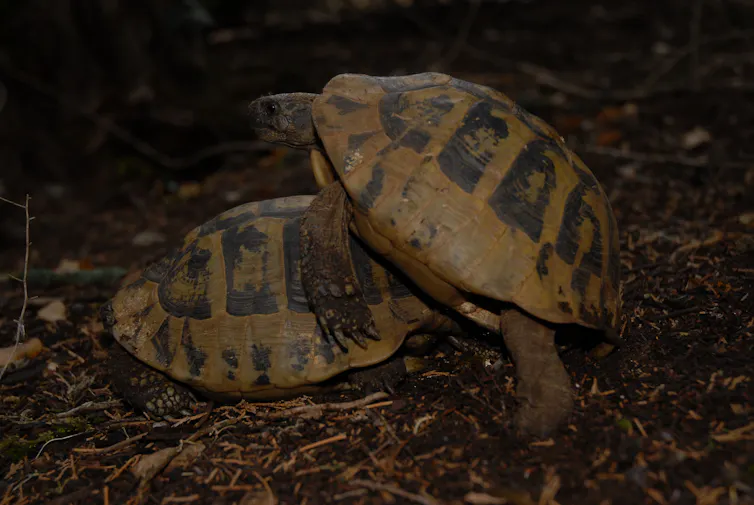
In terrestrial turtles, the mating system is coercive: males chase the females, knock them around, sometimes bite them until they bleed, and with respect to eastern Hermann’s tortoises, they stab them at the cloaca with their long pointed tail until they give in.
Provided by the author
As Hermann’s tortoises are abundant in North Macedonia, we were able to study another very dense population located on the shores of the lake 4 kilometers from the island. Genetically very close to that of Golem Grad, it lives in a protected environment without cliffs. The females are large, heavy (many weigh between 2.5 kg and 2.9 kg) and very fecund as shown by X-rays. Slightly more numerous than the males, they effectively resist their intermittent assaults. No demographic problems have been detected there; demographic projections suggest an increase in the population.

Provided by the author
But at Golem Grad, the situation is quite different. On the plateau, more than 700 adult males patrol searching for around forty adult females. Moreover, if the physiological and environmental conditions are not adequate, a female Hermann’s tortoise may very well not lay eggs after mating. For example, if they are too thin and too stressed, the females cannot accumulate reserves in the ovarian follicles and the eggs do not develop.
There are actually more than 100 males for each female capable of laying eggs. However, the study of newborns and juveniles shows that the sex ratio is not biased at birth. The surplus males often act in packs of three to eight. They harass the females all day long, injure them, and lie down next to them in the evening, ready to start again the next day. The females get little respite and not enough time to feed. They are thin (very few exceed 1.6 kg, the maximum being 1.75 kg) and produce, when they do, half as many eggs as those in the control population.
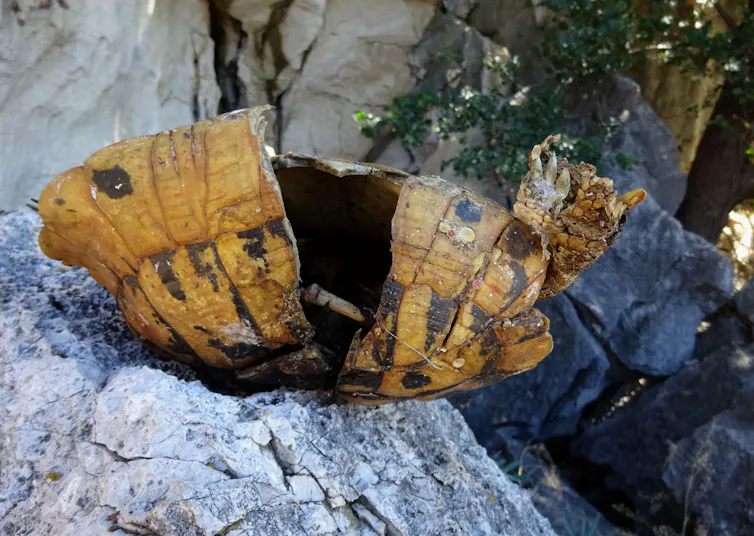
Unable to escape, they are regularly cornered on the edge of cliffs, where insistent males push them into the void. A GPS with an accelerometer installed on a female recorded her fall of more than 20 meters on July 18, 2023; she died broken in two along with her three eggs.
Provided by the author
Since the beginning of the study, we have been identifying all turtles found dead in the field where the shells are preserved for a long time. Among the deceased females, 22% suffered a fatal fall, this proportion is 7% among males.
With British colleagues, we also developed an epigenetic clock that measures the age of individuals through a blood sample. The oldest males are over 60 years old, the oldest female 35 years. These results are consistent with morphological, growth, and demographic analyses. The survival rate is abnormally low among females, and this problem is caused by the brutality of the males.
The extinction vortex
Over time, the decrease in the number of adult females and their fertility slows recruitment. We were thus able to identify in the field 45 adult females in 2009, then 37 in 2010, 20 in 2024, and only 15 in 2025.
However, it takes about fifteen years for a female to reach adulthood. Frustrated by the lack of sexual partners, the males therefore mate with other females, corpses, stones, and immature females. This prematurely affects their survival and worsens the demographic problem. It is possible to model the functioning of the population by integrating the above parameters. It is also possible to make predictions.
The last female could die in 2083, the males will persist for decades, as these turtles can live more than eighty years, then eventually die in their turn. This is a prediction; perhaps the population currently on the brink of extinction will recover, even though we do not see how. If the very slow pace of life of the turtles gave us the chance to observe an extinction vortex in nature, and thus to verify a strange theory, it is especially the intensive field monitoring that provided us with the data and inspiration.

Xavier Bonnet benefited from the support of SEE-Life CNRS.
–ref. How a turtle population is in the process of self-destructing on a Macedonian island –https://theconversation.com/how-a-population-of-turtles-is-in-the-process-of-self-destructing-on-a-macedonian-island-280638