

Summary of defence and geopolitical posts for April 21, 2026.
AI, Lego, and Rap: Iran’s New Weapons Against Trump and Netanyahu
April 21, 2026
Source: French to English Tester Published on: 2026-04-19
Source: The Conversation – France in French (3)– By Arnaud Mercier, Professor of Information and Communication at the French Press Institute (University Paris-Panthéon-Assas), University Paris-Panthéon-Assas

Shortly after the start of the war in Iran, numerous videos generated by artificial intelligence were published on social networks by accounts close to the Tehran regime. Drawn from the Lego universe, combined with a rap text and edited like music videos, they have a very specific goal: to expose the propaganda of the Iranian regime with sarcasm and in an attractive way, and to discredit its American and Israeli adversaries. Analysis of a communication tool that borrows many codes from Western pop culture.
In all wars, the belligerents engage in propaganda operations to enhance their own side and discredit the opponent, while seeking to support the morale of their population and maintain its mobilization. Sometimes, these propaganda operations take the form of speeches and images that primarily act as counter-propaganda, responding to the arguments and imagery of the adversary in order to neutralize their possible effects on their own opinion or on international public opinion.
In this game, the Islamic Republic of Iran shows itself to be very active and efficient. It supports a small network of activists who publish brief videos online generated by artificial intelligence that ridicule the Trump and Netanyahu administrations through animations of… Lego figurines. As we have already shown,AI becomes a key asset for visual contestation.
A preexisting use of Lego to denounce the war
Replicating Lego pieces by AI is relatively simple. Result: many images using this device circulate on the Internet for humorous or critical purposes. The association of the Lego universe with the denunciation of war is part of these uses.
Thus, the destruction of Gaza by Israeli bombings gave rise to the generation of images of Lego boxes, made up of shattered pieces meant to represent the ruins of Gaza, these montages being used bothby supporters of Israel to humiliate the Palestiniansor by defenders of the latter to protest against the actions of the Netanyahu government.
Similarly, the sarcasm targeting Donald Trump’s ambition to appropriate Greenland also involved the use of Lego imagery, which is all the more ironic since the company was born in Denmark, which exercises its guardianship over this Arctic territory.

Account X Piraten_Saar
Lego rap version videos to gain virality
Internet culture is both amemetic cultureand a mimetic culture. Mimetic, because the success conditions of a message partly rely on its prior and recognizable cultural grounding, especially when it comes to content with a humorous or sarcastic intent. The “LOL” culture (an English acronym for “laughing out loud”) consists of winks, allusions, overlaps between current events and older references, and fusions of cultural references that do not spontaneously go together, or even clash.
Also to read:
Ukraine: the meme war
The use of already known references to comment on the news aboutsocial networksthen helps to gain visibility, and catches the eye better in an economy of attention that is always volatile. Taking ownership of existing imagery, which already circulates according to a logic,described by Limor Shifman, remake, parody, imitation (of memes, then), increase the potential for virality. Lego figurines universally known as children’s toys, the animated Legos from mainstream films (The Lego movie, in 2014, was asuccess at the global box office, Lego as a humorous resource, are just as many references already circulating on the Internet and make it an effective memetic resource.
Added to this is the mimetic culture, which means that the initial success inspires other creators who see in a meme and its references an exploitable formula. This mimetic work can be seen in recent times, since following the strong visibility gained by the first Iranian Lego counter-propaganda content, which appeared at the end of March, other creators (anonymous and therefore not necessarily Iranian) also produce Lego videos denouncing the military adventurism of Donald Trump and the Israeli prime minister. They are notably recognizable by the fact that the figurines are not always animated, and by the portrayal of Trump which does not have exactly the same face as in the Iranian videos.
One thing is certain, using very well-known popular figurines guarantees the reception of this message among people who might be attracted by these images, whereas they would have spontaneously fled any classic Iranian propaganda message.
Furthermore, the soundtrack accompanying these videos is always rap, again AI-generated, with lyrics that are virulent and humiliating for Donald Trump and his Israeli ally, which constitutes a counter-discourse well in line with the brutal, unsophisticated, and vulgar phrasing of Donald Trump himself and appropriates the practice ofpunchlinesof rap. Moreover, the use of toys allows showing the violence of war while bypassing the restrictions imposed on these images by social networks.
A well-designed tool for counter-propaganda
Two Iranian propaganda groups sign their works, circulated since the end of March, at a daily rate:Persiaboi & Explosive News. TheBBC intervieweda representative of the second group. The latter admits to having the Iranian state as a “client” and considers it “honorable to work for the homeland.” He also explains that his team atExplosive Mediahas fewer than ten people and uses Lego-style graphics “because it’s a universal language.” On X, the accounts of Iranian and Russian state media regularly share them, which allows reaching millions of views.
This work is very well thought out since it closely follows current events, recycling images that have circulated through news channels worldwide, either to highlight them better or to challenge them if they go against Tehran’s interests. This counter-propaganda indeed responds promptly—often within a few hours—to speeches given or events that have occurred. The aim is to try to nip in the bud an American-Israeli rhetoric that could spread and convince public opinion, by offering an alternative narrative, another way of seeing the facts, of interpreting the situation.
In the following two examples, we see that the image of an American Awacs plane bombed on a Saudi base is part of the Lego imagery in several videos. They are seeking true realism in the depiction of the damage caused to the fuselage.
In the same spirit, Iranian propaganda stagedMohammed Qalibaf, one of the new strongmen of the IR, during his flight to Islamabad to meet J. D. Vance who came to negotiate an outcome to the conflict on behalf of Donald Trump: photos of the children killed in thebombing of their school in Minab on February 28had been placed on the passenger seats of his plane, as well as bloodstained and damaged schoolbags. This macabre staging is taken up at the beginning of aLego video.
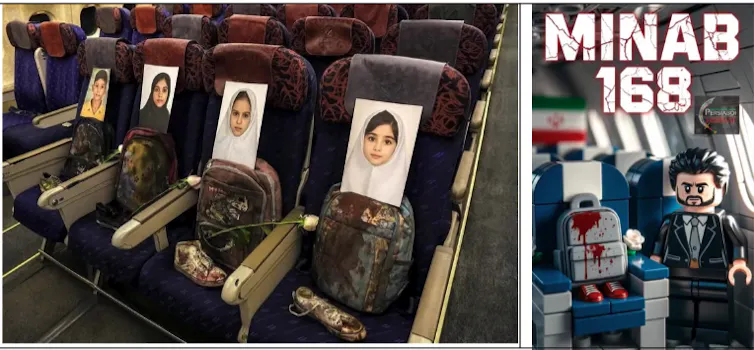
The most blatant counter-narrative is found in the video made by PersiaBoi, published on April 7, 2026, and entitled“Uranium heist. Dead of night”. With these synthetic images, the video runs counter to the heroic narrative of the operation to rescue an American aviator stranded in enemy territory.
Far from the success loudly staged by the Trump administration, this short clip denounces against a rap background a “failed operation, $600 million wasted”. The operation would have been, according to the authors of the video, an (failed) attempt to recover Iranian enriched uranium: “They said it was a rescue. But it was a heist, a uranium heist”: “They say it was a rescue operation, but it was a heist, a uranium heist.”
Donald Trump, the main target of this Lego propaganda
In all war propagandas, one of the obsessions is to discredit one’s enemies and especially their leader. Donald Trump is therefore particularly targeted. Beyond attacks on his failings as a war leader — he is depicted as immature, cowardly, and a liar — Iranian propaganda recycles a whole series of criticisms that have long been directed at him, notably by his American political opponents. Such an approach is likely to delight his many detractors around the world, including some of those who are nonetheless hostile to the mullahs’ regime.
Donald Trump is presented as a “loser”: he is supposedly losing the war, so he experiences panicked fear, materialized by beads of sweat on his face and by a worried or horrified look. He would therefore still be ready to retreat. This is the exploitation of the famous TACO figure:Trump always Chickens Out(“Trump always chickens out”) is the label American political opponents stick on him. And, ultimately, he would be defeated, and we show him burning or agonizing in the emergency room, with petroleum in an IV drip.
His lack of credibility is also denounced by invoking the figure of the clown:
… but also that of the compulsive liar, spreader of fake news.
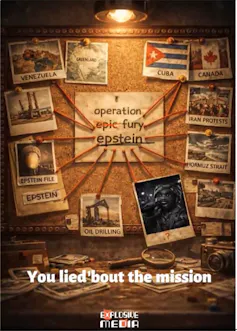
Iran, avenger of the martyr children…
This undermining of Donald Trump’s and the American army’s reputation — who are said to be bogged down in Iran — is accompanied by an attempt to ennoble the regime of the mullahs, who present themselves as defenders of martyred children. Included are the little girls from the Minab school, destroyed by an American missile, as well as references to the teenage girls caught in the nets of Jeffrey Epstein and his accomplices. The heroic defense of Iran is thus portrayed as a way to avenge the memory of these girls with tragic fates.
Once again, internal narratives within American political life are recycled by the Iranians to try to rally opponents of Trump to their cause. This is how, in several videos, memorial inscriptions are drawn on Iranian missiles ready to be launched against American forces.
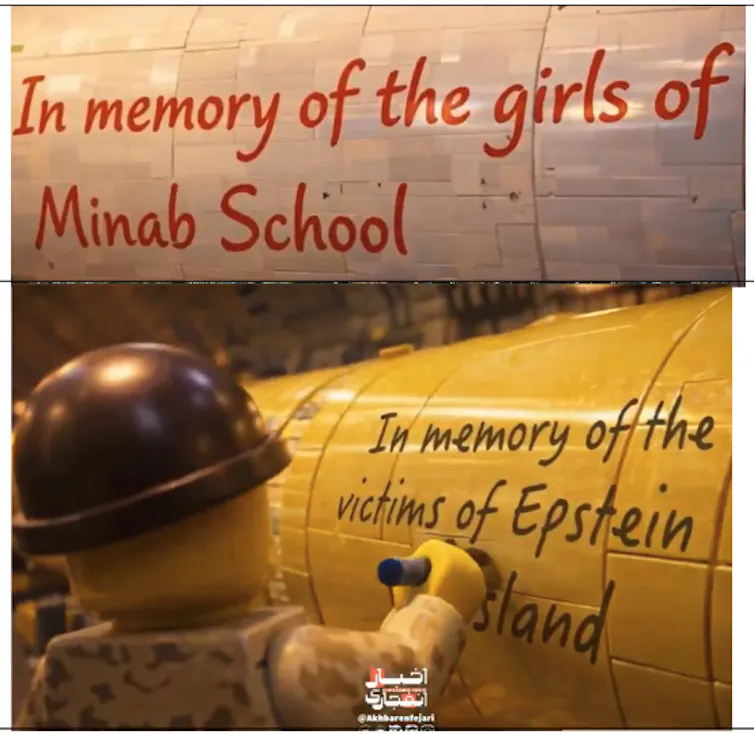
… and unifying the victims of America
To conclude on the incredible wealth of Western references carried by these twenty or so videos posted online (and sometimescensored by the platforms), it is also necessary to point out the presence of references, globally known, to archetypes of anti-Americanism. In these videos, the Iranians seek to rally to their cause all those who have historical grievances against the United States of America. A video published in early April byExplosive Newsprovides a historical overview of the populations that have good reasons to bear ill will towards America.
Under the title“one vengeance for all”mobilized are figurines of feathered Indians, chained African slaves, a Vietnamese family, Japanese victims of the nuclear bomb, Iraqi prisoners of Abu Ghraib, children of Gaza, little girls from Epstein Island. Iran would be their vengeful arm, triggering a series of spectacular destructions: the White House is in ruins, the letters of Hollywood Hill are on fire, the Statue of Liberty collapses, the aircraft carrier Gerald Ford explodes, the 1-dollar bill burns.
The regime that has justmassacre at least 30,000 of its citizensfor having had the misfortune to claim their freedom therefore has the nerve to present himself as the repairer of what he calls historical injustices.
The recycling of antisemitic motifs
To complete this overview of the main aspects of this original counter-propaganda, it is necessary to highlight the antisemitic nature of several depictions produced by a regime that advocates for the disappearance of the State of Israel. These videos point to the responsibility of the Israeli prime minister in Trump’s alignment with the bombings in Iran. They repeatedly use the cliché of the Jew who pulls the strings, the Jew puppeteer who manipulates the world, directly inspired himself by the devil. This nauseating imagery can be found in the history of Slavic (notably Serbian) or Nazi antisemitic iconography.
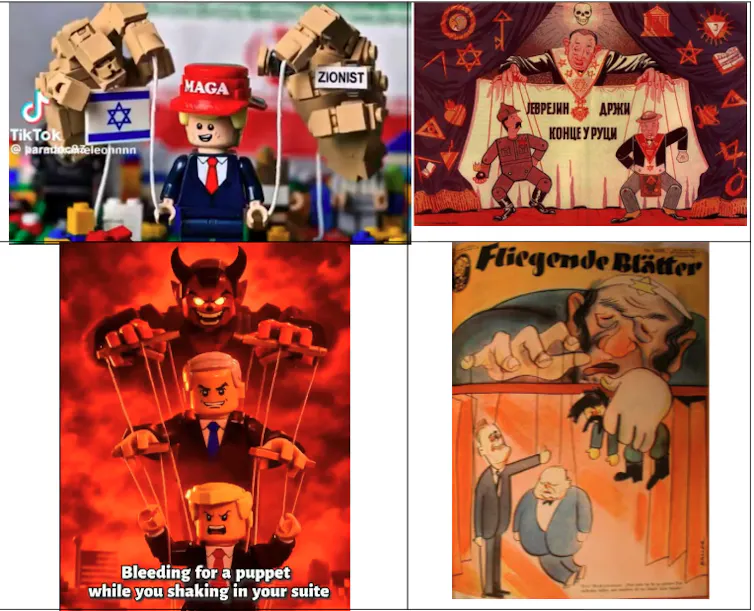
Trump and Netanyahu act under the control of the devil (in his classic Christian representation, red and with horns) and Moloch, in his original Jewish representation but bearing Judaic symbols that make him an anti-Semitic marker. Knowing that the Bible associates the worship of Moloch, practiced among the Canaanites in antiquity, with child sacrifice.
In one of the videos, these diabolical and repulsive figures end up being sacrificed thanks to the supposedly purifying action of Iran. Such iconography also reconnects with the official rhetoric of the Iranian regime, which systematically calls America the “Great Satan” and Israel the “Little Satan.”
Let us add, to conclude, that these videos place Iran on the side of modernity and mastery of AI content generation. This nation of engineers presents itself as capable of producingad libitum, and in a hyper-reactive way, counter-propaganda videos in response to the armed assaults and the communication power of the Americano-Israeli forces.

Arnaud Mercier received funding from the European Commission.
–ref. AI, Lego and rap: Iran’s new weapons against Trump and Netanyahu –https://theconversation.com/lia-lego-and-rap-the-new-weapons-of-iran-against-trump-and-netanyahu-280607
Back to index · Read original article
“StravaLeaks”: when digital traces become a security issue
April 21, 2026
Source: French to English Tester Published on: 2026-04-20
Source: The Conversation – in French– By Fabrice Lollia, Doctor in information and communication sciences, associate researcher at the DICEN Ile de France laboratory, Gustave Eiffel University
The “StravaLeaks” case shows that, in a world saturated with connected objects and location data, ordinary digital traces have become a central security issue for sensitive environments. Simple movement data from a jog, recorded and shared by a public application, were able to be used to locate ships or military bases.
A jog, apparently, has nothing sensitive. Yet, in March 2026, an activity recorded on Strava by a French soldier made it possible to locate in near real time theaircraft carrierCharles de Gaullein the Eastern Mediterranean. Since 2018, theStrava global heatmapA – an aggregated visualization of public activities recorded by its users – had already revealed somemilitary bases and sensitive sites, and more recent investigations have shown that the sporting practices of bodyguards can reveal movement habits ofHeads of State.
The problem does not stem from sophisticated hacking, but from the ordinary use of a connected watch, a public account, and GPS tracking accessible online. This case illustrates how today’s security no longer limits itself to physical protection but also includes controlling the digital traces produced by our most ordinary behaviors.
When an application goes beyond its initial use
Strava is an application designed to track and share sports performances. Its primary use concerns leisure, digital sociability, and self-monitoring, not the documentation of sensitive activities. Yet this is where the ambivalence of this type of tool lies because, although not designed with security in mind, they can have very concrete effects on it.
As tracking technologies become part of daily use, they cease to appear as control devices. They become familiar tools, associated with comfort or the optimization of practices. From then on, a race, a repeated route, a starting or ending point, or an activity recorded at sea can reveal much more than just a sporting practice. A performance data point can become an indication of a routine, a presence, or a travel habit.
The Strava case is not isolated, moreover.At Heathrow Airport(London), in 2014, connected toilets were tested to anonymously measure their usage, improve cleaning, and better allocate maintenance resources. The example may seem remote, but it shows that, beyond explicitly security-related tools, connected devices also discreetly collectdigital traceson user behavior. In this sense, vulnerability no longer arises solely from an attack or a voluntary leak, but alsoof ordinary uses whose visibility effects are often underestimated.
Security is no longer determined only on the field
For a long time, security was thought of according to an essentially physical model. It was necessary to protect a person, secure a movement, control a perimeter, anticipate a threat. This logic is still relevant but, in the digital age, it is no longer sufficient.
In an environment saturated with connected objects, platforms, and location data, vulnerability can now arise at the periphery of the protection system. It no longer necessarily results from an intrusion or malicious action. It can come from a poorly configured use, an unexamined digital routine, or a tool used without awareness of its visibility effects.
The security of a political leader, a business executive, a diplomat, or a sensitive site therefore also depends on the digital traces produced by their human and technical environment: assistants, drivers, escorts, collaborators, military personnel, connected objects, tracking applications, or sharing networks. Protecting a “sensitive person,” a personality, today is no longer just about protecting their body or their itinerary. It is also about protecting the informational ecosystem that surrounds them.
This evolution reflects security increasingly reinforced by technologyviathe sensors, the data, and the monitoring tools. But the addition of technology does not eliminate vulnerability. That is precisely the problem of atechnosolutionist readingwhich overestimates human-machine complementarity. On the contrary, it reminds us that technology is only effective when it is combined with human analysis, field experience, and a deep understanding of the context. Certainly, technology therefore enhances vigilance, but it does not replace judgment, training, or a culture of risk.
The observed vulnerability is also organizational, cultural, and human. It arises from a form of mismatch between the banality of digital practices (running with a connected watch, for example) and the sensitivity of the environments in which they take place (being in a classified secret-defense location). The same tool can be perceived as a comfort or performance device while producing significant exposure effects.
Training thus becomes as important as equipping because it is not just about forbidding certain uses, but rather about making people understand how a digital trace, by definition invisible, can, through aggregation and cross-referencing, become sensitive information. Security is therefore no longer about controlling tools, but about the intelligence of practices.
Reintegrate the human at the center of security doctrine
One of the main lessons from these cases is that no technology protects on its own. An app, a connected watch, or a geolocation device are neither good nor bad in themselves.As research shows, it all depends on the context in which they are used, the rules that surround them, and the ability of the actors to understand their effects. This is why the response cannot be purely “technical”.
It also requires a usage doctrine, appropriate training, and a shared safety culture. Conversely, traceability can also enhance protection, but it does not replace human analysis, context assessment, or traditional safety methods.
In other words, the security of sensitive environments relies on a complementarity between the tool and the human. It is not enough to deploy devices; users must also understand what they produce, what they expose, and the possible consequences of their uses between potential surveillance and asurveillance, that is to say a more discreet form of capturing traces integrated into ordinary gestures and sometimes barely perceived by those who participate in them.
In the Strava case, the issue is therefore not just about better configuring an application. It is about building a culture of digital risk, capable of integrating the most ordinary actions into security considerations.
What research teaches us in connection with these cases is that the real lesson of these affairs may be here: in a connected world, the threat does not only lie in what one tries to hide, but also in what one produces without thinking.
These so-called “StravaLeaks” cases show that digital traceability, far from being a mere convenience of use, can become a security issue when it is part of a sensitive environment. Protecting today is no longer just about locking down a perimeter or escorting a personality. It is also about learning to manage the traces produced by the most ordinary uses.

Fabrice Lollia does not work for, advise, hold shares in, or receive funds from any organization that could benefit from this article, and has declared no other affiliation than his research institution.
–ref. « StravaLeaks »: when digital traces become a security issue –https://theconversation.com/stravaleaks-when-digital-traces-become-a-security-issue-279942
Back to index · Read original article