

AM Edition: Here are the top 10 energy articles on LiveNews.co.nz for April 21, 2026 – Full Text
European Soil Directive: Why Environmental DNA Monitoring Will Not Be Enough
April 21, 2026
Source: French to English Tester Published on: 2026-04-20
Source: The Conversation – in French– By Mickaël Hedde, Research Director, Inrae
The European directive on soil monitoring, adopted by the European Union at the end of 2025, aims to achieve healthy soils by 2050. Soils are indeed at the crossroads of multiple issues: climate, biodiversity, food, etc. Yes, but with what measurement tools? The text decided in Brussels only currently mandates the approach based on environmental DNA. However, France has strong experience in measuring soil quality, which could be advantageously utilized: the best monitoring tools are those that simultaneously integrate several complementary approaches.
Since November 2025, the European Directive onsoil monitoring and resiliencerequires Member States to regularly assess soil biodiversity. For the biological part, the directive provides for monitoring every six years,microbial diversity of soils(bacteria and fungi) fromenvironmental DNA(ADNe).
However, while eDNA is a powerful tool for detecting biodiversity on a large scale, it is insufficient on its own to interpret the observed changes and identify their causes. Indeed, bacterial and fungal communities represent only a part of soil biodiversity, which also includes many organisms with crucial and varied ecological roles.
Soil functioning also relies on the abundance, biomass, and activity of living organisms, aspects that cannot be assessed solely by molecular detection. A graduated approach combining several complementary protocols is therefore necessary to produce robust and useful indicators for public action.
The French experience, notably through the soil quality measurement network (RMQS) and theGIS Sol, constitutes, in this capacity, a reference framework for the interpretation of results and a proven operational framework for soil biodiversity monitoring. This could usefully complement the foundation provided by European legislation.
Environmental DNA, necessary but not sufficient
TheDNAis a molecular approach and, as such, offers advantages in environmental monitoring: broad – and a priori standardized – detection of biodiversity, high spatial and temporal comparability… Such methods constitute a particularly effective tool for detecting changes in the composition of biological communities.
However, molecular signatures derived from eDNA do not always allow for the accurate identification of taxa present in soils. They may exhibit biases ofrepresentativeness. They are, moreover, often weakly correlated with other essential biological characteristics used to characterize biodiversity and soil functioning, such as the abundance of organisms, their biomass, their demographic structure, or their activities. They will therefore provide an incomplete — and sometimes even distorted — view of soil health.
However, beyond simply detecting changes in diversity, monitoring systems must also allow for the interpretation of these changes, that is, understanding what they imply for soil functionality, for example in agriculture, and identifying their causes. This is what will enable the evaluation of the effectiveness of public policies and management practices. In this context, reducing the biological and ecological complexity of soils to this single component carries a risk related to the difficulties of interpretation.
The directive nevertheless provides that Member States may supplement the mandatory indicators with other biological indicators in their national monitoring systems, thereby opening the possibility for more integrated approaches.
A tool for public decision-making assistance
Environmental monitoring pursues two distinct and complementary objectives: detecting changes in the state of ecosystems and attributing these changes to environmental pressures, land uses, or management practices. These two dimensions are closely linked by the biological and ecological processes that structure the functioning of ecosystems.
Beyond their scientific scope, the indicators used to monitor soil biodiversity constitute a tool to aid public decision-making. It is not only about identifying the dynamics of biological communities but also understanding their causes. This therefore concerns, first and foremost, public decision-makers. The aim is to guide sustainable planning and management practices, to identify degradation situations, to implement policies to address them, and to be able to evaluate their effectiveness.
A monitoring system limited to detecting changes in soil biodiversity without enabling their interpretation and attribution to environmental pressures would provide only a limited basis for evaluating public policies and implementing appropriate management strategies.
Biodiversity is not reduced to the number of taxa alone
The ecological functions of the soil – such as the regulation of water and contaminants, the provision of nutrients, carbon storage, maintenance of structure, or the support of biodiversity itself – are not static states, but dynamic processes. They rely on the activity of living organisms, their biomass and their functional characteristics (physiology, behavior) as well as their interactions (competition, symbiosis, parasitism). They manifest through fluxes and renewal rates rather than simple stocks.
In this context, molecular approaches provide valuable information about the presence of organisms but do not, by themselves, allow for the evaluation of these dynamic processes or their intensity. A correct interpretation of soil functioning therefore requires additional measurements as well asinterpretation frameworksallowing to link biological indicators to the different land use contexts and environmental conditions.
Environmental DNA data are increasingly used to develop new approaches, for example those based oninteraction networks, which allow representing the organization of soil biological communities. When these networks are built solely from presence or co-occurrence data, they mainly reflect the sharing of ecological conditions or environmental niches by different species.
This then only provides indirect information about the biological activities at work and the flows of matter and energy, which also determine the functioning of soils. Ecological interpretation requires additional information, particularly about the abundance or biomass of organisms. This is how biological communities can be linked to the ecological processes that support soil functions.
A graduated and complementary approach
In order to reconcile operational efficiency and ecological relevance, soil biodiversity monitoring is increasingly combining several types ofapproaches, each providing specific information about the state and functioning of biological communities.
DNA-based approaches allow for broad and standardized detection of microbial biodiversity, and could be extended to other organisms such as invertebrates.
Other methods are based on the direct observation of soil fauna organisms, the estimation of their abundance or biomass, or the analysis of their functional characteristics. They provide essential information on the biological structure and ecological role of soil communities.
These approaches should not be considered mutually exclusive, but as complementary tools. They allow linking the composition of biological communities (taxonomic and functional structure) to the ecological processes that support soil functions. Their combination is, in this respect, particularly interesting for building a monitoring strategy presenting different levels of information.
This logic of complementarity is already being implemented in some existing monitoring systems. For example, within the framework of the French soil monitoring network (RMQS) or in the mountain biodiversity observatoryOrchamp. These approaches are not meant to be deployed everywhere, but their combination is essential to correctly interpret the state and evolution of soil biodiversity.
Our recommendations for the implementation of the directive at the national level
Preserving the capacity to understand, explain, and act requires recognizing that the biological complexity of soils calls for a controlled diversity of monitoring approaches.
With the support ofGIS Sol, France is among the nations at the forefront of soil biodiversity monitoring. It has tested this approach, combiningseveral protocols within the RMQS, for several years. This experience, rare at the European level, must serve as the foundation on which to build the future national soil monitoring network.
The directive provides, beyond the mandatory indicators, the possibility for Member States to supplement their systems with optional indicators. This flexibility offers the opportunity to establish a monitoring system capable not only of detecting trends in soil biodiversity evolution, but also of interpreting their causes and possibilities.remediation. This finally allows for the assessment of the implications for public policies.
In this perspective, several principles should guide the national implementation of the European directive:
-
Do not restrict national soil biodiversity monitoring to a single measure derived from eDNA, which limits our ability to interpret the observed changes.
-
Implement a combination of complementary measures, enabling the connection of biodiversity detection to community structure and ecological processes that support soil functions, with the support of protocols and measures that will be developed in the PEPR.DynabiodandLivingSoils.
-
Develop interpretation frameworksopenand analytical frameworks that allow evaluating whether the observed variations are significant, in order to link biological indicators to land use and environmental pressures.
-
Make use of existing mechanisms, notably the RMQS supported by the GIS Sol, in order to ensure the coherence, comparability, and scientific robustness of the future national surveillance system.
This article is a joint production of the RMQS Biodiversity, the PEPR SolsVivants and Dynabiod, and the RNEST, represented by the co-authors. The elaboration of this document was also contributed to by: Apolline Auclerc, Nolwenn Bougon, Miriam Buitrago, Philippe Hinsinger, Claudy Jolivet, Antoine Lévêque, Gwenaël Magne, Florence Maunoury-Danger, Jérôme Mathieu, Christian Mougin, Laurent Palka, Benjamin Pauget, Guénola Pérès, Sophie Pouzenc, Sophie Raous, Claire Salomon, Marie-Françoise Slack, Wilfried Thuiller, Cécile Villenave, Quentin Vincent.

Mickaël Hedde has received funding from various French organizations (OFB, ANR, ADEME) and the European Union (Horizon Europe) to conduct his research at INRAE.
Antonio Bispo is the director of the INRAE Info&Sols research unit based in Orléans. He has received funding from various French organizations (Ministries, OFB, ANR, ADEME, Centre Val de Loire Region) and from the European Union (Horizon Europe) to conduct his research. The research unit leads, on behalf of the GIS Sol (www.gissol.fr), the national soil inventory and monitoring programs, it also manages the national soil information system.
Claire Chenu is a member of the French Association for Soil Study (AFES), a corresponding member of the Academy of Agriculture, and a member of the Academy of Technologies. She co-chairs the Scientific, Technical, and Innovation Committee of the National Network for Scientific and Technical Expertise on Soils (CSTI RNEST). She has received European funding (particularly from the European Joint Programme SOIL) to conduct research within INRAE and AgroParisTech.
Flavien Poincot is an engineer at Acta who supports, facilitates, and represents the network of 19 agricultural technical institutes, applied research organizations working for all agricultural, animal, and plant productions.
Jérôme Cortet is a member of the French Society of Evolutionary Ecology (SFE2) and of the French Association for Soil Study (AFES). He currently co-chairs the Scientific, Technical and Innovation Committee of the National Network for Scientific and Technical Expertise on Soils (CSTI RNEST). He has received funding from various French organizations (ANR, ADEME, Occitanie Region) to conduct his research within the Center for Functional and Evolutionary Ecology, a laboratory affiliated with the University of Montpellier Paul-Valéry.
–ref. European Directive on soils: why monitoring by environmental DNA will not be enough –https://theconversation.com/eu-soil-directive-why-monitoring-by-environmental-dna-will-not-be-enough-280098
Back to index · Read original article
Generative AI, the first cognitive revolution in the history of work
April 21, 2026
Source: French to English Tester Published on: 2026-04-20
Source: The Conversation – in French– By Hugo Spring-Ragain, PhD student in economics / mathematical economics, Center for Diplomatic and Strategic Studies (CEDS)
Artificial intelligence does not so much destroy jobs as it profoundly changes the skills required to perform them. From this confusion between jobs and skills, errors may arise in policies supporting ongoing transformations.
Each major technological wave has produced its share of contradictory predictions about employment. Artificial intelligence (AI) is no exception. But before knowing how many jobs AI will create or destroy, we need to agree on what it actually automates. The answer requires distinguishing three notions that public debate regularly confuses: employment, skill, and task.
The great waves of automation have followed a remarkably stable logic over two centuries: steam, electricity, and industrial robotics have displaced repetitive physical tasks and spared non-routine cognitive work. This empirical regularity has beenformalized by Autor, Levy, and Murnanesince 2003 under the name “task polarization hypothesis.”
A persistent illusion
Automation erodes intermediate jobs, those of skilled blue-collar workers and office employees performing routine tasks, but spares the two extremes. On one hand, non-routine manual tasks, such as plumbing or caregiving, on the other, non-routine cognitive tasks, such as analysis, consulting, or expert writing. The latter constituted the core of skilled tertiary professions, and the conviction was firmly established that they would remain out of reach.
Also to read:
Why AI is forcing companies to rethink the value of work
This conviction was based on a conceptual confusion that must be cleared up first and foremost. It was not the job of a lawyer or financial analyst that was protected, but a set of specific tasks that made up this job and which had until now resisted automation. The distinction between these three levels is fundamental.
A job designates a position held within an organization, with a contract, a salary, and a job description. A skill is a cognitive or technical ability that can be applied in various professional contexts. A task is a specific, definable action, for which it is possible to assess whether or not it can be automated at a given cost. It is at this third level that the ongoing transformation truly takes place, and it is precisely this level that the public debate ignores.
Rupture in the long history of industrial capitalism
Generative AI represents a breakthrough in this long history. For the first time since industrialization, qualified cognitive tasks such as writing, document analysis, synthesis, and production of first drafts are directly exposed.Eloundou, Manning, Mishkin and Rockestimate that about 80% of the active U.S. workforce could see at least 10% of their tasks affected by large language models, and that this exposure increases with salary level. This is the exact opposite pattern observed in all previous waves.
The analytical framework developed byAcemoglu and Restrepoallows to go further. Their model distinguishes two opposing effects produced by any wave of automation:
-
The displacement effect, first: workers lose tasks to the benefit of the machine, which mechanically reduces the demand for labor and weighs on the wages of the affected groups;
-
The reintegration effect, then: automation produces new tasks where human value is decisive, generating compensatory demand.
The long history of industrial capitalism can be read as a succession of these two effects, the second generally ending up compensating for the first.
The case of translation allows us to see very concretely how displacement and reintegration combine. Generative AI can produce a first draft in another language in a few seconds, which shifts part of the work previously done by human translators to the machine. But this automation simultaneously reintegrates other tasks or enhances their importance, such as checking for misunderstandings, adapting to the cultural context, harmonizing terminology, quality control, and final validation.
Potential imbalance
What is worrying with generative AI is the potential imbalance between these two dynamics. The shift is happening at a speed that labor markets and training institutions struggle to absorb, while reintegration still largely remains to be built.
However, the most important phenomenon is not sectoral, but it is internal to the professions themselves. In its“Employment Outlook”, the OECDhighlights that the professions most exposed to generative AI are precisely those with a high cognitive density: finance, law, consulting, higher education. Unlike previous waves that affected rural areas and industrial regions, the exposure is now stronger in large metropolitan areas and among highly skilled workers, an unprecedented geographical and social reversal.
Redistribute tasks
This reversal concretely takes place at the level of the task.
In the same position of financial analyst or legal advisor, some tasks are shifting to AI (producing an executive summary, generating an initial contract analysis, synthesizing a literature review), while others are mechanically gaining value: defining the relevant analytical framework, assessing the quality of automated reasoning, detecting factual errors in an output, assuming legal or ethical responsibility for a decision. These are not jobs that disappear. They are bundles of tasks that are redistributed between humans and machines, transforming from within what an employer expects from a qualified employee.
This redistribution of tasks has a direct impact on the skills that will truly be valued in the coming years, and it overturns some of the usual assumptions about professional training.
Train workers to use AI instrumentally, to master a tool, to writepromptsEffective, mastering an interface is useful in the short term, but it is insufficient if the skill truly required tomorrow is not to produce with AI, but to supervise and critique what it produces.
A training challenge
However, effectively supervising an AI output requires exactly what short and technical trainings struggle to develop: a solid general knowledge that allows detecting a fundamental error, an argumentative ability to evaluate the coherence of a reasoning, a knowledge of cognitive biases to identify the blind spots of an automated analysis. These are skills thateducational sciences group under the term metacompetencesTo learn to learn, to exercise critical judgment, to mobilize knowledge in unprecedented situations.
The paradox then becomes the following. As AI automates routine knowledge tasks, it precisely values what generalist training and humanities courses have long cultivated and what debates on employability have tended to disregard in favor of more immediately measurable technical skills.
Not out of nostalgia for the humanities, but out of pure economic logic. If the machine produces the text, the analysis and the synthesis, the marginal value of the human lies in their ability to judge whether this text is true, whether this analysis is relevant in light of the real context, whether this synthesis serves the pursued objective.

Hugo Spring-Ragain does not work for, advise, own shares in, or receive funds from any organization that could benefit from this article, and has declared no other affiliations than his research institution.
–ref. Generative AI, the first cognitive revolution in the history of work –https://theconversation.com/lia-generative-premiere-revolution-cognitive-de-lhistoire-du-travail-279911
Back to index · Read original article
AI, Lego, and Rap: Iran’s New Weapons Against Trump and Netanyahu
April 21, 2026
Source: French to English Tester Published on: 2026-04-19
Source: The Conversation – France in French (3)– By Arnaud Mercier, Professor of Information and Communication at the French Press Institute (University Paris-Panthéon-Assas), University Paris-Panthéon-Assas

Shortly after the start of the war in Iran, numerous videos generated by artificial intelligence were published on social networks by accounts close to the Tehran regime. Drawn from the Lego universe, combined with a rap text and edited like music videos, they have a very specific goal: to expose the propaganda of the Iranian regime with sarcasm and in an attractive way, and to discredit its American and Israeli adversaries. Analysis of a communication tool that borrows many codes from Western pop culture.
In all wars, the belligerents engage in propaganda operations to enhance their own side and discredit the opponent, while seeking to support the morale of their population and maintain its mobilization. Sometimes, these propaganda operations take the form of speeches and images that primarily act as counter-propaganda, responding to the arguments and imagery of the adversary in order to neutralize their possible effects on their own opinion or on international public opinion.
In this game, the Islamic Republic of Iran shows itself to be very active and efficient. It supports a small network of activists who publish brief videos online generated by artificial intelligence that ridicule the Trump and Netanyahu administrations through animations of… Lego figurines. As we have already shown,AI becomes a key asset for visual contestation.
A preexisting use of Lego to denounce the war
Replicating Lego pieces by AI is relatively simple. Result: many images using this device circulate on the Internet for humorous or critical purposes. The association of the Lego universe with the denunciation of war is part of these uses.
Thus, the destruction of Gaza by Israeli bombings gave rise to the generation of images of Lego boxes, made up of shattered pieces meant to represent the ruins of Gaza, these montages being used bothby supporters of Israel to humiliate the Palestiniansor by defenders of the latter to protest against the actions of the Netanyahu government.
Similarly, the sarcasm targeting Donald Trump’s ambition to appropriate Greenland also involved the use of Lego imagery, which is all the more ironic since the company was born in Denmark, which exercises its guardianship over this Arctic territory.
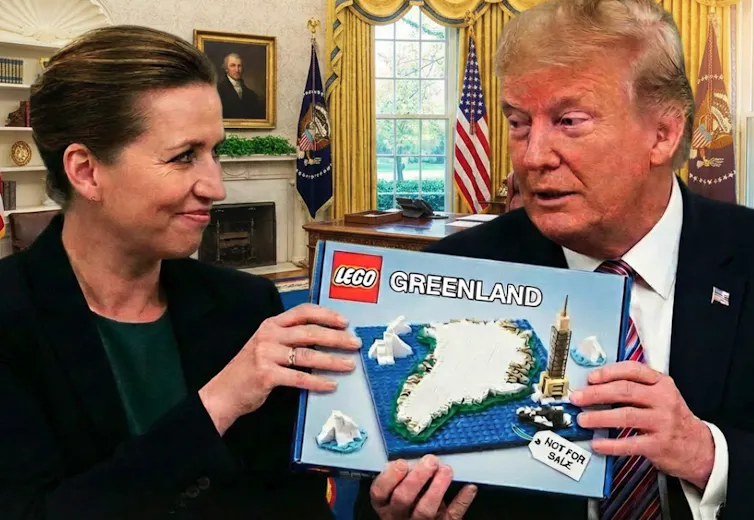
Account X Piraten_Saar
Lego rap version videos to gain virality
Internet culture is both amemetic cultureand a mimetic culture. Mimetic, because the success conditions of a message partly rely on its prior and recognizable cultural grounding, especially when it comes to content with a humorous or sarcastic intent. The “LOL” culture (an English acronym for “laughing out loud”) consists of winks, allusions, overlaps between current events and older references, and fusions of cultural references that do not spontaneously go together, or even clash.
Also to read:
Ukraine: the meme war
The use of already known references to comment on the news aboutsocial networksthen helps to gain visibility, and catches the eye better in an economy of attention that is always volatile. Taking ownership of existing imagery, which already circulates according to a logic,described by Limor Shifman, remake, parody, imitation (of memes, then), increase the potential for virality. Lego figurines universally known as children’s toys, the animated Legos from mainstream films (The Lego movie, in 2014, was asuccess at the global box office, Lego as a humorous resource, are just as many references already circulating on the Internet and make it an effective memetic resource.
Added to this is the mimetic culture, which means that the initial success inspires other creators who see in a meme and its references an exploitable formula. This mimetic work can be seen in recent times, since following the strong visibility gained by the first Iranian Lego counter-propaganda content, which appeared at the end of March, other creators (anonymous and therefore not necessarily Iranian) also produce Lego videos denouncing the military adventurism of Donald Trump and the Israeli prime minister. They are notably recognizable by the fact that the figurines are not always animated, and by the portrayal of Trump which does not have exactly the same face as in the Iranian videos.
One thing is certain, using very well-known popular figurines guarantees the reception of this message among people who might be attracted by these images, whereas they would have spontaneously fled any classic Iranian propaganda message.
Furthermore, the soundtrack accompanying these videos is always rap, again AI-generated, with lyrics that are virulent and humiliating for Donald Trump and his Israeli ally, which constitutes a counter-discourse well in line with the brutal, unsophisticated, and vulgar phrasing of Donald Trump himself and appropriates the practice ofpunchlinesof rap. Moreover, the use of toys allows showing the violence of war while bypassing the restrictions imposed on these images by social networks.
A well-designed tool for counter-propaganda
Two Iranian propaganda groups sign their works, circulated since the end of March, at a daily rate:Persiaboi & Explosive News. TheBBC intervieweda representative of the second group. The latter admits to having the Iranian state as a “client” and considers it “honorable to work for the homeland.” He also explains that his team atExplosive Mediahas fewer than ten people and uses Lego-style graphics “because it’s a universal language.” On X, the accounts of Iranian and Russian state media regularly share them, which allows reaching millions of views.
This work is very well thought out since it closely follows current events, recycling images that have circulated through news channels worldwide, either to highlight them better or to challenge them if they go against Tehran’s interests. This counter-propaganda indeed responds promptly—often within a few hours—to speeches given or events that have occurred. The aim is to try to nip in the bud an American-Israeli rhetoric that could spread and convince public opinion, by offering an alternative narrative, another way of seeing the facts, of interpreting the situation.
In the following two examples, we see that the image of an American Awacs plane bombed on a Saudi base is part of the Lego imagery in several videos. They are seeking true realism in the depiction of the damage caused to the fuselage.
In the same spirit, Iranian propaganda stagedMohammed Qalibaf, one of the new strongmen of the IR, during his flight to Islamabad to meet J. D. Vance who came to negotiate an outcome to the conflict on behalf of Donald Trump: photos of the children killed in thebombing of their school in Minab on February 28had been placed on the passenger seats of his plane, as well as bloodstained and damaged schoolbags. This macabre staging is taken up at the beginning of aLego video.

The most blatant counter-narrative is found in the video made by PersiaBoi, published on April 7, 2026, and entitled“Uranium heist. Dead of night”. With these synthetic images, the video runs counter to the heroic narrative of the operation to rescue an American aviator stranded in enemy territory.
Far from the success loudly staged by the Trump administration, this short clip denounces against a rap background a “failed operation, $600 million wasted”. The operation would have been, according to the authors of the video, an (failed) attempt to recover Iranian enriched uranium: “They said it was a rescue. But it was a heist, a uranium heist”: “They say it was a rescue operation, but it was a heist, a uranium heist.”
Donald Trump, the main target of this Lego propaganda
In all war propagandas, one of the obsessions is to discredit one’s enemies and especially their leader. Donald Trump is therefore particularly targeted. Beyond attacks on his failings as a war leader — he is depicted as immature, cowardly, and a liar — Iranian propaganda recycles a whole series of criticisms that have long been directed at him, notably by his American political opponents. Such an approach is likely to delight his many detractors around the world, including some of those who are nonetheless hostile to the mullahs’ regime.
Donald Trump is presented as a “loser”: he is supposedly losing the war, so he experiences panicked fear, materialized by beads of sweat on his face and by a worried or horrified look. He would therefore still be ready to retreat. This is the exploitation of the famous TACO figure:Trump always Chickens Out(“Trump always chickens out”) is the label American political opponents stick on him. And, ultimately, he would be defeated, and we show him burning or agonizing in the emergency room, with petroleum in an IV drip.
His lack of credibility is also denounced by invoking the figure of the clown:
… but also that of the compulsive liar, spreader of fake news.
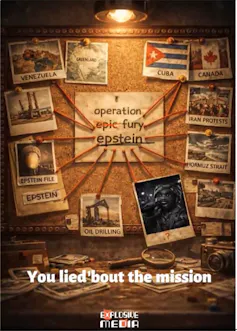
Iran, avenger of the martyr children…
This undermining of Donald Trump’s and the American army’s reputation — who are said to be bogged down in Iran — is accompanied by an attempt to ennoble the regime of the mullahs, who present themselves as defenders of martyred children. Included are the little girls from the Minab school, destroyed by an American missile, as well as references to the teenage girls caught in the nets of Jeffrey Epstein and his accomplices. The heroic defense of Iran is thus portrayed as a way to avenge the memory of these girls with tragic fates.
Once again, internal narratives within American political life are recycled by the Iranians to try to rally opponents of Trump to their cause. This is how, in several videos, memorial inscriptions are drawn on Iranian missiles ready to be launched against American forces.
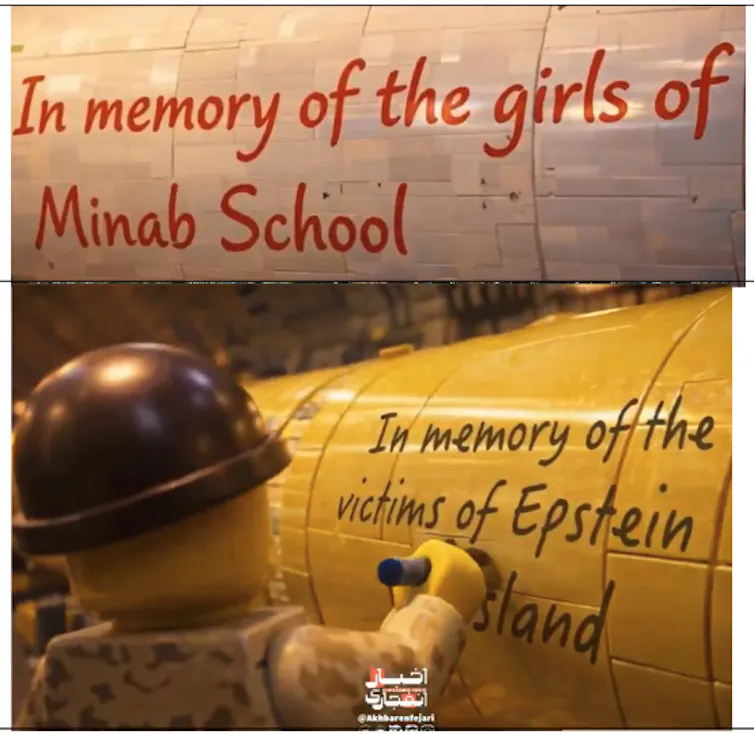
… and unifying the victims of America
To conclude on the incredible wealth of Western references carried by these twenty or so videos posted online (and sometimescensored by the platforms), it is also necessary to point out the presence of references, globally known, to archetypes of anti-Americanism. In these videos, the Iranians seek to rally to their cause all those who have historical grievances against the United States of America. A video published in early April byExplosive Newsprovides a historical overview of the populations that have good reasons to bear ill will towards America.
Under the title“one vengeance for all”mobilized are figurines of feathered Indians, chained African slaves, a Vietnamese family, Japanese victims of the nuclear bomb, Iraqi prisoners of Abu Ghraib, children of Gaza, little girls from Epstein Island. Iran would be their vengeful arm, triggering a series of spectacular destructions: the White House is in ruins, the letters of Hollywood Hill are on fire, the Statue of Liberty collapses, the aircraft carrier Gerald Ford explodes, the 1-dollar bill burns.
The regime that has justmassacre at least 30,000 of its citizensfor having had the misfortune to claim their freedom therefore has the nerve to present himself as the repairer of what he calls historical injustices.
The recycling of antisemitic motifs
To complete this overview of the main aspects of this original counter-propaganda, it is necessary to highlight the antisemitic nature of several depictions produced by a regime that advocates for the disappearance of the State of Israel. These videos point to the responsibility of the Israeli prime minister in Trump’s alignment with the bombings in Iran. They repeatedly use the cliché of the Jew who pulls the strings, the Jew puppeteer who manipulates the world, directly inspired himself by the devil. This nauseating imagery can be found in the history of Slavic (notably Serbian) or Nazi antisemitic iconography.
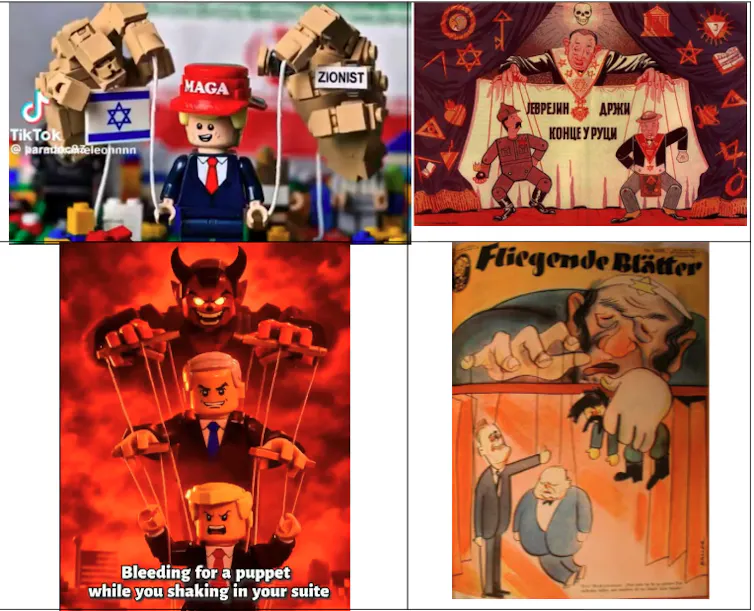
Trump and Netanyahu act under the control of the devil (in his classic Christian representation, red and with horns) and Moloch, in his original Jewish representation but bearing Judaic symbols that make him an anti-Semitic marker. Knowing that the Bible associates the worship of Moloch, practiced among the Canaanites in antiquity, with child sacrifice.
In one of the videos, these diabolical and repulsive figures end up being sacrificed thanks to the supposedly purifying action of Iran. Such iconography also reconnects with the official rhetoric of the Iranian regime, which systematically calls America the “Great Satan” and Israel the “Little Satan.”
Let us add, to conclude, that these videos place Iran on the side of modernity and mastery of AI content generation. This nation of engineers presents itself as capable of producingad libitum, and in a hyper-reactive way, counter-propaganda videos in response to the armed assaults and the communication power of the Americano-Israeli forces.

Arnaud Mercier received funding from the European Commission.
–ref. AI, Lego and rap: Iran’s new weapons against Trump and Netanyahu –https://theconversation.com/lia-lego-and-rap-the-new-weapons-of-iran-against-trump-and-netanyahu-280607
Back to index · Read original article