

Source: French to English Tester Published on: 2026-04-04
Source: The Conversation – France (in French)– By Alessandro Meregaglia, Associate Professor and Archivist, Boise State University
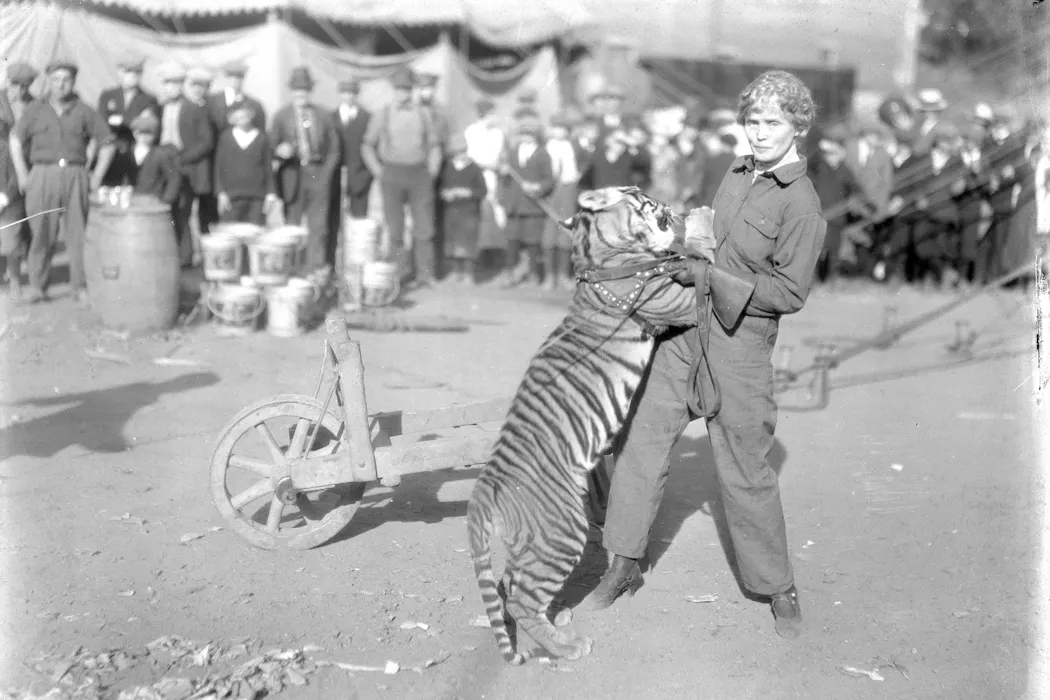
At the beginning of the 20th century, Mabel Stark, a former nurse, became the most famous tiger trainer in the United States. Her story tells both the rise of a woman in a male-dominated world and the constant dangers of training wild beasts.
For the sharpest minds in show business, there is always a new vein to exploit. Take Joe Exotic, who despite hisconviction in 2020for a conspiracy to commit murder and for violations of the Endangered Species Act, the United States law on endangered species, was able to continue making headlines.
Since the beginning of his 21-year sentence, the star of “Tiger King” has launched a cannabis brand, sold digital art, and begun working on an album provisionally titled “Jungle Rhapsody: A Tiger King Experience.” His latest idea is to sell personal phone calls from his cell – “What better Valentine’s Day gift could you give to a loved one?”he wrote on Instagram in January 2026.
But before Joe Exotic, there was Mabel Stark. Often presented as the most famous American tiger trainer, the “Tiger Queen” was known for her daring and charisma.
While conducting research on Caxton Printers, the editor of Stark’s autobiography, I came acrossunpublished archivesdedicated to Stark’s long career in animal training. Like Joe Exotic, Stark had a flair for showmanship. But, even more remarkably, she managed to build a career under the watchful eye of a male-dominated environment while caring for her animals with affection rather than fear.
From nurse to tiger trainer
Born Mary Ann Haynie in 1888 or 1889 – the exact year remains a mystery – Stark grew up in Princeton, Kentucky. At the age of 8, she attended her first circus show, where the trained animal acts fascinated her. It took her two decades before she had the opportunity to try training animals herself.
On vacation in California, while working as a nurse, Stark met Al Sands, the director ofAl G. Barnes Circus. After learning that she was interested in animal training, he hired her on the spot.
Stark first started by horseback riding and training goats. It took him several more years before working with tigers. But once launched, his career took off. Crowds flocked to see the “Tiger Girl” wrestle with big cats and dazzle the audience by commanding up to a dozen tigers at once. His wrestling act with his favorite tiger, Rajah – in which the duo rolled on the ground three or four times – became one of themost famous wild animal acts in the United States. She used this success to join the Ringling Circus – the largest circus in the United States – toa salary twice as high.
As her fame grew, she collaborated with the screenwriterGertrude Orrto tell the story of his life. “Hold That Tiger” appeared in bookstores in 1938.Caxton Printers, a small publishing house located in rural Idaho, published the book and mainly marketed it to a young audience. The book was successful, selling well enough to be reprinted several times.
Known for giving a voice to debut authors and writers from underrepresented groups, Caxton Printers found aeditorial slotin books dedicated to the world of the circus. The house also published works on Stark’s first employer, Al Barnes, as well as on the Ringling brothers and the famous lion trainer Louis Roth, to whom Stark was once married.
Female power in the arena
Stark was fully aware of the path she was opening. “I deliberately chose a field in which no other woman had specialized”.she writesin his autobiography.
The conventional wisdom of the time,she added, wanted the “tigers to be considered too dangerous for a woman to train.” Her determination to defy these conventions mattered.As noted by circus historian Janet M. Davis, “the performances of women in the circus celebrated female power” and represented “a striking alternative to the social norms of the time.”
In early 20th century America, women perhaps could neither vote nor serve on juries in most states, but in the circus ring, they captured the public’s attention, riding bareback horses, displaying strength and endurance, and performing acrobatic feats that defied gravity.
Stark’s pace was relentless. She performed almost every day with traveling circuses and constantly perfected her act. In 1938, she worked simultaneously with tigers and lions, a first for a female trainer. She made history again by presenting an act with12 tigersin the same cage.
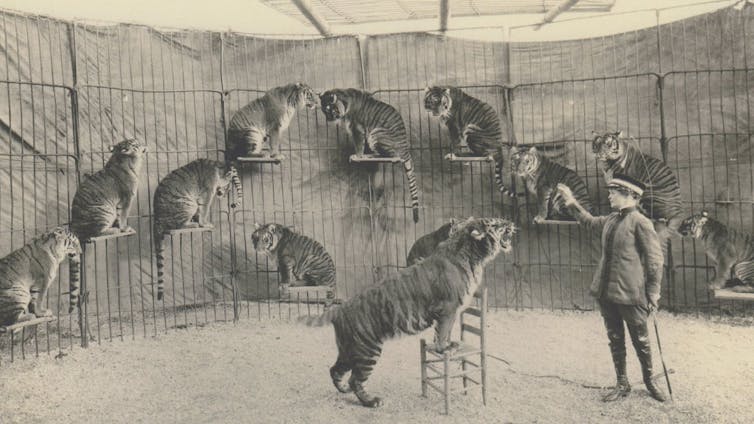
Cinema Libre Studios
Whether due to the demands of his schedule or his preference for his beasts, Stark’s relationships with men rarely worked. Throughout his life,she married four times, and divorced three times.
“I love these big cats like a mother loves her children”.did she confide to a friend. But “with my husbands, I have never been happy.”
“An animal trainer must never be nervous”
Stark, aware ofabusive behaviors of other trainers towards their tigers, chooses another path. “Kindness and patience are the most important factors in training. (…) Trainers who try to dominate animals through violence always end up in trouble”.she explained.
But his job was not without danger.
“An animal trainer must never be nervous. I haven’t been since I left the nursing profession,” she declared inan interview granted toNew York Timesin 1922. “Maybe violets will be planted on my grave tomorrow, but as long as I have health and strength, I prefer to take care of ten tigers rather than one sick person.”
Stark experienced several serious accidents. The worst probably occurred in 1928: after the late arrival of a circus train, Stark began her act without knowing that her tigers had not been fed for 24 hours. Two hungry tigers attacked her after she slipped in the mud.
“While I was lying there, powerless,she wrote, I was wondering into how many pieces I would be torn, and how long it would take the other tigers, growling and grumbling nervously on their seats, to finish me off.” She suffered multiple fractures, nearly lost a leg, and had to receive 300 stitches.
Then, in 1950,a tigress mutilated herwhile she was trying to catch her little one. The doctors initially thought they would have to amputate her arm, but they ultimately managed to save it.
Despite these dangerous encounters with his tigers,Stark said: “I am not afraid. I like the challenge that their roaring challenge represents.”
The harsh reality
Stark toured with circuses until the late 1940s,before being hired by Jungleland, a zoo located near Los Angeles.
Except for the three and a half yearsthat she moved to Japanon tour with her wild animal act, she spent the last twenty years of her career in this zoo.
Stark never stopped attracting crowds to her shows and never stayed away from the spotlight. Sheeven appeared on “What’s My Line?”, in 1961,a televised game show that invited participants to guess the profession of the guest.
“Each year has left scars on my body, but it has also brought me a full dose of happiness”did she remember.
Stark worked at Jungleland untilhis dismissalin 1967, when the park’s insurer no longer wanted to cover her. Being separated from her tigers devastated her and sheat the end of his daysa few months later, on April 20, 1968, at his home in Thousand Oaks.
The last paragraph of Stark’s autobiographyseems to announce the end of his life:
“The backstage door opens as I crack my whip and shout: ‘Let them come!’ The striped beasts advance stealthily, growling and roaring, leaping on each other or on me. It is an incomparable thrill, and life without this would not be worth living for me.”

Alessandro Meregaglia received funding from the Idaho Humanities Council, the Bibliographical Society of America, and the Institute for Advancing American Values at Boise State for his research on Caxton Printers.
–ref. The extraordinary story of Mabel Stark, the most famous tiger trainer in the United States –https://theconversation.com/the-extraordinary-story-of-mabel-stark-the-most-famous-tiger-trainer-in-the-united-states-279587