

Source: French to English Tester Published on: 2026-04-04
Source: The Conversation – France (in French)– By Olly Owen, Research Affiliate, Anthropology, University of Oxford
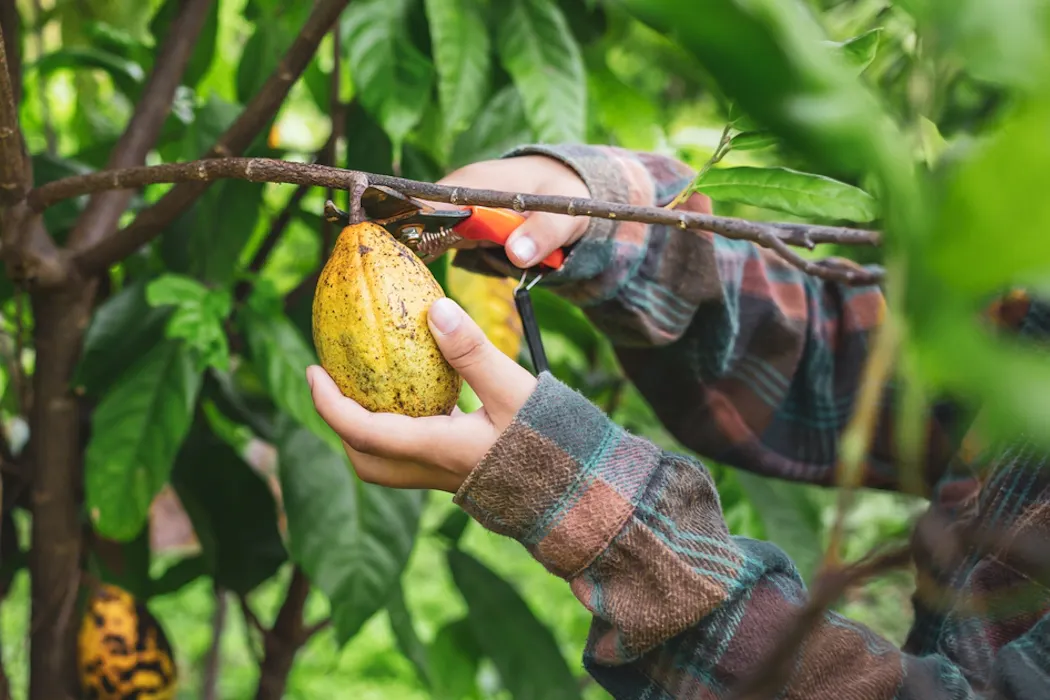
In Ekiti State, Nigeria, many cocoa producers continue to cultivate their plots under forest cover. A practice that protects biodiversity, regulates crop temperature, and provides an economic safety net.
The price of most chocolate bars has increased worldwide over the past year, following the spike in cocoa bean prices in 2024. And, as prices soared, many farmers in tropical countriescocoa producers,including Nigeria, have seen their profits increase.
With the opening of new cocoa plantations on the edge of forest areas,trees are often cut downto plant more cocoa trees. This increases deforestation in tropical forest regions, rich in biodiversity, where most of the cocoa is grown.
But ofstudiesshow that cutting down trees can actually lead, in the long term, to a lower production of beans, because the trees protect the crops against pests and provide the essential shade for cocoa trees.
Our researchconducted in Ekiti State, in southwestern Nigeria, explored how, when, and why trees are preserved in cocoa plantations, as well as the potential benefits they represent both for farmers and for the environment.
Cocoa in Nigeria
Asfourth largest cocoa producer in the world, Nigeria plays an important role in global supply.
Although the country has seen further development ofindustrial-type plantationscomposed solely of cocoa trees and devoid of other trees, its cocoa sector has, to some extent, escaped the wave of deforestation observed in other producing countries. This is partly explained by the fact that, for many years, Nigeria’s economic policy focused on the oil sector, while few investments were made in policies to “modernize” cocoa — the very policies that caused significant damage and heavy deforestation in other producing countries, such asGhana.
In Ekiti State, in the southwest of Nigeria, it is estimated that57% of cocoa is still grown on small farmswhere the tree cover remains significant. And yet, despite everything, Ekiti has lost a significant portion of its forest cover over the past two decades, one third of this deforestation being linked to agriculture. As part of our research, we sought to understand why some farmers choose to preserve trees and how existing production systems could be supported, even as producers around the world try to meet growing demand.
The importance of biodiversity
We visited 15 farms and observed a high level of biodiversity. We recorded 42 different tree species, many of which were recently planted by the farmers. The trees providing the most shade in these plantations are all native tropical forest species, notablytropical woods which are increasingly rare elsewherelike iroko (Excelsa militia), l’oganwo (Khaya senegalensis), the eku (Brachystegia eurycoma) and the obeche (Triplochiton scleroxylon). Some of these species have become so rare in Nigeria that cocoa plantations now serve as seed collection sites. Up to 26 bird species have also been observed at a single site.
The tree cover also plays an economic role in production. Amongthe 15 farmerswhom we interviewed, many value shade trees for their ability to keep the plants cool. The cocoa tree produces poorly when it is too hot and, as climate change threatens the future of many growing regions, temperature regulation will becomeincreasingly important. Trees also constitute a harvestable resource: 11 of the 15 farmers considered trees as a form of direct financial security, as the harvest of fruits and tree spices accounted for between 2% and 43% of their annual income, while wood could represent a share ranging from 0 to 57%.
Income derived from trees accounted for at least 20% of the total household income for the majority of farmers, and in some cases reached nearly 60% of income. Trees therefore serve as a safety net when cocoa income becomes insufficient.
The role of sustainability certificates
Tree cultivation is certainly not without difficulties for these farmers, but native tropical forest species generally harbor fewer pests, especially themirides. They also form canopies higher than thecultivated fruit trees, which limits fungal diseases.
The majority of farmers in Ekiti retain trees other than cocoa trees because of their value. These choices reflect a true balance: the benefits related to shade, pest control, income from fruits and wood, as well as climate regulation can compensate for possible short-term losses in cocoa production.
Efforts to limit deforestation and support sustainable cocoa production must take into account the trade-offs faced by farmers. This is all the more important since Nigeria’s forests arevery rich in biodiversityand that the country is particularly vulnerable to climate change.
The measures ofdurability certification, such as the one implemented by the Rainforest Alliance, could be expanded to further highlight cocoa beans from farms that use sustainable methods protecting the climate, notably by preserving trees in their plantations. This could help conserve tropical forests rich in biodiversity while assisting cocoa producers to make a living from their activity.
Given the global demand for cocoa, this issue is crucial for building a sustainable future.

Olly Owen received funding from the John Fell Fund of the University of Oxford and voluntarily provides technical advice to the Ekiti State Forestry Commission.
Zoe Brown received funding from the Tropical Agriculture Association Fund.
–ref. Cutting down trees to plant cocoa? A study in Nigeria reveals the hidden risks of deforestation for the producers themselves –https://theconversation.com/cutting-down-trees-to-plant-cocoa-a-study-in-nigeria-reveals-the-hidden-risks-of-deforestation-for-the-producers-themselves-279590