

AM Edition: Here are the top 10 law and security articles on LiveNews.co.nz for April 2, 2026: AM – Full Text
New Israeli law could mean death penalty by default for Palestinians convicted of deadly attacks
April 1, 2026
Source: MIL-OSI-Submissions-English
Source: The Conversation – Global Perspectives – By Shannon Bosch, Associate Professor (Law), Edith Cowan University
Israel’s parliament, the Knesset, this week passed legislation that would vastly expand capital punishment in Israel and in the occupied Palestinian territories.
The changes, made via an amendment to Israel’s penal law, allow for executions without proper appeal, pardons or meaningful judicial discretion.
According to media reports, 62 of 120 Knesset members voted in favour of the bill on Monday, including Prime Minister Benjamin Netanyahu, and 48 voted against. The remainder absented themselves from the vote or abstained.
UN experts and Amnesty International have warned these new death sentencing rules would apply almost exclusively to Palestinians.
It would, they argue, entrench discrimination already identified by the International Court of Justice as amounting to apartheid. UN experts said of the bill:
Since Israeli military trials of civilians typically do not meet fair trial standards under international human rights law and humanitarian law, any resulting death sentence would further violate the right to life […] Denial of a fair trial is also a war crime.
This development is a significant change for Israel, which has not executed anyone for more than 60 years. It reverses decades of global movement towards abolition, while normalising executions in an occupied territory.
Death penalty as the default
These changes were made via legislation brought by National Security Minister Itamar Ben-Gvir and his far-right Otzma Yehudit party.
The Penal Bill (Amendment ― Death Penalty for Terrorists) amends both Israeli civil law (applicable to Israeli settlers) and Israeli military law (applicable to Palestinians) in the occupied West Bank.
The law states, according to a Deutsche Welle media report:
Palestinians in the occupied West Bank convicted of terrorism in military courts will face a mandatory death sentence or, in the wording of the bill “his sentence shall be death, and this penalty only.” Only if the court determines that there are “special reasons” can it then commute the death sentence to life in prison.
Under this change:
- prosecutors do not need to request the death penalty
- the defence minister may submit an opinion to the judicial panel of three military officials who only need a simple majority to impose the death penalty
- judges need to record exceptional reasons for imposing a life sentence over the death penalty
- avenues for appeal would be tightly restricted
- there would be no possibility of a pardon
- people sentenced to death would be detained in isolated facilities that would have restricted visitor access, with legal counsel only by video link
- executions (by hanging) would take place within 90 days of the final judgement.
Another yet-to-be-passed bill that may still be brought before the Knesset – the Prosecution of Participants in the October 7 Massacre Events Bill – would also see more death sentences handed down.
It establishes ad hoc military tribunals with retrospective jurisdiction to prosecute those accused of participating in the October 7 2023 Hamas-led attacks on southern Israel.
These tribunals would:
- consist of a retired district court judge and two officers qualified to serve as judges
- be authorised to depart from ordinary rules around evidence and procedure
- be able to impose the death penalty via a simple majority, without prosecutors requesting it.
Appeals and clemency mechanisms would again be extremely limited.
Taken together, the two amendments significantly expand the scope of capital punishment in Israel. They also remove many procedural safeguards.
Supporters argue capital punishment could deter future attacks and preclude hostage-taking for prisoner exchanges.
Yet, historically, Israel’s intelligence services have opposed death sentences. They have argued it may encourage armed groups to kidnap Israelis as bargaining chips to prevent executions.
International humanitarian law
Critics have argued the new changes place Israel in breach of international humanitarian law and international human rights law.
As critics point out, Israel’s new death penalty rules limit access to legal counsel. They also:
- restrict appeals
- allows trials before ad hoc military tribunals for new capital offences
- mandate executions be carried out within 90 days.
This all runs counter to international humanitarian law.
Significant legal concerns are raised by Israel enforcing new capital offences in the occupied territory after the International Court of Justice concluded Israel’s occupation violates international law and must cease.
These concerns are compounded by longstanding criticisms of Israeli military courts in the occupied West Bank, where conviction rates for Palestinian defendants reportedly exceed 99%.
International human rights law
Under international human rights law people should be guaranteed equality before the law and protected from discrimination.
But the changes passed by the Knesset this week subject Palestinians to death sentences as the default, while Israeli citizens accused of killing Palestinians would appear before civil courts. Here, capital punishment would be discretionary and far more limited. This entrenches a discriminatory system.
Critics argue this amounts to collective punishment against Palestinians, which is prohibited under the Geneva Convention.
The European Union has warned that executions through hanging would also violate the absolute prohibition on cruel, inhuman or degrading treatment.
Taken together, the two new amendments normalise state-sanctioned executions and violate Israel’s obligations under international law.

Shannon Bosch does not work for, consult, own shares in or receive funding from any company or organisation that would benefit from this article, and has disclosed no relevant affiliations beyond their academic appointment.
– ref. New Israeli law could mean death penalty by default for Palestinians convicted of deadly attacks – https://theconversation.com/new-israeli-law-could-mean-death-penalty-by-default-for-palestinians-convicted-of-deadly-attacks-279458
Back to index · Read original article
The Department of Justice is suing states for sensitive voter data − an election law scholar explains why federal efforts are facing resistance
April 1, 2026
Source: MIL-OSI-Submissions-English
Source: The Conversation – USA – By John J. Martin, Assistant Professor of Law, Quinnipiac University
In May 2025, the U.S. Department of Justice began sending letters to state governments demanding copies of statewide voter registration lists. The request was unprecedented: It demanded not only publicly available voter data, such as names and addresses, but also sensitive information, including driver’s license and Social Security numbers.
That data is considered highly sensitive because it can be used to commit identity theft, access financial or government records, and facilitate targeted harassment or intimidation, particularly if the data were mishandled or leaked.
Underlying these requests is the Trump administration’s stated goal of rooting out fraudulent and illegal voting. With voter data in its hands, the DOJ seeks to identify ineligible voters and mandate state election officials to remove those voters from the rolls.
States have responded in a variety of ways. Some have fully complied with the requests, some partially complied, and many outright refused to provide any voter information. For the latter states, the Trump administration has taken the fight to court and sued to get the information, claiming that federal law requires the states to hand it over.
The majority of cases are still going through the courts.
I’m an election law scholar who focuses on election administration. This battle over voter data has raised numerous questions about the Trump administration’s motives, the legality of its actions and, more generally, the role of the federal government in election administration.
The DOJ has a tough road ahead in convincing election officials and judges across the country that all of its demands in these cases are constitutionally legitimate.
Federal power grab
States have exclusive authority to govern and administer state and local elections. The federal government, on the other hand, historically has played a much more limited role in election regulation and administration. By constitutional design, Congress may regulate only the “time, place, and manner” of federal elections – in other words, the procedural elements of elections for federal offices.
And even then, states hold concurrent authority to regulate federal elections.
Nevertheless, in his second administration President Donald Trump has sought to expand the federal government’s control over elections. In February 2026 he called on Congress to “nationalize” elections. He has also made an administration priority the passage of the SAVE America Act, a bill that would mandate states to turn away any voter without documentary proof of U.S. citizenship.
Trump’s initiatives apparently stem from conspiratorial allegations that the 2020 presidential election was rigged against him, resulting in fraudulent and illegal voting that gave Joe Biden the presidency. And they are ultimately what animates the DOJ’s crusade for voter information from the states, with Attorney General Pam Bondi having recently stated that “accurate, well-maintained voter rolls are a requisite for the election integrity that the American people deserve.”
So far, the DOJ has sent requests to at least 48 states and the District of Columbia demanding their complete voter registration lists – information on every individual registered to vote in the given state.
In doing so, the DOJ has asked the states to sign onto an agreement under which they agree to remove within 45 days any voters that the DOJ flags as ineligible. But by signing this agreement, a state is effectively handing over the administration of its voter rolls to the federal government.
DOJ’s legal arguments
Only 12 states – Alaska, Arkansas, Indiana, Louisiana, Mississippi, Nebraska, Ohio, Oklahoma, South Dakota, Tennessee, Texas and Wyoming – have fully complied with the requests, handing over to the DOJ private information such as the driver’s license and Social Security numbers of their registered voters.
Five states, meanwhile, have provided publicly available voter information – name, address and party affiliation – to the DOJ while withholding more sensitive information. The remaining 31 states of the 48 to receive requests, along with the District of Columbia, have refused to give any voter list to the federal agency.
The DOJ has sued 29 states for refusing to hand over voter lists and has also sued the District of Columbia, sparing only Iowa, Alabama and South Carolina. Only one sued state – Oklahoma – has thus far capitulated to the DOJ.
In these lawsuits, the DOJ cites three legal sources that supposedly give the agency the right to request voter information from state officials.
First, the DOJ points to a provision of the National Voter Registration Act of 1993 that requires states to “make available for public inspection” all records necessary to ensure the accuracy of their voter registration lists. As critics note, though, this provision does not require states to reveal sensitive voter information. All 50 states are, in fact, currently in compliance with the act’s mandate.
Second, the DOJ invokes the Help America Vote Act of 2002 and its requirement that all states must maintain a computerized, statewide voter registration list. Nevertheless, no provision in that law provides explicit authority to the federal government to request these registration lists from state officials.
Finally, the DOJ has argued that the states have an obligation under the Civil Rights Act of 1960 to comply with the agency’s demands. Specifically, Title III of the act permits the U.S. attorney general to request for inspection “all records and papers” kept by state election officials relating to “any application, registration, payment of poll tax, or other act requisite to voting.”
While perhaps the strongest of the three arguments, that title of the Civil Rights Act goes on to require the attorney general to offer a “statement of the basis and the purpose” of their request.
In the DOJ’s requests to states, Bondi has apparently provided zero justification as to why the states must hand over sensitive voter information to the DOJ. Indeed, any stated purposes appear unrelated to the Civil Rights Act’s aims of combating racial discrimination.

J. Scott Applewhite/AP Photo
What’s possible
There are further legal questions regarding whether the states could even comply with the DOJ’s proposed 45-day deadline for removing declared ineligible voters.
For example, the National Voter Registration Act forbids states from removing people from the voter rolls in certain instances without first providing notice and waiting two federal election cycles – a timeline well beyond 45 days.
In the 29 targeted states, federal courts have thus far dismissed four lawsuits in California, Georgia, Michigan and Oregon. Oklahoma, as noted above, has settled its case with the DOJ. While the remaining lawsuits have yet to fully play out, the DOJ likely faces less-than-sympathetic judges in these cases.
Even if the DOJ loses in court, though, the federal government may continue attempting to receive states’ voter information through other means.
The SAVE America Act, for instance, currently under consideration in the U.S. Senate, contains a provision that incentivizes states to submit their voter registration lists to the U.S. Department of Homeland Security on a quarterly basis or otherwise subject their residents to stringent voter ID laws. Should Congress pass the act, the executive branch would have much clearer federal authority to force voter data from state election officials.

John J. Martin does not work for, consult, own shares in or receive funding from any company or organization that would benefit from this article, and has disclosed no relevant affiliations beyond their academic appointment.
– ref. The Department of Justice is suing states for sensitive voter data − an election law scholar explains why federal efforts are facing resistance – https://theconversation.com/the-department-of-justice-is-suing-states-for-sensitive-voter-data-an-election-law-scholar-explains-why-federal-efforts-are-facing-resistance-278512
Back to index · Read original article
Why Michael Jackson’s daughter, Paris, won’t stop ‘til she gets enough from his estate
April 1, 2026
Source: MIL-OSI-Submissions-English
Source: The Conversation – USA (2) – By Reid Kress Weisbord, Distinguished Professor of Law and Judge Norma Shapiro Scholar, Rutgers University – Newark

When Michael Jackson died in 2009, left everything he owned to a family trust – an estate planning technique for giving away property that allows for privacy. The trust benefits Jackson’s three children and his mother, but nearly two decades later, Jackson’s estate, now worth an estimated US$2 billion, still hasn’t been fully distributed to the trust.
The most recent of many legal skirmishes to come to the public’s attention involves Paris Jackson, Michael Jackson’s daughter. She is asking a court to take a closer look at how the pop icon’s estate is being handled by its executors – the people responsible for managing it.
Paris Jackson has accused executors John Branca and John McClain of paying themselves and the estate’s lawyers too much, and for leaving $464 million owned by the estate uninvested. If that’s true, it would mean there is less money than there should be left over for her and her father’s other heirs. Branca is an entertainment lawyer, and McClain is a music executive.
Both were selected by Michael Jackson and named as executors in his will. They have repeatedly disputed Paris Jackson’s allegations and asserted that Paris has received at least $65 million in payouts from the estate.
Paris Jackson also has accused Branca of misusing his position as producer of “Michael,” an upcoming Michael Jackson biopic reportedly financed by Jackson’s estate, to cast an A-list celebrity – Miles Teller – to play the role of Branca himself in the film. According to Paris, the casting choice was costly and unlikely to increase box office revenue.
Paris Jackson has also stated that the $150 million film is a “botched production.” The executors have responded by arguing that the application of their expertise to other productions about the singer has already provided a huge payoff to the estate. The executors also recently won a court battle against Paris Jackson that ended with a judge ordering her to pay their attorney’s fees in a related dispute.
As law professors who study the transfer of property after death, we find that when disputes over inherited wealth become national news, they are often difficult to understand because this type of legal process is obscure and most people never interact directly with the probate court system.
This case illustrates what happens to property after death, even if the dispute is unusual due to the unique assets involved.

Mohamed Hadid via Getty Images
What happens to property after death
When someone dies, whether or not they’re a celebrity, any property they owned usually goes through a legal process called probate.
Probate is a court process that’s designed to notify everyone who may have an interest in the estate and to make sure that all property the dead person owned is handled properly. The court oversees the collection of assets, the payment of debts and taxes, and the distribution of any remaining assets to heirs.
This process can be completed in roughly one year for typical estates that do not contain unusual assets or erupt into litigation. But when the estate is large, complicated or disputed, probate can last for years or decades.
One of us, Reid Weisbord, co-authored a study of probate cases in San Francisco and found that the average estate remains open for a year and a half, and hotly contested and complex cases tended to linger in the system for two years or longer.
In one of the most extreme examples, resolving probate disputes over the estate of actress and model Marilyn Monroe took more than 40 years after her 1962 death.
Who manages the estate
When people draft their wills, they typically name one or more executors.
Most people who do that choose a child, grandchild, spouse or sibling to serve in that role. On occasion, people choose a lawyer or other professional to serve as executor. That’s what happened in Jackson’s case.
Being an executor for the man who revolutionized pop music after a successful run as a child star is even more complex than it would be for most huge estates because it includes music rights, business interests and licensing agreements that continue to earn money.
Like other executors in this situation, the men handling Jackson’s estate have hired lawyers, accountants and other professionals to assist them. The cost of paying for those professional services comes out of the estate. In this case, Paris Jackson is complaining that the compensation paid to executors of her father’s estate has been excessive. According to her legal complaint, they were paid more than $148 million through the end of 2021, a number that “dwarfs any amount distributed to Paris or her siblings.”
Common causes of probate disputes
To be sure, the Jackson case is an extreme example of probate battles. But about 1 in 9 estates are legally disputed for a wide range of reasons that include:
-
Challenges to the validity of a will, often based on claims like undue influence or diminished mental capacity.
-
Fights over who should serve as executor.
-
Disputes about how much executors and lawyers should be paid.
-
Disagreements about how to interpret unclear language in a will.
A role with fiduciary duty
Executors have many important responsibilities. They must find and protect the dead person’s property, pay their estate’s debts, file tax returns, manage investments and eventually distribute property to the estate’s heirs.
The law says executors must act in the best interests of the estate and its beneficiaries. This is called a fiduciary duty, meaning they must act carefully and honestly.
In real life, it’s hard for executors to be completely neutral.
If the estate hires executors who do not stand to inherit anything from it, they usually expect to be paid for their work. Managing an estate, especially a large one, can take years and require specialized skills.
If the executor is also a beneficiary, meaning they are named in the will or an associated trust, the situation can be even more complicated because they have a personal financial stake in the outcome. Even if they act in good faith, heirs and other people named in the will may question their decisions.
This kind of conflict of interest is often unavoidable, but it is one reason why disputes over fees and decision-making are so common.

Dia Dipasupil/Getty Images
What makes this fight different
Disputes over executor pay are not unusual. But this case stands out because of the type of spending being challenged.
Jackson’s estate is not just collecting his assets and then distributing them. It is actively managing a complex portfolio of intellectual property rights that includes movies, music deals, publicity rights and other business ventures.
That raises a question that can be hard to answer: Are some expenditures from the estate benefiting those managing the estate rather than those who inherit from it?
Paying top lawyers or investing in a film could increase the estate’s value. But Jackson’s relatives may see those same decisions as unnecessary or excessive.
Paris Jackson’s latest legal challenge reflects this tension. Executors get broad power to run an estate, especially one that operates like a business. But they must still justify their decisions to the people who will inherit the estate’s assets once it has settled. That’s why the choice of executor is so important.
As this dispute moves forward, the court will continue to supervise the process, which is helpful when the parties cannot agree on how to settle an estate. In the end, the case highlights a basic truth about probate: Even after death, managing wealth can be complicated, slow and deeply contested.

The authors do not work for, consult, own shares in or receive funding from any company or organization that would benefit from this article, and have disclosed no relevant affiliations beyond their academic appointment.
– ref. Why Michael Jackson’s daughter, Paris, won’t stop ‘til she gets enough from his estate – https://theconversation.com/why-michael-jacksons-daughter-paris-wont-stop-til-she-gets-enough-from-his-estate-279510
Back to index · Read original article



Federal election observers once played a key role in securing voting rights for all − but times have changed
April 1, 2026
Source: MIL-OSI-Submissions-English
Source: The Conversation – USA – By Allison Mashell Mitchell, Assistant Professor of Civil Rights Studies, University of Notre Dame
President Donald Trump appeared on former Deputy FBI Director Dan Bongino’s podcast in February 2026, where he stated: “The Republicans should say, ‘We want to take over, we should take over the voting.’ The Republicans ought to nationalize the voting.”
Trump’s call to nationalize elections, to transfer the constitutionally mandated control of elections from local to federal authorities, drew bipartisan opposition and added to Democratic fears that the president may attempt to interfere with upcoming midterm elections.
Despite Trump’s call to “nationalize the voting,” the U.S. Constitution clearly notes that states run elections – not the federal government.
The federal government, however, has a role to play in national elections – as an observer. Federal observation ensures that Americans cast their votes on election day without reprisal.
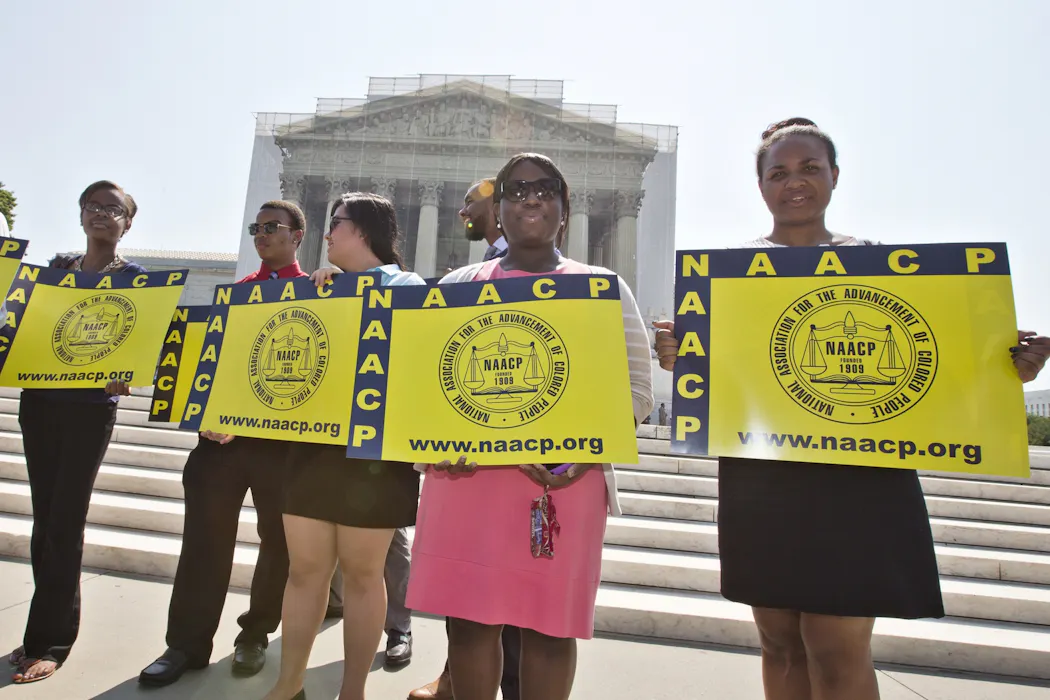
Initially dispatched to deter voter discrimination against Black Americans after passage of the Voting Rights Act of 1965, election observers ensured that those qualified to vote could do so without trouble.
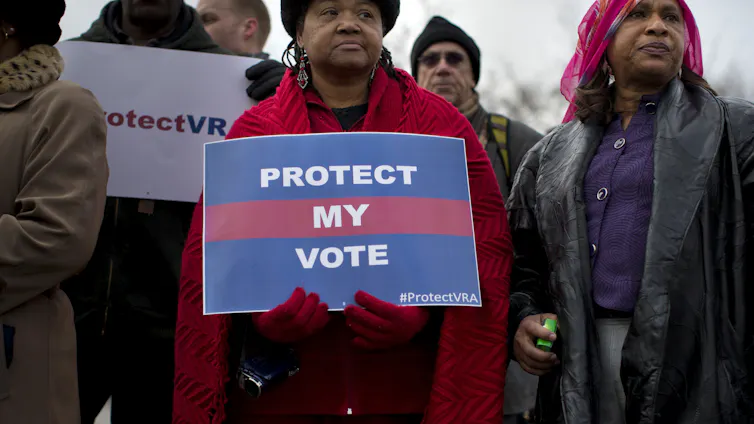
But with its 2013 ruling in the Shelby County v. Holder case, the U.S. Supreme Court changed the federal government’s relationship to the election process. The ruling significantly weakened the federal govenment’s ability to send federal observers to the polls.
As a scholar of civil rights and voting rights, I know that federal oversight during elections has always been a valued part of the electoral process, even when subject to criticism.
Yet, this current moment, with the Trump administration’s efforts to cast doubt on the legitimacy of the 2026 midterms, feels different. What I have noticed recently is how the public’s thinking has shifted about the federal oversight of elections. Where once it was largely welcomed as an ensurer of fairness and proper procedures, now it is seen as a misuse of authority.
Establishment of federal observers
The key contribution of the Voting Rights Act that Americans are typically taught about in school is its abolition of racial discrimination in voting. The measure put a stop to poll taxes and literacy tests, which had disproportionately reduced Black voter registration.
But the act also created the type of federal observation of elections that is most familiar to Americans today.
The measure allows the Department of Justice to deploy federal observers to polling stations. That deployment can happen through a court order or by requirement to places with documented histories of voter suppression. The latter was determined by a section of the Voting Rights Act that also details the guidelines for which places merit that designation.

AP Photo
Federal observers take notes, often beside poll monitors, and document potential unlawful practices by poll workers.
Unlike monitors, federal observers are stationed inside polling stations. They keep notes on the tallying of votes and verify those thrown out. And where the Justice Department requires the permission from respective districts to send monitors, federal observers are sent by the U.S. attorney general and do not require the same permission.
Historically, observers were also charged with registering voters at polling stations and local registrars’ offices with the specific goal of assisting disenfranchised minorities.
Perception of federal observers
Determined to maintain Jim Crow laws that enforced racial segregation, several Southern Democrats opposed the Voting Rights Act.
Some Americans also criticized the act as government overreach. And they castigated the U.S. attorney general in 1965 when he dispatched federal registrars to the South following the passing of the measure, and when he sent federal observers to the South for the 1966 congressional elections.
Despite this opposition to federal observers, and just months after the Voting Rights Act’s passage, the U.S. Commission on Civil Rights wrote that federal observers received “praise from registration workers and the (voter registration) applicants.”
Within a few years of the act, roughly 1 million Black Southerners had registered to vote. Over time, federal election observers began to focus less on registering voters, practically phasing out this practice by the 1980s, and serving only as observers.
The change
Over the decades, conservative politicians, as they gained more seats in Congress and state legislatures, developed new strategies – they filed lawsuits, rearranged voting districts – to circumvent what they argued was federal overreach in the election process. These changes helped them gain political influence and promoted their philosophy of states’ rights. They were successful.
The increase in conservative political influence gave way to an increasingly conservative Supreme Court. This was reflected in the U.S. Supreme Court’s 5-4 ruling in Shelby County v. Holder.
In that ruling, the court struck down the section in the Voting Rights Act outlining the guidelines for deciding whether a county or state needed federal oversight. With no guidelines to follow, the federal government removed most of its oversight.
After the court’s ruling, several states – Texas, Alabama and Mississippi, for example – made rapid changes to the voting process. Those included new voter ID laws, the purging of voter registration rolls and gerrymandering. These changes have resulted in further voter disenfranchisement, disproportionately effecting Black and Hispanic voters.
AP Photo/Evan Vucci
The Voting Rights Act guidelines had also helped determine where to send federal observers. With this section revoked, the federal government’s ability to send federal observers, in the way it had done for roughly 50 years, also disappeared.
The Justice Department sent federal observers to five states during the 2016 presidential election, compared to 23 states during the 2012 presidential election.
Since Shelby, disagreements over federal oversight persist and the role of federal observers has changed.
In 2024, the Justice Department announced it planned to send out 86 monitors on Election Day, the most federal monitors in two decades, due to concerns of possible partisan interference in elections. Some Republican-led states threatened to ban them from the polls.
To send out federal observers, the Justice Department needs a court order. But during the 2024 elections, courts determined that only four states needed federal observer oversight.
Redefining federal observers
During the Civil Rights Movement, federal election observers were the strongest line of defense to ensure fair voting.
Recently, however, the federal government’s election focus – such as attempting to require voters to provide documentary proof of U.S. citizenship when registering to vote – has shifted to what it says is voter fraud and accusations of cheating.
Still, one thing has remained certain. Federal observers are important. Their history, even now as they are less prevalent, can inform how we discuss the federal government’s role in elections.

Allison Mashell Mitchell does not work for, consult, own shares in or receive funding from any company or organization that would benefit from this article, and has disclosed no relevant affiliations beyond their academic appointment.
– ref. Federal election observers once played a key role in securing voting rights for all − but times have changed – https://theconversation.com/federal-election-observers-once-played-a-key-role-in-securing-voting-rights-for-all-but-times-have-changed-275991
Back to index · Read original article
Selling stolen art is tricky, so why even bother heisting it? An expert explains
April 1, 2026
Source: MIL-OSI-Submissions-English
Source: The Conversation – UK – By Anja Shortland, Reader in Political Economy, King’s College London
It took less than three minutes for an organised crime gang to steal a Renoir, Matisse and a Cezanne painting collectively worth around €9 million (£7.8m) from a private museum near Parma, Italy in March 2026. This is the second high profile art heist in recent months, after the theft of jewellery worth €9.5 million (£8.25m) from Paris’s Louvre in October 2025.
The items stolen are clearly valuable. But, as an expert in the governance of criminal markets, I can tell you acquiring the goods is only the first step. Turning this loot into cash is fraught with risk .
The Italian government takes the protection of its cultural heritage seriously, with a whole department of the Carabinieri (Italian police) devoted to the theft of arts and antiquities. This department scans the global art trade for forged, stolen and illegally exported treasures, demanding their return.
There is little chance of selling the stolen masterpieces on the international art market – even at a knockdown price. Whereas in the past dealers and auction houses might have turned a blind eye to the fishy origins of an outstanding artwork, over the past two decades the norms and procedures of the market have tightened considerably.
Anyone who buys art without checking whether a former owner has registered their interest in the object fails the bona fide (good faith) test. This means that they cannot obtain a good title and so the legal property right remains with the person or institution the artwork was stolen from. Also sales of stolen art where the seller sidestepped due diligence can be voided, meaning the money must be returned.
So reputable dealers and auction houses take their duty of care very seriously. At the very least they check the freely accessible Interpol database of stolen art before the sale. However, private databases – like that of the Art Loss Register – provide greater peace of mind, listing many more lost and stolen objects and limit searching to those with a legitimate interest in an object. When a register finds that someone is trying to bring a stolen artwork into the open market, they collect and pass on all information that could lead the police to its location or the people involved in its sale or storage.
Anything fresh from a museum wall is therefore unsaleable – unless it is jewellery that can be broken up and sold as (expensive) scrap. So, what might be the financial motivation behind this theft?
A Bond-style villain ordering favourite paintings to adorn their lair is an unlikely explanation. Yes, paintings could be stolen to order, but buying art on the open market to launder money is less risky. With high rewards for information or the return of stolen artworks, security and omerta (the code of silence) would have to be completely watertight when displaying stolen treasures.
On the other hand, “rewards for information” could be a motivation for theft in itself. In the middle of the last century, insurers regularly paid “finders” with so little scrutiny that high-value art theft became a profitable low-risk occupation. Institutions like the Art Loss Register broke that cosy coexistence and instead used any leads to help the police conduct recoveries and sting operations.
Nowadays, it is only safe to negotiate a deal over a “finder’s fee” when a stolen object has changed hands so many times that the line to the original thieves is lost in the mist of time. Even so, the ultimate “finder” would be lucky to realise more than 10% of the painting’s value, which they would also likely have to share with the thieves and various shady underworld owners along the way.
However, there is a third reason to steal artworks. Organised crime groups sometimes use stolen artworks as bargaining chips to negotiate more lenient punishment. For example, the Dresden jewellery thieves kept a few pieces of their haul aside to use their recovery to negotiate shorter sentences. Penitentos (“repentant ones”) who want to leave mafia organisations also sometimes provide information on the whereabouts of missing treasures. If there is a perception that stolen artworks can used to reduce a prison sentence or financial compensation package, their underworld value can grow far beyond the finder’s fee.
While it is difficult to verify the assertion that stolen artworks are used as collateral in drug deals, several unique treasures have indeed been retrieved from properties owned by senior mafiosi. These works have not been found in temperature controlled galleries, but rolled up in dank places that make museum curators weep with despair. Let us hope that the beautiful artworks from Parma are treated with respect until we see them again.
This article features references to books that have been included for editorial reasons, and may contain links to bookshop.org. If you click on one of the links and go on to buy something from bookshop.org The Conversation UK may earn a commission.

Anja Shortland does not work for, consult, own shares in or receive funding from any company or organisation that would benefit from this article, and has disclosed no relevant affiliations beyond their academic appointment.
– ref. Selling stolen art is tricky, so why even bother heisting it? An expert explains – https://theconversation.com/selling-stolen-art-is-tricky-so-why-even-bother-heisting-it-an-expert-explains-279700
Back to index · Read original article
A popular horror novel was pulled over AI concerns – here’s what it means for publishing
April 1, 2026
Source: MIL-OSI-Submissions-English
Source: The Conversation – UK – By Natalie Wall, PhD in English Literature, University of Liverpool
One of the largest book publishers in the US has pulled an upcoming horror novel from its scheduled release later this year following accusations that the author used artificial intelligence to write it.
Hachette Book Group was approached with what The New York Times claimed was evidence that Shy Girl by Mia Ballard was allegedly AI-generated. Following this, the publisher said its imprint Orbit was removing the book from publication in the US and UK.
The novel follows Gia, a young woman who is “lonely, broke and depressed with a serious case of OCD”. She encounters a mysterious and rich man who, in exchange for her living as his devoted pet, promises to erase all her debts. The novel follows her time in captivity as she becomes increasingly animalistic in nature.
In an email to The New York Times, Ballard said the controversy “has changed my life in many ways and my mental health is at an all time low”. Ballard has denied personally using AI to write the novel. But she has said that an acquaintance she hired to work on an earlier self-published version incorporated AI tools.
Many people disagree with the use of AI for a host of reasons, from environmental to ethical concerns. But cultivating a climate of distrust around writing and authors is also not necessarily productive, and further pushes AI use into secrecy.
The author now faces a challenging situation, as Hachette withdrawing the book will appear to some to validate the accusations, even if it simply reflects uncertainty.
What happened?
The book was initially self-published in February 2025 before it was bought by Orbit Books, following a growing industry trend to traditionally publish successful self-published or fan-fiction works.
Issues started to arise regarding the novel’s provenance in mid-2025 on Reddit when one user, who claimed they were a book editor, made a post which pointed out several issues with the novel that suggested it was AI generated.
Their main claim was based on the novel’s repetitive style, something also pointed out by other critical readers. Specifically, they highlighted that almost every noun is preceded by an adjective, actions are frequently described with similes, descriptions came in lists of three and certain words are overused.
The discussion spread to other platforms such as the BookTok community (TikTok users dedicated to discussing books and publishing), Instagram and YouTube.
There is still no final consensus about how Shy Girl was written and Ballard has removed herself from the public eye and taken her social media accounts offline following the scandal. Hachette told The Independent that they “remain committed to protecting original creative expression and storytelling”. They have made no definitive statement on the claims but did tell the NYT that they conducted a thorough and lengthy review of the text.
How should readers and publishers respond?
Readers and publishers have spent years debating the impact of AI in the abstract but 2026 is the year these debates have become reality.
Stories like Shy Girl and The New York Times’ profile of AI romance author Coral Hart, who boasted of using AI to write and self-publish 200 hundred books across 21 pen names in a recent profile by The New York Times, demonstrate that theoretical disputes did not prepare us to be confronted with the reality of AI.
It’s clear that even the suggestion of AI writing inspires immense disgust in many readers. This means that regardless of the truth (if we ever find it out) Shy Girl and Ballard will likely be tainted by this scandal. Therefore, we must ask whether it is possible for publishing and reading to survive not just AI’s increasing normalisation but also the hostile and suspicious environment its use is creating for writers.
As a researcher of contemporary and digital reading culture, I believe we should cultivate an openness around the use of AI in writing by lobbying publishers to provide this information openly and clearly. This is already starting to happen. The Society of Authors, which is the UK’s largest writers’ trade union, has launched a logo to be used to identify “human authored” books – a step toward empowering consumers to know what they are choosing to support with their money.
Copyright law also needs to reflect AI’s reshaping of the creative field. A work requires a human author to be covered under copyright law in the US and any doubts about this are potentially a big part of Hachette pulling Shy Girl from publication due to the publisher’s inability to copyright.
This creates a difficult position for the novel and author. The book’s cancellation looks like confirmation of guilt whereas it may just be doubt. However, UK copyright law does offer protection for computer-generated works. This creates a murky area where AI-generated or assisted works can receive certain legal protections, but not necessarily the same rights as human-authored works.
Under UK law, computer-generated works can qualify for copyright, with authorship attributed to the person who made the necessary arrangements for the work’s creation. However, these works do not benefit from the full range of protections afforded to human authors, particularly moral rights, such as the right to be identified as the author or to object to derogatory treatment of the work.
This framework may change following a recent consultation led by the UK government on copyright and artificial intelligence. The consultation has now closed and the government has not yet implemented definitive legislative changes. However, its stated priorities suggest any reforms will aim to balance protecting creators’ rights with supporting innovation, investment and growth in the AI sector.
It’s an undeniably fraught situation, which is continually developing. In the near future we may unfortunately see more authors like Ballard made examples of while, behind the scenes, many more may be using AI undetected.

Natalie Wall does not work for, consult, own shares in or receive funding from any company or organisation that would benefit from this article, and has disclosed no relevant affiliations beyond their academic appointment.
– ref. A popular horror novel was pulled over AI concerns – here’s what it means for publishing – https://theconversation.com/a-popular-horror-novel-was-pulled-over-ai-concerns-heres-what-it-means-for-publishing-279714
Back to index · Read original article
Brutal Mau Mau camps in Kenya were an extension of Britain’s colonial prison system – historian traces their roots
April 1, 2026
Source: MIL-OSI-Submissions-English
Source: The Conversation – Africa (2) – By Ian Caistor-Parker, PhD student, University of Warwick
During the Mau Mau uprising between 1952 and 1960, the British colonial government confined an estimated 150,000 Kenyans in a sprawling network of “emergency” detention camps.
None of those held in the camps had been found guilty in a court of law. Instead, they were detained on suspicion of supporting the uprising.
British control over Kenya was effectively declared in 1895. A distinctive feature of colonial rule was the decision to encourage white settlement. These settlers were granted vast tracts of Kenya’s most fertile land and pushed policy in an increasingly harsh and unequal direction.
By the early 1950s, many African Kenyans were facing severe land shortages in the countryside and desperate living conditions in urban areas.
In 1952, this situation erupted into the Mau Mau uprising, a broadly anti-colonial rebellion.
The British government responded with overwhelming force. It declared a state of emergency and suppressed the uprising militarily.
Revelations about the extreme violence employed in some emergency detention camps made the continuation of British rule untenable. Particularly key was the Hola massacre of 1959. Guards beat 11 detainees to death and the colonial government attempted to cover up the crime.
Outrage at these events shattered Britain’s grip on the colony, and Kenya achieved independence in 1963 under the leadership of Jomo Kenyatta.
A great deal is known about these detention camps. They were sites of neglect and brutal violence. Detainees were forced to go through a so-called rehabilitation system designed to make them renounce their support for Mau Mau.
In practice, they were subjected to brutal compulsory labour, were at risk of assault and lived in unhygienic conditions. Some of those who refused to cooperate ultimately faced systematic, state-sanctioned torture.
I am a historian researching punishment in Kenya, and I have been investigating the deeper history of detention camps. My research shows that this emergency detention system was shaped by an earlier network of “ordinary” detention camps. These were established in 1926 and processed more than 400,000 people before the uprising.
These camps, intended as a milder alternative to prison, evolved into a poorly regulated system characterised by exploitation, overcrowding and weak accountability.
These findings challenge the idea that the detention system of the 1950s was exceptional. Instead, it was rooted in long-standing colonial practices, shaped by economic incentives, administrative gaps and coercive labour systems.
Understanding this deeper history matters because it changes how we view the Mau Mau emergency. It proves that the brutal 1950s detention system didn’t just emerge from nowhere – it was built on a foundation of state violence and disorder that had been normalised for decades.
The roots
Influenced by a draconian-minded European settler minority, the Kenyan colonial government adopted a harsh approach to punishing the local population. Judges frequently imprisoned Africans for “technical” offences lacking criminal intent. These included failing to pay tax and minor violations of coercive labour laws.
By the 1920s, Kenya’s prisons were overcrowded and “technical” offenders inevitably mixed with hardened criminals.
In response, the colonial government introduced detention in 1926 as a supposedly milder alternative for technical offenders who had simply broken administrative rules. In theory, prisons were to be reserved for those who had committed crimes involving moral violation. In practice, however, these distinctions didn’t (or couldn’t) hold.
To visibly separate detention from imprisonment, the colonial government gave day-to-day control of detention camps to district commissioners (the powerful heads of local governments), not the prison department.
However, this separation was incomplete. Detainees were legally classified as prisoners (though they were not informed of this). The prison department retained ultimate authority over the camps.
This overlapping authority produced a gap in accountability, which ultimately proved disastrous.
In 1930, seeking to divert more people from formal prisons, government officials removed almost all sentencing restrictions on detention. Subsequently, the only limitations were that sentences had to be under six months and that those with more than one prior prison conviction were ineligible.
Numbers surged immediately, with more convicted offenders sent to detention than formal prisons almost every year until 1952.
Judges increasingly used detention for serious offences, including manslaughter. A limited criminal records system meant that individuals with prior convictions – sometimes as many as 16 – ended up in detention.
Conversely, the amendment did not stop harsh magistrates from continuing to send significant numbers of minor offenders to prisons.
This blurring of populations, combined with a lack of structural and legal separation, meant detention camps mutated into a parallel prison system, serving a different colonial master, district commissioners, but lacking fundamental distinction.
Detention camp living conditions were atrocious. Most district commissioners delegated almost all duties to Kenyan African “overseers”. Overseers were under-trained. Yet they were expected to be on duty constantly and often had to guard more than 60 detainees, making meaningful supervision impossible.
Camps were generally collections of temporary wattle-and-daub huts. Over time, these decayed but were not replaced, resulting in squalid conditions.
Furthermore, overcrowding was endemic. Food rations were poor and basic facilities were often absent. Sickness rates were significant. Detainees responded by escaping at a rate of more than one a day.
Failed reform
In 1937, a high-level committee condemned the system as dangerous and inefficient. Calls for reform from London also grew.
But nothing changed.
Why?
The primary reason was economic. Detainees were a vital reservoir of free labour for cash-strapped district commissioners. When camps were introduced, local governments’ labour budgets were cut. This made detainee labour crucial for maintaining government stations.
In the late 1930s, penal officials sought to reintroduce stricter eligibility criteria for detention. However, they abandoned this idea as it would add to overcrowding in the prison system.
Trapped by bureaucratic gridlock, underfunding and economic dependency, Kenya’s detention system limped into the 1952 emergency – unreformed.
Ultimately, “ordinary” detention camps persisted until the 1980s, far outliving their emergency counterparts.
The consequences
This history exposes stark continuities between the pre-emergency and Mau Mau penal systems. Furthermore, as they were under the control of district officials and lacked standard prison regulations, existing detention camps could, and did, easily become dumping grounds for Mau Mau suspects in the early months of the emergency. Ordinary detention was both a model and enabling mechanism for emergency detention.

Ian Caistor-Parker receives funding from the UK Economic & Social Research Council
– ref. Brutal Mau Mau camps in Kenya were an extension of Britain’s colonial prison system – historian traces their roots – https://theconversation.com/brutal-mau-mau-camps-in-kenya-were-an-extension-of-britains-colonial-prison-system-historian-traces-their-roots-277856
Back to index · Read original article
Aux États-Unis, la forte mobilisation des organisations religieuses contre les actions de l’ICE
April 1, 2026
Source: MIL-OSI-Submissions-French
Source: The Conversation – in French – By Blandine Chelini-Pont, Professeur des Universités en histoire contemporaine et relations internationales, Aix-Marseille Université (AMU)
Aux États-Unis, de plus en plus d’institutions religieuses se mobilisent pour protester contre les opérations de l’Immigration and Customs Enforcement (ICE), dont l’objectif premier est de procéder à l’expulsion des supposés « millions de migrants clandestins » présents sur le sol du pays. Entre les recours juridiques, la mise en place de réseaux d’alertes ou encore l’aménagement des églises en espaces de refuge, elles jouent un véritable rôle dans la défense des sans-papiers.
Alors que de nombreuses Églises chrétiennes ont ouvertement fait part de leur opposition à la guerre déclenchée contre l’Iran le 28 février dernier, on observe depuis plusieurs mois que de plus en plus de responsables religieux américains contestent l’action des agents fédéraux de l’Immigration and Customs Enforcement (ICE).
Loin d’être une réaction conjoncturelle, cette mobilisation s’est intensifiée tout au long de l’année 2025, au fur et à mesure que l’ICE se déployait sur l’ensemble du territoire et outrepassait son périmètre administratif et pénal. L’agence fédérale est normalement chargée de s’occuper des infractions au droit de l’immigration (personnes sans papiers et en situation irrégulière), des processus de reconduite aux frontières (rétention, expulsion) et, aussi, des enquêtes sur les filières criminelles transnationales impliquant des étrangers (traite humaine, blanchiment d’argent, fraude documentaire, narcotrafic, armes). Or elle a commencé à agir en négligeant aussi bien les procédures qui l’encadrent que son obligation de coopérer avec les autorités et les juridictions locales.
Ses agents de terrain – dont les effectifs ont doublé et devraient tripler sur les trois années à venir – se sont transformés en véritable milice armée agissant en toute impunité pour faire du chiffre.
Cette évolution, perçue comme une dérive régressive par de nombreux responsables religieux, alimente une critique morale qui aboutit à la remise en cause de l’ensemble des dispositifs légaux relatifs à la lutte contre l’immigration clandestine. La mobilisation, fortement portée par l’Église catholique, s’élargit en un véritable réseau interchrétien et interreligieux qui entre désormais directement en interaction avec le champ politique et judiciaire.
Mobilisation catholique
Tandis que le pape Léon XIV, lui-même américain, ne mâchait pas ses mots en dénonçant le virage en cours et en appelant à plus d’humanité aux États-Unis, la mobilisation s’est incarnée d’abord dans l’engagement de figures épiscopales majeures, telles que le cardinal Joseph Tobin, archevêque de Newark, véritable porte-voix de la dignité des migrants. Les diocèses des régions frontalières, aux fortes populations hispaniques, ont été particulièrement sensibilisés (n’oublions pas que la majeure partie des personnes arrêtées et expulsées par l’ICE sont originaires d’Amérique latine).
Des évêques du Nouveau-Mexique, comme Mgr John Wester de Santa Fe ou Mgr Peter Baldacchino de Las Cruces, se sont fait entendre, de même que, au Texas, Mgr Mark J. Seitz, d’El Paso, qui a explicitement appelé les agents de l’ICE à refuser d’exécuter des ordres injustes, s’inquiétant que « la frontière (soit) désormais partout ».
L’archevêque Gustavo García-Siller de San Antonio est allé plus loin. Il a dénoncé un système devenu « une industrie » honteuse, structuré autour d’intérêts économiques, notamment à travers les centres de détention privés. En effet, le budget de l’ICE est passé d’environ 9,7 milliards de dollars (8,4 milliards d’euros) en 2025 à plus de 11 milliards de dollars (9,5 milliards d’euros) en 2026. Un plan pluriannuel, voté en octobre dernier, atteint plus de 60 milliards d’euros. Avec l’augmentation des effectifs de ses agents, ce budget colossal doit permettre l’extension massive des capacités de détention, estimée à 33 milliards d’euros.
L’évêque Mario Dorsonville, ancien auxiliaire de Washington, responsable des questions migratoires et aujourd’hui décédé, avait insisté de son côté en 2024 sur la responsabilité morale de l’Église à dénoncer la criminalisation des migrants. Les propos qu’il avait tenus restent, aujourd’hui, une sorte de référence pour les catholiques américains.
À Chicago, le cardinal Blase Cupich a également dénoncé les atteintes par l’ICE à la liberté religieuse des personnes interpellées, soulignant que les autorités fédérales entravaient de manière tout à fait illégale l’action pastorale et interdisaient les visites et l’exercice du culte aux personnes en détention.
À New York, le cardinal Timothy Dolan, pourtant estimé proche du gouvernement actuel, est devenu un détracteur régulier de ses politiques d’immigration.
Sur le terrain, un réseau dense d’acteurs religieux et laïcs s’est mis en place. Les jésuites y sont particulièrement présents à travers des figures comme le père Christopher Collins ou le père James Martin, qui articulent action pastorale, plaidoyer médiatique et engagement politique.
Des organisations comme le Jesuit Refugee Service USA, en lien avec les pays d’Amérique centrale, les Catholic Charities ou encore le NETWORK Lobby for Catholic Social Justice, lancent des actions en justice contre l’ICE au nom des personnes « enlevées ». L’action de ces structures permet de transformer une indignation morale en capacité d’action organisée.
Mobilisation interchrétienne et interreligieuse
Bien d’autres Églises américaines se font également entendre. L’Église épiscopalienne, sous l’impulsion de figures comme Michael Curry (ancien primat) et d’évêques diocésains comme John Harvey Taylor (Los Angeles), s’engage fortement contre les politiques de détention et les « raids ». Plus de 150 évêques épiscopaliens ont signé des déclarations communes dénonçant les pratiques de l’ICE.
Dans le monde luthérien, l’Evangelical Lutheran Church in America (ELCA), dirigée par Yehiel Curry, s’implique aussi, à travers ses synodes locaux, notamment dans le Minnesota (où se trouve Minneapolis, la ville où des agents de l’ICE ont abattu en janvier Renee Good et Alex Pretti) où Curry est en poste et où les luthériens sont nombreux. Leurs responsables ont eux aussi participé à des actions judiciaires pour garantir l’accès pastoral aux migrants détenus.
L’United Church of Christ, historiquement engagée dans les luttes pour les droits civiques, la Presbyterian Church (USA) ou encore la United Methodist Church prennent les mêmes positions publiques et soutiennent les mêmes réseaux d’accueil. Au final, on assiste à une convergence interchrétienne de la mobilisation, avec l’organisation de très nombreuses actions et manifestations communes.
La convergence dépasse enfin le cadre chrétien pour s’inscrire dans une dynamique interreligieuse. Des organisations musulmanes comme le Council on American-Islamic Relations (CAIR), ainsi que des réseaux juifs progressistes comme l’HIAS (Hebrew Immigrant Aid Society), accompagnent les coalitions religieuses de défense des migrants.
Dans certaines villes comme Chicago, Los Angeles ou Minneapolis, ces coalitions interconfessionnelles organisent des formations aux droits des personnes migrantes. Cela renforce la légitimité de la mobilisation, en la fondant sur des principes communs positifs de dignité humaine et de justice. Surtout, cette mobilisation empêche les leaders évangéliques soutenant l’ICE de monopoliser l’espace médiatique.
Une continuation du mouvement Black Lives Matter
La notion de « résistance morale » structure profondément cette mobilisation. Elle renvoie à une tradition historique de contestation de l’injustice légale, héritée notamment des mouvements abolitionnistes et des droits civiques. Elle se manifeste à la fois dans les discours – éditoriaux, sermons, déclarations publiques – et dans les pratiques. Elle transforme les acteurs religieux en « entrepreneurs moraux », capables de contester la légitimité d’une politique publique au nom de principes supérieurs.
Cela a récemment été le cas avec l’engagement des Églises dans le mouvement Black Lives Matter (BLM), contre le racisme systémique et la violence policière. Des figures religieuses comme le révérend William J. Barber II ou le révérend Al Sharpton se sont trouvés aux premiers rangs lors des mobilisations BLM. Les églises ont servi de lieux de rassemblement, d’organisation et de légitimation morale.
De la même manière, sur la question migratoire, les églises deviennent des espaces de refuge, de coordination et de contestation. La différence des publics concernés n’est d’ailleurs pas si « éloignée », puisqu’un préjugé raciste s’exprime fortement derrière la traque des sans-papiers, les agents de l’ICE pratiquant systématiquement le « délit de faciès ».
La mobilisation actuelle en faveur des sans-papiers a approfondi le maillage interchrétien et interconfessionnel, entamé dans le mouvement BLM. Elle ajoute, aux manifestations de rue, les actions de terrain disséminées, incluant recours juridiques et procédures institutionnelles.
Des paroisses, des églises et des réseaux associatifs ont mis en place des dispositifs d’accueil, parfois dans le cadre du mouvement des « sanctuary churches ». Des organisations, comme United We Dream ou Faith in Action, collaborent avec des communautés religieuses pour organiser des réseaux d’alerte en cas de raids. Des bénévoles accompagnent les migrants dans leurs démarches juridiques, financent des avocats et assurent une présence dans les centres de détention.
Ces actions traduisent le passage d’une mobilisation morale à une véritable infrastructure de solidarité, capable de répondre concrètement à la logique d’expansion territoriale de l’ICE.
Impact politique
La mobilisation religieuse anti-ICE entre aussi directement en interaction avec le champ politique. En février 2026, un groupe de 44 représentants démocrates – dont la plupart sont catholiques – mené par Rosa DeLauro du Connecticut, et incluant des figures comme Nancy Pelosi, Joaquin Castro ou James McGovern – s’est publiquement opposé à l’expansion de l’ICE. Leur déclaration a explicitement mobilisé des arguments moraux et religieux, dénonçant une politique incompatible avec la dignité humaine.
De la sorte, même si la Chambre des représentants, où les républicains sont à peine majoritaires (218 sièges contre 214), a voté, fin mars l’intégration de l’ICE dans le budget du Departement of Homeland Security – le ministère dont dépend l’ICE –, les arguments des démocrates, qui dénoncent l’absence de contrôle des recrues à tous les niveaux, le surarmement « effrayant » et les salaires disproportionnés, ont porté au Sénat. Bien qu’à majorité républicain (53 sièges contre 47), ce dernier a voté le budget du DHS sans y inclure le financement de l’ICE. À ce jour, le budget 2026 de l’ICE est bloqué, même si la loi exceptionnelle votée en juillet 2025, le One Big Beautiful Bill Act, continue de lui assurer un financement faramineux.
Enfin, il faut souligner que si plusieurs figures conservatrices, comme le speaker républicain de la Chambre Mike Johnson, tentent de justifier les politiques migratoires par des références bibliques, d’autres semblent hésiter. Ainsi, le vice-président J. D. Vance, qui affiche volontiers son catholicisme, a dans un premier temps raillé les évêques qui s’indignaient des coupes totales de subventions fédérales pour les associations de terrain, les traitant en substance de grippe-sous grincheux, avant de s’en excuser, reconnaissant le caractère excessif de ses propos. Même s’il manifeste pour l’instant un solide optimisme sur les performances de l’ICE, il pourrait tenter d’infléchir sa position, tout comme il cherche à le faire (et à le faire savoir) à propos de la guerre en Iran…

Blandine Chelini-Pont ne travaille pas, ne conseille pas, ne possède pas de parts, ne reçoit pas de fonds d’une organisation qui pourrait tirer profit de cet article, et n’a déclaré aucune autre affiliation que son organisme de recherche.
– ref. Aux États-Unis, la forte mobilisation des organisations religieuses contre les actions de l’ICE – https://theconversation.com/aux-etats-unis-la-forte-mobilisation-des-organisations-religieuses-contre-les-actions-de-lice-279380
Back to index · Read original article
Why Donald Trump will try to declare victory in Iran well before November
April 1, 2026
Source: MIL-OSI-Submissions-English
Source: The Conversation – Canada – By John Duncan, Director of the Ethics, Society and Law Program; Academic Director of the Ideas for the World Program, University of Toronto
The Iranian regime is certainly brutal. But it’s also powerful as it continues to project its might after a month of illegal air strikes by the United States and Israel.
Read more:
Iran’s attacks drone on, with the U.S. at risk of losing the war
Iran is in the top 10 per cent of countries by size and population, has the third largest proven petroleum reserves and controls strategically crucial geography.
Furthermore, both the regime and many ordinary Iranians are prepared to defend the country. Since 1953, when the U.S. helped orchestrate a coup to overthrow Iran’s democratically elected Prime Minister Mohammad Mosaddegh, Iranians have understood they’re in America’s crosshairs.
This was especially true after the 1979 Islamic Revolution that overthrew the shah and during the U.S.-backed Iraq war against Iran that killed a million Iranians in the 1980s. As a result, Iran has spent decades beefing up and decentralizing its military capability.
In contrast, Dan Caine, chairman of the Joint Chiefs of Staff, warned U.S. President Donald Trump in February that the U.S. was short on both munitions and allied support for a war against Iran. Israel, America’s partner in war, is also short, especially in interceptor munitions. Trump and Israeli leader Benjamin Netanyahu dismissed the concerns, which suggests they planned a short war.
What are Trump’s options?
Critics have accused Trump of dragging the U.S. — or allowing it to be dragged — into a “forever war.” Those critics include those in his MAGA base, a problem for Trump as he anticipates November’s mid-term elections.
One unconventional option that might expedite victory, discussed during Trump’s first term, is to use nuclear weapons against Iran. Trump has said nukes won’t be used, but he’s well-known for erratic reversals.
A nuclear strike might expedite surrender, but it took two strikes on Japan in 1945 before the Japanese surrendered, and, failing an Iranian surrender, several strikes might be required to destroy the military capability distributed across Iran’s 31 provinces. Because many Americans would be appalled by a nuclear attack, putting the mid-terms at risk, the nuclear option is unlikely.
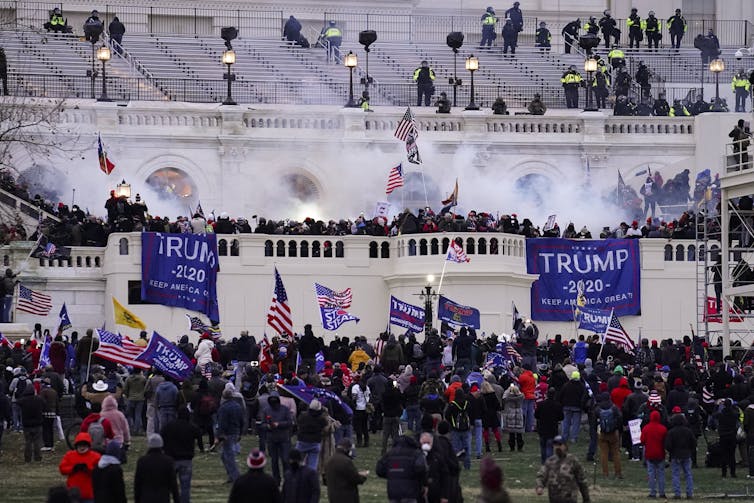
Much of the concern about Trump’s election machinations heading into the mid-terms is focused on the manipulation of procedures and officials. The legacy of the Jan. 6, 2021 attacks on the U.S. Capitol is one extreme possibility, as is manipulating the Iran war to achieve electoral gains.
(AP Photo/John Minchillo)
Trump will probably lean into his rhetorical strengths and try to convince Americans the U.S. has won when it hasn’t. Claiming victory in the face of its absence is not new to him. Even in his second term, Trump continues to push the false claim that he won the 2020 election.
Consider the bizarre drama that started on March 21 when Trump and Iran exchanged dire threats. Then, out of the blue, Trump declared the existence of peace talks, which Iran denied. Perhaps they are imaginary talks on the way to an imaginary victory for Trump.
Read more:
Why Donald Trump is such a relentless bullshitter
Mission accomplished?
It seems clear Trump is planning to declare victory well ahead of the mid-terms — and in part because of them. Such a strategy would involve baiting opponents into “forever war” criticisms, only to ridicule them in stump speeches, generating the image of a president who finishes his wars.
A declared victory in Iran and a timely exit, in addition to the liberation of Venezuela and a possible Cuban coup, might all coalesce into potent election messaging for the Republicans.
Soon enough, Trump may announce something akin to former president George W. Bush’s premature proclamations about the Iraq War in 2003 by saying something like this:
“Major combat operations in Iran have ended. The United States and Israel have prevailed. We do not know the day of final victory, but we have seen the turning of the tide.”
If successful, he will secure two more years “like nobody’s ever seen before” of Republican congressional dominance.

(AP Photo/J. Scott Applewhite)
Major obstacles
The battle for November will feature a few competing narratives in the U.S. But there are four major hurdles for Trump in particular.
- Information: For voters to be convinced that Trump is a decisive crusader against evil rather than another “forever war” president, right-wing media must sell yet another big lie, mainstream media must continue to pull its punches and the Democrats must continue to flounder.
- Affordability crisis: Trump also has to ensure he doesn’t “win” in Iran while losing on affordability at home. Most American oil comes from the U.S., Canada and Mexico, so the U.S. is protected from global supply disruptions, but global markets push up prices everywhere. Trump’s mere declaration of talks recently brought oil prices down, but only temporarily.
- Allies needed: Because voters will want to see a significant military withdrawal, Trump needs other countries to manage the chaos he’s created. But after disrespecting allies for months, he is struggling to establish a “coalition of the willing” on which to offload the conflict.
- Iranians must co-operate: But because the U.S. and Israel have twice attacked Iran during diplomatic negotiations, Iran needs other stakeholders in the process. Without them, Iran will not be incentivized to stop fighting and nothing will belie an imaginary Trump victory more than ongoing Iranian attacks.
Democracy waning
Whichever scenario prevails, Americans will likely lose. Their complete war costs could include repercussions from the unprecedented illegal bombing of Iran, as well as from unnecessarily turning regional allies into targets.
All of this is tied to what many Americans regard as increasing Israeli aggression, including the killing of 70,000 people in Gaza, which the U.S. has facilitated with funding, political cover and its widely mocked Board of Peace.
America’s democracy, economy and credibility are waning as Trump shamelessly pursues self-aggrandizement and self-enrichment.
“That makes me smart,” he might say, but only a failed leader serves his own interests at the expense of his country.

John Duncan is affiliated with Science for Peace, a charitable organization dedicated to popular education and research on the intersections of demilitarization, decarbonization and social justice.
– ref. Why Donald Trump will try to declare victory in Iran well before November – https://theconversation.com/why-donald-trump-will-try-to-declare-victory-in-iran-well-before-november-279059
Back to index · Read original article