Why the Legend of Zelda games still resonate with players after 40 years

Source: The Conversation – UK – By Annayah Prosser, Assistant Professor in Marketing, Business and Society, University of Bath

A large model of Link from the Zelda games, in Tokyo. yu_photo/Shutterstock

Nintendo’s Legend of Zelda video game series celebrated its 40th anniversary in February 2026. Millions of players across the world have grown up alongside the 21-title series, from the release of the original game on the Famicom gaming system in 1986, to the most recent game, Echoes of Wisdom, published for the Switch in 2024.

The Zelda games were inspired by series creator Shigeru Miyamoto’s childhood in the Japanese countryside. They frequently involve complex environmental exploration and problem solving.

Over time, the series has moved from pixelated forests into high resolution, awe-inspiring landscapes. In that time, Zelda has become an intergenerational success, released in new forms for new generations with each Nintendo console.

Many Zelda games serve as flagships for these new consoles, tying the game experience into new technological capacities – showcasing the motion control of the Wii, the dual screens of the DS, and the joystick first introduced on the the N64. Just as the console technology has evolved, so has the Zelda series.

The series is one of Nintendo’s biggest commercial successes, with an estimated 150 million copies of the games sold worldwide. The most popular game within the series, Breath of the Wild (released on the Switch in 2018), has sold more than 34 million copies to date.


Read more:
The Legend of Zelda: Tears of the Kingdom review – a masterclass in rewarding curiosity


Beyond the game

As well as fun past times, video games can be important vehicles for social connection and personal development. The Zelda series grapples with age-old struggles of good versus evil and destruction versus creation.

I’m the editor of the Psychgeist of Pop Culture: The Legend of Zelda – an open-access book which explores the social and psychological impact of the series across a variety of domains. In the book, researchers like myself show how engaging with virtual stories and problems can help us to better understand our own day-to-day lives. For example, recent research from social scientist George Farmer shows that playing video games can be a helpful form of stress relief during times of crisis.

The moral dilemmas presented in the Zelda games also help to train players for real-world social action. Experimental psychologist Kathryn Francis argues in her chapter that the games provide players with an immersive virtual space for moral reflection and development.

In my own chapter, I analysed the environmental narratives of the games Breath of the Wild and Tears of the Kingdom to assess their potential impact on players. I argued that experiencing the environmental devastation wrought by villains in the games, and having the power to save the world in this setting might also equip players with the tools and motivation to address the climate crisis in real life.

The Zelda series can also help players to understand and interrogate their identities, and the roles we play within our own lives. The games allow players to explore what it means to be a hero, villain, or a princess with increasing freedom of expression and action.

They can choose to save the world as quickly as possible (by doing a “speedrun”) or they can take their time to get to know the community and environment. This freedom of play allows for different experiences which appeal to different types of players, making the series particularly versatile. In the games players get to experiment with different quests and narrative paths, and learn more about themselves, their values and preferences in the process.

Forty years on, the Zelda franchise shouldn’t just be seen as a purely economic success. Rather, it should be understood as a cultural powerhouse which has had a very real impact on the lives of millions around the world.

Given the generational staying power of these games, many Zelda fans across the world will be eagerly awaiting the next step for the series. What might the 40th anniversary celebrations bring? Will a new title be revealed? What will the first Switch 2 Zelda game be? Will the virtual world translate well to the upcoming live-action film?

Regardless of the answers to these questions, the series likely will likely to have a significant impact on its players around the world for decades to come.


Looking for something good? Cut through the noise with a carefully curated selection of the latest releases, live events and exhibitions, straight to your inbox every fortnight, on Fridays. Sign up here.


The Conversation

Annayah Prosser does not work for, consult, own shares in or receive funding from any company or organisation that would benefit from this article, and has disclosed no relevant affiliations beyond their academic appointment.

ref. Why the Legend of Zelda games still resonate with players after 40 years – https://theconversation.com/why-the-legend-of-zelda-games-still-resonate-with-players-after-40-years-276456

No, autistic people are not ‘mind blind’ – here’s why

Source: The Conversation – UK – By Travis LaCroix, Assistant Professor of Philosophy, Durham University

maxim ibragimov/Shutterstock.com

For four decades, a controversial idea has shaped how autism is understood by researchers, healthcare professionals and the public: the claim that autistic people are “mind blind”. The phrase suggests an inability to grasp what others think or feel. It is simple, memorable – and wrong.

The claim rests on a concept called “theory of mind”. In everyday terms, theory of mind is the ability to recognise that other people’s thoughts, beliefs and emotions may differ from your own. This idea explains why someone understands that a joke can fall flat, that a promise can be broken, or that a friend can be mistaken without lying. It is often presented as the key to how people make sense of one another.

The idea entered psychology in the late 1970s, when researchers began asking how children learn to reason about other minds. Simple stories were designed to test this ability, often involving a character who holds a false belief. If a child could predict that the character would act on that belief, they were taken to have a theory of mind. These tasks quickly became a standard tool in developmental research.

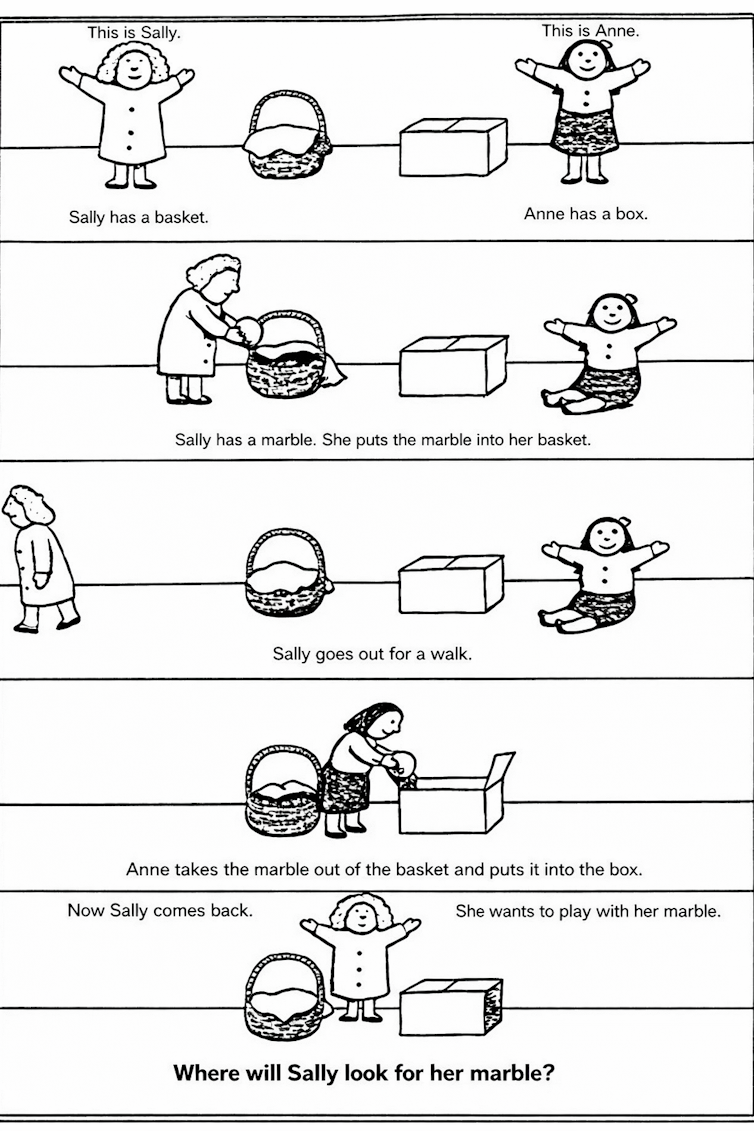
In 1985, one such test was used in a study of autistic children. In the “Sally-Anne” task, a doll (Sally) hides a marble, leaves the room, and returns after another doll (Anne) has moved it. Asked where Sally will look, many autistic children in that study gave the “wrong” answer. This finding was interpreted as evidence that autistic children lacked theory of mind.

The Sally-Anne test

A cartoon of the Sally-Anne test.
Does the autistic child really not have a ‘theory of mind’?
Simon Baron-Cohen, Alan M. Leslie, and Uta Frith

From this experiment, a vast research programme followed. New tasks multiplied: reading emotions from photos of eyes, interpreting short stories, judging intentions from animated shapes.

Across the late 1980s and 1990s, scientific papers and popular media represented autism as defined by a core failure to understand minds. The theory stuck, appearing in academic articles, textbooks, court rulings and popular science writing.

The problem is that the evidence never supported the claim. Even in the original study, one in five autistic children passed the task. Later research found huge variation. Some studies showed most autistic participants passing theory-of-mind tests; others found little or no difference between autistic and non-autistic groups. A theory meant to describe a key deficit kept running into exceptions.

More troubling is the tests themselves. Many rely heavily on language. Performance is often better predicted by vocabulary level than whether someone is autistic.

Different theory-of-mind tasks also fail to line up with one another, suggesting they are not measuring a single underlying ability at all. If an ability cannot be measured consistently, claims about its absence become doubtful.

At this point, a straightforward scientific response would have been to reconsider the theory. Instead, it was repeatedly patched.

When autistic people passed a task, researchers argued that the task was too simple. New, more complex tasks were introduced, which produced the same mixed results. When findings contradicted the core idea, the definition of “theory of mind” quietly expanded to include eye contact, joint attention, or social motivation.

When science stops testing

This pattern matters because of what it says about how science works. Drawing on the philosophy of science, my recent analysis argues that theory-of-mind research in autism has become “degenerating”. Rather than generating new, risky predictions, the theory survives by shifting definitions and goalposts to avoid being disproved. When no possible result counts against a theory, it stops being scientific. In a subsequent response to commentators, I explore why the theory-of-mind paradigm has persisted despite its deep empirical and conceptual difficulties.

Questioning this idea did not come from a single paper or field. Psychologists, linguists, and philosophers all raised concerns. So did autistic people, whose everyday experiences often flatly contradicted the idea that they lacked insights into others.

Studies began to show that non-autistic people are just as poor at interpreting autistic expressions as the reverse. Social misunderstanding, it turns out, goes both ways.

That insight helped fuel alternative approaches. One approach frames communication breakdowns as mutual mismatches between different styles of thinking and communicating, rather than deficits located in autistic people.

Another focuses on differences in attention and interest, offering an explanation of perception, motivation and learning. These approaches generate new, testable questions and align more closely with people’s actual experiences.

Today, the field is at a crossroads. The idea that autistic people are mind blind lacks a secure foundation. Its empirical support has weakened, and its assumptions are increasingly questioned. What remains is its influence. When educators or healthcare professionals assume a lack of empathy, they are less likely to trust autistic people’s own accounts or involve them in decisions that affect their lives.

Abandoning this myth does not weaken autism science. It strengthens it. Social understanding is not absent in autism; it is shaped differently, expressed in different contexts, and often overlooked when the wrong tools are used. Autistic people are not mind blind. They think and understand differently, and the evidence has pointed that way for some time. It’s time science reflected that.

The Conversation

Travis LaCroix received funding from the Social Science and Humanities Research Council (Canada).

ref. No, autistic people are not ‘mind blind’ – here’s why – https://theconversation.com/no-autistic-people-are-not-mind-blind-heres-why-272848

‘Working hard used to get you something’: what Hannah Spencer’s speech tells us about her, and the state of British politics

Source: The Conversation – UK – By Alex Prior, Lecturer in Politics with International Relations, London South Bank University

Hannah Spencer’s parliamentary story – as the new Green MP for Gorton and Denton – has just begun.

Nevertheless, the life story that she presented in her victory speech was that of a plumber, not a politician. She identified herself – in present tense – by that trade; she had not grown up wanting to be a politician. She also celebrated qualifying as a plasterer during the “chaos” and “pressure” of the election campaign. She described campaigning jovially as “all this”, as if it were just a challenge in the broader adventure, not the adventure itself.

Despite, or perhaps because of, accusations that the Greens used “sectarian politics” to secure victory, the speech was one of solidarity, of aligning herself with the struggles and achievements of “the community that I am from”. Spencer said that she had lived there in one of the hardest times of her life, and presented the strength of the community “at holding things together” as an inspiration.

She aligned herself and her personal characteristics with those of the constituency, stressing that “I am no different to every single person here in this constituency. I work hard. That is what we do.”

Alongside all the talk of “we”, of common interests and lack of difference, Spencer singled out several audiences for her story. One such audience? Her now-plumberless “customers”, to whom she duly apologised: “I’m sorry, but I think I might have to cancel the work that you had booked in, because I’m heading to parliament”.

Spencer also addressed those who voted for her, and those who didn’t. She spoke of “my Muslim friends and neighbours”, who “are just like me: human”. She discussed the “left-behind” (“I see you, and I will fight for you”), and people doing jobs like hers: “We will finally get a seat at the table”. And she addressed “our white working class communities, the background that I have become so glad to be from”.

A personal and political journey

My research focuses on political narratives and storytelling as a means of communication: the stories that parliaments contain and project, the stories we tell about the places we’re in and the stories that politicians use to communicate themselves to voters. Spencer’s speech is an attempt to portray a compelling story to her new constituency.

She spoke about how moving away from the constituency to nearby Trafford made the qualities of Gorton and Denton’s community “even clearer”. Only realising your love for a place and the people in it when you’ve moved away is a familiar narrative device. As Joni Mitchell once sang, “You don’t know what you’ve got ‘til it’s gone”.

In Spencer’s speech, this tactic carried a sharper political edge. This is a constituency that people move away from to get the “nice life” that Spencer described: “good schools, a thriving high street and clean air”.

This part of the story carried a rebuke to an audience that Spencer was addressing, but not by name: the Labour Party, for whom this was a traditionally safe seat. Spencer observed that “working hard used to get you something”.

I would argue that “you”, in this context, is a reference to traditional Labour voters. The implication here is that it is voting Labour that “used to get you something”.

Being a politician now isn’t an aspect of Spencer’s story that she’s keen to claim. She may now sit at Westminster, but she appears to frame this as an extension of who she already is — a worker, a neighbour, a constituent — in a new arena.

In doing so, she attempts to recast political representation itself as continuity of identity. The challenge, of course, will be whether she can sustain that claim. It is easier to say “I am no different” on a victory stage following a byelection win than from the House of Commons. The durability of her narrative – and perhaps her political appeal – will rest on whether she can remain recognisably “from” the constituency while operating within the institution of parliament.

The Conversation

Alex Prior does not work for, consult, own shares in or receive funding from any company or organisation that would benefit from this article, and has disclosed no relevant affiliations beyond their academic appointment.

ref. ‘Working hard used to get you something’: what Hannah Spencer’s speech tells us about her, and the state of British politics – https://theconversation.com/working-hard-used-to-get-you-something-what-hannah-spencers-speech-tells-us-about-her-and-the-state-of-british-politics-277121

Twenty-year sentence for Hong Kong media mogul Jimmy Lai is a further blow for journalists feeling the heat of Beijing’s crackdown on press freedom

Source: The Conversation – UK – By Yuen Chan, Senior Lecturer, School of Arts and Social Sciences, Department of Journalism, City St George’s, University of London

The sentencing of Hong Kong media mogul Jimmy Lai to 20 years in prison on February 8 on charges of sedition and collusion with foreign forces prompted international outrage.

Lai founded the now shuttered pro-democracy Apple Daily newspaper – and supporters of press freedom around the world pointed to the chilling effect the sentence would have on the media, in a city once vaunted as a beacon for press freedom in Asia.

The reaction was more muted in Hong Kong, where dissent has been stifled since Beijing imposed the draconian National Security Law in 2020, following months of protests in 2019. A local security law enacted in 2024 further expanded the scope of the city’s national security legislation.

Privately, some local journalists say Lai’s conviction will have limited impact on their work. They have already felt heavily constrained by the security laws and what they’re calling the “new normal” – an overarching national security apparatus and culture. Although saddened, they were not altogether surprised at the severity of Lai’s sentence.

One journalist told me they were more shaken by the sentences of up to ten years that were meted out to six senior Apple Daily editors and writers for “just doing their jobs”.

Since the national security law, Hong Kong journalists’ jobs have involved a great deal of dancing around shifting boundaries as to what can and can’t be reported. Inevitably, this has meant exercising greater self-censorship.

In an editorial on the sentencing, the Ming Pao newspaper, which has long positioned itself as a neutral paper of record, suggested the Lai ruling has brought these boundaries into sharper focus, concluding: “Collusion with foreign forces cannot readily be dressed up as journalism.”

The newspaper said that as Hong Kong now operates within the framework of the national security legislation: “The media must operate within this legal framework while continuing to report facts and hold power to account, a balance essential to preserving the city’s pluralism and openness.”

But it hoped “the Lai case will prove a watershed, allowing space for press freedom to widen step by step, so the media can fulfil its responsibilities more effectively”.

However, local journalists I spoke to described this position as naïve and wishful thinking, and said the red lines are no clearer now than before. Selina Cheng, chair of the Hong Kong Journalists Association (HKJA), believes the constraints on free expression in Hong Kong go far beyond a legal framework.

“If we call it a legal framework, it’s giving the system some kind of legitimacy,” Cheng told me. “In reality, the way it operates is there is a lot of destruction of due process, creating an atmosphere of fear and anxiety in those working in industries of expression.”

Apart from being arrested and jailed, Cheng says journalists and their family members have been doxed, with their personal details posted online, and harassed. Both individual journalists and news outlets have been targeted by unusual tax audits.

Tai Po tragedy

Cheng was one of several journalists I spoke to who pointed to the November 2025 fire which killed 168 people in Tai Po’s Wang Fuk Court Estate as a potent symbol of the current state of press freedom and freedom of speech in Hong Kong.

In the immediate aftermath, local and international journalists interviewed victims and reported extensively on suspected corruption and lack of oversight of building works on the site. But residents and other potential interviewees soon became reluctant to speak to reporters following the arrests of people who had posted comments online.

A student who started a petition for an independent inquiry was arrested – and then recently expelled from his university just weeks from graduation, even though he hasn’t been charged.

For one veteran journalist, who asked to remain anonymous for fear of bringing trouble to their organisation, what led to the Tai Po tragedy highlights a “media failure”. The news outlets which had most doggedly pursued stories about building maintenance, bid-rigging and corruption were the investigative site Factwire and Apple Daily, so “when these outlets disappeared, a lot of the reports also petered out”.

“In the past, you’d have lots of commentary in the media after an incident like this,” they explained. “There’d be legal scholars, experts, people from all different sectors. But now, the universities don’t allow people to comment and articles are spiked or censored, so it’s hard to raise and maintain public concern.”

Snitch culture

The journalist spoke of a system that extends beyond the legal framework of the national security law that restricts speech, through the control of public opinion and a “snitch culture” that weaponises complaints.

A Hong Kong police national security hotline was launched in November 2020; by June 2025, the city’s security chief said it had received more than 920,000 reports. Public bodies and funding organisations also regularly receive complaints about platforming of funding groups or individuals perceived to be pro-democracy or supportive of the 2019 protests.

Last October, a public venue cancelled a play written by Candace Chong, a leading playwright who was been vocal about censorship. The body that manages the Xiqu Centre, part of the West Kowloon Cultural District, said it had received complaints that the show – which depicts a love triangle between three men – defamed Hong Kong.

There are signs the “media failure” is already affecting governance. In January, the government introduced a controversial seat belt law requiring all bus passengers to buckle up while seated, only to shelve it five days later. The bill had received little scrutiny in Hong Kong’s now opposition-free legislature.

“It’s really unthinkable for a government to push out a bill, get it rubber-stamped by the legislature, and then withdraw it because they suddenly realise people are unhappy or the legislative details haven’t been thought through,” the HKJA’s Cheng told me. “It shows how the government misjudged public sentiment. This can be attributed to how the media isn’t free any more.”

The Conversation

Yuen Chan does not work for, consult, own shares in or receive funding from any company or organisation that would benefit from this article, and has disclosed no relevant affiliations beyond their academic appointment.

ref. Twenty-year sentence for Hong Kong media mogul Jimmy Lai is a further blow for journalists feeling the heat of Beijing’s crackdown on press freedom – https://theconversation.com/twenty-year-sentence-for-hong-kong-media-mogul-jimmy-lai-is-a-further-blow-for-journalists-feeling-the-heat-of-beijings-crackdown-on-press-freedom-276992

Why isn’t the Greens’ growing success reflected in media coverage?

Source: The Conversation – UK – By Maxwell Modell, Research associate, Cardiff University

wellphoto/Shutterstock

The victory of the Greens in the Gorton and Denton parliamentary byelection is a landmark for the party. But our new research reveals the Greens have received limited airtime over the last year despite almost doubling their support in the polls and in party membership.

While Reform UK has seen a spike in media coverage since it took a commanding lead in the polls, our research shows the Greens have not received more airtime in recognition of their growing popularity.

Broadcasters have to abide by due impartiality rules, but they have the editorial freedom to balance the airtime of political parties. They consider factors such as a party’s vote share at the last UK general election or a party’s electoral performance at the most recent devolved, regional and local election. Other factors to consider include the latest trends in opinion polls tracking voting intention, and whether what a party is saying the news organisation considers significant or, as the BBC says, whether they are “making the political weather” by setting the agenda.

After winning the byelection, this raises the question: should the Greens now be given more airtime?

Limited coverage of Greens

Our Impartiality project team has been tracking coverage of UK opposition parties on BBC News at Ten and ITV News at Ten, the UK’s most-watched nightly TV news bulletins.

In 2025, we found the Greens were the sixth most covered opposition party, being referenced in just 32 items, behind the Conservatives (375), Reform UK (213), the Liberal Democrats (116), the Scottish National Party or SNP (46) and ahead of Plaid Cymru (10).

Number of items led by an opposition party on BBC News at Ten and ITV News at Ten.
Cardiff University, CC BY-NC-ND

We also tracked how often a party was the leading focus of a broadcaster’s report. The Greens led four items – three on BBC and one on ITV. These stories related to the Greens’ May local election campaign, Zack Polanski winning the party leadership in September and the party conference in October. But neither BBC News at Ten and ITV News at Ten covered the announcement or build-up to the leadership contest.

In contrast, Reform UK led 69 items, Conservatives led 45 items, the Liberal Democrats led 14 items and the SNP led 13 items.

vote green sign, outside blue sky
Growing success of the Green party doesn’t mean more press appearances.
Peter_Fleming

The Greens also appeared on only four episodes of BBC Question Time during 2025. That was about a third as often as the Liberal Democrats and Reform UK.
Despite the leadership change, the subsequent surge in membership and the sustained rise in poll ratings (from 11% in August 2025 to 17% in December 2025), broadcast coverage of Greens did not increase at the end of 2025.

This shows a potential inequality in the treatment of the rising left and right parties. The BBC cited improvements in opinion polling as one of the factors behind the increased coverage of Reform UK, but the Green party’s popularity has not received anywhere near the same recognition.


Read more:
What Hannah Spencer’s historic win means for the Green party’s future


In May 2025, news coverage of Reform UK increased substantially following its victories in local and mayoral elections, which broadcasters considered a sign that the party was now a major player in UK electoral politics. Our research even showed in September 2025 Reform UK was referenced on TV news more than the Conservatives, the party that is supposed to be the UK’s parliamentary official opposition.

The question now is whether broadcasters will take the Green party’s victory in Gorton and Denton as a similar sign of its electoral significance and increase media coverage of the party.

While broadcasters have not broken any of the UK’s rules on due impartiality, our new research raises questions about how they have been interpreting impartiality in a new multi-party system.

Traditionally they have relied on allocating airtime according to parties with the largest number of MPs and total vote at the last general election. They have also factored in performances at the latest local, regional or devolved elections. But they now appear to making more subjective judgements about allocating airtime according to the opinion polls or the newsworthiness of parties.

Given the Greens’ growing popularity, their distinctive set of policies, charismatic leader and byelection victory, they might now look set to receive more media attention and scrutiny over the coming months.

The Conversation

Maxwell Modell receives funding from the AHRC for research into broadcasters’ impartiality.

Matt Walsh receives funding from the AHRC for research into broadcasters’ impartiality.

Stephen Cushion has received funding from the BBC Trust, Ofcom, AHRC, BA and ESRC.

ref. Why isn’t the Greens’ growing success reflected in media coverage? – https://theconversation.com/why-isnt-the-greens-growing-success-reflected-in-media-coverage-277137

Cuba’s speedboat shootout recalls long history of exile groups engaged in covert ops aimed at regime change

Source: The Conversation – Global Perspectives – By William M. LeoGrande, Professor of Government, American University School of Public Affairs

Cuban coast guard ships docked at the port of Havana on Feb. 25, 2026. Adalberto Roque/ AFP via Getty Images

A boat carrying 10 heavily armed men entered Cuban territorial waters on Feb. 25, 2026, intent, according to officials in Havana, on infiltrating the island nation and undermining the communist government through acts of sabotage and terrorism. When the men opened fire on an approaching Cuban Border Guard patrol boat, the border guards returned fire, killing four and wounding the other six. Another Cuban American who had allegedly flown to Cuba from the United States to meet the infiltration team on the beach was later arrested.

While details about the incident continue to come out, the gun battle comes at a time of heightened tensions between Cuba and the United States, which for weeks has been pursuing a de facto total oil blockade of the island. The latest episode is also reminiscent of the early 1960s, when Cuban exiles, trained and armed by the CIA, tried to infiltrate Cuba to conduct acts of sabotage and assassinate the leaders of the Cuban Revolution.

As a longtime expert on U.S. foreign policy toward Latin America and co-author of a history of the bilateral diplomacy between the United States and Cuba, I know that Cuba’s exile community has long contained paramilitary elements. Encouraged by Washington’s intensified sanctions and heated rhetoric, and a weakened government in Havana, these elements seem to sense an opportunity now.

Cuba’s exiled paramilitaries

Following the triumph of the Cuban Revolution and Fidel Castro’s rise to power in 1959, U.S. policy toward the new government was antagonistic almost from the start.

In 1961, the CIA under President John F. Kennedy organized the Bay of Pigs invasion – a military operation by exiled Cubans aimed at overthrowing the young Castro government.

A group of men with guns stand by a boat with a skull and crossbones motif.
Pro-Castro soldiers pose at Playa de Giron, Cuba, after thwarting the ill-fated ‘Bay of Pigs’ invasion.
Graf/Getty Images

The attempted invasion was a “perfect failure,” in the words of author Theodore Draper, after which the agency recruited a number of the invaders to continue to wage irregular war against Cuba. They were part of Operation Mongoose, the Kennedy administration’s multifaceted program of diplomatic, economic, political and paramilitary pressure aimed at overthrowing the Cuban government.

The CIA’s financial support for exile paramilitary groups continued into the late 1960s, until it was phased out because of their ineffectiveness. Although the CIA gave up on overthrowing Castro by force of arms, the paramilitary exile groups did not.

Two of the most prominent groups – Alpha 66 and Omega 7 – continued their war against the Cuban government for years with tacit U.S. support. “We should not inhibit Cuban exile activity against their homeland,” President Richard Nixon wrote in 1971 in response to Coast Guard efforts to arrest members of Alpha 66. Five years later, two of the most prominent paramilitary leaders, Orlando Bosch and Luis Posada Carriles, orchestrated the bombing of a civilian airliner, Cubana Flight 455, killing all 73 people on board.

A change in attitudes

Frustrated by their inability to depose the Cuban government, the paramilitary groups turned their attention inward. In the late 1970s, these groups launched a campaign of terrorist bombings and assassinations mainly targeting Cuban Americans who dared speak out in favor of rapprochement with their homeland. In 1979, two members of the Committee of 75, Cuban Americans who traveled to Cuba to meet with Castro to secure the release of political prisoners, were assassinated by Omega 7.

President Ronald Reagan was certainly no friend of Castro’s Cuba, but his Justice Department launched a major crackdown on the U.S.-based paramilitary groups, winning convictions against a number of their members.

The terrorist attacks subsided, but the martial impulse has remained alive among some Cuban American extremists. Small groups have continued to hold weekend military training exercises in the Everglades in Florida, home to the world’s largest Cuban diaspora. Periodically over the years, some of these weekend warriors have tried to infiltrate Cuba. Almost always, they are quickly captured by Cuban police. The most recent firefight seems to be the latest of these incidents, albeit an unusually violent one.

Ratcheting up US hostility to Cuba

The number of these incursions, along with attempts by Cuban Americans to solicit acts of sabotage over social media, have increased in recent years as relations between Cuba and the U.S. have deteriorated, now at their lowest point in decades.

In his first administration, President Donald Trump reversed President Barack Obama’s 2014 Cuban thaw by imposing the toughest economic sanctions since the 1960s. President Joe Biden left most of those sanctions in place, even as the Cuban economy suffered during the COVID-19 pandemic.

Now in his second term, Trump has turned the screws even tighter by cutting off Cuba’s oil supply from Venezuela and threatening other countries if they send oil to Cuba. The result is a profound, unprecedented economic decline on the island that threatens to precipitate a humanitarian crisis.

Both Trump and Secretary of State Marco Rubio, who built his political career by being the most vocal anti-Cuban government member of Congress, have declared Cuba a failed state and predict its imminent collapse almost daily.

These predictions from the White House, along with the seemingly unsustainable economic crisis on the island, have created an expectation that the Cuban government cannot survive. In this atmosphere, Cuban American militants might well conclude that the long-awaited moment has arrived, and those who fancy themselves soldiers might well decide to take up arms and head south to witness, participate in or even catalyze the demise of the government they have hated so much and for so long.

But Cuba is not a failed state, claims from the White House notwithstanding. The Cuban government is still fully capable of maintaining public order and defending its coastline, as the 10 people that allegedly tried to infiltrate the island found out.

Trump and his hawkish advisers, including Rubio, appear to want to force Cuba into submission, much as they have tried to do in Venezuela.

But there are no visible signs of cracks in the regime and no organized opposition to it. Many Cubans remain fiercely nationalistic and are not likely to accept any deal that requires them to surrender their national sovereignty by remaking their political or economic system to please the United States.

Absent some kind of diplomatic agreement between Washington and Havana, the Cuban economy will continue to deteriorate under the weight of the ongoing oil blockade and all the other elements of the U.S. economic embargo. This will deepen the misery of people living in Cuba and risks prompting other exiles into launching paramilitary adventures in hopes of exploiting Havana’s weakness.

The Conversation

William M. LeoGrande is affiliated with The Quincy Institute as a Non-resident Fellow

ref. Cuba’s speedboat shootout recalls long history of exile groups engaged in covert ops aimed at regime change – https://theconversation.com/cubas-speedboat-shootout-recalls-long-history-of-exile-groups-engaged-in-covert-ops-aimed-at-regime-change-277049

L’affaire Epstein révèle une classe au-dessus des lois

Source: The Conversation – in French – By Dahlia Namian, Sociologue et professeure à l’École de service social de l’Université d’Ottawa, L’Université d’Ottawa/University of Ottawa

L’affaire Epstein ne relève pas de l’exception. À l’instar du mouvement #MeToo, elle s’inscrit dans un continuum de violences exercées par des hommes de pouvoir, rendues possibles par une culture durable de l’impunité. Les dossiers Epstein ne documentent pas seulement des crimes sexuels : ils exposent un monde social solidement interconnecté, où circulent capitaux, prestige, influence et relations de dépendance.


Si la notion de « classe Epstein » permet de rendre visible cette configuration, elle tend néanmoins à en personnaliser les mécanismes, en les ramenant à la figure de ce manipulateur d’exception. Un tel déplacement comporte un risque analytique majeur : celui d’occulter les dimensions structurelles du pouvoir de classe. L’affaire Epstein ne renvoie pas à une déviance individuelle exceptionnelle, mais à la normalisation d’un ordre social où l’accumulation extrême du capital s’imbrique étroitement avec la domination masculine.

Dans La société de provocation, je montrais que cet ordre social repose sur une alliance durable entre élites économiques et politiques, dont les intérêts convergent vers la reproduction de leurs privilèges. Cette alliance se manifeste à travers une économie de l’excès et de la surabondance — la pornopulence — orientée vers la jouissance ostentatoire d’une minorité d’hommes riches et protégés. L’affaire Epstein en constitue la surface visible : elle révèle une logique globale d’accumulation prédatrice, qui transforme corps, territoires et ressources en matières consommables et jetables.

C’est donc cette classe, socialement organisée et institutionnellement protégée, qu’il convient d’interroger à partir des révélations de l’affaire Epstein. Son pouvoir, au-delà du registre de l’anomalie, repose principalement sur trois mécanismes sociaux interdépendants : la cooptation, l’insularisation et la neutralisation.


À lire aussi :
Propulsé par les médias sociaux, le masculinisme sort de l’ombre et trouve un écho dans la sphère publique


La cooptation ou l’entre-soi masculin

La cooptation désigne un mode organisé d’entre-soi masculin au sommet des structures de pouvoir. Cet entre-soi fonctionne comme un boys club pour reprendre le propos de la professeure et écrivaine Martine Delvaux : un monde clos, régi par des règles tacites de loyauté, de discrétion et de protection mutuelle. Les dossiers Epstein montrent que ce boys club regroupe des individus occupant des positions stratégiques et variées : responsables politiques, héritiers, membres de la royauté, traders, entrepreneurs de la tech, scientifiques reconnus ou figures médiatiques.

La collection de noms, qui comptent parmi les plus riches et puissants de la planète, en dit long sur l’étendue du boys club. Mais son pouvoir repose moins sur la richesse seule de ses membres, que sur la convertibilité de leur statut en capital social.

Certains membres, moins fortunés, n’en sont pas moins « richement connectés » : ils monnayent leurs carnets d’adresses, leurs expertises, leur accès privilégié aux cercles décisionnels. Les réseaux qu’ils entretiennent constituent un patrimoine social transnational hautement convertible, susceptible d’être activé selon les circonstances : des informations stratégiques, des dispositifs d’optimisation ou d’évitement fiscal, des accès privilégiés à des professionnels influents (médecins, juristes, magistrats) et à des formes de sociabilité sélectives (clubs privés, événements exclusifs, yachts, résidences fermées).

Dans cet univers, les femmes y sont réduites à des objets de transaction, de distinction et de jouissance. La cooptation est donc un mode de socialisation politique et sexuelle du privilège.

L’insularisation des riches

À cette infrastructure relationnelle s’ajoute une dynamique d’insularisation de classe, par laquelle une fraction dominante se retire progressivement du monde commun pour vivre selon ses propres règles. La concentration extrême des richesses ne renforce pas seulement les inégalités : elle permet à ses bénéficiaires de s’installer dans des « zones de sécession » ; des espaces soustraits aux règles communes et aux contraintes ordinaires de la société.

Les dossiers Epstein révèlent l’existence d’une overclass mobile et transnationale, retranchée au sein d’enclaves d’exception, où les obligations sociales, fiscales et politiques sont fortement atténuées : îles privées, quartiers sécurisés, régimes fiscaux offshore, villes privées, résidences multiples.

Little St. James, désormais connue sous le nom « l’Isle Eptein », incarne cette logique. Cette île privée de 75 acres, cachée dans les îles Vierges américaines, abritait une aire d’atterrissage pour hélicoptères et plusieurs villas dissimulées aux regards. Selon les nombreux témoignages, c’est aussi là qu’Epstein aurait livré ses victimes à certains des hommes les plus riches et les plus puissants du monde, à des fins d’exploitation sexuelle.

Cette classe pornopulente, ne se contente pas, en outre, de se retrancher dans des espaces privatisés. Elle accapare aussi, au besoin, des espaces communs, historiquement partagés, qu’elle transforme en vitrines de son pouvoir, comme l’a illustré le mariage ostentatoire de Jeff Bezos à Venise.

Mais l’insularisation des riches ne se résume pas à une ségrégation spatiale et fiscale : elle s’accompagne d’un retrait social et politique des élites

de l’espace démocratique. Le soutien de plusieurs figures associées aux dossiers Epstein à des courants autoritaires, libertariens et réactionnaires — telles que Donald Trump, Elon Musk et Peter Thiel — s’inscrit dans cette logique, récemment dénoncée par Oxfam.


À lire aussi :
Les inégalités économiques croissantes pavent la voie à la montée des autoritarismes


Déjà des milliers d’abonnés à l’infolettre de La Conversation. Et vous ? Abonnez-vous gratuitement à notre infolettre pour mieux comprendre les grands enjeux contemporains.


La neutralisation de la contestation

Enfin, l’affaire Epstein offre un exemple révélateur d’un processus de neutralisation des plaintes et des autres formes de contestation, qui renforce le pouvoir de classe.

Malgré des signalements répétés et des enquêtes documentées, les institutions chargées de protéger les victimes ont été contournées, affaiblies ou instrumentalisées, tandis que seuls quelques acteurs ont été sanctionnés. Cette situation révèle une asymétrie connue : plus les sociétés sont inégalitaires, plus les dispositifs censés garantir la justice fonctionnent comme des mécanismes de protection des élites.

Cette neutralisation repose d’abord sur l’inégalité d’accès aux ressources
institutionnelles. Cabinets d’avocats spécialisés, réseaux d’influence, firmes de relations publiques et industries de la réputation favorisent les règlements confidentiels, retardent les procédures et épuisent les victimes.

Elle s’appuie aussi sur la proximité étroite entre pouvoir politique et pouvoir médiatique. Aux États-Unis, des figures comme Elon Musk, Larry Ellison, Mark Zuckerberg ou Jeff Bezos contrôlent des médias de plus en plus alignés sur l’ordre promu par Donald Trump, en échange d’avantages économiques et réglementaires. Par le financement, l’acquisition ou l’influence sur les médias et les plates-formes numériques, l’élite au pouvoir restreint les marges du débat public et de la critique.

Ces trois mécanismes (cooptation, insularisation, neutralisation) soutiennent donc une anatomie d’un pouvoir de classe qui déborde largement la figure d’un manipulateur hors pair. Ils soutiennent un régime d’accumulation prédatorial, où la violence économique et sexuelle se renforcent mutuellement au profit d’une minorité qui jouit, transgresse et s’exhibe en toute impunité.

Pendant ce temps, les victimes sont réduites au silence, contenues par un réseau dense de protections juridiques, médiatiques et politiques — même lorsque certaines ont parlé publiquement, comme Virginia Giuffre, sans être réellement entendues. L’affaire Epstein met ainsi au jour une classe dangereuse. Son pouvoir ne menace pas seulement les femmes, mais les conditions mêmes de toute vie démocratique.

La Conversation Canada

Dahlia Namian ne travaille pas, ne conseille pas, ne possède pas de parts, ne reçoit pas de fonds d’une organisation qui pourrait tirer profit de cet article, et n’a déclaré aucune autre affiliation que son organisme de recherche.

ref. L’affaire Epstein révèle une classe au-dessus des lois – https://theconversation.com/laffaire-epstein-revele-une-classe-au-dessus-des-lois-276554

Les raisons de la mobilisation agricole en Europe expliquées par les agriculteurs eux-mêmes

Source: The Conversation – in French – By Sophie Thoyer, Directrice de département Scientifique, Inrae

Depuis l’hiver 2024, les mobilisations agricoles ont été largement interprétées, au plan médiatique, comme un rejet massif des normes environnementales. Mais est-ce vraiment le cas ? Qu’en disent eux-mêmes les agriculteurs mobilisés ? Une vaste étude a recensé leurs réponses en France, en Allemagne, en Belgique et aux Pays-Bas. Elle livre une image bien plus nuancée en fonction des États, où le poids des normes environnementales n’est finalement qu’un enjeu secondaire. Celui-ci a pourtant été au cœur de la réponse politique.


Blocages d’autoroutes, convois de tracteurs vers les capitales, déversements de fumier devant les bâtiments publics… depuis l’hiver 2024, les agriculteurs européens se mobilisent de façon spectaculaire. Très visibles, ces mouvements restent pourtant mal compris. Entre cadrages médiatiques hâtifs et récupérations politiques, leurs revendications ont souvent été résumées à un rejet des normes environnementales. Mais est-ce réellement ce que disent les agriculteurs eux-mêmes ?

Pour répondre à cette question, nous avons récemment publié une étude qui s’est appuyée sur une vase enquête en ligne, menée entre avril et juillet 2024, auprès de plus de 2 200 agriculteurs ayant participé aux mobilisations en France, en Allemagne, en Belgique et aux Pays-Bas.

Plutôt qu’une liste fermée de griefs, nous avons préféré leur poser une question simple et surtout ouverte : « Pourquoi vous mobilisez-vous ? » Les agriculteurs ont ainsi pu répondre de façon anonyme et sous une forme libre : parfois en quelques mots, parfois en plusieurs paragraphes.


À lire aussi :
Colère des agriculteurs : « Ce qui était cohérent et cohésif est devenu explosif »


Une pluralité de motivations

Cette méthode a permis d’éviter d’orienter les réponses et de saisir les motivations telles que formulées spontanément par les intéressés eux-mêmes. Les textes ont ensuite été analysés, dans leur langue d’origine, grâce à un grand modèle de langage (LLM), type d’outil relevant de l’intelligence artificielle (IA), pour identifier les principales revendications. Un codage manuel a ensuite permis, pour la France, de vérifier la cohérence de l’analyse faite par l’IA.

Nous avons ainsi pu identifier les grands thèmes récurrents, et ceci en limitant les biais d’interprétation. À la clé, une dizaine de catégories de motivations, que nous avons résumées dans le tableau ci-dessous :

Principales motivations de la colère des agriculteurs identifiées par l’étude.
Fourni par l’auteur

En termes de codage, une réponse peut entrer dans plusieurs catégories de motivations à la fois. Par exemple, un exploitant français cultivant 175 hectares (ha) a indiqué en réponse à l’enquête :

« On nous fait marcher à la baguette, on nous pond des interdictions de partout qui nous compliquent [le] travail, alors que l’on travaille beaucoup à un tarif horaire de misère. »

Cette réponse a pu ainsi être classée à la fois dans les catégories « réglementation », « difficultés financières », « politiques publiques » et « conditions de travail ».

Des revendications différenciées en Europe

Contrairement à l’idée d’un mouvement unifié partout en Europe autour du rejet des normes environnementales et des insatisfactions liées au revenu, les motivations sont apparues comme fortement différenciées selon les pays.

Les raisons de mobilisation déclarées par les agriculteurs varient en fonction des pays.
Fourni par l’auteur
  • En France et en Belgique, les difficultés financières dominent largement : plus d’un agriculteur sur deux évoque la faiblesse des revenus, la hausse des coûts des intrants et des prix jugés insuffisamment rémunérateurs.

  • En Allemagne, la première préoccupation concerne la charge administrative, citée dans plus de la moitié des réponses.

  • Aux Pays-Bas, les critiques visent plus directement l’inadéquation des réponses en terme de politiques publiques aux besoins et contraintes du monde agricole.

La dénonciation explicite des règles environnementales arrive loin derrière, sauf dans le cas de la Belgique. En France, elle n’est mentionnée que dans une faible proportion des réponses, bien en deçà des enjeux de revenu, de reconnaissance ou de concurrence.

Le mouvement de 2024 apparaît ainsi loin d’être homogène à l’échelle européenne, malgré les tentatives de certains acteurs syndicaux de porter un message unitaire.


À lire aussi :
La FNSEA, syndicat radical ? Derrière le mal-être des agriculteurs, des tensions plus profondes


Un décalage entre les revendications et les réponses politiques

Nous avons ensuite comparé ces motivations aux mesures politiques adoptées entre fin 2023 et septembre 2024 aux niveaux national et européen.

Dans certains cas, les réponses publiques ont été en phase avec les préoccupations exprimées. En Allemagne, l’accent a été mis sur la simplification administrative, qui correspond à la principale revendication identifiée dans notre enquête. En France et en Belgique, plusieurs mesures ont visé à atténuer les difficultés de revenu, mais les moyens mis en œuvre sont restés limités.

En revanche, certaines thématiques ont reçu une attention politique disproportionnée au regard de leur poids réel dans les déclarations des agriculteurs. C’est notamment le cas des régulations environnementales.

Cela s’est traduit notamment dans le paquet simplification de la politique agricole commune (PAC) de mai 2024, qui a accordé des dérogations et des flexibilités supplémentaires à l’application des règles de conditionnalité dans les États membres.

Alors qu’elle n’arrivait qu’en septième position des préoccupations déclarées par les agriculteurs, la réduction des contraintes environnementales a été le troisième chantier législatif en Allemagne, en terme de nombre de mesures prises. Aux Pays-Bas, ce fut même le premier.

De la même manière en France, seuls 7 % des agriculteurs se sont exprimés explicitement pour critiquer le poids des normes environnementales. Pourtant, le gouvernement français a répondu par une suspension du plan Écophyto (destiné à réduire l’usage des pesticides) et par l’allègement des contrôles liés aux obligations environnementales.

Plus tard, une grande partie des débats sur le contenu de la loi d’orientation pour la souveraineté alimentaire et le renouvellement des générations en agriculture, finalement promulguée en mars 2025, et de la proposition de loi sur les contraintes à l’exercice du métier d’agriculteur (dite « loi Duplomb »), ont été extrêmement concentrés sur l’allègement des normes environnementales.


À lire aussi :
Loi Duplomb et pesticides : comment la FNSEA a imposé ses revendications


Entre expression sociale et cadrage stratégique

Cette focalisation sur les normes environnementales interroge. Elle suggère que certaines revendications ont été amplifiées dans l’espace public, au croisement d’intérêts syndicaux, économiques et politiques. Comme dans tout mouvement social, les mots d’ordre qui circulent ne reflètent pas toujours l’ensemble des préoccupations individuelles.

Donner directement la parole aux agriculteurs ne permet pas seulement de nuancer le récit dominant : cela met en lumière la profondeur du malaise. Au-delà des normes ou des aides, beaucoup expriment un sentiment de déclassement, de perte de sens et d’absence de perspectives pour les générations futures.

Comprendre ces mobilisations suppose donc d’aller au-delà des slogans et de reconnaître leur diversité interne. Faute de quoi, les réponses politiques risquent de traiter seulement les symptômes stratégiquement mis en visibilité par les groupes d’influence plutôt que les causes structurelles du malaise agricole européen.


Solal Courtois-Thobois a participé à la réalisation de cet article.

The Conversation

Les auteurs ne travaillent pas, ne conseillent pas, ne possèdent pas de parts, ne reçoivent pas de fonds d’une organisation qui pourrait tirer profit de cet article, et n’ont déclaré aucune autre affiliation que leur organisme de recherche.

ref. Les raisons de la mobilisation agricole en Europe expliquées par les agriculteurs eux-mêmes – https://theconversation.com/les-raisons-de-la-mobilisation-agricole-en-europe-expliquees-par-les-agriculteurs-eux-memes-276656

Chiens de race : l’esthétique peut-elle justifier la souffrance ?

Source: The Conversation – in French – By Valérie Chansigaud, Historienne des sciences et de l’environnement, chercheuse associée au laboratoire Sphère (Paris Cité – CNRS), Université Paris Cité

Un bouledogue français, un cavalier King Charles Spaniel, un chat sans poil sphynx, un teckel à poil ras. Greggabet photographie caudry / Cavalier King Charles Spaniels / Dmitry Makeev / Dalila Dalprat Sousa Santos , CC BY

Afin de limiter la souffrance animale, la Commission européenne tâche de poser des limites à la sélection génétique des races de chiens et chats aux traits extrêmes. Si cette avancée demeure inédite, elle réagit à un phénomène tout sauf nouveau : l’obsession de l’homme pour l’apparence des animaux domestiques.


La Conseil et le Parlement européen ont récemment adopté une accord provisoire visant à encadrer plus strictement l’élevage des chiens et des chats, en interdisant notamment la reproduction et la mise en avant d’animaux présentant des « formes extrêmes ».

Sont particulièrement concernées certaines morphologies associées à des troubles graves et durables, comme les chiens au museau écrasé, chez lesquels les difficultés respiratoires, l’intolérance à l’effort ou les problèmes locomoteurs sont désormais bien documentés.

Cette évolution réglementaire répond à des alertes répétées du monde vétérinaire et à une sensibilité croissante de l’opinion publique à la souffrance animale. Elle s’inscrit également dans une longue histoire de la place démesurée accordée par les sociétés humaines à l’apparence des animaux domestiques et à leur volonté de la façonner.

Sélectionner l’apparence : une pratique ancienne aux usages multiples

Il est impossible de dater précisément le moment où les humains auraient commencé à sélectionner des animaux sur des critères esthétiques. Bien avant l’existence des « races » au sens moderne (un phénomène qui émerge au XIXe siècle), des animaux étaient déjà choisis en fonction de leur sexe, de leur âge, de leur couleur ou de leur conformation. Dans de nombreuses sociétés anciennes, les animaux destinés au sacrifice devaient ainsi répondre à des critères précis d’apparence et d’intégrité corporelle : dans les cultes grecs et romains, seuls des animaux « sans défaut » étaient admis devant les divinités ; en Chine, sous la dynastie Zhou, les sacrifices royaux exigeaient également des bêtes jugées parfaites, tant extérieurement qu’intérieurement.

Autrement dit, la sélection sur l’apparence est probablement aussi ancienne que la domestication elle-même. Elle n’était jamais isolée : elle s’entremêlait à des critères religieux, sociaux, économiques ou politiques, par exemple lorsque le pouvoir politique affirme sa puissance en imposant des animaux sacrificiels répondant à des normes précises.

Ce qui change à l’époque contemporaine, c’est que l’apparence peut devenir, dans certains cas, le critère central, voire exclusif, de la création des races. Posséder un chien de race peut ainsi marquer un rang, une appartenance sociale ou un certain rapport au monde, comme d’autres animaux ont pu, à différentes époques, signaler le prestige ou le pouvoir de leur propriétaire, à commencer par le cheval, mais aussi certains chiens de chasse.

Une préoccupation tardive pour la santé et le bien-être

Les races modernes émergent au XIXe siècle, dans un contexte marqué par le goût pour la classification, la hiérarchisation et la distinction sociale fondée sur la notion de race. Cette passion pour les lignées « pures » n’est pas sans lien avec les cadres intellectuels qui, à la même époque, voient se développer les théories raciales appliquées aux humains.

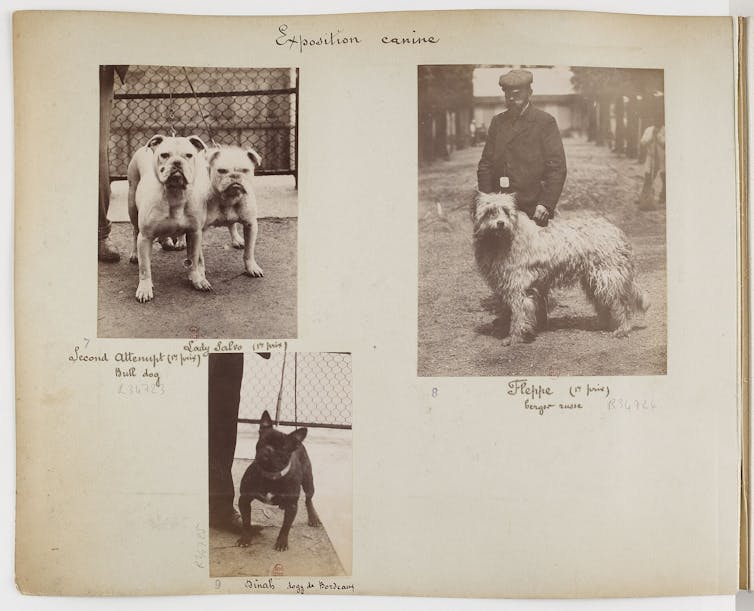
Photographies de l’exposition canine, au jardin des Tuileries en mai 1898
Photographies de l’exposition canine, au jardin des Tuileries en mai 1898.
Jules Beau/Gallica BNF, Fourni par l’auteur

Pendant longtemps, les effets de la sélection ont été évalués presque exclusivement à l’aune de la productivité, de l’efficacité ou de la conformité à un standard. La souffrance animale était connue, mais largement tolérée, considérée comme secondaire, voire inévitable. Les pratiques vétérinaires elles-mêmes en témoignent : pendant une longue période, des interventions lourdes ont été pratiquées sans anesthésie, comme la stérilisation des chiennes.

D’autres gestes, aujourd’hui reconnus comme inutiles et douloureux, étaient également courants : on sectionnait par exemple le frein de la langue chez les chiens, dans l’idée erronée de prévenir la rage.

Ces pratiques témoignent d’un rapport au corps animal dans lequel la souffrance était largement ignorée, par indifférence plus que par méconnaissance.

Ce n’est qu’à partir de la seconde moitié du XXe siècle que la douleur chronique, la qualité de vie ou la santé à long terme des animaux commencent à être pensées comme des problèmes en tant que tels. Les inquiétudes actuelles concernant les chiens aux morphologies extrêmes – difficultés respiratoires, troubles locomoteurs, intolérance à l’effort – s’inscrivent pleinement dans cette histoire récente de la sensibilité au bien-être animal.

Des chats qui ont longtemps échappé à cette logique

La récente réglementation européenne semble concerner plus directement les chiens que les chats, et cette impression correspond à une réalité historique, biologique et sociologique. En France comme dans de nombreux pays européens, les chiens de race sont proportionnellement plus nombreux que les chats de race. Cette différence s’explique en grande partie par l’histoire de l’élevage.

L’intérêt pour les races de chiens est ancien et structurant. La sélection de types morphologiques spécifiques devient l’un des moteurs centraux de l’élevage canin au XIXe siècle, en systématisant et en normant des pratiques bien plus anciennes de différenciation fonctionnelle. Dès l’Antiquité, certains chiens sont ainsi recherchés pour des usages guerriers ou de combat, en fonction de leur taille, de leur puissance ou de leur agressivité.

Ce type de sélection n’est d’ailleurs pas propre aux chiens : chez les gallinacés, des individus ont été privilégiés très tôt pour des usages non alimentaires, notamment pour le combat de coqs ou comme animaux d’ornement, bien avant que ne s’impose une sélection orientée vers la production de chair ou d’œufs.

À l’inverse, les chats ont longtemps échappé à cette logique. Les premiers concours félins du XIXe siècle récompensaient des individus – souvent des chats de gouttière – et non des représentants de races qui n’étaient pas encore standardisées. Le chat est resté plus longtemps un animal ordinaire, moins soumis aux impératifs de sélection morphologique.

Exposition féline à la salle Wagram en 1934
Exposition féline à la salle Wagram en 1934.
Gallica/BNF

Quels chiens demain ?

Populaires sur les réseaux sociaux, les Pomskys sont issus de croisements entre des Huskys sibériens et de spitz-nains
Populaires sur les réseaux sociaux, les Pomskys sont issus de croisements entre des Huskys sibériens et de spitz-nains.
GJH-hoond, CC BY

Les croisements récents, comme le pomsky (issu de croisement entre le husky sibérien et le spitz-nain), témoignent aujourd’hui d’une forte demande pour des animaux perçus comme originaux et attendrissants, mais sont surtout emblématiques d’un effet de mode.

Le choix de ces chiens relève moins d’une réflexion sur leurs besoins ou leur santé que d’une logique de distinction : on choisit un chien comme on choisirait une paire de chaussures, parce qu’il flatte l’ego de son propriétaire et signale une position sociale. Dénoncées depuis longtemps par les vétérinaires, qui constatent au quotidien les conséquences de la sélection de morphologies extrêmes, ces pratiques pourraient être freinées par la nouvelle réglementation européenne, en rappelant clairement que tout croisement n’est pas acceptable dès lors qu’il compromet la santé ou le bien-être des animaux concernés.

Prédire à quoi ressembleront les chiens du futur reste toutefois hasardeux. L’histoire montre que les avancées en matière de protection animale ne sont ni linéaires ni irréversibles. L’émergence d’idéologies brutales ou violentes pourrait très bien conduire à un recul de la prise en compte de la souffrance animale. L’interdiction des formes extrêmes révèle ainsi une tension ancienne entre la vanité des désirs humains parfois cruels et la nécessité d’établir des règles morales pour en limiter les effets – un débat aussi vieux que la philosophie elle-même.

Cette réflexion trouve un écho particulier dans certaines initiatives muséales récentes. L’exposition Domestique-moi si tu peux, présentée au Muséum de Toulouse, propose ainsi de revisiter l’histoire longue de la domestication en montrant qu’il ne s’agit pas d’un phénomène « naturel » et qu’elle est façonnée par des choix humains parfois irrationnels. Elle met surtout en évidence la place centrale de la domestication dans la construction des cultures humaines, la sélection artificielle ayant pour objectif principal de rendre des organismes vivants – animaux comme végétaux – compatibles avec les modes de vie et les besoins humains.


L’exposition Domestique-moi si tu peux retrace l’histoire des domestications animales et végétales, leur histoire et leurs conséquences sur la biodiversité. On peut la visiter jusqu’au 5 juillet 2026 au Muséum de Toulouse. L’historienne Valérie Chansigaud en a été la commissaire scientifique.


The Conversation

Valérie Chansigaud ne travaille pas, ne conseille pas, ne possède pas de parts, ne reçoit pas de fonds d’une organisation qui pourrait tirer profit de cet article, et n’a déclaré aucune autre affiliation que son organisme de recherche.

ref. Chiens de race : l’esthétique peut-elle justifier la souffrance ? – https://theconversation.com/chiens-de-race-lesthetique-peut-elle-justifier-la-souffrance-275835

Avalanches meurtrières : pourquoi les skieurs sous-estiment les risques, malgré les avertissements

Source: The Conversation – in French – By Frédéric Dimanche, Professor and former Director (2015-2025), Ted Rogers School of Hospitality and Tourism Management, Toronto Metropolitan University

« La montagne n’est ni juste, ni injuste. Elle est dangereuse », disait le grand alpiniste italien, Reinhold Messner. Cette année encore, la montagne lui donne raison. Les conditions climatiques ont favorisé des avalanches meurtrières, notamment à Lake Tahoe, en Californie, mais aussi dans les Alpes.


Selon les chiffres du Système national d’Observation de la Sécurité en Montagne (SNOSM), les décès par accident sur les domaines skiables en France s’élevaient entre 8 et 14 par an, selon les années.

Cette année, en février, nous avons déjà largement dépassé ces moyennes. Malgré les progrès réalisés pour prévenir les avalanches – dont la gestion est depuis 2018 inscrite par l’UNESCO au patrimoine culturel immatériel de l’humanité – elles continuent de faire des victimes.

La situation, particulièrement dramatique cette année, s’explique par la structure instable du manteau neigeux, mais aussi par une mauvaise compréhension des risques perçus par certains skieurs et surfeurs, qui, souvent, déclenchent eux-mêmes les avalanches.


À lire aussi :
Tragédie en motoneige au lac Saint-Jean : peut-on vraiment réglementer l’aventure ?


La fascination du hors-piste : liberté, poudreuse et adrénaline

Chaque hiver, des skieurs se lancent hors des pistes balisées, parfois au péril de leur vie. Ces personnes ne sont pas toutes inconscientes ou débutantes dans cette pratique : certaines sont expérimentées, bien équipées de matériel de survie (détecteur de victime d’avalanche ou DVA, pelle, et sonde), et connaissent les dangers. Pourtant, elles décident malgré tout de s’aventurer hors-piste.

Alors, pourquoi skier hors-piste malgré les dangers et les recommandations des professionnels ? Le ski hors-piste fascine, que ce soit en station ou en ski de randonnée bien au-delà des pistes. En effet, il représente le plaisir, la liberté, et l’aventure, dans des sites d’une grande beauté. La poudreuse, aussi appelée pow ou peuf, est dans les rêves de tous les amateurs de glisse : elle offre des sensations rares, exaltantes et recherchées. Elle procure un plaisir intense pour qui sait la maîtriser… et elle peut rendre accro.

Mais le risque est invariablement présent en montagne. On définit souvent le risque par deux critères : (1) la probabilité que quelque chose de néfaste se produise, et (2) la gravité des conséquences. On peut évaluer ces critères rationnellement, avec de l’information fournie par sa propre expérience, ou par les bulletins d’estimation du risque d’avalanche (BERA). Mais la compréhension des risques n’est pas simple.

Pourquoi prenons-nous des risques en montagne ?

Lorsqu’une couche de neige fraîche recouvre les pentes, elle agit comme les sirènes d’Homère, ensorcelant le skieur et l’attirant vers une zone dangereuse et parfois fatale. Mais pourquoi prendre des risques qui peuvent être funestes ? Les chercheurs en psychologie, en sociologie et en neurosciences ont tenté de répondre à cette question et plusieurs théories permettent de comprendre ce comportement.

L’envie de sensations fortes. La première explication vient de la psychologie de la personnalité. Certains ont un besoin plus fort que d’autres de vivre des expériences intenses. On appelle cela la recherche de sensations fortes (ou sensation seeking en anglais). Cette quête de sensations fortes mène à la prise de risque. On peut bien sûr associer à cela la recherche de plaisir dans l’activité.

L’illusion de la maîtrise. Les skieurs expérimentés développent souvent une illusion de maîtrise : ils connaissent le terrain, ils ont déjà skié en poudreuse, et ils ont confiance dans leur matériel, le trio indispensable de secours. Or, les avalanches sont des phénomènes complexes où même une faible erreur d’appréciation peut être fatale. Le danger est d’autant plus grand que la confiance est élevée. De plus, se munir d’un DVA, d’une pelle et d’une sonde (et éventuellement d’un sac à dos airbag) n’empêche pas l’avalanche de se produire. Elle surprend même les guides et moniteurs de ski.

L’influence des réseaux sociaux et de la culture du freeride. Le rôle des réseaux sociaux est devenu important dans la popularisation du hors-piste. Des vidéos montrant des descentes spectaculaires dans de la neige fraîche attirent de nombreux amateurs vers des zones non sécurisées et parfois dangereuses. D’après un article américain, les messages et vidéos incitent des personnes sans expérience à suivre des itinéraires dangereux, entraînant une augmentation des interventions de secours.

Les contenus générés par les utilisateurs peuvent créer une perception biaisée des risques : les vidéos et photos spectaculaires et les commentaires de skieurs suggèrent que l’aventure hors-piste est accessible à tous, sans insister suffisamment sur la nécessité d’une formation adéquate, d’un équipement adapté, et d’une connaissance avancée des conditions nivologiques locales.

Sous-estimation du danger et heuristiques cognitives (raccourcis mentaux). Les chercheurs qui étudient le comportement des victimes d’accidents d’avalanche soulignent des biais psychologiques dans la prise de décision. Par exemple, la familiarité avec une pente ou un accès facile peut amener un skieur à sous-estimer le danger d’un itinéraire simplement parce qu’il a déjà skié au même endroit sans incident ou parce qu’il y a déjà des traces de descente. Cette tendance à atténuer la perception du risque, même lorsque les conditions d’enneigement ou météorologiques changent, explique souvent pourquoi certains skieurs s’aventurent hors-piste sans évaluer correctement le danger.

Dynamiques sociales et culturelles. Les dynamiques de groupe jouent aussi un rôle clé. La pression des pairs et le désir de ne pas être perçu comme peureux jouent souvent dans la prise de risque. Ainsi, des décisions dangereuses peuvent être prises collectivement, mais sans réel débat. Aussi, montrer ses compétences à descendre une belle pente de neige engendre de la reconnaissance parmi ses pairs et incite à la prise de risque.

Cerveau et dopamine. Les neurosciences montrent que l’attrait du risque a aussi une explication biologique. Le cerveau est programmé pour rechercher la récompense, et quand on prend un risque sans conséquences néfastes, le cerveau libère de la dopamine, ce qui procure un intense plaisir, et peut expliquer l’exposition au danger. Ainsi, le freerider devient accro à cette émotion et recommence pour retrouver ce plaisir, en laissant au second plan une analyse rationnelle du risque et de ses répercussions.


À lire aussi :
Bain glacé et douche froide sont-ils la panacée après l’effort ?


Mieux comprendre pour mieux prévenir

Les skieurs ne sont pas tous inconscients. Leurs choix s’expliquent par un ensemble de facteurs psychologiques, sociaux, et biologiques. Mais leurs actions mènent parfois à des tragédies. Comprendre ces mécanismes ne sert pas à juger, mais à mieux prévenir.

Mieux informer sur les risques, adapter les campagnes de sensibilisation, exiger le port d’un équipement de sécurité et ouvrir le débat sur la gratuité des secours en montagne constituent des pistes possibles. Plutôt qu’interdire l’accès à cet espace de liberté qu’est la montagne, il s’agit sans doute de renforcer une culture du renoncement et de la responsabilité.

La Conversation Canada

Frédéric Dimanche ne travaille pas, ne conseille pas, ne possède pas de parts, ne reçoit pas de fonds d’une organisation qui pourrait tirer profit de cet article, et n’a déclaré aucune autre affiliation que son organisme de recherche.

ref. Avalanches meurtrières : pourquoi les skieurs sous-estiment les risques, malgré les avertissements – https://theconversation.com/avalanches-meurtrieres-pourquoi-les-skieurs-sous-estiment-les-risques-malgre-les-avertissements-274785