[PRESS RELEASE, 24 December 2025] – The Ministry of Agriculture & Fisheries (MAF) wishes to inform the public of the recent detection of American Foulbrood (AFB) in Samoa. The detection was reported in late November 2025 by the Samoa Apiculture Association (SAO), led by its President Papalii Richard Wetzell. The affected locations include Siusega and nearby villages, where AFB has been confirmed in several bee hives.
About American Foulbrood (AFB):
American Foulbrood is a highly contagious bacterial disease that affects honeybee colonies. It is caused by the bacterium Paenibacillus larvae, which produces extremely resilient spores capable of surviving in the environment for more than 20 years.
While AFB was first detected in Samoa in 2016, periodic emergence can occur due to a long-term persistence of these spores.
Eradication and Control Measures:
MAF, in collaboration with SAO, is implementing necessary eradication and containment measures to control and eliminate the disease. These measures include:
• Full spraying and disinfection of affected apiaries.
• Collection and on-site destruction of all infested hives through controlled burning.
• Surveillance and monitoring of surrounding areas to prevent further spread.
Public Advisory:
Members of the public, particularly families residing in the affected areas identified by SAO, are kindly requested to fully cooperate with MAF and SAO officers undertaking surveillance and eradication activities.
A formal notification has been issued through the Ministry of Women, Community & Social Development (MWCSD) via village Mayors to ensure that households permit access to their properties for surveillance and eradication activities.
At this stage, there is no cause for alarm. MAF and SAO are actively managing the situation, and are currently engaging only with households where AFB has been confirmed.
The community is encouraged to remain vigilant, follow guidelines provided by authorities, and support ongoing efforts to protect our honeybee industry.
For further information, please contact:
Matai’a Ricky Faatonu, email: ricky.faatonu@maf.gov.ws or phone: 7735353, Seumaloisalafai Afele Faiilagi, afele.faiilagi@maf.gov.ws or phone: 7591723
His Excellency Dr. Gábor Tamás Nagy presented his Letter of Credence to the Head of State of the Independent State of Samoa, Afioga Tuimaleali’ifano Va’aletoa Sualauvi II, at a Credentials Ceremony held this morning at the Official Residence of the Head of State at Vailele. The presentation formally accredited His Excellency as Ambassador Extraordinary and Plenipotentiary of Hungary to Samoa, with residence in Wellington, New Zealand.
Samoa and Hungary have enjoyed cordial relations since the establishment of diplomatic ties on 7 September 2011. Despite the geographical distance between us, we continue to engage through our shared membership in the United Nations, the OACP-EU and other international fora on matters of mutual interest, including peace and security, respect for sovereignty, human rights, and the implementation of the 2030 Agenda for Sustainable Development. Ambassador Nagy reaffirmed Hungary’s commitment to the diplomatic partnership between our two countries in various areas, be it bilateral as well as multilateral formats based on the solid foundation that has already been established by his predecessors.
Afioga Tuimaleali‘ifano Va‘aletoa Sualauvi II welcomed the Ambassador and acknowledged the positive development of relations between Samoa and Hungary. The Head of State conveyed his congratulations to the Government of Hungary on the establishment of an Honorary Consulate in Samoa and extended his best wishes to Afioga Saumalaulu Stefan Szegedi on his appointment as the first Honorary Consul of Hungary to Samoa. He expressed confidence that this new representation will further strengthen cooperation and people-to-people ties between the two countries. The Head of State also stated that Ambassador Nagy’s tenure would further strengthen existing friendship and cooperation between Samoa and Hungary.
H.E. Dr. Gábor Tamás Nagy has a distinguished career in public service, academia, and politics. He most recently served as Deputy Head of Mission and Consul at the Permanent Mission of Hungary to Vilnius, Lithuania (2022–2024). Over his extensive career, he has held prominent roles including as Mayor of Budapest’s 1st District (Buda Castle Municipality), Member of the Hungarian Parliament and its Foreign Affairs Committee, and Member of the Budapest City Council. Prior to his political career, he worked as a lecturer at Eötvös Loránd University and as a researcher at the Hungarian Academy of Sciences. Dr. Nagy holds degrees in Law and Sociology from Eötvös Loránd University and is fluent in English and German.
His Excellency Patryk Michal Blaszczak presented his Letters of Credence to the Head of State of the Independent State of Samoa, Afioga Tuimaleali’ifano Va’aletoa Sualauvi II, at a Credentials Ceremony held this morning at the Official Residence of the Head of State at Vailele. The presentation formally accredited His Excellency as Ambassador Extraordinary and Plenipotentiary of the Republic of Poland to Samoa, with residence in Wellington, New Zealand.
Samoa and Poland have enjoyed cordial relations since the establishment of diplomatic ties on 8 March 2012. The two countries continue to engage closely through their shared membership in the United Nations, the OACPS–EU framework, and other international fora on matters of mutual interest, including international peace and security, the promotion of democracy and fundamental human rights, and climate change. Ambassador Błaszczak reaffirmed Poland’s commitment to strengthening the diplomatic partnership between Samoa and Poland, both bilaterally and multilaterally, building on the solid foundation established by his predecessors.
Afioga Tuimaleali‘ifano Va‘aletoa Sualauvi II welcomed the Ambassador and acknowledged the positive development of relations between Samoa and Poland. The Head of State conveyed his congratulations to the Government of Poland on the establishment of an Honorary Consul in Samoa and extended his best wishes to Mr. Anthony Pereira on his appointment as the first Honorary Consul of Poland to Samoa. He expressed confidence that this new representation will further strengthen cooperation and people-to-people ties, and that Ambassador Blaszczak’s tenure will continue to enhance friendship and cooperation between the two countries.
His Excellency Patryk Michał Błaszczak is currently the Ambassador of Poland to New Zealand (since 2025) with concurrent accreditation to Samoa and other Pacific countries. He has held senior diplomatic including Deputy Head of Mission in Copenhagen, Acting Director of the European Policy Department at Poland’s Ministry of Foreign Affairs, and Head of the Political Section at the Polish Embassy in Paris. Ambassador Błaszczak holds a Master’s degree in Applied Linguistics from the University of Warsaw, is fluent in English and French, and is a recipient of the Bronze Cross of Merit of the Republic of Poland.
Source: The Conversation – UK – By Arshin Adib-Moghaddam, Professor in Global Thought and Comparative Philosophies, Inaugural Co-Director of Centre for AI Futures, SOAS, University of London
The US president has repeatedly said that Iran can’t be allowed to develop a nuclear weapon. But the IAEA has stated that there is no evidence that Iran is pursuing a nuclear weapon. Iran’s foreign minister, Abbas Araghchi, said after the latest round of talks that “good progress” was being made on a deal to limit Iran’s nuclear programme in return for sanctions relief.
Now, from everything that the US president is saying, the goalposts have shifted from a nuclear deal to an attempt to force regime change.
So bombs are falling on various cities in Iran, family members are hiding, tragedies will inevitably happen and the innocent will suffer. This is the endpoint of a longstanding campaign by the US and Israeli right-wing to reshape the Middle East and the wider Muslim world at the barrel of a gun. This is yet another intervention in a long history of disastrous foreign moves that have destabilised the country since Britain and the Soviet Union deposed Reza Shah Pahlavi in 1941 and the CIA and MI6 orchestrated a coup to depose Iran’s democratically elected prime minister, Mohammad Mossadegh, in 1953.
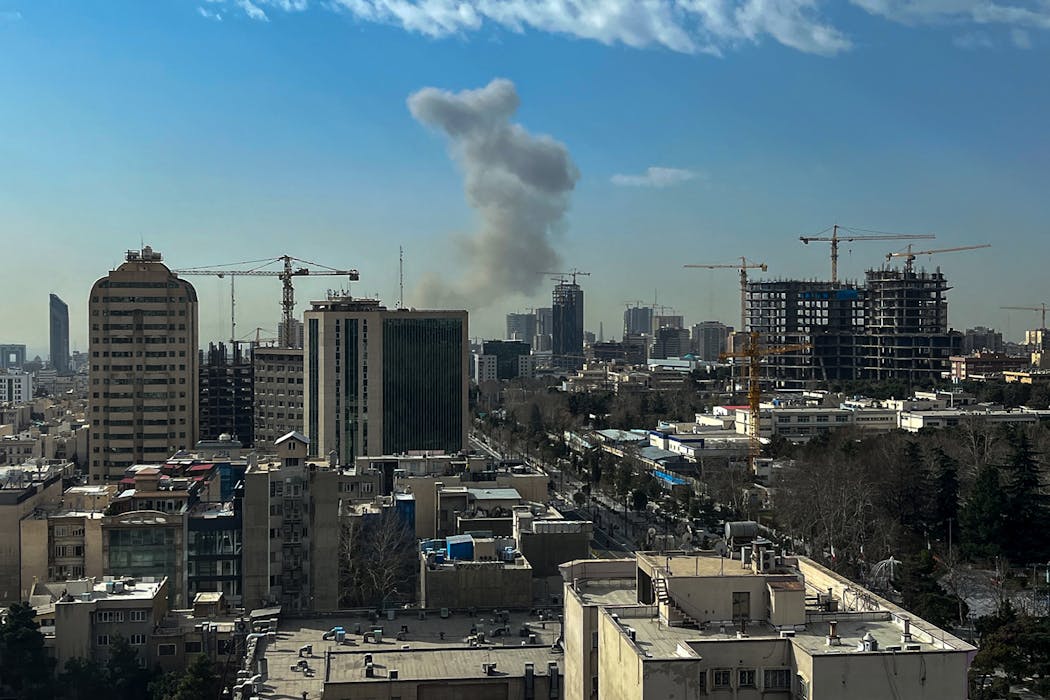
The consequences of this attack are likely to be dire for the region and the world. Already, Iran has retaliated by targeting US bases in Kuwait, Qatar, the United Arab Emirates and Bahrain and the first reports of casualties are emerging. Iran is unlikely to hold back. It’s clear that the Islamic Republic is viewing this as an existential threat.
Tehran will call on its allies in the region, the Houthis in Yemen, the Popular Mobilisation Forces in Iraq and Hezbollah in Lebanon which – despite being weakened over two years of attacks by Israel aided and abetted by the United States – have the capacity to expand the conflict throughout the region.
Iran has already indicated in recent drills with the Russian Navy that it may be capable of closing off the Strait of Hormuz, through which around one-quarter of the world’s oil and one-third of its liquefied natural gas travel. As a consequence, oil prices will explode and the world economy will suffer.
Clash of civilisations
There is a cultural component to this war, too. Israel and the US are conducting this war during the month of Ramadan. Muslims all over the world are fasting. For billions of them, this is the month of spirituality, peace and solidarity. Images of Iranian Muslims being killed by Israeli and US bombs threaten to further a clash of civilisations narrative which pits the Judeo-Christian world against Islam.
Muslims in European capitals, together with anti-war activists, will see this war as a clear aggression on the part of the US and Israel. Global public opinion will not be easily swayed into the direction Trump and Netanyahu would like.
And it must be asked, what will the leaders in Moscow and Beijing be thinking as they watch this illegal war and what might this mean for Ukraine and Taiwan? Vladimir Putin and Xi Jinping are close to the government of Iran and will condemn this war. At the same time, they must feel emboldened to pursue their own agendas with military might.
So Trump and Netanyahu’s attack on Iran has the potential to plunge the world into deep crisis. Expect more refugees, more economic turmoil, more trauma, death and destruction. The only hope now is that cooler heads among world leaders can prevail to contain this conflict and to limit the actions of Trump and Netanyahu.
Diplomacy has to be prioritised. Attempting to force regime change by launching an illegal war is foolhardy. If Iran is further destabilised, the entire Middle East and beyond will be plunged into utter turmoil. From there the outcome for the whole world is dangerously uncertain.
Arshin Adib-Moghaddam does not work for, consult, own shares in or receive funding from any company or organisation that would benefit from this article, and has disclosed no relevant affiliations beyond their academic appointment.
US and Iranian negotiators met in Geneva earlier this week in what mediators described as the most serious and constructive talks in years. Oman’s foreign minister, Badr Albusaidi, spoke publicly of “unprecedented openness,” signalling that both sides were exploring creative formulations rather than repeating entrenched positions. Discussions showed flexibility on nuclear limits and sanctions relief, and mediators indicated that a principles agreement could have been reached within days, with detailed verification mechanisms to follow within months.
These were not hollow gestures. Real diplomatic capital was being spent. Iranian officials floated proposals designed to meet US political realities – including potential access to energy sectors and economic cooperation. These were gestures calibrated to allow Donald Trump to present any deal as tougher and more advantageous than the 2015 agreement he withdrew the US from in May 2018. Tehran appeared to understand the optics Washington required, even if contentious issues such as ballistic missiles and regional proxy networks remained outside the immediate framework. Then, in the middle of these talks, the bridge was shattered.
Sensing how close the negotiations were — and how imminent military escalation had become — Oman’s foreign minister, Badr Albusaidi, made an emergency dash to Washington in a last-ditch effort to preserve the diplomatic track.
In an unusually public move for a mediator, he appeared on CBS to outline just how far the talks had progressed. He described a deal that would eliminate Iranian stockpiles of highly enriched uranium, down-blend existing material inside Iran, and allow full verification by the International Atomic Energy Agency (IAEA) — with the possibility of US inspectors participating alongside them. Iran, he suggested, would enrich only for civilian purposes. A principles agreement, he indicated, could be signed within days. It was a remarkable disclosure — effectively revealing the contours of a near-breakthrough in an attempt to prevent imminent war.
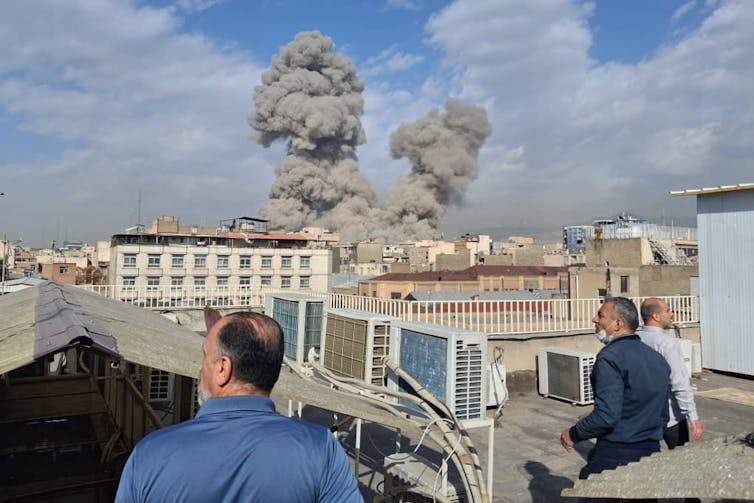
But rather than allowing diplomacy to conclude, the US and Israel have launched coordinated strikes across Iran. Explosions were reported in Tehran and other cities. Trump announced “major combat operations,”, framing them as necessary to eliminate nuclear and missile threats while urging Iranians to seize the moment and overthrow their leadership. Iran responded with missile and drone attacks targeting US bases and allied states across the region.
What is most striking is not merely that diplomacy failed, but that it failed amid visible progress. Mediators were openly discussing a viable framework; both sides had demonstrated flexibility – a pathway to constrain nuclear escalation appeared tangible. Choosing military escalation at that moment undermines the premise that negotiation is a genuine alternative to war. It signals that even active diplomacy offers no guarantee of restraint. Peace was not naïve. It was plausible.
Iran’s approach in Geneva was strategic, not submissive. Proposals involving economic incentives – including energy cooperation – were not unilateral concessions but calculated compromises designed to structure a politically survivable agreement in Washington. The core objective was clear: constrain Iran’s nuclear programme through enforceable limits and intrusive verification, thereby addressing the very proliferation risks that sanctions and threats of force were meant to prevent.
Talks had moved beyond rhetorical posturing toward concrete proposals. For the first time in years, there was credible movement toward stabilising the nuclear issue. By attacking during that negotiation window, Washington and its allies have not only derailed a diplomatic opening but have cast doubt on the durability of American commitments to negotiated solutions. The message to Tehran – and to other adversaries weighing diplomacy – is stark: even when talks appear to work, they can be overtaken by force.
Iran is not Iraq or Libya
Advocates of escalation often invoke Iraq in 2003 or Libya in 2011 as precedents for rapid regime collapse under pressure. Those analogies are misleading. Iraq and Libya were highly personalised systems, overly dependent on narrow patronage networks and individual rulers. Remove the centre, and the structure imploded.
Iran is structurally different. It is not a dynastic dictatorship but an ideologically entrenched state with layered institutions, doctrinal legitimacy and a deeply embedded security apparatus, including the Islamic Revolutionary Guard Corps. Its authority is intertwined with religious, political and strategic narratives cultivated over decades. It has endured sanctions, regional isolation and sustained external pressure without fracturing.
Even a previous US-Israeli campaign in 2025 that lasted 12 days failed to eliminate Tehran’s retaliatory capacity. Far from collapsing, the state absorbed pressure and responded. Hitting such a system with maximum force does not guarantee implosion; it may instead consolidate internal cohesion and reinforce narratives of external aggression that the leadership has long leveraged.
Rhetoric surrounding the strikes has already shifted from tactical objectives to the language of regime change. US and Israeli leaders framed military action not solely as neutralising missile or nuclear capabilities, but as an opportunity for Iranians to overthrow their government. That calculus – regime change by force – is historically fraught with risk.
The Iraq invasion should be a cautionary tale. The US spent more than a decade cultivating multiple Iraqi opposition groups – yet dismantling the centralised state apparatus still produced chaos, insurgency and fragmentation. The vacuum gave rise to extremist organisations such as IS, drawing the US into years of renewed conflict.
Approaching Iran with similar assumptions ignores both its institutional resilience and the complexity of regional geopolitics. Sectarian divisions, entrenched alliances and proxy networks mean that destabilisation in Tehran would not remain contained. It could rapidly spill across borders and harden into prolonged confrontation.
A region wired for escalation
Iran has invested heavily in asymmetric capabilities precisely to deter and complicate external intervention. Its missile, drone and naval systems are embedded along the Strait of Hormuz — a chokepoint for global energy — and linked into a network of regional allies and militias.
In the current escalation, Tehran has already launched retaliatory missile and drone strikes against US military bases and allied territories in the Gulf, hitting locations in Iraq, Bahrain, the United Arab Emirates (including Abu Dhabi), Kuwait and Qatar in direct response to US and Israeli strikes on Iran’s cities, including Tehran, Qom and Isfahan. Explosions have been reported in Bahrain and the UAE, with at least one confirmed fatality in Abu Dhabi, and several bases housing US personnel have been struck or targeted, underscoring how the conflict has already spread beyond Iran’s borders
A full-scale regional war is now more likely than it was a week ago. Miscalculation could draw multiple states into conflict, inflame sectarian fault lines and disrupt global energy markets. What might have remained a contained nuclear dispute now risks expanding into a wider geopolitical confrontation.
What about Trump’s promise of no more forever wars?
Trump built his political brand opposing “endless wars” and criticising the Iraq invasion. “America First” promised strategic restraint, hard bargaining and an aversion to open-ended intervention. Escalating militarily at the very moment diplomacy was advancing sits uneasily with that doctrine and revives questions about the true objectives of US strategy in the Middle East.
If a workable nuclear framework was genuinely emerging, abandoning it in favour of escalation invites a deeper question: does sustained tension serve certain strategic preferences more comfortably than durable peace?
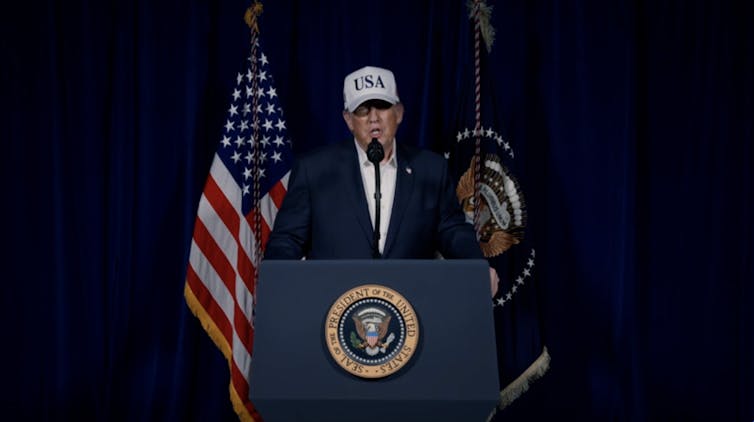
Trump’s Mar-a-Lago address announcing the strikes carried unmistakable echoes of George W. Bush before the 2003 invasion of Iraq. Military action was framed as reluctant yet necessary – a pre-emptive move to eliminate gathering threats and secure peace through strength. The rhetoric of patience exhausted and danger confronted before it fully materialises closely mirrors the language Bush used to justify the march into Baghdad.
The parallel extends beyond tone. Bush cast the Iraq war as liberation as well as disarmament, promising Iraqis freedom from dictatorship. Trump similarly urged Iranians to reclaim their country, implicitly linking force to regime change. In Iraq, that fusion of shock and salvation produced not swift democratic renewal but prolonged instability. The assumption that military force can reorder political systems from the outside has already been tested – and its costs remain visible.
The central challenge now facing the US is not simply Iran’s military capability. It is credibility. Abandoning negotiations mid-course signals that diplomacy can be overridden by force even when progress is visible. That perception will resonate far beyond Tehran.
Peace was never guaranteed. It was limited and imperfect, focused primarily on nuclear constraints rather than human rights or regional proxy networks. But it was plausible – and closer than many assumed. Breaking the bridge while building it does more than halt a single agreement – it risks convincing both sides that negotiation itself is futile.
In that world, trust erodes, deterrence hardens and aggression – not agreement – becomes the default language of international power. What we are witnessing is yet another clear indication that the rules-based order has been consigned to the history books.
Bamo Nouri does not work for, consult, own shares in or receive funding from any company or organisation that would benefit from this article, and has disclosed no relevant affiliations beyond their academic appointment.
After U.S. and Israeli missiles struck Iran’s nuclear sites in June 2025, Tehran responded with a limited attack on the American airbase in Qatar. Five years before that, a U.S. drone strike against Qasem Soleimani, head of the powerful Islamic Revolutionary Guard Corps Quds Force, was met with followed by an attack on two American bases in Iraq shortly thereafter.
In the early hours of Feb. 28, 2026, hundreds of missiles struck multiple sites in Iran. Part of “Operation Epic Fury,” as the U.S. Department of Defense has called it, the strikes follow months of U.S. military buildup in the region. But they also come after apparent diplomatic efforts, in the shape of a series of nuclear talks in Oman and Geneva aimed at a peaceful resolution.
Any such deal is surely now completely off the table. In scale and scope, the U.S. and Israel attack goes far beyond any previous strikes on the Gulf nation.
In response, Iran has said it will use “crushing” force. As an expert on Middle East affairs and a former senior official at the National Security Council during the first Trump administration, I believe the calculus both in Washington and more so in Tehran is very different from earlier confrontations: Iran’s leaders almost certainly see this as an existential threat given President Donald Trump’s statement and the military campaign already underway. And there appears to be no obvious off-ramp to avoid further escalation.
What we should expect now is a response from Tehran that utilizes all of its capabilities – even though they have been significantly degraded. And that should be a worry for all nations in the region and beyond.
The apparent aims of the US operation
It is important to note that we are in the early stages of this conflict – much is unknown.
As of Feb. 28, it is unclear who has been killed among Iran’s leadership and to what extent Iran’s ballistic missile capabilities have been degraded. The fact that ballistic missiles have been launched at regional states that host U.S. military bases suggests that, at a minimum, Iran’s military capabilities have not been entirely wiped out.
Iran fired over 600 missiles against Israel last June during their 12-day war, but media reporting and Iranian statements over the past month suggested that Iran managed to replenish some of its missile inventory, which it is now using.
Clearly Washington is intent on crippling Iran’s ballistic program, as it is that capability that allows Iran to threaten the region most directly. A sticking point in the negotiations in Geneva and Oman was U.S. officials’ insistence that both Iran’s ballistic missiles and its funneling of support to proxy groups in the region be on the table, along with the longstanding condition that Tehran ends all uranium enrichment. Tehran has long resisted attempts to have limits on its ballistic missiles as part of any negotiated nuclear deal given their importance in Iran’s national security doctrine.
This explains why some U.S. and Israeli strikes appear to be aimed at taking out Iran’s ballistic and cruise missile launch sites and production facilities and storage locations for such weapons.
But the Trump administration appears to have expanded its aims beyond removing Iran’s nuclear and non-nuclear military threat. The latest strikes have gone after leadership, too.
Among the locations of the first U.S.-Israeli strikes was a Tehran compound in which the Supreme Leader Ayatollah Ali Khamenei in known to reside, and Israel’s prime minister has confirmed that the 86-year-old leader was a target of the operation.
While the status of the supreme leader and other key members of Iran’s leadership remains unknown as of this writing, it is clear that the U.S. administration hopes that regime change will follow Operation Epic Fury. “When we are finished, take over your government. It will be yours to take,” Trump told Iranians via a video message recorded during the early hours of the attack.
Signaling a regime change operation may encourage Iranians unhappy with decades of repressive rule and economic woes to continue where they left off in January – when hundreds of thousands took to the street to protest.
But it carries risks for the U.S. and its interests. Iran’s leaders will no longer feel constrained, as they did after the Soleimani assassination and the June 2025 conflict. On those occasions, Iran responded in a way that was not even proportionate to its losses – limited strikes on American military bases in the region.
Now the gloves are off, and each side will be trying to land a knockout blow. But what does that constitute? The U.S. administration appears to be set on regime change. Iran’s leadership will be looking for something that goes beyond its previous retaliatory strikes – and that likely means American deaths. That eventuality has been anticipated by Trump, who warned that there might be American casualties.
So why is Trump willing to risk that now? It is clear to me that despite talk of progress in the rounds of diplomatic talks, Trump has lost his patience with the process.
On Feb. 26, after the latest round of talks in Geneva, we didn’t hear much from the U.S. side. Trump’s calculus may have been that Iran wasn’t taking the hint – made clear by adding a second carrier strike group to the other warships and hundreds of fighter aircraft sent to the region over the past several weeks – that Tehran had no option other than agreeing to the U.S. demands.
Iranians watch as explosions erupt across Tehran. AP Photo
What happens next
What we don’t know is whether the U.S. strategy is now to pause and see if an initial round of strikes has forced Iran to sue for peace – or whether the initial strikes are just a prelude to more to come.
For now, the diplomatic ship appears to have sailed. Trump seems to have no appetite for a deal now – he just wants Iran’s regime gone.
In order to do that, he has made a number of calculated gambles. First politically and legally: Trump did not go through Congress before ordering Operation Epic Fury. Unlike 23 years ago when President George W. Bush took the U.S. into Iraq, there is no war authorization giving the president cover.
Instead, White House lawyers must have assessed that Trump can carry out this operation under his Article 2 powers to act as commander in chief. Even so, the 1973 War Powers Act will mean the clock is now ticking. If the attacks are not concluded in 60 days, the administration will have to go back to Congress and say the operation is complete, or work with Congress for an authorization to use force or a formal declaration of war.
The second gamble is whether Iranians will heed his call to remove a regime that many have long wanted gone. Given the ferocity of the regime’s response to the protests in January, which resulted in the deaths of thousands of Iranians, are Iranians willing to face down Iran’s internal security forces and drive what remains of the regime from power?
Third, the U.S. administration has made a bet that the Iranian regime – even confronted with an existential threat – does not have the capability to drag the U.S. into a lengthy conflict to inflict massive casualties.
But it can lean on unconventional capabilities. Terrorism is a real concern – either through the Islamic Revolutionary Guard Corps’ Quds Force, which coordinates Iran’s unconventional warfare, or through its partnership with Hezbollah in Lebanon. Or actors like the Houthis in Yemen or Shia militias in Iraq may seek to conduct attacks against U.S. interests in solidarity with Iran or directed to do so by the regime.
A mass casualty event may put political pressure on Trump, but I cannot see it leading to U.S. boots on ground in Iran. The American public doesn’t have the appetite for such an eventuality, and that would necessitate Trump gaining Congressional approval, which for now has not yet materialized.
No one has a crystal ball, and it is early in an operation that will likely go on for days, if not longer. But one thing is clear: Iran’s regime is facing an existential threat. Do not expect it to show restraint.
Javed Ali does not work for, consult, own shares in or receive funding from any company or organization that would benefit from this article, and has disclosed no relevant affiliations beyond their academic appointment.
Source: The Conversation – USA – By Donald Heflin, Executive Director of the Edward R. Murrow Center and Senior Fellow of Diplomatic Practice, The Fletcher School, Tufts University
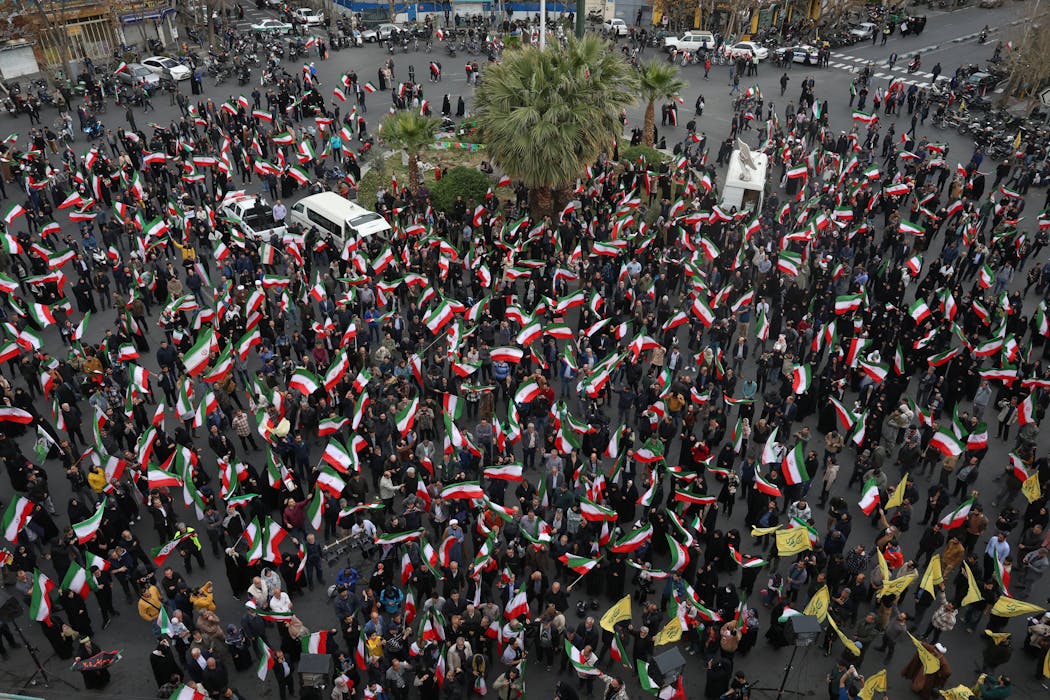
A group of demonstrators in Tehran wave Iranian flags in support of the government on Feb. 28, 2026AP Photo/Vahid Salemi
To better understand what this means for the U.S. and Iran, Alfonso Serrano, a U.S. politics editor at The Conversation, interviewed Donald Heflin, a veteran diplomat who now teaches at Tufts University’s Fletcher School.
Widespread attacks have been reported across Iran, following weeks of U.S. military buildup in the region. What does the scale of the attacks tell you?
I think that Trump and his administration are going for regime change with these massive strikes and with all the ships and some troops in the area. I think there will probably be a couple more days’ worth of strikes. They’ll start off with the time-honored strategy of attacking what’s known as command and control, the nerve centers for controlling Iran’s military. From media reporting, we already know that the residence of Supreme Leader Ayatollah Ali Khamenei was attacked.
What is the U.S. strategic end game here?
Regime change is going to be difficult. We heard Trump today call for the Iranian people to bring the government down. In the first place, that’s difficult. It’s hard for people with no arms in their hands to bring down a very tightly controlled regime that has a lot of arms.
The second point is that U.S. history in that area of the world is not good with this. You may recall that during the Gulf War of 1990-1991, the U.S. basically encouraged the Iraqi people to rise up, and then made its own decision not to attack Baghdad, to stop short. And that has not been forgotten in Iraq or surrounding countries. I would be surprised if we saw a popular uprising in Iran that really had a chance of bringing the regime down.
A group of men wave Iranian flags as they protest U.S. and Israeli strikes in Tehran, Iran, on Feb. 28, 2026. AP Photo/Vahid Salemi
Do you see the possibility of U.S. troops on the ground to bring about regime change?
I will stick my neck out here and say that’s not going to happen. I mean, there may be some small special forces sent in. That’ll be kept quiet for a while. But as far as large numbers of U.S. troops, no, I don’t think it’s going to happen.
Two reasons. First off, any president would feel that was extremely risky. Iran’s a big country with a big military. The risks you would be taking are large amounts of casualties, and you may not succeed in what you’re trying to do.
But Trump, in particular, despite the military strike against Iran and the one against Venezuela, is not a big fan of big military interventions and war. He’s a guy who will send in fighter planes and small special forces units, but not 10,000 or 20,000 troops.
And the reason for that is, throughout his career, he does well with a little bit of chaos. He doesn’t mind creating a little bit of chaos and figuring out a way to make a profit on the other side of that. War is too much chaos. It’s really hard to predict what the outcome is going to be, what all the ramifications are going to be. Throughout his first term and the first year of his second term, he has shown no inclination to send ground troops anywhere.
Speaking of President Trump, what are the risks he faces?
One risk is going on right now, which is that the Iranians may get lucky or smart and manage to attack a really good target and kill a lot of people, like something in Jerusalem or Tel Aviv or a U.S. military base.
The second risk is that the attacks don’t work, that the supreme leader and whoever else is considered the political leadership of Iran survives, and the U.S. winds up with egg on its face.
The third risk is that it works to a certain extent. You take out the top people, but then who steps into their shoes? I mean, go back and look at Venezuela. Most people would have thought that who was going to wind up winning at the end of that was the head of the opposition. But it wound up being the vice president of the old regime, Delcy Rodríguez.
I can see a similar scenario in Iran, if Khamenei and a couple of other leaders were taken out. But the only institution in Iran strong enough to succeed them is the army, the Revolutionary Guards in particular. Would that be an improvement for the U.S.? It depends on what their attitude was. The same attitude that the vice president of Venezuela has been taking, which is, “Look, this is a fact of life. We better negotiate with the Americans and figure out some way forward we can both live with.”
But these guys are pretty hardcore revolutionaries. I mean, Iran has been under revolutionary leadership for 47 years. All these guys are true believers. I don’t know if we’ll be able to work with them.
I think the timing is interesting. If you go back to last year, Trump, after being in office a little and watching the situation between Israel and Gaza, was given an opening, when Israeli Prime Minister Benjamin Netanyahu attacked Qatar.
A lot of conservative Mideast regimes, who didn’t have a huge problem with Israel, essentially said “That’s going too far.” And Trump was able to use that as an excuse. He was able to essentially say, “Okay, you’ve gone too far. You’re really taking risk with world peace. Everybody’s gonna sit at the table.”
I think the same thing’s happening here. I believe many countries would love to see regime change in Iran. But you can’t go into the country and say, “We don’t like the political leadership being elected. We’re going to get rid of them for you.” What often happens in that situation is people begin to rally around the flag. They begin to rally around the government when the bombs start falling.
That’s the excuse Trump can use. You can sell it to the Iranian people and say, “Look, they’re killing you in the streets. Forget about your problems with Israel and the U.S. and everything. They’re real, but you’re getting killed in the streets, and that’s why we’re intervening.” It’s a bit of a fig leaf.
Now, as I said earlier, the problem with this is if your next line is, “You know, we’re going to really soften this regime up with bombs; now it’s your time to go out in the streets and bring the regime down.” I may eat these words, but I don’t think that’s going to happen. The regime is just too strong for it to be brought down by bare hands.
Donald Heflin does not work for, consult, own shares in or receive funding from any company or organization that would benefit from this article, and has disclosed no relevant affiliations beyond their academic appointment.
Ayatollah Ali Khamenei, Iran’s supreme leader for 36 years, has been killed in US and Israeli airstrikes on his country, according to US President Donald Trump. Iran did not immediately confirm his death.
As one of Iran’s longest-serving leaders, Khamenei has been almost as ubiquitous in Iranian society as his predecessor, Ayatollah Ruhollah Khomeini, who founded the Islamic Republic of Iran in 1979.
And despite the fact Khomeini authored the Iranian Revolution, some say Khamenei was actually the most powerful leader modern Iran has had.
In more than three decades as supreme leader, Khamenei amassed unprecedented power over domestic politics and cracked down ever more harshly on internal dissent. In recent years, he prioritised his survival – and that of his regime – above all else. His government brutally put down a popular uprising in December 2025–January 2026 that killed thousands.
Ultimately, though, Khamenei will not be remembered by most Iranians as a strong leader. Nor will he be revered. Instead, his legacy will be the profound weakness his regime brought the Islamic Republic on all fronts.
Khamenei’s rise through the ranks
Khamenei was born in the city of Marshad in northeastern Iran in 1939. As a boy, he began to form his political and religious world view by studying at Islamic seminaries in Najaf and Qom. At 13, he started to embrace ideas relating to revolutionary Islam. These included the teachings of cleric Navab Safavi, who often called for political violence against the rule of the shah of Iran, Mohammad Reza Pahlavi.
Khamenei met Khomeini in 1958 and immediately embraced his philosophy, often referred to as “Khomeinism”.
The concept of velayat-e faqih, also known as guardianship of the jurist, is central to Khomeinism. It dictates that the supreme leader should be endowed with “all the authorities that the Prophet and infallible Imams were entitled”.
Essentially, this means Iran was to be ruled by a single scholar of Shia Islam. This is where Khomeini, and later Khamenei, would draw their sweeping power and control.
From 1962, Khamenei began almost two decades of revolutionary activity against Pahlavi (the shah) on behalf of Khomeini, who was exiled in 1964. Khamenei was arrested by the shah’s secret police in 1971 and tortured, according to his memoirs.
When the shah was overthrown in the Islamic Revolution in 1979, Khomeini returned from exile to become the new supreme leader.
Khamenei was selected to join the Revolutionary Council, which ruled alongside the provisional government. He then became deputy defence minister and assisted in organising the Islamic Revolutionary Guard Corps (IRGC). This military institution – initially created to protect the revolution and supreme leader – would become one of the most powerful political forces in Iran.
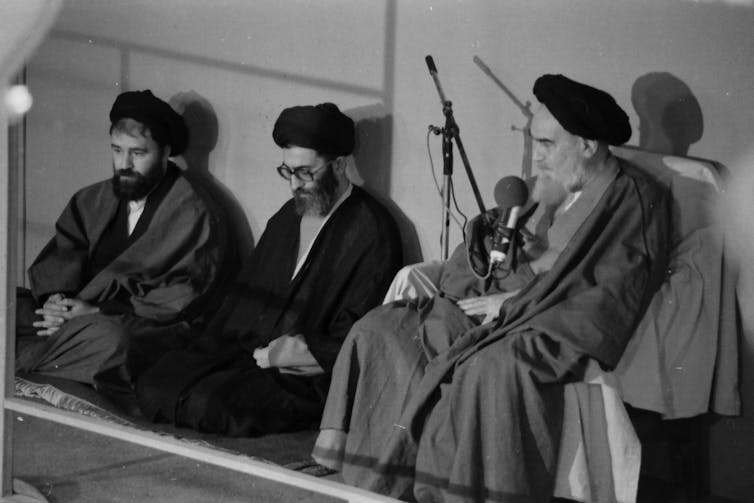
Ayatollah Ruhollah Khomeini (sitting on chair), Ali Khamenei (middle), and Khomeini’s son, Ahmad Khomeini (left), pictured in 1981. Wikimedia Commons
Although subordinate to the supreme leader, Khamenei wielded significant power compared to later presidents, given the revolution was still very young and the Iraq war posed a great threat to the regime. But he remained in lock-step with Khomeini’s wishes. He also managed to build a close relationship with the IRGC that would go far beyond his presidency.
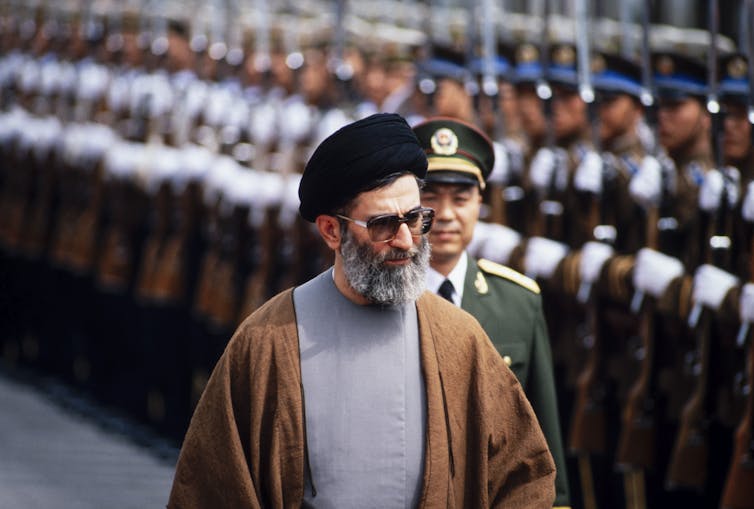
Then-President Ali Khamenei during a state visit to China in May 1989. Forrest Anderson/Getty Images
A surprising choice for supreme leader
Khomeini died in June 1989 after a period of deteriorating health, with no clear successor.
Khomeini had initially supported Grand Ayatollah Hossein-Ali Montazeri to be his successor. However, Montazeri had become increasingly critical of the supreme leader’s authority and human rights violations in the country. He resigned in 1988 and was put under house arrest until his death in 2009.
In fact, his appointment sparked a significant amount of controversy and criticism. Some Islamic scholars believed he lacked the clerical rank of grand ayatollah, which was required under the constitution to ascend to the position. These critics believed the Iranian people would not respect the word of “a mere human being” without a proper connection to God.
The constitutional amendments, however, had given Khamenei significantly more power to intervene in political affairs. In fact, he had far more power as supreme leader than Khomeini ever enjoyed.
This included the ability to determine general policies, appoint and dismiss members of the Council of Guardians, and order public referendums. He also had enough power to silence dissent with relative ease.
Consolidating power over the decades
Khamenei worked with his presidents to varying degrees, though he exercised his power to undermine legislation when he disagreed with it.
For example, he largely backed the economic agenda of President Hashemi Rafsanjani (who served from 1989 to 1997), but he often stood in the way of Mohammad Khatami (1997–2005) and Hassan Rouhani (2013–21). Both had attempted to reform Iran’s political system and foster a better relationship with the West.
Khamenei’s most famous intervention in domestic politics occurred after the first term of President Mahmoud Ahmadinejad (2005–13). After Ahmadinejad claimed victory in the disputed 2009 presidential election, thousands of Iranians took to the streets in one of the largest protest movements since the revolution. Khamenei backed the election result and cracked down harshly on the protesters. Dozens were killed (perhaps more), while thousands were arbitrarily arrested.
Khamenei later clashed with Ahmadinejad and warned him against seeking the presidency again in 2017. Ahmadinejad defied him, but was later barred from running.
After the death of hardline President Ebrahim Raisi in a helicopter crash in 2024, Khameini continued his manoeuvring behind the scenes. After the reformist Masoud Pezeshkian won the presidency, Khameini immediately blocked him from negotiating with the United States over sanctions relief and used his influence to thwart his economic reform agenda.
Thanks to the powers vested in him in the constitution, Khamenei also had extraordinary control over Iran’s foreign policy.
Like his mentor, Khomeini, he staunchly supported the regime’s resistance to what it considered “Western imperialism”. He was also a key architect of Iran’s regional proxy strategy, funding militant groups like Hezbollah, Hamas, the Houthis and others to carry out Iran’s military objectives.
During the first Trump administration, however, Khamenei returned to a staunchly anti-Western posture. His government railed against Trump’s scuttling of the 2015 nuclear deal, the reimposed economic sanctions on Iran’s energy sector and the assassination of the head of the IRGC’s Quds force, Qassem Soleimani.
After Trump returned to office in 2025, Iran grew even weaker. And Khamenei’s anti-Western posture began to look increasingly hollow. Iran’s defeat in the 12-day war with Israel in 2025 shredded whatever legitimacy his regime had left.
In the months that followed, Khamenei ruled over a population increasingly resentful of the Iranian political system and its leadership. In the 2025–26 protests, some openly chanted for Khamenei’s death.
When Khomenei died in 1989, his state funeral was attended by millions. Mourners pulled him out of his coffin and scrambled for sacred mementos.
Though Khameini served longer, Iranians will likely not show the same grief for him.
Andrew Thomas does not work for, consult, own shares in or receive funding from any company or organisation that would benefit from this article, and has disclosed no relevant affiliations beyond their academic appointment.
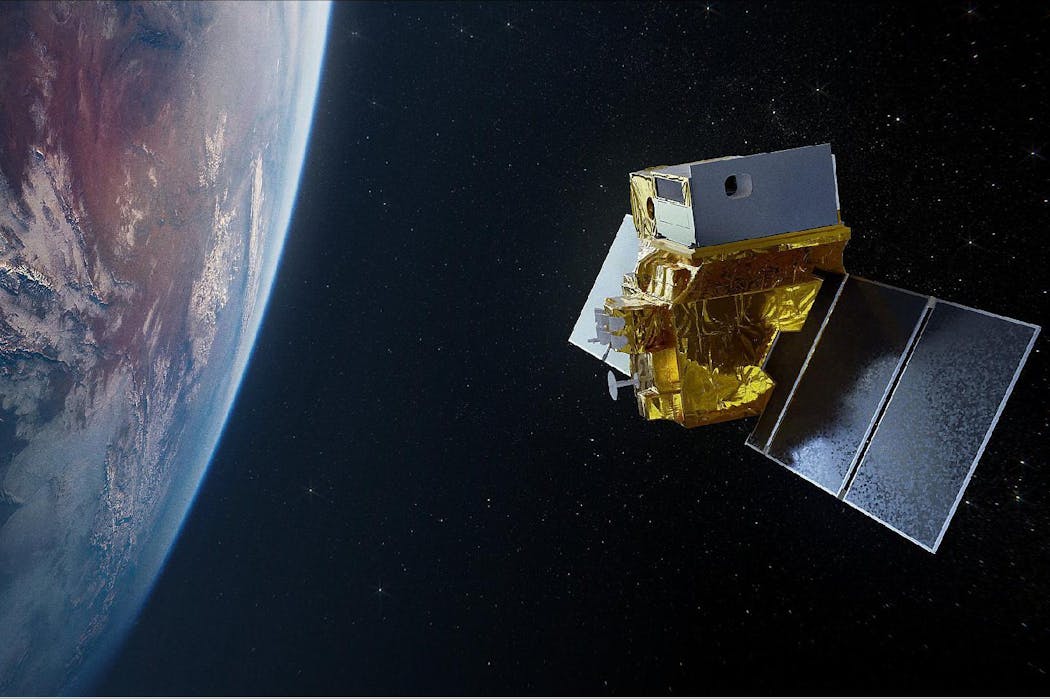
TRISHNA est le dernier satellite en date de la flotte franco-indienne. Il est voué au suivi du climat et aux applications opérationnelles, par exemple en agriculture.CNES/ISRO, Fourni par l’auteur
En 2027, un satellite franco-indien va être mis en orbite pour détecter la température de la surface de la Terre, en évaluer le contenu en eau et aider différents secteurs d’activités : agriculture, agroforesterie, hydrologie, micrométéorologie urbaine, biodiversité.
« Trishna » veut dire « soif » en sanscrit. Pour un satellite qui contribuera de manière significative à la détection du stress hydrique (déficience en eau) des écosystèmes et à l’optimisation de l’utilisation de l’eau en agriculture, dans un contexte de changement climatique mondial, cela nous semble bien adéquat. TRISHNA, acronyme anglophone de Thermal InfraRed Imaging Satellite for High-resolution Natural resource Assesment, signifie aussi « satellite d’imagerie infrarouge thermique pour l’évaluation haute-résolution de ressources naturelles ».
Une fois en orbite, TRISHNA mesurera tous les trois jours, sur tout le globe terrestre et à 60 mètres de résolution, la température de surfaces des continents et de l’océan côtier, c’est-à-dire jusqu’à 100 kilomètres du littoral. Car, aussi étrange que cela puisse paraître, cette coopération entre le Centre national d’études spatiales français (Cnes) et son homologue indien l’Indian Space Research Organisation (ISRO) va mesurer la température terrestre pour étudier l’eau.
Des besoins, une mission
En effet, il est maintenant prouvé que sous l’effet d’une pression anthropique croissante et du changement climatique, notre environnement se réchauffe et se transforme de plus en plus vite, avec notamment un impact sur le cycle de l’eau, indissociable du cycle de l’énergie.
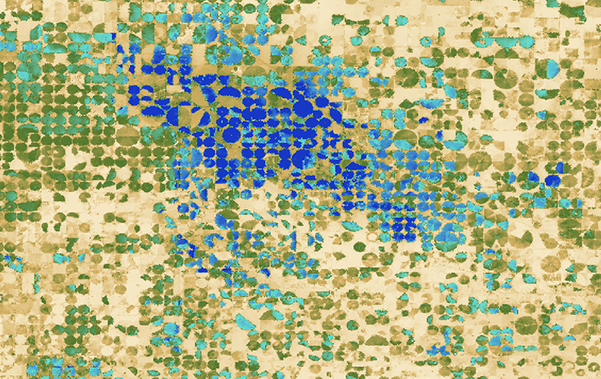
Une image de la mission Ecostress de la NASA, qui permet d’évaluer l’évapotranspiration dans une région irriguée (faible en jaune, forte en bleu). Cesbio et JPL, CC BY
En effet, depuis l’échelle globale jusqu’à des échelles beaucoup plus locales, l’eau est à la fois un élément indispensable à la vie et le principal vecteur des échanges de chaleur dans la machine météorologique et climatique. Aujourd’hui, la modification conjuguée des températures et des régimes de précipitations impacte les réserves accessibles d’eau douce, dont 70 % sont voués aux usages agricoles (irrigation), 25 % à l’industrie et le reste aux usages domestiques.
Il est donc logique de rechercher une gestion optimisée de cette ressource, à la fois en termes de quantité et de qualité. Cet objectif permet de répondre à plusieurs objectifs gouvernementaux et internationaux portés par des organismes tels que le GEOGLAM (organisme international qui surveille les cultures agricoles au niveau planétaire et génère des prévisions de récolte via un système satellite mondial), la FAO (organisation pour l’alimentation et l’agriculture des Nations unies) et les Nations unies elles-mêmes.
Pour aller dans ce sens, la mission TRISHNA a été conçue de manière spécifique pour étudier prioritairement le stress hydrique des écosystèmes naturels et agricoles ainsi que l’hydrologie côtière et continentale.
Comment la température de la Terre renseigne-t-elle sur l’utilisation de l’eau par les végétaux ?
La température de surface et sa dynamique sont des indicateurs précieux de la « soif » des végétaux car, en s’évaporant, l’eau refroidit la surface dont elle provient et réciproquement, les surfaces se réchauffent lorsqu’il n’y a plus d’eau à évaporer ou à transpirer (notons que ce principe vaut autant pour les animaux que pour les végétaux).
Or, une loi physique, dite loi de Wien, connue depuis 1893, met en relation la température d’un objet avec l’énergie électromagnétique qu’il émet dans différentes longueurs d’onde. Selon cette loi, la planète Terre émet le plus d’énergie dans le domaine infrarouge dit « thermique » aux alentours de 10 micromètres.
Les détecteurs de TRISHNA ont donc été conçus en visant ce domaine spectral afin de mesurer l’énergie émise par les surfaces terrestres, quelles qu’elles soient (végétation, environnement côtier, lacs, rivières, neige, glaciers, surfaces artificialisées, milieux urbains) pour en déduire leur température.
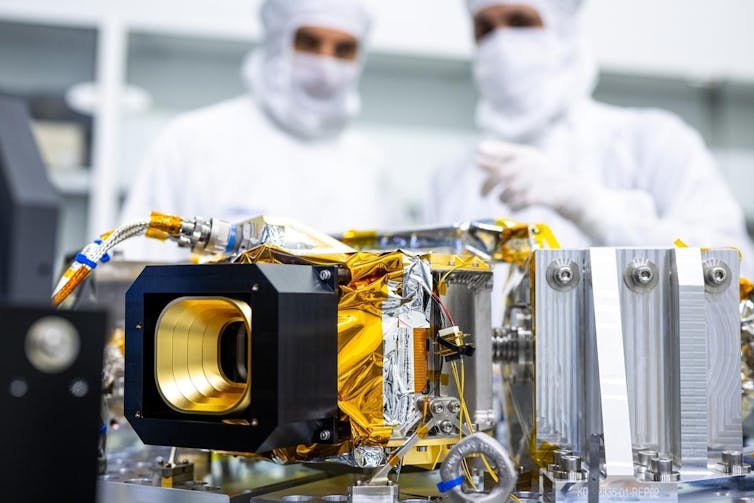
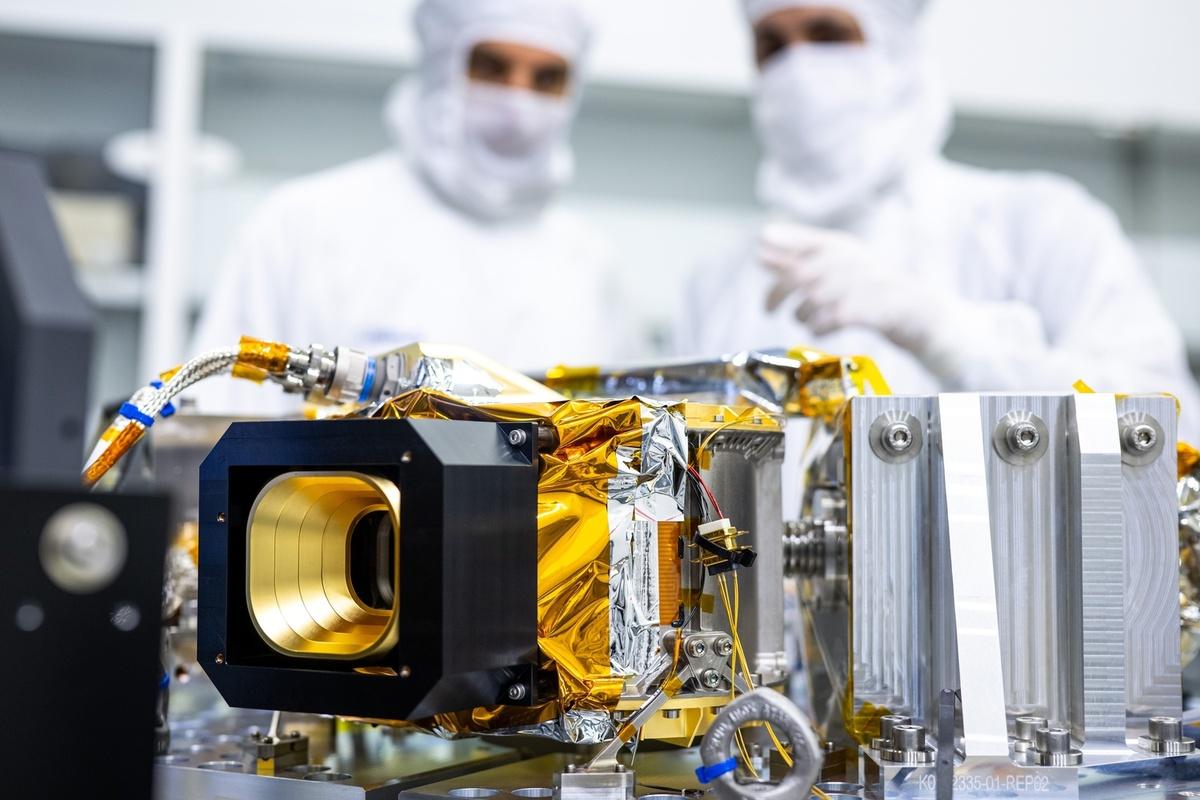
La maquette de l’instrument de mesure dans l’infrarouge thermique en salle blanche, lors des préparatifs de la mission TRISHNA, permet de valider le design de l’instrument et de vérifier certaines performances critiques avant la fabrication du modèle de vol. Cnes/Frédéric Lancelot, 2023, Fourni par l’auteur
Pour les besoins de la recherche et des applications qui en découlent, la fréquence élevée de revisite (tous les trois jours) et ses résolutions spatiale (60 mètres) et spectrale permettront d’aborder des enjeux scientifiques, économiques et sociétaux majeurs dans différents secteurs : agriculture, agroforesterie, hydrologie, micrométéorologie urbaine, biodiversité.
Le partenariat franco-indien
La coopération spatiale entre la France et l’Inde est un élément important de l’axe indopacifique de notre politique étrangère.
Son histoire riche est marquée par des collaborations scientifiques et techniques débutées dès les années 1960, époque à laquelle les deux nations travaillaient notamment au développement de fusées-sondes. De part et d’autre, l’intention stratégique était alors de développer une autonomie nationale d’accès à l’espace.
Cette collaboration a jeté les bases de deux projets spatiaux emblématiques qui ont suivi plus récemment. Le premier de ces projets est le satellite Megha-Tropiques, conçu pour caractériser le potentiel de précipitation des nuages dans les régions tropicales et lancé en 2011. Puis, en 2013, est arrivée la mission SARAL/AltiKa, consacrée à la mesure du niveau des surfaces couvertes d’eau sur les océans et les continents.
En 2016, la visite officielle du président François Hollande en Inde a favorisé le démarrage du projet TRISHNA, tirant également parti de l’accord-cadre que le Cnes et l’ISRO avaient signé l’année précédente. La France et l’Inde lançaient ainsi une nouvelle étape de leur coopération spatiale sur le thème de l’eau.
Cette nouvelle coopération présente de nombreux avantages pour nos deux pays. L’industrie franco-européenne en bénéficie avec la forte implication de nos entreprises dans la réalisation de l’instrument thermique. Ainsi positionnés, nos industriels augmentent leur chance d’être impliqués dans les futurs grands contrats indiens. En contrepartie, ce schéma partenarial permet à l’Inde de parfaire son cheminement vers des industries stratégiques autonomes et vers des moyens de supervision environnementale appropriés.
Plus largement, TRISHNA consolide la coopération franco-indienne, ouvrant des perspectives de partenariats dans les secteurs des satellites d’observation et de télécommunications. Autres retombées importantes pour nos deux pays, le projet TRISHNA permet aux communautés scientifiques indienne (ISRO et instituts techniques universitaires) et française (CNES et laboratoires intervenants) de se positionner dans la recherche spatiale environnementale et de créer des applications à la fois rentables et utiles à différents secteurs d’activités, dont l’agriculture.
L’irrigation agricole, une des applications les plus prometteuses de la mission TRISHNA
En combinant les données thermiques de TRISHNA avec des informations issues d’autres satellites (permettant d’évaluer la végétation, l’humidité des sols ou les précipitations), il sera possible d’estimer avec précision l’évapotranspiration réelle des cultures, c’est-à-dire la quantité d’eau effectivement utilisée par les plantes.
Cette information permettra aux agriculteurs, aux gestionnaires de bassins versants et aux décideurs politiques d’adapter les calendriers et les volumes d’irrigation en temps quasi réel, selon les besoins réels des cultures et non sur des moyennes ou des approches empiriques. Ce pilotage de l’irrigation « à la demande » représentera une avancée majeure, en particulier pour les régions où les ressources en eau sont limitées ou irrégulièrement réparties.
En Inde comme en France, des expérimentations sont déjà envisagées pour intégrer les données TRISHNA dans les systèmes d’aide à la décision utilisés par les agriculteurs. À terme, cela pourrait conduire à des économies d’eau significatives, à une réduction de l’impact environnemental de l’agriculture et à une meilleure résilience des systèmes de production face au changement climatique.
De manière plus générale, la mission pourra également contribuer à la prévention des risques liés aux évènements extrêmes, comme les canicules, les sécheresses, les feux, les inondations – des aléas auxquels nos deux pays sont de plus en plus confrontés.
En somme, TRISHNA offre à la France et à l’Inde une opportunité exceptionnelle de renforcer leur partenariat et de répondre aux défis économiques et climatiques auxquels nos deux pays et le monde entier font face aujourd’hui.
Philippe Maisongrande (responsable thématique Biosphère continentale, au Cnes) et Thierry Carlier (chef de projet TRISHNA) ont contribué à la réflexion sur les premières versions de cet article.
Corinne Salcedo ne travaille pas, ne conseille pas, ne possède pas de parts, ne reçoit pas de fonds d’une organisation qui pourrait tirer profit de cet article, et n’a déclaré aucune autre affiliation que son organisme de recherche.
D’une part, un auteur dont les nombreuses maîtresses et la vie intime mouvementée sont bien connues. De l’autre, une œuvre où se multiplient les héros vierges et où l’érotisme brille par sa rareté. Comment expliquer cette contradiction dans l’une des œuvres romanesques les plus lues de tous les temps ?
Le XIXe siècle n’est pas une période totalement hostile aux représentations sexuelles. Si l’avènement du romantisme a pu favoriser la représentation d’amours chastes et valoriser la pudeur dans les représentations de l’érotisme, nombre d’auteurs ont abordé frontalement la sexualité de leurs personnages. On peut citer Barbey d’Aurevilly ou encore Balzac, chez qui les aventures extraconjugales se multiplient et constituent régulièrement le cœur de l’intrigue.
Si l’acte sexuel en lui-même n’est pas décrit de manière explicite, on comprend très bien qu’il a lieu, et les personnages ne se privent pas d’exprimer leur désir. Sur un mode parfois moins trivial, des auteurs romantiques comme George Sand ont pu aborder la question du désir, masculin comme féminin, et en faire un élément important des relations inter-personnages.
Dans le roman hugolien, l’abstinence règne
Rien de tout cela chez Hugo. Ses romans sont généralement dominés par des figures masculines qui se distinguent par leur absence totale de sexualité : Quasimodo, Jean Valjean, Javert, Enjolras, Gilliatt, Cimourdain, pour en citer quelques-uns. Explicitement désignés par l’auteur comme totalement inactifs sexuellement, à l’instar de Javert, le « mouchard vierge » des Misérables, ces personnages ressentent et expriment parfois des désirs contrariés, mais pas toujours ; certains apparaissent comme tout bonnement asexuels.
Ils consacrent généralement l’énergie habituellement vouée à la poursuite amoureuse et à la fondation d’une famille à une cause qui les dépasse, pour le meilleur ou pour le pire. Le superflic infatigable Javert n’est jamais distrait par ses affaires personnelles ; le révolutionnaire Enjolras se consacre à sa cause politique comme à une maîtresse ; quant à Quasimodo, il sera le seul à montrer pour Esmeralda un amour pur et désintéressé et à la protéger.
Si ces personnages ne sont pas unilatéralement bons, car le sublime chez Hugo cohabite souvent avec une forme de monstruosité, ils n’en demeurent pas moins profondément idéalisés et tiennent du surhomme. L’absence de sexualité devient une manière de distinguer les personnages du commun des mortels, de mettre en valeur leur caractère exceptionnel.
Une représentation négative du désir
Qu’en est-il des autres ? Il y a bien des personnages qui échappent à cette épidémie de chasteté, mais leur traitement interroge tout autant. Les quelques représentations du désir, chez Hugo, ne font pas franchement envie, entre l’obsession vicieuse et destructrice de Claude Frollo pour Esmeralda dans Notre-Dame de Paris et la duchesse Josiane qui, dans L’homme qui rit, semble ensorceler le héros Gwynplaine avec ses charmes et l’éloigne de sa véritable bien-aimée Déa.
Le sexe semble toujours être du côté de la trivialité et de la perversion, voire de l’égoïsme pur et simple, en opposition à l’abnégation des héros vierges cités plus haut. Il apparaît aussi comme destructeur pour les femmes : on pense à Fantine, plongée dans la prostitution et tourmentée par des bourgeois qui l’utilisent pour leur désir jusqu’à provoquer sa chute et, au bout du compte, sa mort. Rares sont les représentations érotiques positives dans les romans de Hugo ; ce dernier semble presque ressentir de l’effroi devant la question sexuelle.
Illustration de Notre-Dame de Paris, « Claude Frollo et la Esmeralda », Louis Candide Boulanger, vers 1831.
On pourrait trouver des exceptions dans les jeunes couples qui jalonnent son univers romanesque : Marius et Cosette (les Misérables), Gwynplaine et Déa (L’homme qui rit), Ordener et Ethel (Han d’Islande)… Mais la sexualité de ces personnages est très discrète et sous-entendue, et ressemble beaucoup à celle que l’on retrouve dans le roman courtois du Moyen Âge. Autrement dit les jeunes filles sont encensées pour leurs qualités virginales, et les jeunes garçons doivent contrôler leur désir et traverser une série d’épreuves qui leur permettra, au final, de s’unir à leur bien-aimée, dans une représentation toujours très prude et dont les détails intimes demeureront cachés. L’érotisme franc et véritablement positif, lui, manque résolument à l’appel.
Victor Hugo avait-il peur de parler de sexe ?
Comment expliquer cette timidité, chez un auteur dont la vie intime mouvementée est pourtant bien connue, au point qu’il a fait en son temps l’objet d’un scandale sexuel ? Difficile à dire.
Certains chercheurs en littérature ont tenté de trouver une explication à cet écart. Pour certains, Hugo valorisait dans ses personnages une qualité, la chasteté, qui lui paraissait d’autant plus admirable qu’il se sentait bien incapable de s’astreindre à cet état. Pour d’autres, il écrit ces figures vierges avec la nostalgie de ses années de jeunesse, pendant lesquelles il était, lui aussi, parfaitement chaste et voué à l’étude.
Il est probablement impossible s’arrêter sur une explication définitive, puisque l’auteur ne s’est jamais, en son nom propre, exprimé sur la question. Il ne fait nul doute que l’asexualité de ses personnages est autant liée à des éléments personnels qu’à un contexte culturel extérieur, dans un XIXᵉ siècle tiraillé entre libération des discours sur la sexualité, bouleversements politiques et importance de la culture religieuse, et qui voyait se dessiner, dans les romans comme dans les traités de médecine, les fondements de notre sexualité moderne.
Loup Belliard ne travaille pas, ne conseille pas, ne possède pas de parts, ne reçoit pas de fonds d’une organisation qui pourrait tirer profit de cet article, et n’a déclaré aucune autre affiliation que son organisme de recherche.