Voici Epiaceratherium itjilik, le rhinocéros qui a vécu dans l’Arctique

Source: The Conversation – in French – By Danielle Fraser, Head & Research scientist, Palaeobiology, Canadian Museum of Nature & Adjunct Research Professor, Department of Biology, Carleton University

Les paléontologues du Musée canadien de la nature ont récemment étudié le fossile d’un rhinocéros. Ce qui est fascinant, c’est que ses restes ont été découverts sur l’île Devon, dans l’Arctique canadien.

Les mammifères, qui peuplent aujourd’hui presque tous les coins de la Terre, sont arrivés en Asie, en Europe et en Amérique du Nord par trois voies : le détroit de Béring et deux voies dans l’Atlantique Nord.

La plus connue d’entre elles, le pont continental de Béring, a permis le passage des premiers humains vers l’Amérique du Nord, il y a environ 20 000 ans, et a façonné la génétique des populations d’animaux, comme les ours, les lions et les chevaux.

Les deux autres routes, moins connues, traversaient l’Atlantique Nord : l’une partait de la péninsule scandinave vers le Svalbard et le Groenland, et l’autre de l’Écosse vers l’Islande, puis le Groenland et l’Arctique canadien.

Généralement, on considère que les animaux terrestres n’ont pas pu traverser l’Atlantique Nord durant l’Éocène inférieur, il y a environ 50 millions d’années, à une époque où le climat terrestre était plus chaud.

Les restes du rhinocéros arctique fournissent toutefois des preuves indiquant que les mammifères terrestres ont pu traverser l’Atlantique Nord en empruntant des ponts terrestres gelés bien plus récemment que l’Éocène inférieur.

Un rhinocéros dans l’Arctique

Danielle Fraser présente les recherches de son équipe sur le rhinocéros arctique. (Musée canadien de la nature).

Cette nouvelle espèce de rhinocéros a été découverte à partir d’un spécimen presque complet trouvé au site de Haughton, sur l’île Devon, au Nunavut. Il s’agit de sédiments lacustres formés dans un cratère d’impact d’astéroïde qui remonterait au début du Miocène, il y a environ 23 millions d’années.

Les sédiments du cratère Haughton ont permis de préserver des plantes, des mammifères et des oiseaux. La plupart des ossements du rhinocéros ont été récoltés dans les années 1980 par la paléontologue Mary Dawson et son équipe, puis d’autres éléments ont été prélevés par Natalia Rybczynski, Marisa Gilbert et leur équipe au cours des années 2010.

Le rhinocéros n’avait pas de corne, ce qui est courant chez les espèces de rhinocéros disparues. Il se distingue toutefois par des caractéristiques propres à des espèces beaucoup plus anciennes, comme des dents semblables à celles d’espèces datant de plusieurs millions d’années. Il présente également un cinquième orteil sur la patte avant, ce qui est rare chez les rhinocéros.

Une comparaison anatomique et une analyse évolutive suggèrent que le spécimen appartient à un genre existant, Epiaceratherium, que l’on a trouvé uniquement en Europe et en Asie occidentale. Pour nommer la nouvelle espèce, l’équipe a consulté Jarloo Kiguktak, un aîné d’Aujuittuq (Grise Fiord), la communauté autochtone la plus proche du cratère Haughton. Ensemble, ils l’ont baptisée Epiaceratherium itjilik. Itjilik, qui signifie « gel » ou « givré » en inuktitut, a été choisi en hommage à l’environnement arctique où le spécimen a été découvert.

Le plus surprenant est que l’analyse évolutive de l’équipe a montré qu’E. itjilik ressemble le plus à l’espèce européenne d’Epiaceratherium. Cela suggère que ses ancêtres auraient traversé l’Atlantique Nord pour passer de l’Europe à l’Amérique du Nord vers la fin de l’Éocène, il y a entre 38 et 33 millions d’années.

Des analyses biogéographiques ont par ailleurs révélé un nombre étonnamment élevé de traversées de l’Atlantique Nord par des rhinocéros, directement entre l’Europe et l’Amérique du Nord, dont certaines remontent à environ 20 millions d’années. Alors que la découverte d’une traversée aussi récente de l’Atlantique Nord était souvent considérée comme improbable, de nouvelles preuves géologiques proposent une toute autre histoire.

Comment les rhinocéros sont-ils arrivés dans l’Arctique ?

Aujourd’hui, plusieurs étendues d’eau larges et profondes empêchent les animaux terrestres de passer de l’Europe à l’Amérique du Nord. Les îles Féroé, l’Islande et le Groenland sont séparés par le chenal du banc des Féroé, le chenal Féroé-Shetland et le détroit du Danemark. Entre la péninsule scandinave, le Svalbard et le Groenland, on trouve la mer de Barents et le détroit de Fram. Les animaux terrestres auraient pu traverser au moins l’une de ces zones jusqu’au début de l’Éocène, il y a environ 50 millions d’années.

Cependant, des études récentes dressent un tableau plus complexe des changements géologiques dans cette région. Les estimations de la date de formation des différents chenaux qui séparent aujourd’hui les masses terrestres présentent une grande variabilité.

Une modélisation mathématique suggère qu’il y a encore 2,7 millions d’années, une région montagneuse aurait relié le Svalbard à l’Europe du Nord. De nouvelles données indiquent également que le détroit de Fram était étroit et peu profond jusqu’au début du Miocène, il y a environ 23 millions d’années. Le chenal Féroé-Shetland s’est probablement ouvert il y a entre 50 et 34 millions d’années, tandis que le chenal Féroé-Islande [JG1]et le détroit du Danemark auraient été submergés plus tard, il y a entre 34 et 10 millions d’années.

Cela suggère que les rhinocéros auraient pu marcher sur la terre ferme pendant au moins une partie de leur traversée de l’Atlantique Nord. Ils ont peut-être nagé sur de courtes distances entre les masses continentales, mais l’équipe a émis l’hypothèse que la glace marine saisonnière aurait pu faciliter leur déplacement.

La glace saisonnière

Il y a plus de 47 millions d’années, l’océan Arctique et les régions environnantes étaient libres de glace toute l’année. Des échantillons prélevés par carottage dans cette région (boue, sable et matière organique) contiennent des traces de débris transportés par la glace au cours de l’Éocène moyen, il y a entre 47 et 38 millions d’années, ce qui indique la présence de glace saisonnière.

Une autre carotte océanique, prélevée entre le Groenland et le Svalbard, recèle des débris transportés par la glace provenant de toute la région arctique, et datant de 48 à 26 millions d’années. Il apparaît donc que les animaux terrestres auraient pu traverser l’Atlantique Nord en empruntant des routes formées sur la terre ferme et sur la glace saisonnière.

Les fossiles de vertébrés provenant des îles qui composaient autrefois les ponts terrestres de l’Atlantique Nord sont extrêmement rares. Une grande partie de ces ponts étant aujourd’hui submergée, les preuves directes de la façon dont les animaux se sont répandus à travers l’Atlantique Nord pourraient avoir disparu.

Les études biogéographiques, comme celle menée par l’équipe du Musée canadien de la nature, montrent à quel point les découvertes arctiques bouleversent nos connaissances sur l’évolution des mammifères. Elles nous aident à mieux comprendre comment les animaux se sont déplacés sur notre planète.

La Conversation Canada

Danielle Fraser a reçu un financement du Conseil de recherches en sciences naturelles et en génie du Canada (CRSNG RGPIN-2018-05305). Natalia Rybczynski, coauteure de l’étude mentionnée dans cet article, a reçu un financement de la Fondation W. Garfield Weston. Mary Dawson, coauteure de l’étude, a reçu un financement de National Geographic pour ses travaux sur le terrain.

ref. Voici Epiaceratherium itjilik, le rhinocéros qui a vécu dans l’Arctique – https://theconversation.com/voici-epiaceratherium-itjilik-le-rhinoceros-qui-a-vecu-dans-larctique-274913

Networking can boost your earnings and get you promoted – but it’s harder for women to reap the benefits

Source: The Conversation – UK – By Andrew Kloeden, PhD Candidate in Management, University of Exeter

PeopleImages/Shutterstock

For many workers, the benefits of professional relationships and the networks they create are clear. Bringing together people and social spheres that are otherwise unconnected is linked to higher salaries and more rapid promotion. So it’s no surprise that “networking” is a serious business for so many professionals.

In network theory, the process of linking unconnected people and groups – either within the workplace or outside it – is known as “brokerage”. When you’re a broker, your networks are “open”, with lots of links to unconnected people. All these connections give brokers access to potentially useful information – after all, people who don’t know each other are likely to know different things.

And continued networking, where more new relationships are generated over time, is important to maintain the benefits. Otherwise, networks can grow stale. Being close to the “centre” of the network (having more network ties) brings additional benefits in terms of access to knowledge, information and resources.

But as in many other aspects of life, gender is a fundamental force in terms of professional relationships and the structure of professional networks. It may come as little surprise that women face disadvantages compared to men – both in the positions they hold within networks and the characteristics of their contacts.

For example, women’s networks tend to contain fewer men. Men still hold more positions of power than women in organisations, which leaves women with fewer senior-level connections. Women also tend to find themselves closer to the edge than the centre of organisational networks. Separately, they are less likely to be brokers.

Women’s networks also tend to be “stickier” – where old ties are less likely to be replaced with new ones. These new ties can help to keep the access to information fresh. What’s more, women tend to receive lower returns from the positions they occupy in their networks. For example, even when women are brokers they tend not to enjoy the benefits that can lead to rapid promotion in the way that men might.

The root of the problem

There are many reasons for these disadvantages. First, women usually carry a greater burden of unpaid domestic caring work than men in heterosexual couples (the so-called “second shift”). This can eat up the time that women could otherwise use investing in professional networks. It’s even more acute for mothers or the (mostly) women who care for adult relatives.

Second, the stereotypes of “assertive” men and “communal” women have an effect on organisational networks. Women who occupy strong network positions may not conform to this stereotype of co-operation and communality, which might be frowned upon. For the same reason, men are often seen as more legitimate or useful networking partners.

This also explains why women tend to feel “stereotype threat” (where people fear living up to negative stereotypes) when they are brokers. They may be sensitive to being seen negatively for violating this stereotype.

a woman crouches down to greet two children coming out of school.
The ‘second shift’ can make it harder to find the time for networking.
Kzenon/Shutterstock

Similarly, homophily (the tendency for people to form relationships with those they see as similar to themselves) can harm women’s network position and the returns they get, especially in organisations with more men than women. In these situations, women can miss out on senior-level connections (who are more likely to be men). Or they may just end up with smaller networks.

While all women face barriers to network success, there are strategies that can help them to overcome these. Successful women tend to embrace network churn by keeping a core group of contacts but otherwise strategically changing their professional networks. This can help to keep contacts fresh.

And the most successful women have been shown to resist the temptation to focus purely on social support from their contacts. Instead (or in addition), they seek more strategic support – things like introductions and information.

Of course, these strategies all involve women doing extra work to navigate environments that were not built for them. So it is important for employers to take steps to mitigate these problems. This can also help organisations retain staff, and it can help to tackle other workplace problems related to gender biases.

It doesn’t have to be difficult. Employers can structure teams or committees to increase opportunities for interaction between women and senior men. They can also run surveys to map the social networks in their organisations to identify exclusion and disadvantage. Lastly, they can educate senior staff and executives about the issues.

Ultimately, everyone should understand the importance of networking to an employee’s prospects and how they can help to share out the benefits equally.

The Conversation

Andrew Kloeden does not work for, consult, own shares in or receive funding from any company or organisation that would benefit from this article, and has disclosed no relevant affiliations beyond their academic appointment.

ref. Networking can boost your earnings and get you promoted – but it’s harder for women to reap the benefits – https://theconversation.com/networking-can-boost-your-earnings-and-get-you-promoted-but-its-harder-for-women-to-reap-the-benefits-276315

How the Seattle Seahawks’ sale will score a touchdown for charity 8 years after Paul Allen’s death

Source: The Conversation – USA (2) – By Reid Kress Weisbord, Distinguished Professor of Law and Judge Norma Shapiro Scholar, Rutgers University – Newark

Paul Allen, wearing a gray jacket, salutes the crowd during a celebration of the Seattle Seahawks’ Super Bowl victory in 2014. AP Photo/Ted S. Warren

When Microsoft co-founder Paul Allen died on Oct. 15, 2018, he left behind an estimated US$26 billion that he wanted to largely leave to charity.

Allen died at 65 of septic shock after a yearslong cancer battle. He’s back in the news because his estate is finally selling an asset that represents nearly a quarter of his fortune: the Seattle Seahawks football team, which he bought in 1997 for roughly $200 million.

The sale of the 2014 and 2026 Super Bowl champions could fetch more than $6.5 billion – a potentially record-breaking sum.

Allen never married and he had no children. His sister, businesswoman Jody Allen, is his estate’s trustee and executor. She’s now overseeing the Seahawks’ sale.

As law professors who study the transfer of property after death, we can explain why it often takes a long time for complex estates to settle following the death of ultrawealthy people.

Settling the estates of billionaires

When most people die, the distribution of any wealth they leave to their heirs or charitable causes can be relatively straightforward.

If all goes well, the process will take a few years at most. Homes, vehicles, bank accounts and retirement assets can usually be relatively quickly sold or transferred to members of the family or friends of the deceased.

When people hear that an estate is still being sorted out years after someone’s death, they often assume that big disputes have interfered with the settlement process.

Indeed, high-profile celebrity estates, including those that celebrity musicians such Prince and Aretha Franklin left behind, have been delayed by legal battles.

But delays are common even without conflicts, particularly when an estate is very large or complex.

Similar to sprawling empires

As you might imagine, billionaires’ estates are different. They tend to be more like sprawling business empires than what your beloved aunt left behind when she died. Multibillion-dollar estates usually take many years to unwind because they involve complex assets that are hard to assess and sell.

Some of Allen’s holdings, for example, were patents, which often complicate estate administration because intellectual property rights can be difficult to value for tax purposes.

Although the contents of Allen’s will were made public in 2018, the specifics of his estate plan remain confidential.

That’s because he used a private family office to manage his wealth – and he left all of his property owned at death to a private trust.

The specific terms of that trust aren’t publicly known, but his family foundation continues to support charitable causes tied to the arts, the environment and the engagement of young people in civic life.

An ecstatic woman holds a shiny trophy aloft while a man behind her pumps his fist into the air.
Jody Allen, the sister of the Seattle Seahawks’ late owner Paul Allen, lifts the Vince Lombardi Trophy as she celebrates with head coach Mike Macdonald after the Seattle Seahawks won their second Super Bowl in 2026.
Josh Edelson/AFP via Getty Images

Unwinding unusual assets

Sports teams, while clearly valuable, are infrequently sold. That makes them some of the hardest assets to get rid of after an owner’s death.

Jody Allen, as her brother’s executor and trustee, has a legal obligation to sell the team for as much money as possible, which requires careful timing and good business judgment when appraising the asset’s fair market value.

She managed the sale of another sports franchise Allen owned, the NBA’s Portland Trail Blazers, in 2025. The reportedly $4.25 billion deal brought the estate revenue that’s also slated for charity. The timing of the Seahawks’ pending sale – shortly after their latest Super Bowl win – is most likely intended to maximize the amount of money the estate will collect from the eventual buyer.

But some of the National Football League’s rules can complicate a team’s sale.

Other team owners and league officials, for example, must approve any change of ownership. Approval requires the support of more than three-quarters of the league’s other owners.

The NFL also requires all teams to submit a succession plan that explains what will happen if their owner dies to reduce the chance of any disruption that could arise from uncertainty of ownership.

Bulking up his endowment

Once the sale does go through, the money could end up in the foundation Paul Allen co-founded.

Allen donated more than $2 billion during his lifetime to support a wide range of causes primarily tied to medical research, education, the arts and the environment.

Like many ultrawealthy donors, he gave through his own foundation, now called Allen Family Philanthropies.

Six years after his death, it had a roughly $1.4 billion endowment and made more than $62 million in grants annually. Jody Allen, who co-founded Allen Family Philanthropies with her late brother, serves as its board chair and president.

The sale of the Trail Blazers, like the upcoming sale of the Seattle Seahawks, may make his foundation far bigger – leading to even more charitable gifts for years to come.

The Conversation

The authors do not work for, consult, own shares in or receive funding from any company or organization that would benefit from this article, and have disclosed no relevant affiliations beyond their academic appointment.

ref. How the Seattle Seahawks’ sale will score a touchdown for charity 8 years after Paul Allen’s death – https://theconversation.com/how-the-seattle-seahawks-sale-will-score-a-touchdown-for-charity-8-years-after-paul-allens-death-276577

Contre le tabagisme, l’alcoolisme, l’insécurité routière… le marketing social en santé est plus efficace que la communication

Source: The Conversation – France in French (3) – By Karine Gallopel-Morvan, professeur santé publique, École des hautes études en santé publique (EHESP)

Le succès de campagnes de marketing social, comme le « Mois sans tabac », dont l’efficacité a été évaluée scientifiquement, montre comment cette stratégie peut se révéler payante pour déclencher des changements de comportements bénéfiques pour la santé. La restructuration annoncée de Santé publique France, qui met en œuvre les campagnes de prévention en santé, pourrait conduire à un recentrage vers la communication, au détriment du marketing social qui a pourtant fait ses preuves.


De nombreux pays s’appuient sur la démarche du marketing social pour élaborer des campagnes de prévention dont le but est de changer les comportements de santé. En France, cette mission est principalement assurée par Santé publique France, l’agence nationale de santé publique, dont un des rôles est d’« améliorer et protéger la santé des populations ».

Santé publique France intervient dans des domaines aussi variés que les déterminants de santé (tabac, alcool, drogues, nutrition, environnement, etc.), les maladies infectieuses (Covid-19, grippe…), la santé sexuelle, la santé mentale, les pathologies chroniques comme les cancers, le diabète, etc. L’agence a pleinement intégré le marketing social dès sa création, en 2016.

A l’époque, ce positionnement avait suscité des débats, notamment quant à sa valeur ajoutée par rapport aux campagnes de communication « classiques » qui avaient été mobilisées par le passé. Ce choix stratégique a pourtant permis à Santé publique France de développer des interventions de prévention plus efficaces pour déclencher des changements de comportement.

Depuis, d’autres acteurs, associatifs et publics, ont recours au marketing social. Par exemple, depuis 2020, le « Défi de janvier » (Dry January) vise à questionner individuellement et collectivement notre rapport à l’alcool et changer nos habitudes de consommation pour inciter à un changement de comportement vis-à-vis de ce produit. Cette initiative, qui connaît un succès croissant, est portée par un collectif d’associations. Elle a lieu tous les ans sans l’appui des pouvoirs publics.

Le marketing social : des techniques de marketing commercial appliquées à la santé

L’association des deux termes, « marketing » et « social », est née en 1971. Le marketing social consiste ainsi à transposer certaines techniques du marketing commercial à des programmes sociaux et de santé, dans l’objectif d’en améliorer l’efficacité en matière de changement de comportements.

Son principe fondamental repose sur une connaissance approfondie des publics cibles, afin d’adapter les interventions à leurs caractéristiques, leurs besoins et leurs contraintes. Cette compréhension s’appuie à la fois sur des enquêtes et les apports de la littérature scientifique, afin d’identifier les déterminants des comportements de santé et leurs leviers de modification.

Le marketing social prend également en compte l’environnement dans lequel s’inscrit l’intervention, notamment les facteurs concurrents du comportement promu, comme le marketing des industries du tabac, de l’alcool ou de l’alimentation ultratransformée. Ces pratiques commerciales “concourrentes” à la santé sont connues sous le terme de « déterminants commerciaux de la santé ». Le but sera ici de bloquer la publicité de ces firmes (avec des régulations et interdictions), ou d’apposer des avertissements sanitaires sur les publicités et packagings afin de contrer les messages marketing attractifs.

Le marketing social repose par ailleurs sur une segmentation des populations, donnant lieu à des programmes différenciés selon les spécificités des individus : âge, genre, environnement social, ancrage communautaire, niveau de littératie (niveaux de lecture, d’écriture et de compréhension des textes), etc.

« Mois sans tabac »,« Défi de janvier » et autres marques sociales

Si la campagne de marketing social est amenée à durer, il est opportun qu’elle s’appuie sur une marque qui aide à la mémoriser, à se l’approprier et à l’apprécier : « Mois sans tabac », le « Défi de janvier », ou encore Sam de la Sécurité routière sont des marques sociales connues de toutes et tous.

Sam, le conducteur engagé est une marque sociale de la Sécurité routière (Securite-routiere.gouv.fr).

Chaque programme est ensuite décliné opérationnellement pour chaque cible, autour d’objectifs de changement de comportement, et mis en œuvre selon le « modèle des 5 c » :

  • le comportement à adopter (par exemple, arrêter de fumer) ;

  • des aides et solutions proposées pour réduire les coûts et freins à l’adoption de ce comportement (applications, préservatifs gratuits ou à faible coût…) ;

  • une capacité d’accès aisée aux aides et comportements (rendez-vous rapide pour un dépistage, éthylotests disponibles dans les bars…) ;

  • une communication créative qui mobilise des canaux variés (médias, réseaux sociaux, etc.) ;

  • des collaborations avec des acteurs proches des publics bénéficiaires (associations, éducateurs, professionnels de santé) pour assurer la diffusion de l’intervention.

Enfin, toute campagne de marketing social s’inscrit dans une logique d’évaluation, afin de vérifier que les objectifs souhaités ont bien été atteints au regard des moyens mobilisés (évaluations de processus, d’impact et médicoéconomiques).

Marketing social et communication : une différence fondamentale

Ainsi, si la communication est nécessaire pour dérouler une campagne de marketing social (un des 5C), elle n’est pas suffisante. C’est la conclusion de nombreuses études ayant analysé l’efficacité des interventions élaborées selon les principes du marketing social et qui se déroulaient dans des contextes et milieux variés (lutte contre le tabagisme, l’alcoolisme ou les drogues illicites ; promotion de l’activité physique et de la nutrition à l’école, en entreprise, etc.) puis sur des cibles différentes (population défavorisée, adolescents, professionnels de santé, grand public, etc.).

Les chercheurs sont arrivés à la conclusion suivante : si les campagnes de communication peuvent agir sur les connaissances, les représentations, les normes, ou encore si elles informent sur l’existence d’un service, elles ne déclenchent pas, à elles seules, des changements de comportement si les autres composantes du marketing social n’y sont pas associées.

L’exemple emblématique du « Mois sans tabac »

L’exemple de la campagne annuelle « Mois sans tabac » lancée en 2016 par Santé publique France et adaptée de la campagne britannique Stoptober est illustratif de l’intérêt du marketing social. Cette intervention inédite en France en a intégré tous les ingrédients pour inviter les fumeurs à faire une tentative d’arrêt du tabac pendant 30 jours, en novembre, et optimiser ainsi leurs chances d’arrêter durablement.

Elle s’est basée sur les modèles théoriques de changement de comportements (théorie de la contagion), une connaissance des parties prenantes et de la cible visée, une prise en compte de la « concurrence » (l’industrie du tabac), une segmentation réfléchie (campagne ciblant les fumeurs quotidiens souhaitant arrêter de fumer, âgés de 18 à 64 ans et les plus vulnérables).

De plus, cette campagne s’appuie sur une proposition comportementale atteignable (arrêter de fumer pendant un « mois »), une marque chaleureuse et conviviale ainsi que des aides et services accessibles facilement et gratuitement ou à un prix très faible (site Internet, coaching personnalisé, numéro de téléphone, kit pour arrêter…).

L’accent est mis sur les bénéfices de l’arrêt. Puis, des collaborateurs et partenaires assurent la diffusion de la campagne et de ses services vers les lieux de vie des fumeurs (associations, pharmacies, entreprises, etc.). Enfin, une campagne de communication est diffusée dans les médias et sur les réseaux sociaux.

Cette combinaison s’est révélée bénéfique puisque les évaluations quasi continues de la campagne « Mois sans tabac » ont montré son efficacité pour inciter les Français à arrêter de fumer, bien plus que les précédentes campagnes qui se basaient essentiellement sur la communication.

« Mois sans tabac » a ainsi joué un rôle dans l’augmentation des tentatives d’arrêt du tabac (les éditions 2018 et 2019 auraient chacune généré environ 50 0000 tentatives), ainsi que sur l’arrêt du tabac à plus long terme. De plus, l’OCDE a estimé que si elle était maintenue sur la période 2023-2050, cette campagne permettrait d’économiser en moyenne 7 euros par an en dépenses de santé pour 1 euro investi.

Renoncer au marketing social : un retour en arrière pour la santé publique

Dix ans après sa création, la restructuration de Santé publique France annoncée par le gouvernement en janvier 2026 pourrait conduire à un abandon du marketing social au profit d’un « recentrage stratégique » sur la communication, qui serait désormais pilotée par le ministère de la santé et l’Assurance-maladie. Les pouvoirs publics justifient cette évolution par la volonté d’« offrir aux citoyens des messages plus clairs » et « une meilleure efficacité ».

Penser que le recentrage sur la communication et l’abandon du marketing social pourrait être aussi efficace et efficient n’est pas fondé, ni sur le plan scientifique, ni sur le plan empirique. Il faut alors se questionner les réels motifs qui poussent à cette décision : coupe budgétaire, volonté de reprise en main du contenu des messages au détriment des données probantes et des évaluations de campagnes, influence des lobbys ?

L’avenir nous le dira, mais cette évolution pourrait s’opérer au détriment de l’efficacité des politiques de prévention et, in fine, de la santé des Français.

The Conversation

Karine Gallopel-Morvan a reçu des financements de l’INCa, l’IRESP, JApreventNCDs, le Fonds de lutte contre les addictions, la Ligue contre le cancer, Ramsay fondation, l’ARS Bretagne

Ancien Directeur général de Santé publique France 2016-2019

Sylvain Gautier est vice-président de la Société Française de Santé Publique (SFSP) et membre du Comité national de lutte contre le tabagisme (CNCT). Il est président du Conseil national professionnel de santé publique (CNP-SP) et membre du Collège universitaire des enseignants de santé publique (CUESP).

ref. Contre le tabagisme, l’alcoolisme, l’insécurité routière… le marketing social en santé est plus efficace que la communication – https://theconversation.com/contre-le-tabagisme-lalcoolisme-linsecurite-routiere-le-marketing-social-en-sante-est-plus-efficace-que-la-communication-276408

Could joining the state sector be an option for private schools?

Source: The Conversation – UK – By Tilly Clough, Lecturer in Law, Queen’s University Belfast

Molodid Studio/Shutterstock

Private schools in England are facing new financial realities. Following the UK general election in July 2024, the new government introduced VAT on school fees and removed charitable business rates relief for independent schools. At the same time, staffing costs have continued to rise. Employer national insurance contributions have increased, and the national minimum wage has risen.

For some schools – particularly smaller institutions with limited endowments or declining enrolments – this has raised questions about their sustainability.

Although the full impact of these funding changes remains to be seen, they have intensified concerns about sustainability within parts of the independent sector and raised broader questions about reform.

One viable yet underexplored option is the conversion of private schools to the state sector.

Although still relatively rare, a small number of independent schools have taken this route over the past two decades. In a new report, commissioned by thinktank the Private Education Policy Forum, my colleague Tom Richmond and I have carried out the first comprehensive analysis of what happens when independent schools become state schools in England.

Between 2007 and 2017, 27 independent schools converted into state-funded academies or free schools. Twenty-four are still operating today. While the legal route from independent to state provision technically still exists, it has largely fallen out of use, with no conversions taking place since 2017. Independent to state conversion is therefore often overlooked in debates about the future of private education.

Conversion is often viewed as a last resort taken only by schools in serious financial trouble. However, while financial pressures were relevant to many of the schools that converted between 2007 and 2017, they were not the whole story. Schools have also framed conversion as a way to return to their founding missions, which were often explicitly about inclusion and serving local communities rather than educating a fee-paying intake.

The transition itself was not straightforward. Schools reported significant challenges in adapting to the expectations of the state sector. These included the loss of academic selection, the requirement to deliver the national curriculum, and regular inspections by Ofsted, England’s school inspectorate. Many also highlighted the absence of clear guidance from government on key aspects of the conversion process.

In practical terms, this meant that schools which had previously operated with considerable autonomy had to adjust to a far more regulated environment. In some cases, early Ofsted inspections highlighted weaknesses in data use, governance and oversight as schools adjusted to the demands of state accountability.

However, these difficulties were not permanent. Over time, outcomes improved markedly. All but one of the schools that converted and remained open are now rated “good” or “outstanding” by Ofsted.

Former independent primary schools perform at broadly similar levels than other schools in their local authorities. Former independent secondary schools generally achieve stronger attainment and progress outcomes than nearby state schools, though performance varies. Initial adjustment challenges, in other words, did not prevent long-term success.

The consequences – and the future

One of the most significant changes following conversion is in pupil intake.

Removing academic selection and fees transformed who these schools serve. Since conversion, the proportion of pupils with special educational needs has more than doubled. The share eligible for free school meals has risen sharply.

Children on school staircase
There are challenges in moving to the state sector.
Monkey Business Images/Shutterstock

Research has shown that while these schools do not perfectly mirror the national state school population, the gap between them and their local communities has narrowed dramatically.

In many cases, they are far more representative of their surrounding areas than they were as independent institutions. Conversion does not simply change how a school is funded. It can reshape who benefits from its facilities and educational offer.

A common concern is that families will withdraw their children once fees are removed. In practice, this rarely appears to have happened at scale.

Consultation evidence and enrolment patterns show that large majorities of parents supported the move, particularly because it eliminated fees and provided financial certainty. Where schools were required to demonstrate parental demand, applications frequently exceeded available places. Widespread collapse in enrolment – a frequently voiced fear – did not materialise.

Conversion to the state sector is not a solution for every school. Local context matters. The availability of places, building condition and leadership capacity all shape whether conversion is viable. But, the experience of the past two decades suggests that, where carefully managed, conversion can preserve provision, widen access and deliver strong outcomes.

As debates about school funding and the future of private education continue, independent to state conversion is likely to resurface.

If the route is to become viable again, greater clarity is necessary. A clear and permanent pathway – assessed case by case and aligned with local need – would reduce uncertainty. Drawing on the more flexible elements of earlier academy reforms and providing practical support during transition could make the process more workable.

The Conversation

This report was commissioned by the Private Education Policy Forum.

ref. Could joining the state sector be an option for private schools? – https://theconversation.com/could-joining-the-state-sector-be-an-option-for-private-schools-275132

Former Harvard president Summers’ soft landing after Epstein revelations is case study of economics’ trouble with misbehaving men

Source: The Conversation – USA (2) – By Yana van der Meulen Rodgers, Professor of Labor Studies, Rutgers University

Larry Summers, center, is surrounded by the media in 2005 amid calls for his resignation. Jodi Hilton/Getty Images

Economist Larry Summers will resign from his tenured job as a professor at Harvard University, the school announced on Feb. 25, 2026, following heightened scrutiny of his ties with the late convicted sex offender Jeffrey Epstein. Summers will leave at the end of the 2025-26 academic year, with a new title: president emeritus.

It’s a soft landing for his fall from grace.

In November 2025, Harvard launched an investigation of Summers, a former U.S. treasury secretary who previously served as Harvard’s president.

The probe looked into whether Summers and other members of Harvard’s faculty and administration had interactions with Epstein that violated its guidelines on accepting gifts and should be subject to disciplinary action. Summers’ resignation is connected with this ongoing investigation, a Harvard spokesperson told The Hill.

Despite repeated calls by students for Harvard to revoke Summers’ tenure, he held onto his teaching and academic appointments at Harvard until he chose to retire. Students and staff also called for his resignation in 2005 following his disparaging comments about women in science.

“Free of formal responsibility, as President Emeritus and a retired professor, I look forward in time to engaging in research, analysis, and commentary on a range of global economic issues,” Summers said in a statement released on Feb. 25.

Not surprised

As a female economist and a board member of the Committee on the Status of Women in the Economics Profession – a standing committee of the American Economic Association – I wasn’t surprised by the revelations of Summers’ apparent chumminess with Epstein, shocking as they may appear.

After all, it was Summers’ disparaging remarks about what he said was women’s relative inability to do math that led him to agree to relinquish the Harvard presidency in 2006.

And for years, researchers have documented the gender bias that pervades the field of economics.

The title of president emeritus is honorary. It brings with it symbolic recognition and the opportunity to maintain a formal connection to the university. Emeritus status is selective and requires approval at most universities. It’s usually bestowed on retiring professors.

In my view, by conferring this title on Summers, Harvard is signaling that powerful men can outlast gross misconduct with their honorifics intact.

Mugshot of Jeffrey Epstein, left, and headshot of economist Larry Summers.
Documents released in 2025 pointed to close ties between Jeffrey Epstein and Larry Summers.
New York State Sex Offender Registry via AP/Michel Euler

Summers’ ties to Epstein

Summers, until his entanglement in the Epstein scandal came to light, was among the nation’s most influential economists.

But his history of public controversy stretches back to at least 1991, when a memo he wrote while serving as the World Bank’s chief economist appeared to justify sending toxic waste to poorer countries.

Criticism of Summers surged after the House of Representatives released damning messages between Summers and Epstein as part of a dump of more than 20,000 public documents from Epstein’s estate in November 2025.

A series of emails and texts documented how Summers repeatedly sought Epstein’s advice while pursuing an intimate relationship with a woman he was mentoring – while the economist was married to someone else.

Summers was close enough to Epstein that in 2014, the sex offender named the economist as a backup executor for his estate.

The Department of Justice released a much larger tranche of documents in January 2026 in compliance with a law passed by Congress. So far, no major media outlet has reported on any new Summers materials discovered as a result.

Four women hold photos of Jeffrey Epstein aloft.
Protesters hold signs bearing photos of convicted sex criminal and Larry Summers confidante Jeffrey Epstein in front of a federal courthouse on July 8, 2019, in New York.
Stephanie Keith/Getty Images

Harvard’s slow response

The Summers-Epstein exchanges released in November ignited a new round of scrutiny and led to the unraveling of Summers’ prestigious career.

Summers went on leave from teaching at Harvard on Nov. 19 and stepped down from several high-profile boards.

But beyond launching the investigation, Harvard took no decisive action to discipline or sanction Summers. This calculated hesitation, which reflects the institution’s efforts to court funding, power and influence among top donors, appears to have put donor politics above basic accountability.

By contrast, the American Economic Association, the primary professional association for economists, did take swift and harsh action. In an unprecedented move, on Dec. 2, 2025, the AEA announced that it had placed a lifetime ban on Summers from all its conferences and other activities.

Having lots of company

To be sure, Harvard is not the only prestigious university dealing with the aftermath of the Epstein revelations.

The Epstein documents include evidence that administrators and professors at other prestigious colleges and universities like Duke, Yale, Bard, Princeton and Columbia also exchanged messages with Epstein.

As public funding for higher education has eroded, universities have increasingly turned to wealthy donors to underwrite major projects and supplement budgets by endowing professorships and research centers. Epstein appears to have taken advantage of this dependence on rich supporters by presenting himself as someone who could deliver both his own money and access to other affluent donors.

The Epstein files uncovered many email exchanges, meetings and discussions with the sex offender about research and funding opportunities, and they demonstrated how thoroughly the man had embedded himself in academic circles.

Disturbingly, Summers was hardly the only scholar to solicit Epstein’s help in pursuing women.

Among others, Duke University economist Dan Ariely asked him for the contact information of a “redhead” he had met, and Yale computer scientist David Gelernter told Epstein about a woman he called a “v small goodlooking blonde.”

Young women hold signs that say 'Larry Must Go!'
Harvard students and other protesters demand an end to Larry Summers’ Harvard presidency in 2005, after he made disparaging remarks about women in science.
Jodi Hilton/Getty Images

An economics problem

While Summers’ behavior and the reported dynamics between him and a woman he mentored may appear shocking, they are all too common in economics. For years, researchers have been documenting the gender bias that pervades the profession.

The data shows that abuse of power is common among male economists.

A 2019 survey by the AEA documented widespread sexual discrimination and harassment. Almost half of the women surveyed said that they had experienced sexual discrimination, and 43% reported having experienced offensive sexual behavior from another economist – almost always men.

Also, a 2021 study published by the National Bureau of Economic Research documented hostile environments in economics seminars, with female presenters experiencing more interruptions and encountering more patronizing behavior.

In 2024, according to the National Science Foundation, about 1 in 3 newly minted economics Ph.D.s in the U.S. were women, a considerably lower share than in other social sciences, business, the humanities and scientific disciplines. This ratio has changed very little since 1995.

After earning doctoral degrees in economics, women face a leaky pipeline in the tenure track, which represents the highest-paid, most secure and prestigious academic jobs. The higher the rank, the lower the representation of women.

The gender gap is wider in influential positions, such as economics department chairs and the editorial board members of economics journals. Women are also substantially underrepresented as authors in the top economics journals.

This bias not only hurts women who are economists; it can also hamper policymaking by limiting the range of perspectives that inform economic decisions.

Allowing a soft landing

Allowing Summers to commence a dignified retirement while continuing to hold honorifics risks signaling that there are ultimately few consequences at the very top in higher education.

I believe that if colleges and universities want to prove that they are serious about confronting abuses of power within their ranks, they must show that prestige does not entitle anyone, however accomplished, to a soft landing.

Portions of this article appeared in a related article published on Dec. 2, 2025.

The Conversation

Yana van der Meulen Rodgers is a board member of the Committee on the Status of Women in the Economics Association.

ref. Former Harvard president Summers’ soft landing after Epstein revelations is case study of economics’ trouble with misbehaving men – https://theconversation.com/former-harvard-president-summers-soft-landing-after-epstein-revelations-is-case-study-of-economics-trouble-with-misbehaving-men-277025

The man who fell in love with the sound of Spitfires – here’s what this unusual symptom can teach us about dementia

Source: The Conversation – UK – By Lucy Core, Postdoctoral Researcher in the Brain Behaviour Group, UCL

A 68-year-old man’s sudden love for Spitfire engine noises turned out to be an early sign of dementia. Kev Gregory/ Shutterstock

When people hear the word dementia, they often think of someone who has problems with memory. While memory is often affected in dementia, this is not always the case. There are many different types of dementia – and each can produce a wide range of symptoms.

A recent case study has even described a 68-year-old man with a rare form of dementia that caused him to develop a fascination with a very specific type of noise. As this type of dementia has only been recently recognised by medical experts, this finding suggests that changes in preferences for sounds may be a key feature of the syndrome.

Dementia is an umbrella term to describe cognitive (thinking) problems that are severe enough to affect everyday life. There are many types of dementia – such as Alzheimer’s disease, which is the most common form. It is characterised by memory loss and other cognitive changes.

Another subtype is frontotemporal dementia, which tends to affect people before age 65.

As the name suggests, frontotemporal dementia affects brain regions in the frontal and temporal lobes, which sit behind the forehead and above the ears. These areas of the brain are involved in a wide range of functions – including personality, behaviour, problem solving, planning, language, processing and understanding sounds. This form of dementia mainly affects behaviour or language abilities.

There are three main variants of frontotemporal dementia, each of which have differing symptoms: the behavioural variant (affecting behaviour and personality), the non-fluent variant (affecting speech production) and the semantic variant (affecting knowledge and understanding speech).

But some researchers believe there’s a fourth variant of frontotemporal dementia, as well. Evidence for this fourth variant was described in a case study I helped conduct.

A 68-year-old man, who we called “CP”, developed an unusual love for Spitfire engine noises. CP’s wife first noticed this strange behaviour about two years before he was diagnosed with dementia.

CP lived near an airfield, and veteran aircraft would frequently fly over his home. He would drop whatever he was doing and run outside, waving at the planes and crying tears of joy whenever he heard them. He had never reacted this way before the onset of his condition.

His love for engine noises was very specific to this type of plane. He did not react the same way to the sound of other planes, nor show a general interest in aircraft or vehicles. He also found birdsong and people with high-pitched voices irritating. He even became very particular about music, disliking covers and preferring originals.

A few years before his sudden love for Spitfire noises began, CP became moody and short-tempered. He became increasingly cold and apathetic towards others and lacked impulse control and awareness of socially acceptable behaviour. For instance, he was indifferent to a death in the family and frequently interrupted other people when they were speaking – things he would have never done before his disease.

He also lost understanding of humour, developed a sweet tooth and became fixated on playing chess and doing word searches. He sometimes failed to recognise the faces of acquaintances but did not have problems recognising people’s voices over the telephone. CP did not show any problems with remembering previous events or language.

About five years after symptoms emerged, CP was diagnosed with behavioural variant frontotemporal dementia. But we believe CP had a newer, fourth variant – sometimes referred to as the “right temporal variant”.

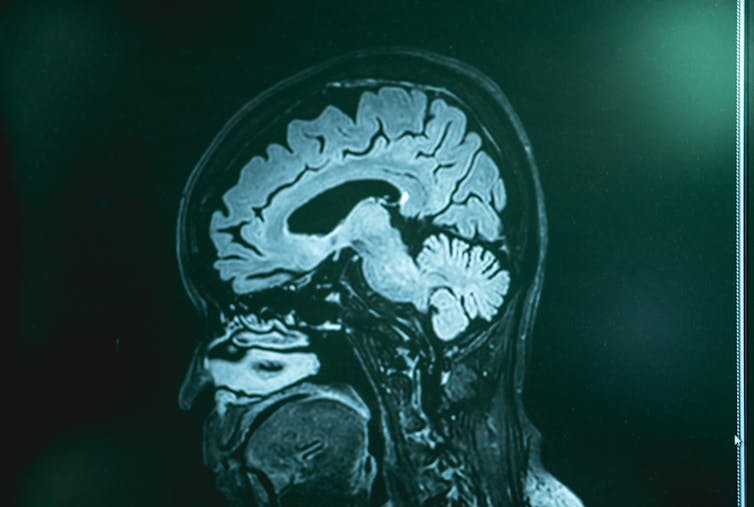
An MRI scan showing a brain with frontotemporal dementia.
There are potentially four variants of frontotemporal dementia.
Atthapon Raksthaput/ Shutterstock

This variant was given its name because most of the tissue loss occurs in the right temporal lobe of the brain. This brain area is mainly involved in understanding concepts and deriving meaning from nonverbal information, such as social cues. Scans of CP’s brain showed that large portions of this region were missing.

The right temporal variant of frontotemporal dementia also appears to cause a mix of symptoms typically seen in both the behavioural and semantic variants. However, there’s still debate within the research community over how to define it.

Learning about dementia

There’s a lot that can be learned from CP.

First, his story helps spread awareness of frontotemporal dementia. Lack of awareness is a major issue – even among doctors, as it’s commonly misdiagnosed as other psychiatric illnesses or Alzheimer’s disease.

CP’s story also helps to clarify the right temporal variant of frontotemporal dementia. His symptoms suggest that the development of new fixations may be a defining feature of the syndrome.

CP’s case is also an example of how dementia can cause changes in how people process sounds.

A link between hearing impairment and dementia is already well established. However, the nature of this relationship is unclear.

Although it has been widely claimed in the media that hearing loss causes dementia, it might also be the other way around – that dementia causes hearing changes. CP’s story provides evidence of this, as his abnormal love for specific noises only occurred after disease onset.

Alzheimer’s disease research also supports the idea of dementia causing hearing changes. For instance, impairments in auditory scene analysis – the ability to separate overlapping sounds, such as listening to one speaker among background noise – has emerged as a common symptom.

CP’s story also demonstrates how dementia can change what people find pleasurable as well as their emotions. Intense obsessions, aversions and changes in preferences (such as suddenly loving or hating certain foods, music or colours) have been widely reported in frontotemporal dementia.

I had the pleasure of meeting CP and his wife and learning about their dementia journey first-hand. CP’s story illustrates how important it is to recognise the variety of symptoms in dementia. This will in turn help lead to earlier diagnosis and the development of tailored interventions.

The Conversation

Lucy Core was supported by the UCL Research Excellence Scholarship while the case study was conducted and received funding from the Royal National Institute of the Deaf while preparing this article.

ref. The man who fell in love with the sound of Spitfires – here’s what this unusual symptom can teach us about dementia – https://theconversation.com/the-man-who-fell-in-love-with-the-sound-of-spitfires-heres-what-this-unusual-symptom-can-teach-us-about-dementia-275107

Drug company ads are easy to blame for misleading patients and raising costs, but research shows they do help patients get needed treatment

Source: The Conversation – USA (3) – By Anna Chorniy, Assistant Professor of Pediatrics, Icahn School of Medicine at Mount Sinai; Institute for Humane Studies

The United States is one of just two countries where drugmakers can advertise directly to patients. BrianAJackson/iStock via Getty Images

It’s a familiar experience for many Americans: You’re watching your favorite show and suddenly you’re ambushed by an ad for a drug whose name sounds like a Wi-Fi password, before a relentlessly cheerful voice tells you to “Ask your doctor” and then blasts through a side-effect list that’s laughably long.

But that might soon change. After nearly 30 years of giving pharmaceutical companies free rein to advertise prescription drugs directly to consumers, U.S. officials are now seeking to curb this practice.

Soon after his appointment in 2025, Health and Human Services Secretary Robert F. Kennedy Jr. stated that he believes direct-to-consumer advertising of prescription drugs has contributed to overmedication and inflated health care costs, and that stronger oversight is long overdue. Meanwhile, politicians on both sides of the aisle have called for banning direct-to-consumer drug ads outright – though the Food and Drug Administration has so far focused on restricting “digital” loopholes and enforcing the laws about advertisement.

As a health economist who studies how health care policies shape decisions made by doctors and patients, I agree that the practice can steer patients toward heavily marketed brands instead of the most appropriate treatment.

But the research on how such advertising affects patients is more nuanced. Many rigorous studies show that these ads can benefit patients’ health by encouraging them to seek lifesaving treatment for conditions such as depression and heart disease and sparking conversations with their doctors. In my view, within the realities of the U.S. health care system, getting rid of direct-to-consumer drug advertising may do more harm than good.

The origins of US prescription drug advertising

Only two countries – the U.S. and New Zealand – allow drug companies to advertise prescription medications directly to the public. Elsewhere, this practice is banned out of concern that short ads cannot adequately explain medical risks and that prescribing decisions should remain under physicians’ control.

And for good reason: Research on risk statements in drug ads on television shows they are often dense, fast-paced and paired with distracting visuals, making them difficult for consumers to understand.

In the European Union, Canada and Japan, for example, manufacturers may run disease awareness campaigns but cannot name specific products.

The U.S. approach to regulating drug advertising evolved gradually over more than a century. Congress’ 1906 Pure Food and Drugs Act was the first major federal step in drug oversight. It required manufacturers to label their products accurately and to disclose the presence of key ingredients.

An old-fashioned illustration of a herald arriving on horseback to a pharmacy to promote Carter's Little Liver Pills
An early 20th-century advertisement for a cure-all medicine called Carter’s Little Liver Pills, made by a Pennsylvania company. In 1959 the Federal Trade Commission made the company take ‘liver’ out of the name.
Wellcome Collection, CC BY

For decades, pharmaceutical marketing focused on physicians by advertising in medical journals, visits by sales representatives and providing free samples. Drug companies still market heavily to physicians, but FDA policies and television changed the calculus.

By the 1960s and ’70s, the reach of mass media prompted companies to communicate complex medical information in brief commercial formats. The 1962 Kefauver–Harris Amendments, which required drugmakers to prove their products were both safe and effective to receive FDA approval, also gave the FDA explicit authority over prescription drug advertising. This allowed the agency to police exaggerated claims and require that promotional materials present a fair balance of benefits and risks, including clear disclosure of known side effects.

In the 1980s, several pharmaceutical companies experimented with marketing drugs directly to consumers in magazines and newspapers. The FDA paused these efforts in 1985 to study their effects but later allowed them to resume.

An opening for television ads

The pivotal change came in 1997, when the agency issued draft guidance that television ads needed to present only major risk information and could direct viewers elsewhere – via phone lines, print materials or websites – for the full details.

Reliable, up-to-date figures are hard to come by, but according to a widely cited estimate, the U.S. pharmaceutical industry now spends more than US$6 billion on direct-to-consumer advertising, roughly twice the amount spent in 2012.

In September 2025, the FDA announced it would revoke this change, restoring pre-1997 standards for fuller disclosure, and would more aggressively enforce currently existing rules for direct-to-consumer drug advertising. Despite growing interest from policymakers and Congress to ban them outright, a total ban likely would not survive a Supreme Court challenge.

How direct-to-consumer ads affect patients

Studies show direct-to-consumer drug advertising increases demand for medications and prompts more doctor visits and diagnoses. Policymakers and the FDA specifically have raised concerns that these ads mislead patients, encouraging them to overuse or inappropriately use drugs and choose more expensive treatments over less costly alternatives. This, in addition, could raise drug prices and result in wasteful spending. But research convincingly demonstrating this has been difficult to come by.

For example, a 2023 analysis showed that drug companies spend more on advertising drugs that have been rated as having relatively lower clinical benefit than on drugs that offer higher clinical benefit. This may imply, according to the authors, that drug companies are trying to steer patients to drugs that physicians would be less likely to prescribe.

Interestingly, though, rigorous research showed that direct-to-consumer advertising increases prescribing of both advertised and nonadvertised drugs – suggesting that overall this increase is serving patients.

U.S. health officials are moving to restrict direct-to-consumer drug advertising.

Demonstrated benefits

For all the criticism that these ads are deceptive, the evidence indicates they can generate substantial clinical benefits for patients.

Research finds that ads bring patients into care, while leaving prescribing decisions largely in physicians’ hands, resulting in more patients being diagnosed and treated. For example, according to a 2022 study on antidepressants, advertising encouraged more people to start treatment and expanded overall use, especially for underdiagnosed conditions.

During the 2008 election season, political ads displaced drug commercials, providing a natural experiment on the effects of direct-to-consumer drug advertising. One study probed that period to examine ads for cholesterol-lowering medications known as statins, which are some of the most widely prescribed medications in the U.S. It found that removing drug ads reduced sales.

That study also ran a simulation banning drug ads entirely to show that doing so would have reduced new statin users by about 600,000 in 2008. Combining their estimates with clinical evidence on the drug’s benefits, the researchers found that health gains from additional treatment outweighed the costs of advertising.

Another study took advantage of the rollout of Medicare Part D, which helps cover the cost of prescription drugs, as a natural experiment. After Part D expanded drug coverage, pharmaceutical advertising increased more in areas with larger Medicare populations. In those areas, researchers found that more patients began treatment and stuck with it.

Importantly, the number of prescriptions also rose for nonadvertised drugs, including lower-cost generics, suggesting that advertising expanded overall treatment rather than simply shifting patients to heavily promoted brands.

It’s easy to single out pharmaceutical ads aimed at patients, but they are only one piece of a complex health care system – one in which drug manufacturers, providers, insurers and pharmacies all have financial incentives that shape which medications patients can access.

For example, drug company marketing directly to physicians does skew prescribing, increasing drug costs, with little evidence that patients receive better or more appropriate treatment as a result. Yet in the absence of direct-to-consumer advertising, patients’ choices of medications would be more heavily controlled by that dynamic.

The challenge for policymakers will be to curb misleading promotion without cutting off patients’ access to reliable information or undermining their role in directing their own care – and that will likely require addressing broader issues in the health care system.

The Conversation

Anna Chorniy does not work for, consult, own shares in or receive funding from any company or organization that would benefit from this article, and has disclosed no relevant affiliations beyond their academic appointment.

ref. Drug company ads are easy to blame for misleading patients and raising costs, but research shows they do help patients get needed treatment – https://theconversation.com/drug-company-ads-are-easy-to-blame-for-misleading-patients-and-raising-costs-but-research-shows-they-do-help-patients-get-needed-treatment-265724

Twenty-year sentence for Hong Kong media mogul Jimmy Lai is a further blow for journalists feeling the heat of Beijing’s crackdown on press freedom

Source: The Conversation – UK – By Yuen Chan, Senior Lecturer, School of Arts and Social Sciences, Department of Journalism, City St George’s, University of London

The sentencing of Hong Kong media mogul Jimmy Lai to 20 years in prison on February 8 on charges of sedition and collusion with foreign forces prompted international outrage.

Lai founded the now shuttered pro-democracy Apple Daily newspaper – and supporters of press freedom around the world pointed to the chilling effect the sentence would have on the media, in a city once vaunted as a beacon for press freedom in Asia.

The reaction was more muted in Hong Kong, where dissent has been stifled since Beijing imposed the draconian National Security Law in 2020, following months of protests in 2019. A local security law enacted in 2024 further expanded the scope of the city’s national security legislation.

Privately, some local journalists say Lai’s conviction will have limited impact on their work. They have already felt heavily constrained by the security laws and what they’re calling the “new normal” – an overarching national security apparatus and culture. Although saddened, they were not altogether surprised at the severity of Lai’s sentence.

One journalist told me they were more shaken by the sentences of up to ten years that were meted out to six senior Apple Daily editors and writers for “just doing their jobs”.

Since the national security law, Hong Kong journalists’ jobs have involved a great deal of dancing around shifting boundaries as to what can and can’t be reported. Inevitably, this has meant exercising greater self-censorship.

In an editorial on the sentencing, the Ming Pao newspaper, which has long positioned itself as a neutral paper of record, suggested the Lai ruling has brought these boundaries into sharper focus, concluding: “Collusion with foreign forces cannot readily be dressed up as journalism.”

The newspaper said that as Hong Kong now operates within the framework of the national security legislation: “The media must operate within this legal framework while continuing to report facts and hold power to account, a balance essential to preserving the city’s pluralism and openness.”

But it hoped “the Lai case will prove a watershed, allowing space for press freedom to widen step by step, so the media can fulfil its responsibilities more effectively”.

However, local journalists I spoke to described this position as naïve and wishful thinking, and said the red lines are no clearer now than before. Selina Cheng, chair of the Hong Kong Journalists Association (HKJA), believes the constraints on free expression in Hong Kong go far beyond a legal framework.

“If we call it a legal framework, it’s giving the system some kind of legitimacy,” Cheng told me. “In reality, the way it operates is there is a lot of destruction of due process, creating an atmosphere of fear and anxiety in those working in industries of expression.”

Apart from being arrested and jailed, Cheng says journalists and their family members have been doxed, with their personal details posted online, and harassed. Both individual journalists and news outlets have been targeted by unusual tax audits.

Tai Po tragedy

Cheng was one of several journalists I spoke to who pointed to the November 2025 fire which killed 168 people in Tai Po’s Wang Fuk Court Estate as a potent symbol of the current state of press freedom and freedom of speech in Hong Kong.

In the immediate aftermath, local and international journalists interviewed victims and reported extensively on suspected corruption and lack of oversight of building works on the site. But residents and other potential interviewees soon became reluctant to speak to reporters following the arrests of people who had posted comments online.

A student who started a petition for an independent inquiry was arrested – and then recently expelled from his university just weeks from graduation, even though he hasn’t been charged.

For one veteran journalist, who asked to remain anonymous for fear of bringing trouble to their organisation, what led to the Tai Po tragedy highlights a “media failure”. The news outlets which had most doggedly pursued stories about building maintenance, bid-rigging and corruption were the investigative site Factwire and Apple Daily, so “when these outlets disappeared, a lot of the reports also petered out”.

“In the past, you’d have lots of commentary in the media after an incident like this,” they explained. “There’d be legal scholars, experts, people from all different sectors. But now, the universities don’t allow people to comment and articles are spiked or censored, so it’s hard to raise and maintain public concern.”

Snitch culture

The journalist spoke of a system that extends beyond the legal framework of the national security law that restricts speech, through the control of public opinion and a “snitch culture” that weaponises complaints.

A Hong Kong police national security hotline was launched in November 2020; by June 2025, the city’s security chief said it had received more than 920,000 reports. Public bodies and funding organisations also regularly receive complaints about platforming of funding groups or individuals perceived to be pro-democracy or supportive of the 2019 protests.

Last October, a public venue cancelled a play written by Candace Chong, a leading playwright who was been vocal about censorship. The body that manages the Xiqu Centre, part of the West Kowloon Cultural District, said it had received complaints that the show – which depicts a love triangle between three men – defamed Hong Kong.

There are signs the “media failure” is already affecting governance. In January, the government introduced a controversial seat belt law requiring all bus passengers to buckle up while seated, only to shelve it five days later. The bill had received little scrutiny in Hong Kong’s now opposition-free legislature.

“It’s really unthinkable for a government to push out a bill, get it rubber-stamped by the legislature, and then withdraw it because they suddenly realise people are unhappy or the legislative details haven’t been thought through,” the HKJA’s Cheng told me. “It shows how the government misjudged public sentiment. This can be attributed to how the media isn’t free any more.”

The Conversation

Yuen Chan does not work for, consult, own shares in or receive funding from any company or organisation that would benefit from this article, and has disclosed no relevant affiliations beyond their academic appointment.

ref. Twenty-year sentence for Hong Kong media mogul Jimmy Lai is a further blow for journalists feeling the heat of Beijing’s crackdown on press freedom – https://theconversation.com/twenty-year-sentence-for-hong-kong-media-mogul-jimmy-lai-is-a-further-blow-for-journalists-feeling-the-heat-of-beijings-crackdown-on-press-freedom-276992

‘Working hard used to get you something’: what Hannah Spencer’s speech tells us about her, and the state of British politics

Source: The Conversation – UK – By Alex Prior, Lecturer in Politics with International Relations, London South Bank University

Hannah Spencer’s parliamentary story – as the new Green MP for Gorton and Denton – has just begun.

Nevertheless, the life story that she presented in her victory speech was that of a plumber, not a politician. She identified herself – in present tense – by that trade; she had not grown up wanting to be a politician. She also celebrated qualifying as a plasterer during the “chaos” and “pressure” of the election campaign. She described campaigning jovially as “all this”, as if it were just a challenge in the broader adventure, not the adventure itself.

Despite, or perhaps because of, accusations that the Greens used “sectarian politics” to secure victory, the speech was one of solidarity, of aligning herself with the struggles and achievements of “the community that I am from”. Spencer said that she had lived there in one of the hardest times of her life, and presented the strength of the community “at holding things together” as an inspiration.

She aligned herself and her personal characteristics with those of the constituency, stressing that “I am no different to every single person here in this constituency. I work hard. That is what we do.”

Alongside all the talk of “we”, of common interests and lack of difference, Spencer singled out several audiences for her story. One such audience? Her now-plumberless “customers”, to whom she duly apologised: “I’m sorry, but I think I might have to cancel the work that you had booked in, because I’m heading to parliament”.

Spencer also addressed those who voted for her, and those who didn’t. She spoke of “my Muslim friends and neighbours”, who “are just like me: human”. She discussed the “left-behind” (“I see you, and I will fight for you”), and people doing jobs like hers: “We will finally get a seat at the table”. And she addressed “our white working class communities, the background that I have become so glad to be from”.

A personal and political journey

My research focuses on political narratives and storytelling as a means of communication: the stories that parliaments contain and project, the stories we tell about the places we’re in and the stories that politicians use to communicate themselves to voters. Spencer’s speech is an attempt to portray a compelling story to her new constituency.

She spoke about how moving away from the constituency to nearby Trafford made the qualities of Gorton and Denton’s community “even clearer”. Only realising your love for a place and the people in it when you’ve moved away is a familiar narrative device. As Joni Mitchell once sang, “You don’t know what you’ve got ‘til it’s gone”.

In Spencer’s speech, this tactic carried a sharper political edge. This is a constituency that people move away from to get the “nice life” that Spencer described: “good schools, a thriving high street and clean air”.

This part of the story carried a rebuke to an audience that Spencer was addressing, but not by name: the Labour Party, for whom this was a traditionally safe seat. Spencer observed that “working hard used to get you something”.

I would argue that “you”, in this context, is a reference to traditional Labour voters. The implication here is that it is voting Labour that “used to get you something”.

Being a politician now isn’t an aspect of Spencer’s story that she’s keen to claim. She may now sit at Westminster, but she appears to frame this as an extension of who she already is — a worker, a neighbour, a constituent — in a new arena.

In doing so, she attempts to recast political representation itself as continuity of identity. The challenge, of course, will be whether she can sustain that claim. It is easier to say “I am no different” on a victory stage following a byelection win than from the House of Commons. The durability of her narrative – and perhaps her political appeal – will rest on whether she can remain recognisably “from” the constituency while operating within the institution of parliament.

The Conversation

Alex Prior does not work for, consult, own shares in or receive funding from any company or organisation that would benefit from this article, and has disclosed no relevant affiliations beyond their academic appointment.

ref. ‘Working hard used to get you something’: what Hannah Spencer’s speech tells us about her, and the state of British politics – https://theconversation.com/working-hard-used-to-get-you-something-what-hannah-spencers-speech-tells-us-about-her-and-the-state-of-british-politics-277121