Ayatollah Ali Khamenei has ruled Iran with defiance and brutality for 36 years. For many Iranians, he will not be revered

Source: The Conversation – Global Perspectives – By Andrew Thomas, Lecturer in Middle East Studies, Deakin University

Ayatollah Ali Khamenei, Iran’s supreme leader for 36 years, has been killed in US and Israeli airstrikes on his country, according to US President Donald Trump. Iran did not immediately confirm his death.

As one of Iran’s longest-serving leaders, Khamenei has been almost as ubiquitous in Iranian society as his predecessor, Ayatollah Ruhollah Khomeini, who founded the Islamic Republic of Iran in 1979.

And despite the fact Khomeini authored the Iranian Revolution, some say Khamenei was actually the most powerful leader modern Iran has had.

In more than three decades as supreme leader, Khamenei amassed unprecedented power over domestic politics and cracked down ever more harshly on internal dissent. In recent years, he prioritised his survival – and that of his regime – above all else. His government brutally put down a popular uprising in December 2025–January 2026 that killed thousands.

Ultimately, though, Khamenei will not be remembered by most Iranians as a strong leader. Nor will he be revered. Instead, his legacy will be the profound weakness his regime brought the Islamic Republic on all fronts.

Khamenei’s rise through the ranks

Khamenei was born in the city of Marshad in northeastern Iran in 1939. As a boy, he began to form his political and religious world view by studying at Islamic seminaries in Najaf and Qom. At 13, he started to embrace ideas relating to revolutionary Islam. These included the teachings of cleric Navab Safavi, who often called for political violence against the rule of the shah of Iran, Mohammad Reza Pahlavi.

Khamenei met Khomeini in 1958 and immediately embraced his philosophy, often referred to as “Khomeinism”.

This world view was informed by anti-colonial sentiment, Shia Islam and elements of social engineering through state planning, particularly when it came to preserving a “just” Islamic society. Khomeinism stipulates that a system of earthly laws alone cannot create a just society – Iran must draw its legitimacy from “God Almighty”.

The concept of velayat-e faqih, also known as guardianship of the jurist, is central to Khomeinism. It dictates that the supreme leader should be endowed with “all the authorities that the Prophet and infallible Imams were entitled”.

Essentially, this means Iran was to be ruled by a single scholar of Shia Islam. This is where Khomeini, and later Khamenei, would draw their sweeping power and control.

From 1962, Khamenei began almost two decades of revolutionary activity against Pahlavi (the shah) on behalf of Khomeini, who was exiled in 1964. Khamenei was arrested by the shah’s secret police in 1971 and tortured, according to his memoirs.

When the shah was overthrown in the Islamic Revolution in 1979, Khomeini returned from exile to become the new supreme leader.

Khamenei was selected to join the Revolutionary Council, which ruled alongside the provisional government. He then became deputy defence minister and assisted in organising the Islamic Revolutionary Guard Corps (IRGC). This military institution – initially created to protect the revolution and supreme leader – would become one of the most powerful political forces in Iran.
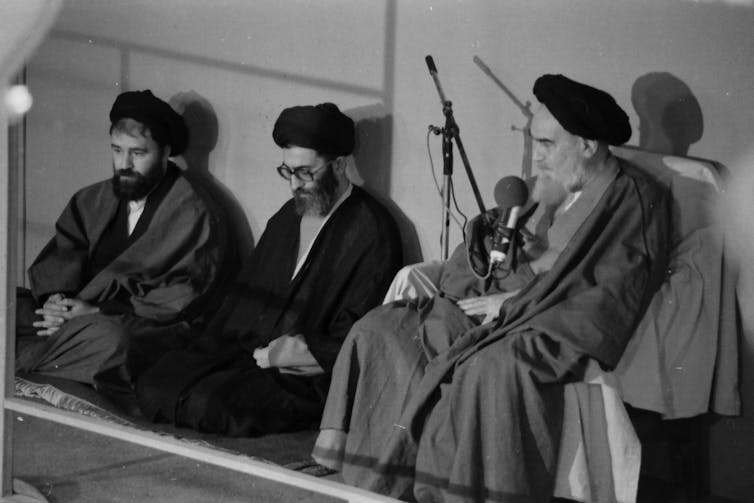
Ayatollah Ruhollah Khomeini (sitting on chair), Ali Khamenei (middle), and Khomeini’s son, Ahmad Khomeini (left), pictured in 1981.
Wikimedia Commons

After surviving an assassination attempt in 1981, Khamenei was elected president of Iran in 1982 and again in 1985. He held the presidency during the majority of the Iran–Iraq war – a conflict that devastated both countries in both human and economic cost.

Although subordinate to the supreme leader, Khamenei wielded significant power compared to later presidents, given the revolution was still very young and the Iraq war posed a great threat to the regime. But he remained in lock-step with Khomeini’s wishes. He also managed to build a close relationship with the IRGC that would go far beyond his presidency.
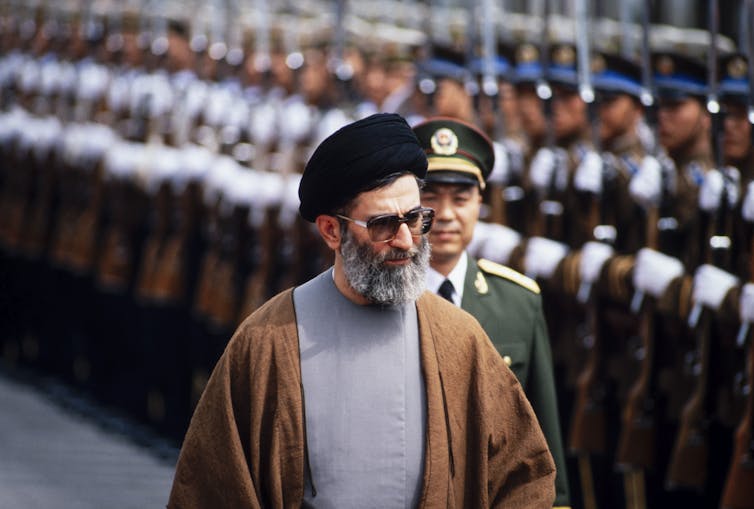
Then-President Ali Khamenei during a state visit to China in May 1989.
Forrest Anderson/Getty Images

A surprising choice for supreme leader

Khomeini died in June 1989 after a period of deteriorating health, with no clear successor.

Khomeini had initially supported Grand Ayatollah Hossein-Ali Montazeri to be his successor. However, Montazeri had become increasingly critical of the supreme leader’s authority and human rights violations in the country. He resigned in 1988 and was put under house arrest until his death in 2009.

Khamenei had the political credentials to lead. He was also a steadfast support of Khomeinism. However, he was seen a surprising choice for supreme leader when he was elected by the Assembly of Experts, a group of Islamic clerics.

In fact, his appointment sparked a significant amount of controversy and criticism. Some Islamic scholars believed he lacked the clerical rank of grand ayatollah, which was required under the constitution to ascend to the position. These critics believed the Iranian people would not respect the word of “a mere human being” without a proper connection to God.

A referendum was held in July 1989 to change the constitution to allow for a supreme leader who has shown “Islamic scholarship”. It passed overwhelmingly and Khamenei became an ayatollah.

Khamenei’s position had been consolidated on paper, but despite being president since 1982, he did not enjoy the same popularity as Khomeini within both the clerical elite and general public.

The constitutional amendments, however, had given Khamenei significantly more power to intervene in political affairs. In fact, he had far more power as supreme leader than Khomeini ever enjoyed.

This included the ability to determine general policies, appoint and dismiss members of the Council of Guardians, and order public referendums. He also had enough power to silence dissent with relative ease.

Consolidating power over the decades

Khamenei worked with his presidents to varying degrees, though he exercised his power to undermine legislation when he disagreed with it.

For example, he largely backed the economic agenda of President Hashemi Rafsanjani (who served from 1989 to 1997), but he often stood in the way of Mohammad Khatami (1997–2005) and Hassan Rouhani (2013–21). Both had attempted to reform Iran’s political system and foster a better relationship with the West.

Khamenei’s most famous intervention in domestic politics occurred after the first term of President Mahmoud Ahmadinejad (2005–13). After Ahmadinejad claimed victory in the disputed 2009 presidential election, thousands of Iranians took to the streets in one of the largest protest movements since the revolution. Khamenei backed the election result and cracked down harshly on the protesters. Dozens were killed (perhaps more), while thousands were arbitrarily arrested.

Khamenei later clashed with Ahmadinejad and warned him against seeking the presidency again in 2017. Ahmadinejad defied him, but was later barred from running.

After the death of hardline President Ebrahim Raisi in a helicopter crash in 2024, Khameini continued his manoeuvring behind the scenes. After the reformist Masoud Pezeshkian won the presidency, Khameini immediately blocked him from negotiating with the United States over sanctions relief and used his influence to thwart his economic reform agenda.

And when protests again broke out at the end of 2025 over the struggling economy, Khamenei again ordered them to be crushed by any means necessary.

A tarnished legacy

Thanks to the powers vested in him in the constitution, Khamenei also had extraordinary control over Iran’s foreign policy.

Like his mentor, Khomeini, he staunchly supported the regime’s resistance to what it considered “Western imperialism”. He was also a key architect of Iran’s regional proxy strategy, funding militant groups like Hezbollah, Hamas, the Houthis and others to carry out Iran’s military objectives.

Khamenei had, at times, been amenable to cooperation with the West – namely negotiating with the US over Iran’s nuclear enrichment program.

During the first Trump administration, however, Khamenei returned to a staunchly anti-Western posture. His government railed against Trump’s scuttling of the 2015 nuclear deal, the reimposed economic sanctions on Iran’s energy sector and the assassination of the head of the IRGC’s Quds force, Qassem Soleimani.

After Trump returned to office in 2025, Iran grew even weaker. And Khamenei’s anti-Western posture began to look increasingly hollow. Iran’s defeat in the 12-day war with Israel in 2025 shredded whatever legitimacy his regime had left.

In the months that followed, Khamenei ruled over a population increasingly resentful of the Iranian political system and its leadership. In the 2025–26 protests, some openly chanted for Khamenei’s death.

When Khomenei died in 1989, his state funeral was attended by millions. Mourners pulled him out of his coffin and scrambled for sacred mementos.

Though Khameini served longer, Iranians will likely not show the same grief for him.

The Conversation

Andrew Thomas does not work for, consult, own shares in or receive funding from any company or organisation that would benefit from this article, and has disclosed no relevant affiliations beyond their academic appointment.

ref. Ayatollah Ali Khamenei has ruled Iran with defiance and brutality for 36 years. For many Iranians, he will not be revered – https://theconversation.com/ayatollah-ali-khamenei-has-ruled-iran-with-defiance-and-brutality-for-36-years-for-many-iranians-he-will-not-be-revered-259268

Massive US attacks on Iran unlikely to produce regime change in Tehran

Source: The Conversation – USA – By Donald Heflin, Executive Director of the Edward R. Murrow Center and Senior Fellow of Diplomatic Practice, The Fletcher School, Tufts University

A group of demonstrators in Tehran wave Iranian flags in support of the government on Feb. 28, 2026 AP Photo/Vahid Salemi

After the largest buildup of U.S. warships and aircraft in the Middle East in decades, American and Israeli military forces launched a massive assault on Iran on Feb. 28, 2026.

President Donald Trump has called the attacks “major combat operations” and has urged regime change in Tehran.

To better understand what this means for the U.S. and Iran, Alfonso Serrano, a U.S. politics editor at The Conversation, interviewed Donald Heflin, a veteran diplomat who now teaches at Tufts University’s Fletcher School.

Widespread attacks have been reported across Iran, following weeks of U.S. military buildup in the region. What does the scale of the attacks tell you?

I think that Trump and his administration are going for regime change with these massive strikes and with all the ships and some troops in the area. I think there will probably be a couple more days’ worth of strikes. They’ll start off with the time-honored strategy of attacking what’s known as command and control, the nerve centers for controlling Iran’s military. From media reporting, we already know that the residence of Supreme Leader Ayatollah Ali Khamenei was attacked.

What is the U.S. strategic end game here?

Regime change is going to be difficult. We heard Trump today call for the Iranian people to bring the government down. In the first place, that’s difficult. It’s hard for people with no arms in their hands to bring down a very tightly controlled regime that has a lot of arms.

The second point is that U.S. history in that area of the world is not good with this. You may recall that during the Gulf War of 1990-1991, the U.S. basically encouraged the Iraqi people to rise up, and then made its own decision not to attack Baghdad, to stop short. And that has not been forgotten in Iraq or surrounding countries. I would be surprised if we saw a popular uprising in Iran that really had a chance of bringing the regime down.

Several men wave flags in front of a building.
A group of men wave Iranian flags as they protest U.S. and Israeli strikes in Tehran, Iran, on Feb. 28, 2026.
AP Photo/Vahid Salemi

Do you see the possibility of U.S. troops on the ground to bring about regime change?

I will stick my neck out here and say that’s not going to happen. I mean, there may be some small special forces sent in. That’ll be kept quiet for a while. But as far as large numbers of U.S. troops, no, I don’t think it’s going to happen.

Two reasons. First off, any president would feel that was extremely risky. Iran’s a big country with a big military. The risks you would be taking are large amounts of casualties, and you may not succeed in what you’re trying to do.

But Trump, in particular, despite the military strike against Iran and the one against Venezuela, is not a big fan of big military interventions and war. He’s a guy who will send in fighter planes and small special forces units, but not 10,000 or 20,000 troops.

And the reason for that is, throughout his career, he does well with a little bit of chaos. He doesn’t mind creating a little bit of chaos and figuring out a way to make a profit on the other side of that. War is too much chaos. It’s really hard to predict what the outcome is going to be, what all the ramifications are going to be. Throughout his first term and the first year of his second term, he has shown no inclination to send ground troops anywhere.

Speaking of President Trump, what are the risks he faces?

One risk is going on right now, which is that the Iranians may get lucky or smart and manage to attack a really good target and kill a lot of people, like something in Jerusalem or Tel Aviv or a U.S. military base.

The second risk is that the attacks don’t work, that the supreme leader and whoever else is considered the political leadership of Iran survives, and the U.S. winds up with egg on its face.

The third risk is that it works to a certain extent. You take out the top people, but then who steps into their shoes? I mean, go back and look at Venezuela. Most people would have thought that who was going to wind up winning at the end of that was the head of the opposition. But it wound up being the vice president of the old regime, Delcy Rodríguez.

I can see a similar scenario in Iran, if Khamenei and a couple of other leaders were taken out. But the only institution in Iran strong enough to succeed them is the army, the Revolutionary Guards in particular. Would that be an improvement for the U.S.? It depends on what their attitude was. The same attitude that the vice president of Venezuela has been taking, which is, “Look, this is a fact of life. We better negotiate with the Americans and figure out some way forward we can both live with.”

But these guys are pretty hardcore revolutionaries. I mean, Iran has been under revolutionary leadership for 47 years. All these guys are true believers. I don’t know if we’ll be able to work with them.

Smoke rises over a city center.
Smoke rises over Tehran on Feb. 28, 2026, after the U.S. and Israel launched airstrikes on Iran.
Fatemeh Bahrami/Anadolu via Getty Images

Any last thoughts?

I think the timing is interesting. If you go back to last year, Trump, after being in office a little and watching the situation between Israel and Gaza, was given an opening, when Israeli Prime Minister Benjamin Netanyahu attacked Qatar.

A lot of conservative Mideast regimes, who didn’t have a huge problem with Israel, essentially said “That’s going too far.” And Trump was able to use that as an excuse. He was able to essentially say, “Okay, you’ve gone too far. You’re really taking risk with world peace. Everybody’s gonna sit at the table.”

I think the same thing’s happening here. I believe many countries would love to see regime change in Iran. But you can’t go into the country and say, “We don’t like the political leadership being elected. We’re going to get rid of them for you.” What often happens in that situation is people begin to rally around the flag. They begin to rally around the government when the bombs start falling.

But in the last few months, we’ve seen a huge human rights crackdown in Iran. We may never know the number of people the Iranian regime killed in the last few months, but 10,000 to 15,000 protesters seems a minimum.

That’s the excuse Trump can use. You can sell it to the Iranian people and say, “Look, they’re killing you in the streets. Forget about your problems with Israel and the U.S. and everything. They’re real, but you’re getting killed in the streets, and that’s why we’re intervening.” It’s a bit of a fig leaf.

Now, as I said earlier, the problem with this is if your next line is, “You know, we’re going to really soften this regime up with bombs; now it’s your time to go out in the streets and bring the regime down.” I may eat these words, but I don’t think that’s going to happen. The regime is just too strong for it to be brought down by bare hands.

The Conversation

Donald Heflin does not work for, consult, own shares in or receive funding from any company or organization that would benefit from this article, and has disclosed no relevant affiliations beyond their academic appointment.

ref. Massive US attacks on Iran unlikely to produce regime change in Tehran – https://theconversation.com/massive-us-attacks-on-iran-unlikely-to-produce-regime-change-in-tehran-277180

Iran will respond to US-Israeli strikes as existential threats to the regime – because they are

Source: The Conversation – Global Perspectives – By Javed Ali, Associate Professor of Practice of Public Policy, University of Michigan

A plume of smoke rises above Tehran on Feb. 28, 2026. AFP via Getty Images

After U.S. and Israeli missiles struck Iran’s nuclear sites in June 2025, Tehran responded with a limited attack on the American airbase in Qatar. Five years before that, a U.S. drone strike against Qasem Soleimani, head of the powerful Islamic Revolutionary Guard Corps Quds Force, was met with followed by an attack on two American bases in Iraq shortly thereafter.

Expect none of that restraint by Iran’s leaders following the latest U.S. and Israeli military operation currently playing out in the Gulf nation.

In the early hours of Feb. 28, 2026, hundreds of missiles struck multiple sites in Iran. Part of “Operation Epic Fury,” as the U.S. Department of Defense has called it, the strikes follow months of U.S. military buildup in the region. But they also come after apparent diplomatic efforts, in the shape of a series of nuclear talks in Oman and Geneva aimed at a peaceful resolution.

Any such deal is surely now completely off the table. In scale and scope, the U.S. and Israel attack goes far beyond any previous strikes on the Gulf nation.

In response, Iran has said it will use “crushing” force. As an expert on Middle East affairs and a former senior official at the National Security Council during the first Trump administration, I believe the calculus both in Washington and more so in Tehran is very different from earlier confrontations: Iran’s leaders almost certainly see this as an existential threat given President Donald Trump’s statement and the military campaign already underway. And there appears to be no obvious off-ramp to avoid further escalation.

What we should expect now is a response from Tehran that utilizes all of its capabilities – even though they have been significantly degraded. And that should be a worry for all nations in the region and beyond.

The apparent aims of the US operation

It is important to note that we are in the early stages of this conflict – much is unknown.

As of Feb. 28, it is unclear who has been killed among Iran’s leadership and to what extent Iran’s ballistic missile capabilities have been degraded. The fact that ballistic missiles have been launched at regional states that host U.S. military bases suggests that, at a minimum, Iran’s military capabilities have not been entirely wiped out.

Iran fired over 600 missiles against Israel last June during their 12-day war, but media reporting and Iranian statements over the past month suggested that Iran managed to replenish some of its missile inventory, which it is now using.

Clearly Washington is intent on crippling Iran’s ballistic program, as it is that capability that allows Iran to threaten the region most directly. A sticking point in the negotiations in Geneva and Oman was U.S. officials’ insistence that both Iran’s ballistic missiles and its funneling of support to proxy groups in the region be on the table, along with the longstanding condition that Tehran ends all uranium enrichment. Tehran has long resisted attempts to have limits on its ballistic missiles as part of any negotiated nuclear deal given their importance in Iran’s national security doctrine.

This explains why some U.S. and Israeli strikes appear to be aimed at taking out Iran’s ballistic and cruise missile launch sites and production facilities and storage locations for such weapons.

With no nuclear weapon, Iran’s ballistic missiles have been the country’s go-to method for responding to any threat. And so far in the current conflict, they have been used on nations including the United Arab Emirates, Qatar, Kuwait and Bahrain.

‘It will be yours to take’

But the Trump administration appears to have expanded its aims beyond removing Iran’s nuclear and non-nuclear military threat. The latest strikes have gone after leadership, too.

Among the locations of the first U.S.-Israeli strikes was a Tehran compound in which the Supreme Leader Ayatollah Ali Khamenei in known to reside, and Israel’s prime minister has confirmed that the 86-year-old leader was a target of the operation.

While the status of the supreme leader and other key members of Iran’s leadership remains unknown as of this writing, it is clear that the U.S. administration hopes that regime change will follow Operation Epic Fury. “When we are finished, take over your government. It will be yours to take,” Trump told Iranians via a video message recorded during the early hours of the attack.

A man in a suit and a baseball cap with USA on it stands at a podium.
U.S. President Donald Trump addressed the nation on Iran strikes.
US President Trump Via Truth Social/Anadolu via Getty Images

Regime change carries risks for Trump

Signaling a regime change operation may encourage Iranians unhappy with decades of repressive rule and economic woes to continue where they left off in January – when hundreds of thousands took to the street to protest.

But it carries risks for the U.S. and its interests. Iran’s leaders will no longer feel constrained, as they did after the Soleimani assassination and the June 2025 conflict. On those occasions, Iran responded in a way that was not even proportionate to its losses – limited strikes on American military bases in the region.

Now the gloves are off, and each side will be trying to land a knockout blow. But what does that constitute? The U.S. administration appears to be set on regime change. Iran’s leadership will be looking for something that goes beyond its previous retaliatory strikes – and that likely means American deaths. That eventuality has been anticipated by Trump, who warned that there might be American casualties.

So why is Trump willing to risk that now? It is clear to me that despite talk of progress in the rounds of diplomatic talks, Trump has lost his patience with the process.

On Feb. 26, after the latest round of talks in Geneva, we didn’t hear much from the U.S. side. Trump’s calculus may have been that Iran wasn’t taking the hint – made clear by adding a second carrier strike group to the other warships and hundreds of fighter aircraft sent to the region over the past several weeks – that Tehran had no option other than agreeing to the U.S. demands.

Three iranian men look out from a rooftop as smoke rises from explosions over buildings
Iranians watch as explosions erupt across Tehran.
AP Photo

What happens next

What we don’t know is whether the U.S. strategy is now to pause and see if an initial round of strikes has forced Iran to sue for peace – or whether the initial strikes are just a prelude to more to come.

For now, the diplomatic ship appears to have sailed. Trump seems to have no appetite for a deal now – he just wants Iran’s regime gone.

In order to do that, he has made a number of calculated gambles. First politically and legally: Trump did not go through Congress before ordering Operation Epic Fury. Unlike 23 years ago when President George W. Bush took the U.S. into Iraq, there is no war authorization giving the president cover.

Instead, White House lawyers must have assessed that Trump can carry out this operation under his Article 2 powers to act as commander in chief. Even so, the 1973 War Powers Act will mean the clock is now ticking. If the attacks are not concluded in 60 days, the administration will have to go back to Congress and say the operation is complete, or work with Congress for an authorization to use force or a formal declaration of war.

The second gamble is whether Iranians will heed his call to remove a regime that many have long wanted gone. Given the ferocity of the regime’s response to the protests in January, which resulted in the deaths of thousands of Iranians, are Iranians willing to face down Iran’s internal security forces and drive what remains of the regime from power?

Third, the U.S. administration has made a bet that the Iranian regime – even confronted with an existential threat – does not have the capability to drag the U.S. into a lengthy conflict to inflict massive casualties.

And this last point is crucial. Experts know Tehran has no nuclear bomb and only has a limited stockpile of drones and cruise and ballistic missiles.

But it can lean on unconventional capabilities. Terrorism is a real concern – either through the Islamic Revolutionary Guard Corps’ Quds Force, which coordinates Iran’s unconventional warfare, or through its partnership with Hezbollah in Lebanon. Or actors like the Houthis in Yemen or Shia militias in Iraq may seek to conduct attacks against U.S. interests in solidarity with Iran or directed to do so by the regime.

A mass casualty event may put political pressure on Trump, but I cannot see it leading to U.S. boots on ground in Iran. The American public doesn’t have the appetite for such an eventuality, and that would necessitate Trump gaining Congressional approval, which for now has not yet materialized.

No one has a crystal ball, and it is early in an operation that will likely go on for days, if not longer. But one thing is clear: Iran’s regime is facing an existential threat. Do not expect it to show restraint.

The Conversation

Javed Ali does not work for, consult, own shares in or receive funding from any company or organization that would benefit from this article, and has disclosed no relevant affiliations beyond their academic appointment.

ref. Iran will respond to US-Israeli strikes as existential threats to the regime – because they are – https://theconversation.com/iran-will-respond-to-us-israeli-strikes-as-existential-threats-to-the-regime-because-they-are-277176

Networking can boost your earnings and get you promoted – but it’s harder for women to reap the benefits

Source: The Conversation – UK – By Andrew Kloeden, PhD Candidate in Management, University of Exeter

PeopleImages/Shutterstock

For many workers, the benefits of professional relationships and the networks they create are clear. Bringing together people and social spheres that are otherwise unconnected is linked to higher salaries and more rapid promotion. So it’s no surprise that “networking” is a serious business for so many professionals.

In network theory, the process of linking unconnected people and groups – either within the workplace or outside it – is known as “brokerage”. When you’re a broker, your networks are “open”, with lots of links to unconnected people. All these connections give brokers access to potentially useful information – after all, people who don’t know each other are likely to know different things.

And continued networking, where more new relationships are generated over time, is important to maintain the benefits. Otherwise, networks can grow stale. Being close to the “centre” of the network (having more network ties) brings additional benefits in terms of access to knowledge, information and resources.

But as in many other aspects of life, gender is a fundamental force in terms of professional relationships and the structure of professional networks. It may come as little surprise that women face disadvantages compared to men – both in the positions they hold within networks and the characteristics of their contacts.

For example, women’s networks tend to contain fewer men. Men still hold more positions of power than women in organisations, which leaves women with fewer senior-level connections. Women also tend to find themselves closer to the edge than the centre of organisational networks. Separately, they are less likely to be brokers.

Women’s networks also tend to be “stickier” – where old ties are less likely to be replaced with new ones. These new ties can help to keep the access to information fresh. What’s more, women tend to receive lower returns from the positions they occupy in their networks. For example, even when women are brokers they tend not to enjoy the benefits that can lead to rapid promotion in the way that men might.

The root of the problem

There are many reasons for these disadvantages. First, women usually carry a greater burden of unpaid domestic caring work than men in heterosexual couples (the so-called “second shift”). This can eat up the time that women could otherwise use investing in professional networks. It’s even more acute for mothers or the (mostly) women who care for adult relatives.

Second, the stereotypes of “assertive” men and “communal” women have an effect on organisational networks. Women who occupy strong network positions may not conform to this stereotype of co-operation and communality, which might be frowned upon. For the same reason, men are often seen as more legitimate or useful networking partners.

This also explains why women tend to feel “stereotype threat” (where people fear living up to negative stereotypes) when they are brokers. They may be sensitive to being seen negatively for violating this stereotype.

a woman crouches down to greet two children coming out of school.
The ‘second shift’ can make it harder to find the time for networking.
Kzenon/Shutterstock

Similarly, homophily (the tendency for people to form relationships with those they see as similar to themselves) can harm women’s network position and the returns they get, especially in organisations with more men than women. In these situations, women can miss out on senior-level connections (who are more likely to be men). Or they may just end up with smaller networks.

While all women face barriers to network success, there are strategies that can help them to overcome these. Successful women tend to embrace network churn by keeping a core group of contacts but otherwise strategically changing their professional networks. This can help to keep contacts fresh.

And the most successful women have been shown to resist the temptation to focus purely on social support from their contacts. Instead (or in addition), they seek more strategic support – things like introductions and information.

Of course, these strategies all involve women doing extra work to navigate environments that were not built for them. So it is important for employers to take steps to mitigate these problems. This can also help organisations retain staff, and it can help to tackle other workplace problems related to gender biases.

It doesn’t have to be difficult. Employers can structure teams or committees to increase opportunities for interaction between women and senior men. They can also run surveys to map the social networks in their organisations to identify exclusion and disadvantage. Lastly, they can educate senior staff and executives about the issues.

Ultimately, everyone should understand the importance of networking to an employee’s prospects and how they can help to share out the benefits equally.

The Conversation

Andrew Kloeden does not work for, consult, own shares in or receive funding from any company or organisation that would benefit from this article, and has disclosed no relevant affiliations beyond their academic appointment.

ref. Networking can boost your earnings and get you promoted – but it’s harder for women to reap the benefits – https://theconversation.com/networking-can-boost-your-earnings-and-get-you-promoted-but-its-harder-for-women-to-reap-the-benefits-276315

How the Seattle Seahawks’ sale will score a touchdown for charity 8 years after Paul Allen’s death

Source: The Conversation – USA (2) – By Reid Kress Weisbord, Distinguished Professor of Law and Judge Norma Shapiro Scholar, Rutgers University – Newark

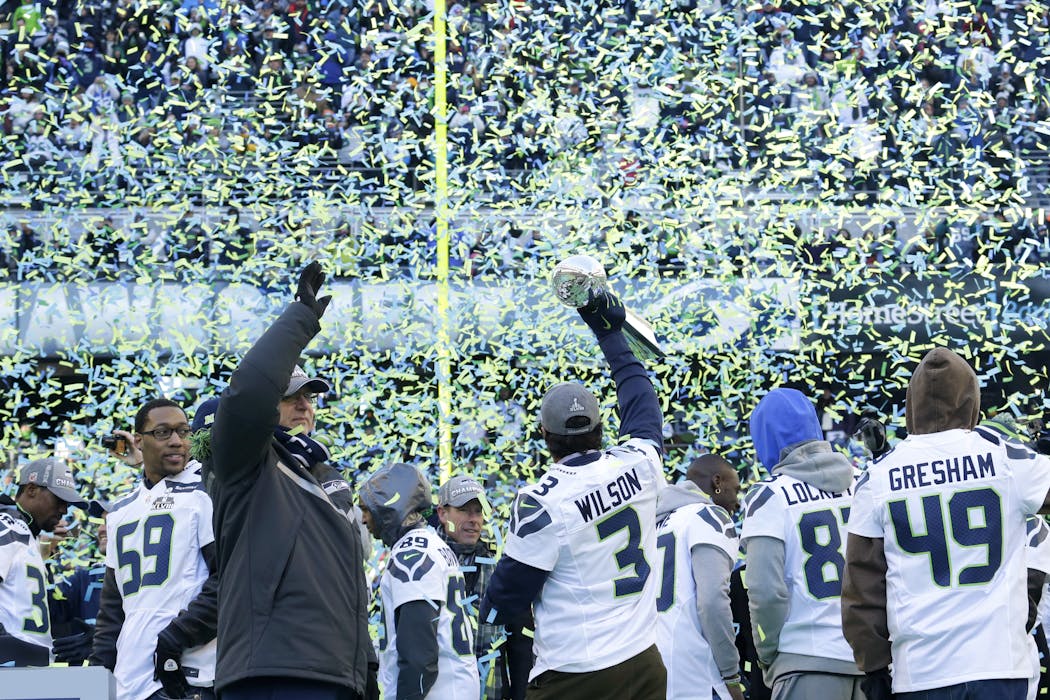
Paul Allen, wearing a gray jacket, salutes the crowd during a celebration of the Seattle Seahawks’ Super Bowl victory in 2014. AP Photo/Ted S. Warren

When Microsoft co-founder Paul Allen died on Oct. 15, 2018, he left behind an estimated US$26 billion that he wanted to largely leave to charity.

Allen died at 65 of septic shock after a yearslong cancer battle. He’s back in the news because his estate is finally selling an asset that represents nearly a quarter of his fortune: the Seattle Seahawks football team, which he bought in 1997 for roughly $200 million.

The sale of the 2014 and 2026 Super Bowl champions could fetch more than $6.5 billion – a potentially record-breaking sum.

Allen never married and he had no children. His sister, businesswoman Jody Allen, is his estate’s trustee and executor. She’s now overseeing the Seahawks’ sale.

As law professors who study the transfer of property after death, we can explain why it often takes a long time for complex estates to settle following the death of ultrawealthy people.

Settling the estates of billionaires

When most people die, the distribution of any wealth they leave to their heirs or charitable causes can be relatively straightforward.

If all goes well, the process will take a few years at most. Homes, vehicles, bank accounts and retirement assets can usually be relatively quickly sold or transferred to members of the family or friends of the deceased.

When people hear that an estate is still being sorted out years after someone’s death, they often assume that big disputes have interfered with the settlement process.

Indeed, high-profile celebrity estates, including those that celebrity musicians such Prince and Aretha Franklin left behind, have been delayed by legal battles.

But delays are common even without conflicts, particularly when an estate is very large or complex.

Similar to sprawling empires

As you might imagine, billionaires’ estates are different. They tend to be more like sprawling business empires than what your beloved aunt left behind when she died. Multibillion-dollar estates usually take many years to unwind because they involve complex assets that are hard to assess and sell.

Some of Allen’s holdings, for example, were patents, which often complicate estate administration because intellectual property rights can be difficult to value for tax purposes.

Although the contents of Allen’s will were made public in 2018, the specifics of his estate plan remain confidential.

That’s because he used a private family office to manage his wealth – and he left all of his property owned at death to a private trust.

The specific terms of that trust aren’t publicly known, but his family foundation continues to support charitable causes tied to the arts, the environment and the engagement of young people in civic life.

An ecstatic woman holds a shiny trophy aloft while a man behind her pumps his fist into the air.
Jody Allen, the sister of the Seattle Seahawks’ late owner Paul Allen, lifts the Vince Lombardi Trophy as she celebrates with head coach Mike Macdonald after the Seattle Seahawks won their second Super Bowl in 2026.
Josh Edelson/AFP via Getty Images

Unwinding unusual assets

Sports teams, while clearly valuable, are infrequently sold. That makes them some of the hardest assets to get rid of after an owner’s death.

Jody Allen, as her brother’s executor and trustee, has a legal obligation to sell the team for as much money as possible, which requires careful timing and good business judgment when appraising the asset’s fair market value.

She managed the sale of another sports franchise Allen owned, the NBA’s Portland Trail Blazers, in 2025. The reportedly $4.25 billion deal brought the estate revenue that’s also slated for charity. The timing of the Seahawks’ pending sale – shortly after their latest Super Bowl win – is most likely intended to maximize the amount of money the estate will collect from the eventual buyer.

But some of the National Football League’s rules can complicate a team’s sale.

Other team owners and league officials, for example, must approve any change of ownership. Approval requires the support of more than three-quarters of the league’s other owners.

The NFL also requires all teams to submit a succession plan that explains what will happen if their owner dies to reduce the chance of any disruption that could arise from uncertainty of ownership.

Bulking up his endowment

Once the sale does go through, the money could end up in the foundation Paul Allen co-founded.

Allen donated more than $2 billion during his lifetime to support a wide range of causes primarily tied to medical research, education, the arts and the environment.

Like many ultrawealthy donors, he gave through his own foundation, now called Allen Family Philanthropies.

Six years after his death, it had a roughly $1.4 billion endowment and made more than $62 million in grants annually. Jody Allen, who co-founded Allen Family Philanthropies with her late brother, serves as its board chair and president.

The sale of the Trail Blazers, like the upcoming sale of the Seattle Seahawks, may make his foundation far bigger – leading to even more charitable gifts for years to come.

The Conversation

The authors do not work for, consult, own shares in or receive funding from any company or organization that would benefit from this article, and have disclosed no relevant affiliations beyond their academic appointment.

ref. How the Seattle Seahawks’ sale will score a touchdown for charity 8 years after Paul Allen’s death – https://theconversation.com/how-the-seattle-seahawks-sale-will-score-a-touchdown-for-charity-8-years-after-paul-allens-death-276577

Could joining the state sector be an option for private schools?

Source: The Conversation – UK – By Tilly Clough, Lecturer in Law, Queen’s University Belfast

Molodid Studio/Shutterstock

Private schools in England are facing new financial realities. Following the UK general election in July 2024, the new government introduced VAT on school fees and removed charitable business rates relief for independent schools. At the same time, staffing costs have continued to rise. Employer national insurance contributions have increased, and the national minimum wage has risen.

For some schools – particularly smaller institutions with limited endowments or declining enrolments – this has raised questions about their sustainability.

Although the full impact of these funding changes remains to be seen, they have intensified concerns about sustainability within parts of the independent sector and raised broader questions about reform.

One viable yet underexplored option is the conversion of private schools to the state sector.

Although still relatively rare, a small number of independent schools have taken this route over the past two decades. In a new report, commissioned by thinktank the Private Education Policy Forum, my colleague Tom Richmond and I have carried out the first comprehensive analysis of what happens when independent schools become state schools in England.

Between 2007 and 2017, 27 independent schools converted into state-funded academies or free schools. Twenty-four are still operating today. While the legal route from independent to state provision technically still exists, it has largely fallen out of use, with no conversions taking place since 2017. Independent to state conversion is therefore often overlooked in debates about the future of private education.

Conversion is often viewed as a last resort taken only by schools in serious financial trouble. However, while financial pressures were relevant to many of the schools that converted between 2007 and 2017, they were not the whole story. Schools have also framed conversion as a way to return to their founding missions, which were often explicitly about inclusion and serving local communities rather than educating a fee-paying intake.

The transition itself was not straightforward. Schools reported significant challenges in adapting to the expectations of the state sector. These included the loss of academic selection, the requirement to deliver the national curriculum, and regular inspections by Ofsted, England’s school inspectorate. Many also highlighted the absence of clear guidance from government on key aspects of the conversion process.

In practical terms, this meant that schools which had previously operated with considerable autonomy had to adjust to a far more regulated environment. In some cases, early Ofsted inspections highlighted weaknesses in data use, governance and oversight as schools adjusted to the demands of state accountability.

However, these difficulties were not permanent. Over time, outcomes improved markedly. All but one of the schools that converted and remained open are now rated “good” or “outstanding” by Ofsted.

Former independent primary schools perform at broadly similar levels than other schools in their local authorities. Former independent secondary schools generally achieve stronger attainment and progress outcomes than nearby state schools, though performance varies. Initial adjustment challenges, in other words, did not prevent long-term success.

The consequences – and the future

One of the most significant changes following conversion is in pupil intake.

Removing academic selection and fees transformed who these schools serve. Since conversion, the proportion of pupils with special educational needs has more than doubled. The share eligible for free school meals has risen sharply.

Children on school staircase
There are challenges in moving to the state sector.
Monkey Business Images/Shutterstock

Research has shown that while these schools do not perfectly mirror the national state school population, the gap between them and their local communities has narrowed dramatically.

In many cases, they are far more representative of their surrounding areas than they were as independent institutions. Conversion does not simply change how a school is funded. It can reshape who benefits from its facilities and educational offer.

A common concern is that families will withdraw their children once fees are removed. In practice, this rarely appears to have happened at scale.

Consultation evidence and enrolment patterns show that large majorities of parents supported the move, particularly because it eliminated fees and provided financial certainty. Where schools were required to demonstrate parental demand, applications frequently exceeded available places. Widespread collapse in enrolment – a frequently voiced fear – did not materialise.

Conversion to the state sector is not a solution for every school. Local context matters. The availability of places, building condition and leadership capacity all shape whether conversion is viable. But, the experience of the past two decades suggests that, where carefully managed, conversion can preserve provision, widen access and deliver strong outcomes.

As debates about school funding and the future of private education continue, independent to state conversion is likely to resurface.

If the route is to become viable again, greater clarity is necessary. A clear and permanent pathway – assessed case by case and aligned with local need – would reduce uncertainty. Drawing on the more flexible elements of earlier academy reforms and providing practical support during transition could make the process more workable.

The Conversation

This report was commissioned by the Private Education Policy Forum.

ref. Could joining the state sector be an option for private schools? – https://theconversation.com/could-joining-the-state-sector-be-an-option-for-private-schools-275132

Former Harvard president Summers’ soft landing after Epstein revelations is case study of economics’ trouble with misbehaving men

Source: The Conversation – USA (2) – By Yana van der Meulen Rodgers, Professor of Labor Studies, Rutgers University

Larry Summers, center, is surrounded by the media in 2005 amid calls for his resignation. Jodi Hilton/Getty Images

Economist Larry Summers will resign from his tenured job as a professor at Harvard University, the school announced on Feb. 25, 2026, following heightened scrutiny of his ties with the late convicted sex offender Jeffrey Epstein. Summers will leave at the end of the 2025-26 academic year, with a new title: president emeritus.

It’s a soft landing for his fall from grace.

In November 2025, Harvard launched an investigation of Summers, a former U.S. treasury secretary who previously served as Harvard’s president.

The probe looked into whether Summers and other members of Harvard’s faculty and administration had interactions with Epstein that violated its guidelines on accepting gifts and should be subject to disciplinary action. Summers’ resignation is connected with this ongoing investigation, a Harvard spokesperson told The Hill.

Despite repeated calls by students for Harvard to revoke Summers’ tenure, he held onto his teaching and academic appointments at Harvard until he chose to retire. Students and staff also called for his resignation in 2005 following his disparaging comments about women in science.

“Free of formal responsibility, as President Emeritus and a retired professor, I look forward in time to engaging in research, analysis, and commentary on a range of global economic issues,” Summers said in a statement released on Feb. 25.

Not surprised

As a female economist and a board member of the Committee on the Status of Women in the Economics Profession – a standing committee of the American Economic Association – I wasn’t surprised by the revelations of Summers’ apparent chumminess with Epstein, shocking as they may appear.

After all, it was Summers’ disparaging remarks about what he said was women’s relative inability to do math that led him to agree to relinquish the Harvard presidency in 2006.

And for years, researchers have documented the gender bias that pervades the field of economics.

The title of president emeritus is honorary. It brings with it symbolic recognition and the opportunity to maintain a formal connection to the university. Emeritus status is selective and requires approval at most universities. It’s usually bestowed on retiring professors.

In my view, by conferring this title on Summers, Harvard is signaling that powerful men can outlast gross misconduct with their honorifics intact.

Mugshot of Jeffrey Epstein, left, and headshot of economist Larry Summers.
Documents released in 2025 pointed to close ties between Jeffrey Epstein and Larry Summers.
New York State Sex Offender Registry via AP/Michel Euler

Summers’ ties to Epstein

Summers, until his entanglement in the Epstein scandal came to light, was among the nation’s most influential economists.

But his history of public controversy stretches back to at least 1991, when a memo he wrote while serving as the World Bank’s chief economist appeared to justify sending toxic waste to poorer countries.

Criticism of Summers surged after the House of Representatives released damning messages between Summers and Epstein as part of a dump of more than 20,000 public documents from Epstein’s estate in November 2025.

A series of emails and texts documented how Summers repeatedly sought Epstein’s advice while pursuing an intimate relationship with a woman he was mentoring – while the economist was married to someone else.

Summers was close enough to Epstein that in 2014, the sex offender named the economist as a backup executor for his estate.

The Department of Justice released a much larger tranche of documents in January 2026 in compliance with a law passed by Congress. So far, no major media outlet has reported on any new Summers materials discovered as a result.

Four women hold photos of Jeffrey Epstein aloft.
Protesters hold signs bearing photos of convicted sex criminal and Larry Summers confidante Jeffrey Epstein in front of a federal courthouse on July 8, 2019, in New York.
Stephanie Keith/Getty Images

Harvard’s slow response

The Summers-Epstein exchanges released in November ignited a new round of scrutiny and led to the unraveling of Summers’ prestigious career.

Summers went on leave from teaching at Harvard on Nov. 19 and stepped down from several high-profile boards.

But beyond launching the investigation, Harvard took no decisive action to discipline or sanction Summers. This calculated hesitation, which reflects the institution’s efforts to court funding, power and influence among top donors, appears to have put donor politics above basic accountability.

By contrast, the American Economic Association, the primary professional association for economists, did take swift and harsh action. In an unprecedented move, on Dec. 2, 2025, the AEA announced that it had placed a lifetime ban on Summers from all its conferences and other activities.

Having lots of company

To be sure, Harvard is not the only prestigious university dealing with the aftermath of the Epstein revelations.

The Epstein documents include evidence that administrators and professors at other prestigious colleges and universities like Duke, Yale, Bard, Princeton and Columbia also exchanged messages with Epstein.

As public funding for higher education has eroded, universities have increasingly turned to wealthy donors to underwrite major projects and supplement budgets by endowing professorships and research centers. Epstein appears to have taken advantage of this dependence on rich supporters by presenting himself as someone who could deliver both his own money and access to other affluent donors.

The Epstein files uncovered many email exchanges, meetings and discussions with the sex offender about research and funding opportunities, and they demonstrated how thoroughly the man had embedded himself in academic circles.

Disturbingly, Summers was hardly the only scholar to solicit Epstein’s help in pursuing women.

Among others, Duke University economist Dan Ariely asked him for the contact information of a “redhead” he had met, and Yale computer scientist David Gelernter told Epstein about a woman he called a “v small goodlooking blonde.”

Young women hold signs that say 'Larry Must Go!'
Harvard students and other protesters demand an end to Larry Summers’ Harvard presidency in 2005, after he made disparaging remarks about women in science.
Jodi Hilton/Getty Images

An economics problem

While Summers’ behavior and the reported dynamics between him and a woman he mentored may appear shocking, they are all too common in economics. For years, researchers have been documenting the gender bias that pervades the profession.

The data shows that abuse of power is common among male economists.

A 2019 survey by the AEA documented widespread sexual discrimination and harassment. Almost half of the women surveyed said that they had experienced sexual discrimination, and 43% reported having experienced offensive sexual behavior from another economist – almost always men.

Also, a 2021 study published by the National Bureau of Economic Research documented hostile environments in economics seminars, with female presenters experiencing more interruptions and encountering more patronizing behavior.

In 2024, according to the National Science Foundation, about 1 in 3 newly minted economics Ph.D.s in the U.S. were women, a considerably lower share than in other social sciences, business, the humanities and scientific disciplines. This ratio has changed very little since 1995.

After earning doctoral degrees in economics, women face a leaky pipeline in the tenure track, which represents the highest-paid, most secure and prestigious academic jobs. The higher the rank, the lower the representation of women.

The gender gap is wider in influential positions, such as economics department chairs and the editorial board members of economics journals. Women are also substantially underrepresented as authors in the top economics journals.

This bias not only hurts women who are economists; it can also hamper policymaking by limiting the range of perspectives that inform economic decisions.

Allowing a soft landing

Allowing Summers to commence a dignified retirement while continuing to hold honorifics risks signaling that there are ultimately few consequences at the very top in higher education.

I believe that if colleges and universities want to prove that they are serious about confronting abuses of power within their ranks, they must show that prestige does not entitle anyone, however accomplished, to a soft landing.

Portions of this article appeared in a related article published on Dec. 2, 2025.

The Conversation

Yana van der Meulen Rodgers is a board member of the Committee on the Status of Women in the Economics Association.

ref. Former Harvard president Summers’ soft landing after Epstein revelations is case study of economics’ trouble with misbehaving men – https://theconversation.com/former-harvard-president-summers-soft-landing-after-epstein-revelations-is-case-study-of-economics-trouble-with-misbehaving-men-277025

The man who fell in love with the sound of Spitfires – here’s what this unusual symptom can teach us about dementia

Source: The Conversation – UK – By Lucy Core, Postdoctoral Researcher in the Brain Behaviour Group, UCL

A 68-year-old man’s sudden love for Spitfire engine noises turned out to be an early sign of dementia. Kev Gregory/ Shutterstock

When people hear the word dementia, they often think of someone who has problems with memory. While memory is often affected in dementia, this is not always the case. There are many different types of dementia – and each can produce a wide range of symptoms.

A recent case study has even described a 68-year-old man with a rare form of dementia that caused him to develop a fascination with a very specific type of noise. As this type of dementia has only been recently recognised by medical experts, this finding suggests that changes in preferences for sounds may be a key feature of the syndrome.

Dementia is an umbrella term to describe cognitive (thinking) problems that are severe enough to affect everyday life. There are many types of dementia – such as Alzheimer’s disease, which is the most common form. It is characterised by memory loss and other cognitive changes.

Another subtype is frontotemporal dementia, which tends to affect people before age 65.

As the name suggests, frontotemporal dementia affects brain regions in the frontal and temporal lobes, which sit behind the forehead and above the ears. These areas of the brain are involved in a wide range of functions – including personality, behaviour, problem solving, planning, language, processing and understanding sounds. This form of dementia mainly affects behaviour or language abilities.

There are three main variants of frontotemporal dementia, each of which have differing symptoms: the behavioural variant (affecting behaviour and personality), the non-fluent variant (affecting speech production) and the semantic variant (affecting knowledge and understanding speech).

But some researchers believe there’s a fourth variant of frontotemporal dementia, as well. Evidence for this fourth variant was described in a case study I helped conduct.

A 68-year-old man, who we called “CP”, developed an unusual love for Spitfire engine noises. CP’s wife first noticed this strange behaviour about two years before he was diagnosed with dementia.

CP lived near an airfield, and veteran aircraft would frequently fly over his home. He would drop whatever he was doing and run outside, waving at the planes and crying tears of joy whenever he heard them. He had never reacted this way before the onset of his condition.

His love for engine noises was very specific to this type of plane. He did not react the same way to the sound of other planes, nor show a general interest in aircraft or vehicles. He also found birdsong and people with high-pitched voices irritating. He even became very particular about music, disliking covers and preferring originals.

A few years before his sudden love for Spitfire noises began, CP became moody and short-tempered. He became increasingly cold and apathetic towards others and lacked impulse control and awareness of socially acceptable behaviour. For instance, he was indifferent to a death in the family and frequently interrupted other people when they were speaking – things he would have never done before his disease.

He also lost understanding of humour, developed a sweet tooth and became fixated on playing chess and doing word searches. He sometimes failed to recognise the faces of acquaintances but did not have problems recognising people’s voices over the telephone. CP did not show any problems with remembering previous events or language.

About five years after symptoms emerged, CP was diagnosed with behavioural variant frontotemporal dementia. But we believe CP had a newer, fourth variant – sometimes referred to as the “right temporal variant”.

An MRI scan showing a brain with frontotemporal dementia.
There are potentially four variants of frontotemporal dementia.
Atthapon Raksthaput/ Shutterstock

This variant was given its name because most of the tissue loss occurs in the right temporal lobe of the brain. This brain area is mainly involved in understanding concepts and deriving meaning from nonverbal information, such as social cues. Scans of CP’s brain showed that large portions of this region were missing.

The right temporal variant of frontotemporal dementia also appears to cause a mix of symptoms typically seen in both the behavioural and semantic variants. However, there’s still debate within the research community over how to define it.

Learning about dementia

There’s a lot that can be learned from CP.

First, his story helps spread awareness of frontotemporal dementia. Lack of awareness is a major issue – even among doctors, as it’s commonly misdiagnosed as other psychiatric illnesses or Alzheimer’s disease.

CP’s story also helps to clarify the right temporal variant of frontotemporal dementia. His symptoms suggest that the development of new fixations may be a defining feature of the syndrome.

CP’s case is also an example of how dementia can cause changes in how people process sounds.

A link between hearing impairment and dementia is already well established. However, the nature of this relationship is unclear.

Although it has been widely claimed in the media that hearing loss causes dementia, it might also be the other way around – that dementia causes hearing changes. CP’s story provides evidence of this, as his abnormal love for specific noises only occurred after disease onset.

Alzheimer’s disease research also supports the idea of dementia causing hearing changes. For instance, impairments in auditory scene analysis – the ability to separate overlapping sounds, such as listening to one speaker among background noise – has emerged as a common symptom.

CP’s story also demonstrates how dementia can change what people find pleasurable as well as their emotions. Intense obsessions, aversions and changes in preferences (such as suddenly loving or hating certain foods, music or colours) have been widely reported in frontotemporal dementia.

I had the pleasure of meeting CP and his wife and learning about their dementia journey first-hand. CP’s story illustrates how important it is to recognise the variety of symptoms in dementia. This will in turn help lead to earlier diagnosis and the development of tailored interventions.

The Conversation

Lucy Core was supported by the UCL Research Excellence Scholarship while the case study was conducted and received funding from the Royal National Institute of the Deaf while preparing this article.

ref. The man who fell in love with the sound of Spitfires – here’s what this unusual symptom can teach us about dementia – https://theconversation.com/the-man-who-fell-in-love-with-the-sound-of-spitfires-heres-what-this-unusual-symptom-can-teach-us-about-dementia-275107

Drug company ads are easy to blame for misleading patients and raising costs, but research shows they do help patients get needed treatment

Source: The Conversation – USA (3) – By Anna Chorniy, Assistant Professor of Pediatrics, Icahn School of Medicine at Mount Sinai; Institute for Humane Studies

The United States is one of just two countries where drugmakers can advertise directly to patients. BrianAJackson/iStock via Getty Images

It’s a familiar experience for many Americans: You’re watching your favorite show and suddenly you’re ambushed by an ad for a drug whose name sounds like a Wi-Fi password, before a relentlessly cheerful voice tells you to “Ask your doctor” and then blasts through a side-effect list that’s laughably long.

But that might soon change. After nearly 30 years of giving pharmaceutical companies free rein to advertise prescription drugs directly to consumers, U.S. officials are now seeking to curb this practice.

Soon after his appointment in 2025, Health and Human Services Secretary Robert F. Kennedy Jr. stated that he believes direct-to-consumer advertising of prescription drugs has contributed to overmedication and inflated health care costs, and that stronger oversight is long overdue. Meanwhile, politicians on both sides of the aisle have called for banning direct-to-consumer drug ads outright – though the Food and Drug Administration has so far focused on restricting “digital” loopholes and enforcing the laws about advertisement.

As a health economist who studies how health care policies shape decisions made by doctors and patients, I agree that the practice can steer patients toward heavily marketed brands instead of the most appropriate treatment.

But the research on how such advertising affects patients is more nuanced. Many rigorous studies show that these ads can benefit patients’ health by encouraging them to seek lifesaving treatment for conditions such as depression and heart disease and sparking conversations with their doctors. In my view, within the realities of the U.S. health care system, getting rid of direct-to-consumer drug advertising may do more harm than good.

The origins of US prescription drug advertising

Only two countries – the U.S. and New Zealand – allow drug companies to advertise prescription medications directly to the public. Elsewhere, this practice is banned out of concern that short ads cannot adequately explain medical risks and that prescribing decisions should remain under physicians’ control.

And for good reason: Research on risk statements in drug ads on television shows they are often dense, fast-paced and paired with distracting visuals, making them difficult for consumers to understand.

In the European Union, Canada and Japan, for example, manufacturers may run disease awareness campaigns but cannot name specific products.

The U.S. approach to regulating drug advertising evolved gradually over more than a century. Congress’ 1906 Pure Food and Drugs Act was the first major federal step in drug oversight. It required manufacturers to label their products accurately and to disclose the presence of key ingredients.

An old-fashioned illustration of a herald arriving on horseback to a pharmacy to promote Carter's Little Liver Pills
An early 20th-century advertisement for a cure-all medicine called Carter’s Little Liver Pills, made by a Pennsylvania company. In 1959 the Federal Trade Commission made the company take ‘liver’ out of the name.
Wellcome Collection, CC BY

For decades, pharmaceutical marketing focused on physicians by advertising in medical journals, visits by sales representatives and providing free samples. Drug companies still market heavily to physicians, but FDA policies and television changed the calculus.

By the 1960s and ’70s, the reach of mass media prompted companies to communicate complex medical information in brief commercial formats. The 1962 Kefauver–Harris Amendments, which required drugmakers to prove their products were both safe and effective to receive FDA approval, also gave the FDA explicit authority over prescription drug advertising. This allowed the agency to police exaggerated claims and require that promotional materials present a fair balance of benefits and risks, including clear disclosure of known side effects.

In the 1980s, several pharmaceutical companies experimented with marketing drugs directly to consumers in magazines and newspapers. The FDA paused these efforts in 1985 to study their effects but later allowed them to resume.

An opening for television ads

The pivotal change came in 1997, when the agency issued draft guidance that television ads needed to present only major risk information and could direct viewers elsewhere – via phone lines, print materials or websites – for the full details.

Reliable, up-to-date figures are hard to come by, but according to a widely cited estimate, the U.S. pharmaceutical industry now spends more than US$6 billion on direct-to-consumer advertising, roughly twice the amount spent in 2012.

In September 2025, the FDA announced it would revoke this change, restoring pre-1997 standards for fuller disclosure, and would more aggressively enforce currently existing rules for direct-to-consumer drug advertising. Despite growing interest from policymakers and Congress to ban them outright, a total ban likely would not survive a Supreme Court challenge.

How direct-to-consumer ads affect patients

Studies show direct-to-consumer drug advertising increases demand for medications and prompts more doctor visits and diagnoses. Policymakers and the FDA specifically have raised concerns that these ads mislead patients, encouraging them to overuse or inappropriately use drugs and choose more expensive treatments over less costly alternatives. This, in addition, could raise drug prices and result in wasteful spending. But research convincingly demonstrating this has been difficult to come by.

For example, a 2023 analysis showed that drug companies spend more on advertising drugs that have been rated as having relatively lower clinical benefit than on drugs that offer higher clinical benefit. This may imply, according to the authors, that drug companies are trying to steer patients to drugs that physicians would be less likely to prescribe.

Interestingly, though, rigorous research showed that direct-to-consumer advertising increases prescribing of both advertised and nonadvertised drugs – suggesting that overall this increase is serving patients.

U.S. health officials are moving to restrict direct-to-consumer drug advertising.

Demonstrated benefits

For all the criticism that these ads are deceptive, the evidence indicates they can generate substantial clinical benefits for patients.

Research finds that ads bring patients into care, while leaving prescribing decisions largely in physicians’ hands, resulting in more patients being diagnosed and treated. For example, according to a 2022 study on antidepressants, advertising encouraged more people to start treatment and expanded overall use, especially for underdiagnosed conditions.

During the 2008 election season, political ads displaced drug commercials, providing a natural experiment on the effects of direct-to-consumer drug advertising. One study probed that period to examine ads for cholesterol-lowering medications known as statins, which are some of the most widely prescribed medications in the U.S. It found that removing drug ads reduced sales.

That study also ran a simulation banning drug ads entirely to show that doing so would have reduced new statin users by about 600,000 in 2008. Combining their estimates with clinical evidence on the drug’s benefits, the researchers found that health gains from additional treatment outweighed the costs of advertising.

Another study took advantage of the rollout of Medicare Part D, which helps cover the cost of prescription drugs, as a natural experiment. After Part D expanded drug coverage, pharmaceutical advertising increased more in areas with larger Medicare populations. In those areas, researchers found that more patients began treatment and stuck with it.

Importantly, the number of prescriptions also rose for nonadvertised drugs, including lower-cost generics, suggesting that advertising expanded overall treatment rather than simply shifting patients to heavily promoted brands.

It’s easy to single out pharmaceutical ads aimed at patients, but they are only one piece of a complex health care system – one in which drug manufacturers, providers, insurers and pharmacies all have financial incentives that shape which medications patients can access.

For example, drug company marketing directly to physicians does skew prescribing, increasing drug costs, with little evidence that patients receive better or more appropriate treatment as a result. Yet in the absence of direct-to-consumer advertising, patients’ choices of medications would be more heavily controlled by that dynamic.

The challenge for policymakers will be to curb misleading promotion without cutting off patients’ access to reliable information or undermining their role in directing their own care – and that will likely require addressing broader issues in the health care system.

The Conversation

Anna Chorniy does not work for, consult, own shares in or receive funding from any company or organization that would benefit from this article, and has disclosed no relevant affiliations beyond their academic appointment.

ref. Drug company ads are easy to blame for misleading patients and raising costs, but research shows they do help patients get needed treatment – https://theconversation.com/drug-company-ads-are-easy-to-blame-for-misleading-patients-and-raising-costs-but-research-shows-they-do-help-patients-get-needed-treatment-265724

Mexico is losing its battle with the cartels after years of flawed strategy

Source: The Conversation – UK – By Amalendu Misra, Professor of International Politics, Lancaster University

Crime is deeply entrenched in Mexico. The Global Organized Crime Index, a tool designed to measure levels of organised crime in a country, places Mexico third out of 193 nations in terms of criminality. At the core of Mexico’s struggle with organised crime is its network of powerful drug cartels.

The Mexican state and society have long been held hostage to the power and influence of these organisations, the most recent manifestation being the anarchy that followed the killing of Jalisco cartel leader, Nemesio “El Mencho” Oseguera Cervantes, by security forces on February 22.

His killing unleashed a wave of violent unrest. Cartel members blockaded roads and torched vehicles across various towns and cities in retaliation. And a number of inmates were sprung from a prison in the coastal city of Puerto Vallarta, prompting the authorities to urge people not to venture out.

Mexico has been following the same rulebook of engagement with the cartels for much of the past two decades, with limited success. The war on drugs that started in 2006 under the then-Mexican president, Felipe Calderón, has seen the authorities go after cartel bosses.

This has resulted in the capture of senior Sinaloa cartel figures like Joaquín “El Chapo” Guzmán, Ovidio Guzmán López and Ismael “El Mayo” Zambada. It has also led to a number of high-profile killings, including Los Zetas cartel leader Heriberto Lazcano Lazcano in 2010 and now El Mencho.

As I have argued in the past, this is a futile strategy. The killing or arrest of cartel leaders rarely spells the end for an affected organisation. As El Mayo said in an interview with a Mexican news magazine called El Proceso in 2010: “As soon as capos [leaders] are locked up, killed or extradited, their replacements are already around.”

Killings and arrests can also create openings for other cartels or splinter groups to fill the vacuum left behind by the previous leadership. This often results in violent turf wars. The arrest of Sinaloa cartel leader El Chapo in 2016, for example, led to hundreds of killings within the cartel itself as well between rival cartels that continue to this day. The killing of El Mencho is likewise bound to stir the pot of violence.

Explaining cartel violence

There are several interrelated factors that contribute to the power of Mexican cartels, complicating the government’s efforts to tackle crime. Restricting cartel violence in Mexico requires overcoming criminal impunity, youth unemployment and, perhaps the most challenging problem, the complete disregard for life among cartel members.

The Mexican judiciary has long been plagued by impunity, corruption and mismanagement. The rate of impunity for violent crimes in Mexico is estimated to stand at close to 95%, while just 16% of criminal investigations in the country were resolved in 2022. According to Human Rights watch, the violence perpetrated by Mexican criminal groups is directly linked to the impunity they enjoy.

Mexico, like many other countries in Latin America, is also affected by rampant youth unemployment. Figures released by the International Labour Organization suggest the unemployment rate for young people in the region was three times higher than that of adults in 2025. And around 60% of the young people who are employed in Latin America work under informal conditions.

Mexican governments have consistently failed to produce a national strategy to address this, with the perpetually reproducing ecosystem of grinding poverty and government apathy pushing generations of underprivileged young people towards the cartels.

As various studies show in Mexico and elsewhere, those without a social security umbrella or access to opportunities to address their everyday economic needs are more likely to join criminal groups. Now, estimates of cartel membership in Mexico suggest that such groups would rank as the fourth-largest employer in the country.

Meanwhile, the Mexican authorities lack a nationwide strategy aimed at the voluntary demobilisation of cartel members and their reintegration into society. Successive governments have responded to rising violence with policies that favour military force and arrest over rehabilitation.

Weak law enforcement and a void of economic opportunities have undoubtedly contributed to the spread of cartel violence in Mexico. But the complete disregard for life among cartel members is another contributing factor. As UK-based researcher Karina García Reyes, whose work involves speaking to former cartel members, wrote in a recent article in the Spanish-language newspaper El País:

Mexico’s narcos may not blame the state or society for their condition of poverty – each is, after all, his own man – but they don’t feel remorse for their crimes, either. They had the ‘bad luck’ of being born in poverty, they told me, and their victims had the ‘bad luck’ to be in their way.

The Mexican state is taking steps to address youth unemployment and criminal impunity. Through the Plan México initiative, for example, the president, Claudia Sheinbaum, has promised to provide apprenticeships and monthly stipends to young people and boost educational infrastructure. The initiative also involves a pledge to expand university spots by 330,000 places.

However, with Mexico’s sluggish GDP growth of only 1% over the past 12 months, achieving these goals appears more difficult now than when Sheinbaum announced the plan in January 2025. And, even with these efforts, weaning criminals away from their established practice of violence will be a difficult undertaking.

Clearly, countering cartel violence in Mexico through military action has its limitations. In order to achieve greater success in addressing the problem, the government needs to undertake wholesale reforms to tackle the root causes of criminality – poverty, inequality and corruption – rather than relying solely on force to silence criminals.

Until then, Mexico will remain hostage to cycles of violence at the hands of its cartels.

The Conversation

Amalendu Misra is a recipient of British Academy and Nuffield Foundation Fellowships.

ref. Mexico is losing its battle with the cartels after years of flawed strategy – https://theconversation.com/mexico-is-losing-its-battle-with-the-cartels-after-years-of-flawed-strategy-277104