Actually, Doug Ford, basket-weaving is innovative and in-demand

Source: MIL-OSI-Submissions-English

Source: The Conversation – Canada – By Victoria MacBeath, PhD Candidate, Art History, Concordia University
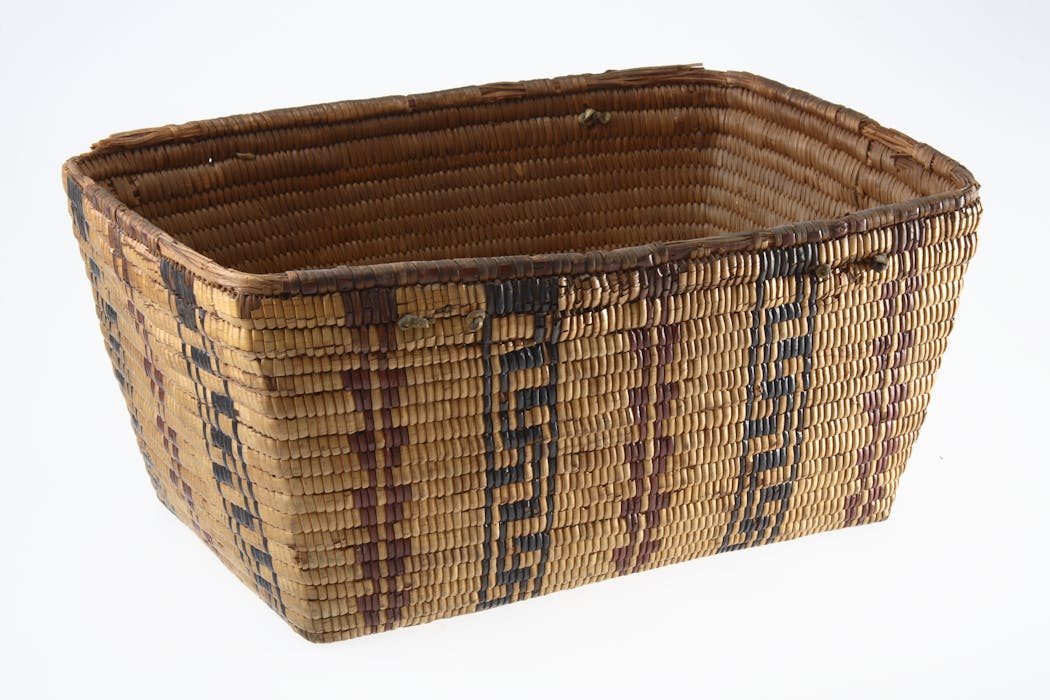
Salish Nlaka’pamux basket made of cedar or spruce root, cedar wood and hide. (McCord Museum)

The Ontario government recently announced massive cuts to Ontario Student Assistance Program (OSAP) funding, decreasing the maximum funding from 85 per cent to 25 per cent.

Student response to this has been largely negative. Speaking to the media, Ontario Premier Doug Ford said that he received “thousands of calls” from students expressing concerns. Ford’s response: telling them to invest in education that leads to in-demand jobs.

At a February news conference responding to OSAP cuts, Ford relayed that he told frustrated students: “You’re picking basket-weaving courses, and there’s not too many baskets being sold out there.” He said, instead, students should invest in their future through their program decisions — insinuating that craft curriculums hold no value in the job market. Ford mentioned trades, STEM and health-care fields as ones that would provide post-graduation employment.

As a researcher that engages with scholars specialized in the history of craft practices in Canada, alongside teaching art history courses that highlight the social, political and economic importance of fibre arts, Ford’s response is troubling and unsurprising.

Basket-weavers push back

Ford’s rhetoric demonstrates a misunderstanding of Canada’s cultural sector, basket weaving and the purpose of higher education.

In response to Ford’s comments, basket-weavers and craft organizations across the country noted the lucrative nature of their practice alongside the widely applicable skills learned through craft education.

Basket-maker Spencer Lunham Jr., of the Chippewas of Kettle and Stony Point First Nation, for example, told CBC that he sells a couple hundred baskets per year for around $150 to $3,000 each.

The prosperity of Canada’s cultural sector is backed by data from the Canadian chamber of Commerce, whose business data lab reported in October 2025 that the arts and culture sector’s GDP has grown nearly eight per cent, outpacing an overall economic growth of four per cent. In addition, the sector supports “13 jobs for every million in output, which is more than oil and gas, manufacturing or agriculture.”

Ontario is one of the provinces to see the highest economic impact from the sector, according to the report.

Winner of Sobey Art Award

Ford’s emphasis on the uselessness of craft practices is also challenged by recent winners of the Sobey Art Award, one of the most prestigious art awards in the country.

Many of the recent winners incorporate craft or craft-like practices into their work. This includes the 2017 winner of the award, Ursula Johnson,
an artist from the Eskasoni First Nation, in Cape Breton, Nova Scotia, who has an innovative basket-making practice. It seems that, at the very least, gallerists are buying baskets.

Johnson’s practice in particular highlights that — despite craft’s common framing as traditional, overly indulgent and frozen in time — basket-weaving is an innovative, adaptive and in-demand field.

As curator Heather Anderson argues in her 2021 writing on Johnson’s work: the artist utilizes weaving practices to highlight Canada’s ongoing role in colonization, and to question the contemporary museum’s implication in it.

Craft and technological innovation

A large wooden weaving loom.
Wooden Jacquard loom shown at the Museum of Science and Industry in Manchester, England.
(Wikimedia), CC BY

Craft practices have always been at the centre of technological innovation.

Some scholars contend that the inventor of the computer, Charles Babbage, was likely inspired by the Jacquard loom: a weaving machine whose invention had a profound impact on the industrial revolution in Europe.

Other writers, like journalist Brian Merchant, have recently argued that those opposed to artificial intelligence can take inspiration from the first rebellions against big tech: the 19th century Luddites who opposed the mass industrialization of weaving practices.

Illustration of a 19th century protest figure outdoors.
‘The Leader of the Luddites,’ illustration, 1812.
(Wikimedia)

From AI to the clothes we wear, weaving has shaped the contemporary global economy.

While weaving can be lucrative, members of the Toronto Guild of Spinners and Weavers noted that basket-weaving courses do not emphasize their monetary value, but rather their educational value.

Purpose of learning

This is where Ford’s real misunderstanding of education is revealed: the purpose of learning is not simply to remember and regurgitate facts, it is to problem solve, to expand our horizons and to think critically. These skills can be developed in basket-weaving courses just as well as math courses.


Read more:
Ada Lovelace’s skills with language, music and needlepoint contributed to her pioneering work in computing


Johnson, for example, says that her grandmother taught her that the maker does not manipulate the wood they use to weave, but instead the wood guides the maker. Basket weaving teaches us to listen, to collaborate and build from a strong foundation and work our way up.

TED talk with Ursula Johnson, an artist from the Eskasoni First Nation who tells the story of preserving Mi’kmaq culture through the art of basketry.

College admissions expert and counsellor Scott White, writing for Forbes Magazine, wrote in 2025 that “we need a system that prioritizes critical thinking, emotional intelligence and practical skills over rote memorization.”

He and many others who are invested in supporting young people and helping our systems change to support our society through turbulent times note that current education systems still reflects outdated ideas about the future of workers: of those in factories, rather than creative thinkers.

Pipeline to a job?

The Ford government’s approach to higher education seems to be the same — funding a system that put us on a pipeline to a job and where programs that demand critical and creative thinking are undervalued, and also, underfunded: Recent reports note that funding for Ontario’s post-secondary sector is low compared to support in other provinces.

Author Ursula K. Le Guin argued in 1986 that rather than a weapon for killing, the first human tool was likely a container: a basket or a woven net. She writes that the basket — and craft practices — are not supplemental to human survival: rather, they enable it.

Craft practices allow us to carry our culture, our belongings and our sustenance. If we focus only on the money-making schemes in society, then we lose a part of ourselves.

This is the real power of craft education: when we engage hands-on craft, we learn about our past and build problem-solving skills.

The Conversation

Victoria MacBeath receives funding from the Social Sciences and Humanities Research Council of Canada for craft history research.

ref. Actually, Doug Ford, basket-weaving is innovative and in-demand – https://theconversation.com/actually-doug-ford-basket-weaving-is-innovative-and-in-demand-276496
Failure of US-Iran talks was all-too predictable – but Trump could still have stuck with diplomacy over strikes

Source: MIL-OSI-Submissions-English

Source: The Conversation – USA – By Nina Srinivasan Rathbun, Professor of International Relations, Munk School of Global Affairs & Public Policy, University of Toronto; USC Dornsife College of Letters, Arts and Sciences

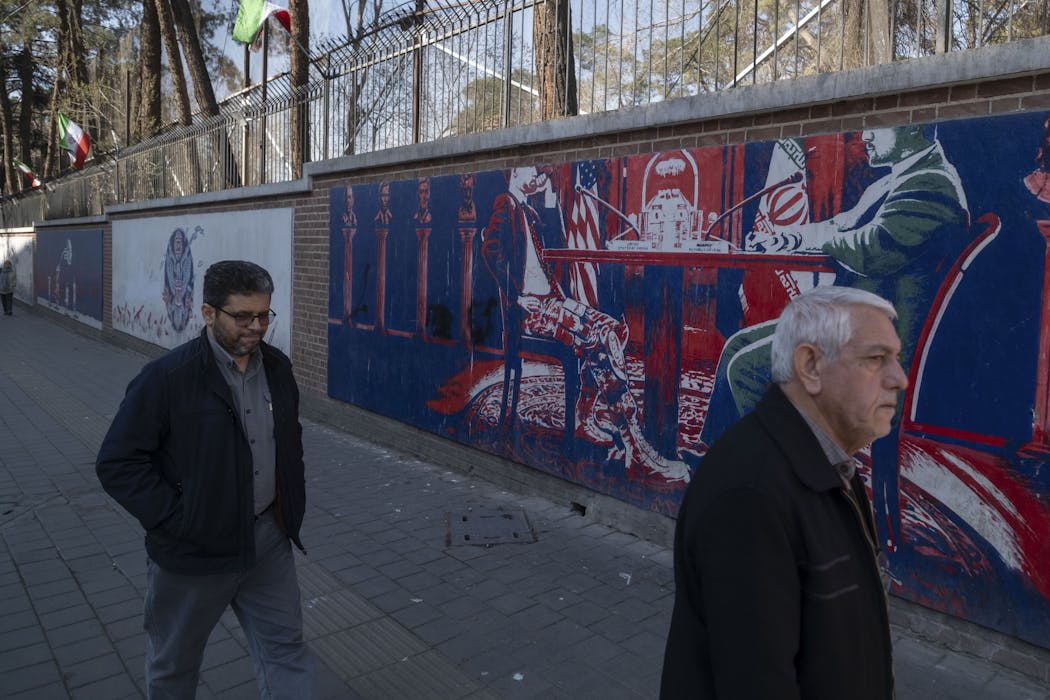
When it came to U.S.-Iran talks, the writing was on the wall. Morteza Nikoubazl/NurPhoto via Getty Images

Three rounds of nuclear talks between the U.S. and Iran failed to persuade President Donald Trump that a solution to the two country’s nuclear impasse lay in diplomacy, rather than military action. A perceived lack of progress in the last of those indirect negotiations on Feb 26, 2026, was enough to prompt Trump to green-light a massive onslaught of missiles that has degraded Iran’s offensive capabilities and killed Ayatollah Ali Khamenei and several members of Iran’s senior military leadership.

In response, Tehran has launched strikes across the Middle East, targeting Israel as well as Gulf states that host U.S. airbases. At least three Americans have been killed.

While the scale of the U.S., Israeli and Iranian strikes has taken some observers by surprise, the failure of the talks that led to them was all too predictable.

For diplomacy to be successful, both sides need to agree on the issues subject to negotiation and also believe that peaceful resolution is more valuable than military engagement. This clearly was not the case in the U.S.-Iran nuclear talks of 2025 and 2026.

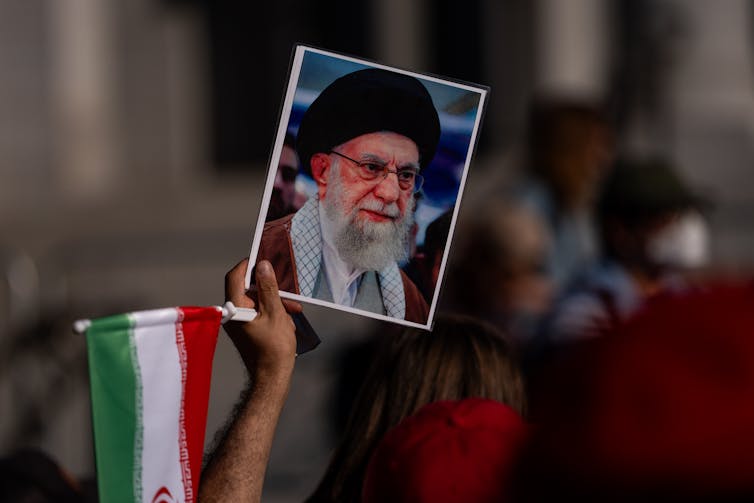
An arm holds aloft a photo of a man with a long beard.
A demonstrator holds a portrait of Ayatollah Ali Khamenei in Los Angeles on Feb. 28, 2026.
Qian Weizhong/VCG via Getty Images

As someone who has researched nonproliferation and U.S. national security for two decades and was involved in State Department nuclear diplomacy, I know that even under more favorable conditions, negotiations often fail. And the chances for success in the Iran-U.S. talks were always slim. In fact, publicly stated red lines by both sides were incompatible with each other – meaning negotiations were always likely to fail.

Iran wanted the talks confined only to guarantees about the civilian purpose of its nuclear program, not its missile program, support of regional proxy groups or human rights abuses. Essentially it wanted a return to 2015’s Joint Comprehensive Plan of Action, which halted Iran’s development of nuclear technology and stockpiling of nuclear material in exchange for lifting multiple international economic sanctions placed on Iran.

Meanwhile, Trump insisted on limits to Iran’s ballistic missiles and the cutting of Tehran’s support for regional militias. These were not included in the 2015 agreement, with parties ultimately deciding that a nuclear deal was better than the alternative of no deal at all.

False hope

Nevertheless, there had been a slim chance for a breakthrough of late.

While the positions of both the U.S. and Iranian governments had ossified since May 8, 2018 – the date when the first Trump administration withdrew the United States from the Obama-era Iran nuclear deal – there had been some recent movement by Iran, according to former U.S. diplomats involved in negotiations during the Obama and Biden administrations.

With U.S. military building up in the region, Iran appeared more willing to negotiate within the nuclear arena than before. There were plausible solutions to the issue of Iran’s enrichment of uranium capabilities, including maintaining a minimum domestic capacity to develop medical isotopes and a removal of Iran’s stockpile of enriched uranium necessary to build a nuclear bomb.

There was less openness on other points of contention. Notably, there was no movement on ballistic missiles, which had always been a red line. On the eve of the round of discussions held in Geneva on Feb. 17, Trump stated: “I think they want to make a deal.” Iran’s foreign minister, Abbas Araghchi, noted progress over the “guiding principles” of the talks.

But a lot of this optimism appeared to have dissipated by the time the two sides held another round of talks on Feb. 26. While mediator Oman’s negotiators continued to talk of progress, the U.S. side was noticeably silent. Reporting since has suggested that Trump was displeased with the way the talks had gone, setting the stage for the Feb. 28 attack.

Military brinkmanship

The threat of military action was, of course, a continued backdrop to the talks.

The USS Abraham Lincoln carrier group was deployed near Iranian waters in January as a signal of support to the Iranian protesters. The USS Gerald R Ford carrier group joined the buildup before the last round of talks.

Trump warned Iran that “if they don’t make a deal, the consequences are very steep.”

The thinking may have been that Iran, weakened by both the June 2025 U.S.-Israeli strikes and diminished capabilities of Tehran proxies Hamas and Hezbollah, was playing a weak hand in the talks.

Yet Iran also signaled a willingness to engage in military action. In the run-up to the last round of talks, Iran held military exercises and closed the Strait of Hormuz for a live-fire drill. Leaders in Tehran also declared that they would not restrain its response to another attack. The world is seeing that now, with a response that has seen Iran launch missiles across the Middle East and at rival Gulf nations.

Optimism has fallen before

Trump isn’t the first president to fail to secure a nuclear deal, although he is the first to respond to that failure with military action.

The Biden administration publicly pledged to strengthen and renew the Obama-era nuclear deal in 2021. However, Iran had significantly increased its nuclear technical capability during the years that had passed since the Joint Comprehensive Plan of Action collapsed. That increased the difficulty – just to return to the previous deal would have required Iran to give up the new technical capability it had achieved for no new benefits.

That window closed in 2022 after Iran removed all of the International Atomic Energy Agency’s surveillance and monitoring under the deal and started enriching uranium to near-weapons levels and stockpiling sufficient amounts for several nuclear weapons. The IAEA, the United Nations’ nuclear watchdog, maintains only normal safeguards that Iran had agreed to before the plan of action.

Optimism also existed for a short time in spring 2025 during five rounds of indirect talks that preceded the United States bombing Iran’s nuclear infrastructure in June as part of a broader Israeli attack.

A more unstable Middle East

When I worked in multilateral nuclear diplomacy for the U.S. State Department, we saw talks fail in 2009 regarding North Korea’s nuclear weapons program, after six years of on-and-off progress. The consequence of that failure is a more unstable East Asia and renewed interest by South Korea in developing nuclear weapons.

Unfortunately, the same dynamic appears to be playing out in the Middle East.

Military strikes have already killed more than 200 in Iran and across the region. A wider war in the Middle East is a possibility, and should the Iranian regime survive, it may commit to developing nuclear weapons given that the lack of them proved no deterrent to U.S. and Israeli military action.

Talks do not necessarily need an end point – in the shape of a deal – for them to have purpose. Under situations of increased military brinkmanship, talks could have helped the U.S. and Iran step back from the edge, build trust and perhaps develop better political relations – even if an actual deal remained out of reach.

Instead, Trump opted to go a different route.

This article includes sections originally published by The Conversation U.S. on Feb. 17, 2026.

The Conversation

Nina Srinivasan Rathbun does not work for, consult, own shares in or receive funding from any company or organization that would benefit from this article, and has disclosed no relevant affiliations beyond their academic appointment.

ref. Failure of US-Iran talks was all-too predictable – but Trump could still have stuck with diplomacy over strikes – https://theconversation.com/failure-of-us-iran-talks-was-all-too-predictable-but-trump-could-still-have-stuck-with-diplomacy-over-strikes-277209

Ayatollah Ali Khamenei has ruled Iran with defiance and brutality for 36 years. For many Iranians, he will not be revered

Source: The Conversation – Global Perspectives – By Andrew Thomas, Lecturer in Middle East Studies, Deakin University

Ayatollah Ali Khamenei, Iran’s supreme leader for 36 years, has been killed in US and Israeli airstrikes on his country, according to US President Donald Trump. Iran did not immediately confirm his death.

As one of Iran’s longest-serving leaders, Khamenei has been almost as ubiquitous in Iranian society as his predecessor, Ayatollah Ruhollah Khomeini, who founded the Islamic Republic of Iran in 1979.

And despite the fact Khomeini authored the Iranian Revolution, some say Khamenei was actually the most powerful leader modern Iran has had.

In more than three decades as supreme leader, Khamenei amassed unprecedented power over domestic politics and cracked down ever more harshly on internal dissent. In recent years, he prioritised his survival – and that of his regime – above all else. His government brutally put down a popular uprising in December 2025–January 2026 that killed thousands.

Ultimately, though, Khamenei will not be remembered by most Iranians as a strong leader. Nor will he be revered. Instead, his legacy will be the profound weakness his regime brought the Islamic Republic on all fronts.

Khamenei’s rise through the ranks

Khamenei was born in the city of Marshad in northeastern Iran in 1939. As a boy, he began to form his political and religious world view by studying at Islamic seminaries in Najaf and Qom. At 13, he started to embrace ideas relating to revolutionary Islam. These included the teachings of cleric Navab Safavi, who often called for political violence against the rule of the shah of Iran, Mohammad Reza Pahlavi.

Khamenei met Khomeini in 1958 and immediately embraced his philosophy, often referred to as “Khomeinism”.

This world view was informed by anti-colonial sentiment, Shia Islam and elements of social engineering through state planning, particularly when it came to preserving a “just” Islamic society. Khomeinism stipulates that a system of earthly laws alone cannot create a just society – Iran must draw its legitimacy from “God Almighty”.

The concept of velayat-e faqih, also known as guardianship of the jurist, is central to Khomeinism. It dictates that the supreme leader should be endowed with “all the authorities that the Prophet and infallible Imams were entitled”.

Essentially, this means Iran was to be ruled by a single scholar of Shia Islam. This is where Khomeini, and later Khamenei, would draw their sweeping power and control.

From 1962, Khamenei began almost two decades of revolutionary activity against Pahlavi (the shah) on behalf of Khomeini, who was exiled in 1964. Khamenei was arrested by the shah’s secret police in 1971 and tortured, according to his memoirs.

When the shah was overthrown in the Islamic Revolution in 1979, Khomeini returned from exile to become the new supreme leader.

Khamenei was selected to join the Revolutionary Council, which ruled alongside the provisional government. He then became deputy defence minister and assisted in organising the Islamic Revolutionary Guard Corps (IRGC). This military institution – initially created to protect the revolution and supreme leader – would become one of the most powerful political forces in Iran.

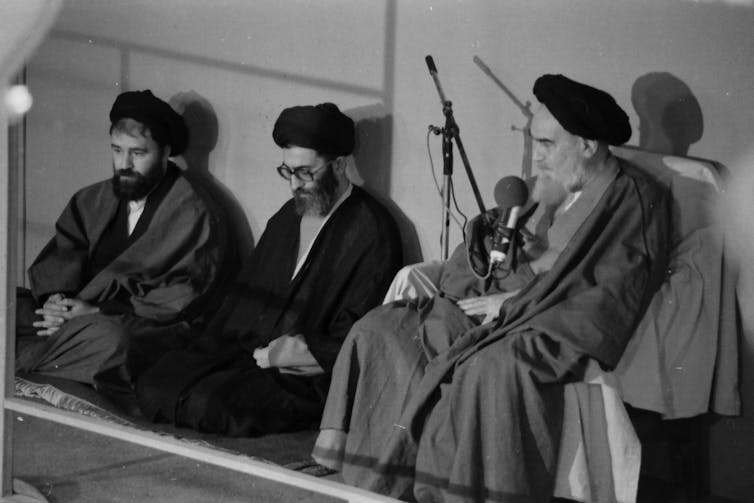
Ayatollah Ruhollah Khomeini (sitting on chair), Ali Khamenei (middle), and Khomeini’s son, Ahmad Khomeini (left), pictured in 1981.
Wikimedia Commons

After surviving an assassination attempt in 1981, Khamenei was elected president of Iran in 1982 and again in 1985. He held the presidency during the majority of the Iran–Iraq war – a conflict that devastated both countries in both human and economic cost.

Although subordinate to the supreme leader, Khamenei wielded significant power compared to later presidents, given the revolution was still very young and the Iraq war posed a great threat to the regime. But he remained in lock-step with Khomeini’s wishes. He also managed to build a close relationship with the IRGC that would go far beyond his presidency.

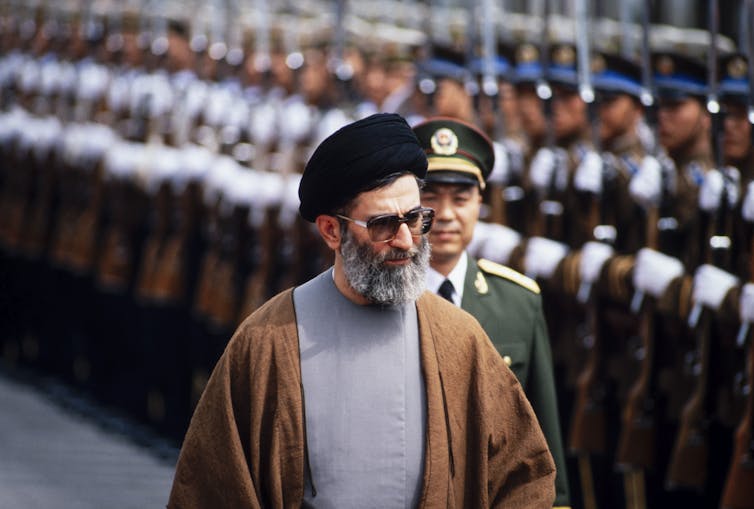
Then-President Ali Khamenei during a state visit to China in May 1989.
Forrest Anderson/Getty Images

A surprising choice for supreme leader

Khomeini died in June 1989 after a period of deteriorating health, with no clear successor.

Khomeini had initially supported Grand Ayatollah Hossein-Ali Montazeri to be his successor. However, Montazeri had become increasingly critical of the supreme leader’s authority and human rights violations in the country. He resigned in 1988 and was put under house arrest until his death in 2009.

Khamenei had the political credentials to lead. He was also a steadfast support of Khomeinism. However, he was seen a surprising choice for supreme leader when he was elected by the Assembly of Experts, a group of Islamic clerics.

In fact, his appointment sparked a significant amount of controversy and criticism. Some Islamic scholars believed he lacked the clerical rank of grand ayatollah, which was required under the constitution to ascend to the position. These critics believed the Iranian people would not respect the word of “a mere human being” without a proper connection to God.

A referendum was held in July 1989 to change the constitution to allow for a supreme leader who has shown “Islamic scholarship”. It passed overwhelmingly and Khamenei became an ayatollah.

Khamenei’s position had been consolidated on paper, but despite being president since 1982, he did not enjoy the same popularity as Khomeini within both the clerical elite and general public.

The constitutional amendments, however, had given Khamenei significantly more power to intervene in political affairs. In fact, he had far more power as supreme leader than Khomeini ever enjoyed.

This included the ability to determine general policies, appoint and dismiss members of the Council of Guardians, and order public referendums. He also had enough power to silence dissent with relative ease.

Consolidating power over the decades

Khamenei worked with his presidents to varying degrees, though he exercised his power to undermine legislation when he disagreed with it.

For example, he largely backed the economic agenda of President Hashemi Rafsanjani (who served from 1989 to 1997), but he often stood in the way of Mohammad Khatami (1997–2005) and Hassan Rouhani (2013–21). Both had attempted to reform Iran’s political system and foster a better relationship with the West.

Khamenei’s most famous intervention in domestic politics occurred after the first term of President Mahmoud Ahmadinejad (2005–13). After Ahmadinejad claimed victory in the disputed 2009 presidential election, thousands of Iranians took to the streets in one of the largest protest movements since the revolution. Khamenei backed the election result and cracked down harshly on the protesters. Dozens were killed (perhaps more), while thousands were arbitrarily arrested.

Khamenei later clashed with Ahmadinejad and warned him against seeking the presidency again in 2017. Ahmadinejad defied him, but was later barred from running.

After the death of hardline President Ebrahim Raisi in a helicopter crash in 2024, Khameini continued his manoeuvring behind the scenes. After the reformist Masoud Pezeshkian won the presidency, Khameini immediately blocked him from negotiating with the United States over sanctions relief and used his influence to thwart his economic reform agenda.

And when protests again broke out at the end of 2025 over the struggling economy, Khamenei again ordered them to be crushed by any means necessary.

A tarnished legacy

Thanks to the powers vested in him in the constitution, Khamenei also had extraordinary control over Iran’s foreign policy.

Like his mentor, Khomeini, he staunchly supported the regime’s resistance to what it considered “Western imperialism”. He was also a key architect of Iran’s regional proxy strategy, funding militant groups like Hezbollah, Hamas, the Houthis and others to carry out Iran’s military objectives.

Khamenei had, at times, been amenable to cooperation with the West – namely negotiating with the US over Iran’s nuclear enrichment program.

During the first Trump administration, however, Khamenei returned to a staunchly anti-Western posture. His government railed against Trump’s scuttling of the 2015 nuclear deal, the reimposed economic sanctions on Iran’s energy sector and the assassination of the head of the IRGC’s Quds force, Qassem Soleimani.

After Trump returned to office in 2025, Iran grew even weaker. And Khamenei’s anti-Western posture began to look increasingly hollow. Iran’s defeat in the 12-day war with Israel in 2025 shredded whatever legitimacy his regime had left.

In the months that followed, Khamenei ruled over a population increasingly resentful of the Iranian political system and its leadership. In the 2025–26 protests, some openly chanted for Khamenei’s death.

When Khomenei died in 1989, his state funeral was attended by millions. Mourners pulled him out of his coffin and scrambled for sacred mementos.

Though Khameini served longer, Iranians will likely not show the same grief for him.

The Conversation

Andrew Thomas does not work for, consult, own shares in or receive funding from any company or organisation that would benefit from this article, and has disclosed no relevant affiliations beyond their academic appointment.

ref. Ayatollah Ali Khamenei has ruled Iran with defiance and brutality for 36 years. For many Iranians, he will not be revered – https://theconversation.com/ayatollah-ali-khamenei-has-ruled-iran-with-defiance-and-brutality-for-36-years-for-many-iranians-he-will-not-be-revered-259268

Massive US attacks on Iran unlikely to produce regime change in Tehran

Source: The Conversation – USA – By Donald Heflin, Executive Director of the Edward R. Murrow Center and Senior Fellow of Diplomatic Practice, The Fletcher School, Tufts University

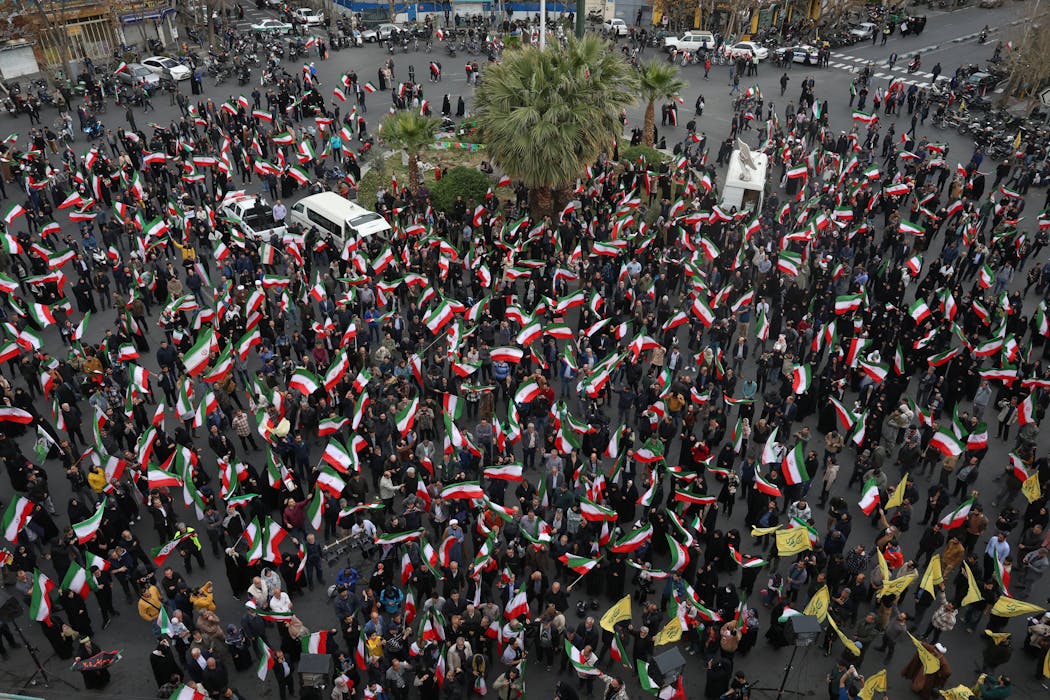
A group of demonstrators in Tehran wave Iranian flags in support of the government on Feb. 28, 2026 AP Photo/Vahid Salemi

After the largest buildup of U.S. warships and aircraft in the Middle East in decades, American and Israeli military forces launched a massive assault on Iran on Feb. 28, 2026.

President Donald Trump has called the attacks “major combat operations” and has urged regime change in Tehran.

To better understand what this means for the U.S. and Iran, Alfonso Serrano, a U.S. politics editor at The Conversation, interviewed Donald Heflin, a veteran diplomat who now teaches at Tufts University’s Fletcher School.

Widespread attacks have been reported across Iran, following weeks of U.S. military buildup in the region. What does the scale of the attacks tell you?

I think that Trump and his administration are going for regime change with these massive strikes and with all the ships and some troops in the area. I think there will probably be a couple more days’ worth of strikes. They’ll start off with the time-honored strategy of attacking what’s known as command and control, the nerve centers for controlling Iran’s military. From media reporting, we already know that the residence of Supreme Leader Ayatollah Ali Khamenei was attacked.

What is the U.S. strategic end game here?

Regime change is going to be difficult. We heard Trump today call for the Iranian people to bring the government down. In the first place, that’s difficult. It’s hard for people with no arms in their hands to bring down a very tightly controlled regime that has a lot of arms.

The second point is that U.S. history in that area of the world is not good with this. You may recall that during the Gulf War of 1990-1991, the U.S. basically encouraged the Iraqi people to rise up, and then made its own decision not to attack Baghdad, to stop short. And that has not been forgotten in Iraq or surrounding countries. I would be surprised if we saw a popular uprising in Iran that really had a chance of bringing the regime down.

Several men wave flags in front of a building.
A group of men wave Iranian flags as they protest U.S. and Israeli strikes in Tehran, Iran, on Feb. 28, 2026.
AP Photo/Vahid Salemi

Do you see the possibility of U.S. troops on the ground to bring about regime change?

I will stick my neck out here and say that’s not going to happen. I mean, there may be some small special forces sent in. That’ll be kept quiet for a while. But as far as large numbers of U.S. troops, no, I don’t think it’s going to happen.

Two reasons. First off, any president would feel that was extremely risky. Iran’s a big country with a big military. The risks you would be taking are large amounts of casualties, and you may not succeed in what you’re trying to do.

But Trump, in particular, despite the military strike against Iran and the one against Venezuela, is not a big fan of big military interventions and war. He’s a guy who will send in fighter planes and small special forces units, but not 10,000 or 20,000 troops.

And the reason for that is, throughout his career, he does well with a little bit of chaos. He doesn’t mind creating a little bit of chaos and figuring out a way to make a profit on the other side of that. War is too much chaos. It’s really hard to predict what the outcome is going to be, what all the ramifications are going to be. Throughout his first term and the first year of his second term, he has shown no inclination to send ground troops anywhere.

Speaking of President Trump, what are the risks he faces?

One risk is going on right now, which is that the Iranians may get lucky or smart and manage to attack a really good target and kill a lot of people, like something in Jerusalem or Tel Aviv or a U.S. military base.

The second risk is that the attacks don’t work, that the supreme leader and whoever else is considered the political leadership of Iran survives, and the U.S. winds up with egg on its face.

The third risk is that it works to a certain extent. You take out the top people, but then who steps into their shoes? I mean, go back and look at Venezuela. Most people would have thought that who was going to wind up winning at the end of that was the head of the opposition. But it wound up being the vice president of the old regime, Delcy Rodríguez.

I can see a similar scenario in Iran, if Khamenei and a couple of other leaders were taken out. But the only institution in Iran strong enough to succeed them is the army, the Revolutionary Guards in particular. Would that be an improvement for the U.S.? It depends on what their attitude was. The same attitude that the vice president of Venezuela has been taking, which is, “Look, this is a fact of life. We better negotiate with the Americans and figure out some way forward we can both live with.”

But these guys are pretty hardcore revolutionaries. I mean, Iran has been under revolutionary leadership for 47 years. All these guys are true believers. I don’t know if we’ll be able to work with them.

Smoke rises over a city center.
Smoke rises over Tehran on Feb. 28, 2026, after the U.S. and Israel launched airstrikes on Iran.
Fatemeh Bahrami/Anadolu via Getty Images

Any last thoughts?

I think the timing is interesting. If you go back to last year, Trump, after being in office a little and watching the situation between Israel and Gaza, was given an opening, when Israeli Prime Minister Benjamin Netanyahu attacked Qatar.

A lot of conservative Mideast regimes, who didn’t have a huge problem with Israel, essentially said “That’s going too far.” And Trump was able to use that as an excuse. He was able to essentially say, “Okay, you’ve gone too far. You’re really taking risk with world peace. Everybody’s gonna sit at the table.”

I think the same thing’s happening here. I believe many countries would love to see regime change in Iran. But you can’t go into the country and say, “We don’t like the political leadership being elected. We’re going to get rid of them for you.” What often happens in that situation is people begin to rally around the flag. They begin to rally around the government when the bombs start falling.

But in the last few months, we’ve seen a huge human rights crackdown in Iran. We may never know the number of people the Iranian regime killed in the last few months, but 10,000 to 15,000 protesters seems a minimum.

That’s the excuse Trump can use. You can sell it to the Iranian people and say, “Look, they’re killing you in the streets. Forget about your problems with Israel and the U.S. and everything. They’re real, but you’re getting killed in the streets, and that’s why we’re intervening.” It’s a bit of a fig leaf.

Now, as I said earlier, the problem with this is if your next line is, “You know, we’re going to really soften this regime up with bombs; now it’s your time to go out in the streets and bring the regime down.” I may eat these words, but I don’t think that’s going to happen. The regime is just too strong for it to be brought down by bare hands.

The Conversation

Donald Heflin does not work for, consult, own shares in or receive funding from any company or organization that would benefit from this article, and has disclosed no relevant affiliations beyond their academic appointment.

ref. Massive US attacks on Iran unlikely to produce regime change in Tehran – https://theconversation.com/massive-us-attacks-on-iran-unlikely-to-produce-regime-change-in-tehran-277180