Could joining the state sector be an option for private schools?

Source: The Conversation – UK – By Tilly Clough, Lecturer in Law, Queen’s University Belfast

Molodid Studio/Shutterstock

Private schools in England are facing new financial realities. Following the UK general election in July 2024, the new government introduced VAT on school fees and removed charitable business rates relief for independent schools. At the same time, staffing costs have continued to rise. Employer national insurance contributions have increased, and the national minimum wage has risen.

For some schools – particularly smaller institutions with limited endowments or declining enrolments – this has raised questions about their sustainability.

Although the full impact of these funding changes remains to be seen, they have intensified concerns about sustainability within parts of the independent sector and raised broader questions about reform.

One viable yet underexplored option is the conversion of private schools to the state sector.

Although still relatively rare, a small number of independent schools have taken this route over the past two decades. In a new report, commissioned by thinktank the Private Education Policy Forum, my colleague Tom Richmond and I have carried out the first comprehensive analysis of what happens when independent schools become state schools in England.

Between 2007 and 2017, 27 independent schools converted into state-funded academies or free schools. Twenty-four are still operating today. While the legal route from independent to state provision technically still exists, it has largely fallen out of use, with no conversions taking place since 2017. Independent to state conversion is therefore often overlooked in debates about the future of private education.

Conversion is often viewed as a last resort taken only by schools in serious financial trouble. However, while financial pressures were relevant to many of the schools that converted between 2007 and 2017, they were not the whole story. Schools have also framed conversion as a way to return to their founding missions, which were often explicitly about inclusion and serving local communities rather than educating a fee-paying intake.

The transition itself was not straightforward. Schools reported significant challenges in adapting to the expectations of the state sector. These included the loss of academic selection, the requirement to deliver the national curriculum, and regular inspections by Ofsted, England’s school inspectorate. Many also highlighted the absence of clear guidance from government on key aspects of the conversion process.

In practical terms, this meant that schools which had previously operated with considerable autonomy had to adjust to a far more regulated environment. In some cases, early Ofsted inspections highlighted weaknesses in data use, governance and oversight as schools adjusted to the demands of state accountability.

However, these difficulties were not permanent. Over time, outcomes improved markedly. All but one of the schools that converted and remained open are now rated “good” or “outstanding” by Ofsted.

Former independent primary schools perform at broadly similar levels than other schools in their local authorities. Former independent secondary schools generally achieve stronger attainment and progress outcomes than nearby state schools, though performance varies. Initial adjustment challenges, in other words, did not prevent long-term success.

The consequences – and the future

One of the most significant changes following conversion is in pupil intake.

Removing academic selection and fees transformed who these schools serve. Since conversion, the proportion of pupils with special educational needs has more than doubled. The share eligible for free school meals has risen sharply.

Children on school staircase
There are challenges in moving to the state sector.
Monkey Business Images/Shutterstock

Research has shown that while these schools do not perfectly mirror the national state school population, the gap between them and their local communities has narrowed dramatically.

In many cases, they are far more representative of their surrounding areas than they were as independent institutions. Conversion does not simply change how a school is funded. It can reshape who benefits from its facilities and educational offer.

A common concern is that families will withdraw their children once fees are removed. In practice, this rarely appears to have happened at scale.

Consultation evidence and enrolment patterns show that large majorities of parents supported the move, particularly because it eliminated fees and provided financial certainty. Where schools were required to demonstrate parental demand, applications frequently exceeded available places. Widespread collapse in enrolment – a frequently voiced fear – did not materialise.

Conversion to the state sector is not a solution for every school. Local context matters. The availability of places, building condition and leadership capacity all shape whether conversion is viable. But, the experience of the past two decades suggests that, where carefully managed, conversion can preserve provision, widen access and deliver strong outcomes.

As debates about school funding and the future of private education continue, independent to state conversion is likely to resurface.

If the route is to become viable again, greater clarity is necessary. A clear and permanent pathway – assessed case by case and aligned with local need – would reduce uncertainty. Drawing on the more flexible elements of earlier academy reforms and providing practical support during transition could make the process more workable.

The Conversation

This report was commissioned by the Private Education Policy Forum.

ref. Could joining the state sector be an option for private schools? – https://theconversation.com/could-joining-the-state-sector-be-an-option-for-private-schools-275132

Networking can boost your earnings and get you promoted – but it’s harder for women to reap the benefits

Source: The Conversation – UK – By Andrew Kloeden, PhD Candidate in Management, University of Exeter

PeopleImages/Shutterstock

For many workers, the benefits of professional relationships and the networks they create are clear. Bringing together people and social spheres that are otherwise unconnected is linked to higher salaries and more rapid promotion. So it’s no surprise that “networking” is a serious business for so many professionals.

In network theory, the process of linking unconnected people and groups – either within the workplace or outside it – is known as “brokerage”. When you’re a broker, your networks are “open”, with lots of links to unconnected people. All these connections give brokers access to potentially useful information – after all, people who don’t know each other are likely to know different things.

And continued networking, where more new relationships are generated over time, is important to maintain the benefits. Otherwise, networks can grow stale. Being close to the “centre” of the network (having more network ties) brings additional benefits in terms of access to knowledge, information and resources.

But as in many other aspects of life, gender is a fundamental force in terms of professional relationships and the structure of professional networks. It may come as little surprise that women face disadvantages compared to men – both in the positions they hold within networks and the characteristics of their contacts.

For example, women’s networks tend to contain fewer men. Men still hold more positions of power than women in organisations, which leaves women with fewer senior-level connections. Women also tend to find themselves closer to the edge than the centre of organisational networks. Separately, they are less likely to be brokers.

Women’s networks also tend to be “stickier” – where old ties are less likely to be replaced with new ones. These new ties can help to keep the access to information fresh. What’s more, women tend to receive lower returns from the positions they occupy in their networks. For example, even when women are brokers they tend not to enjoy the benefits that can lead to rapid promotion in the way that men might.

The root of the problem

There are many reasons for these disadvantages. First, women usually carry a greater burden of unpaid domestic caring work than men in heterosexual couples (the so-called “second shift”). This can eat up the time that women could otherwise use investing in professional networks. It’s even more acute for mothers or the (mostly) women who care for adult relatives.

Second, the stereotypes of “assertive” men and “communal” women have an effect on organisational networks. Women who occupy strong network positions may not conform to this stereotype of co-operation and communality, which might be frowned upon. For the same reason, men are often seen as more legitimate or useful networking partners.

This also explains why women tend to feel “stereotype threat” (where people fear living up to negative stereotypes) when they are brokers. They may be sensitive to being seen negatively for violating this stereotype.

a woman crouches down to greet two children coming out of school.
The ‘second shift’ can make it harder to find the time for networking.
Kzenon/Shutterstock

Similarly, homophily (the tendency for people to form relationships with those they see as similar to themselves) can harm women’s network position and the returns they get, especially in organisations with more men than women. In these situations, women can miss out on senior-level connections (who are more likely to be men). Or they may just end up with smaller networks.

While all women face barriers to network success, there are strategies that can help them to overcome these. Successful women tend to embrace network churn by keeping a core group of contacts but otherwise strategically changing their professional networks. This can help to keep contacts fresh.

And the most successful women have been shown to resist the temptation to focus purely on social support from their contacts. Instead (or in addition), they seek more strategic support – things like introductions and information.

Of course, these strategies all involve women doing extra work to navigate environments that were not built for them. So it is important for employers to take steps to mitigate these problems. This can also help organisations retain staff, and it can help to tackle other workplace problems related to gender biases.

It doesn’t have to be difficult. Employers can structure teams or committees to increase opportunities for interaction between women and senior men. They can also run surveys to map the social networks in their organisations to identify exclusion and disadvantage. Lastly, they can educate senior staff and executives about the issues.

Ultimately, everyone should understand the importance of networking to an employee’s prospects and how they can help to share out the benefits equally.

The Conversation

Andrew Kloeden does not work for, consult, own shares in or receive funding from any company or organisation that would benefit from this article, and has disclosed no relevant affiliations beyond their academic appointment.

ref. Networking can boost your earnings and get you promoted – but it’s harder for women to reap the benefits – https://theconversation.com/networking-can-boost-your-earnings-and-get-you-promoted-but-its-harder-for-women-to-reap-the-benefits-276315

Thousands of dead puffins are washing up on Europe’s beaches – why it’s been such a dangerous winter for seabirds

Source: The Conversation – UK – By Ruth Dunn, Senior Research Associate in Marine Ecology, Lancaster University

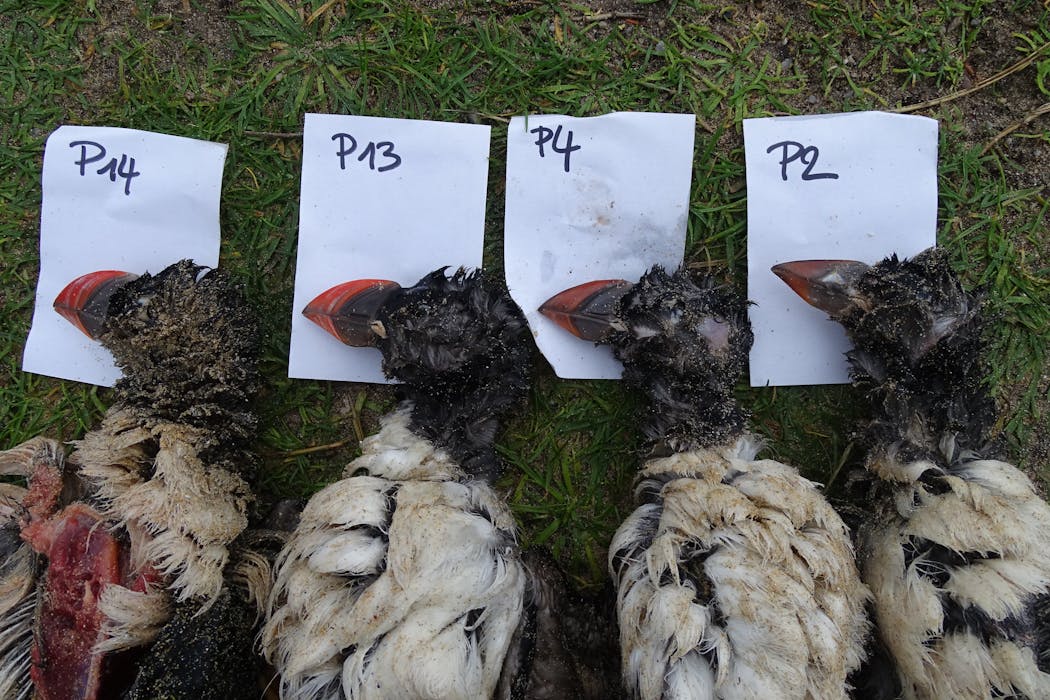
Puffins are dying from starvation due to recent storms. Bernard Cadiou, CC BY-ND

February 2026 has seen thousands of dead seabirds washing up along the coastlines of the UK, France, Spain and Portugal.

There’s evidence that these “wrecks” (where large numbers of seabirds are found along beaches) are becoming increasingly common because of climate change. Worse still, these dead birds – including Atlantic puffins and European shags – only tell a fraction of the story. Many more are likely to have been lost out in the stormy open ocean.

Even as someone who has dedicated the last decade of my life to researching seabirds, I have found myself beginning to feel desensitised to the increasingly regular news of these dead birds found in great numbers. Current estimates are high: over 20,000 birds swept up along beaches in France alone since mid January.

Seabirds’ bodies are also being found on beaches along the the North Sea, off the southern coast of Ireland and the Bay of Biscay.

Although increasing temperatures are perhaps the most well-known consequence of human-induced climate change, increased storm frequencies and intensities are another critical symptom.

A number of storms have swept across Europe so far this year. Storm Chandra poured down over the UK and other parts of Europe in late January, while six further named storms blew across Portugal, Spain and France in quick succession throughout February. Looking at the evidence, it is possible that this ensemble of storms concocted a lethal cocktail of conditions for wintering seabirds, by creating multiple wreck events over a short amount of time.

The back-to-back barrage of storms this winter has provided little respite for seabirds that must struggle with strong winds, torrential rain and high seas, desperately hungry but apparently unable to feed. The bodies of birds washed up in wreck events are skinny and their muscles are very hard (indicated by high levels of lactate). Despite paddling hard amongst the waves, they were unable to catch enough prey to survive.

Studying survival

The Isle of May Long-Term Study, led by the UK Centre for Ecology and Hydrology, has been monitoring seabirds since 1973, making it one of the most data-rich studies of its kind.

This monitoring includes looping small metal rings, engraved with unique identification codes, around the legs of seabirds. These rings allow corpses to be traced back to the Isle of May, off the east coast of Scotland, or other seabird colonies where seabird ringing takes place.

Every year, the Isle of May team deal with these reports and use them to understand seabird deaths and survival rates. In 2026, Josie Hewitt, an expert in avian ecology, has received more than usual: 33 dead shags and nine dead puffins throughout February.

Among these numbers are birds that survived the avian flu outbreak in 2022-23, and the stormy 2023-24 winter, making these reports even more heartbreaking.

Seabird colonies are often home to thousands of birds during the breeding season – too many to ring. Many more that don’t have these rings are also being found. Others swallowed by the waves may never be recovered.

In winter, seabirds must forage intensively to catch enough prey to survive the cold, while also building up reserves for the approaching breeding season. Many are therefore experts at navigating the underwater marine environment.

Puffins flap their wings to move through the water to chase fish, while shags propel themselves by thrusting their feet.

However, when bad weather hits, seabirds can struggle. Even during their summer breeding seasons, when storms are less common and less severe, they are more reluctant to forage in high winds, struggling to capture prey in churned-up waters.

Populations in crisis

Seabirds live for a long time (one victim of the current wreck was a 34-year-old puffin) and only breed once a year, meaning their populations rely on adults surviving. These huge numbers of deaths can therefore have a long-term impact on population trends.

This is especially true when adult birds, which are generally better at surviving winters than juveniles, are among the casualties. Worse still, these events are happening increasingly regularly, with less time to recover in between.

When I stayed on the Isle of May last summer, there was an eerie quietness along large stretches of the island’s rocky borders. During previous visits, I had become used to sharing the island with more than 500 noisy, smelly pairs of breeding shags – each pair taking great care of their oversized nests, gently shifting broken twigs and fronds of seaweed into the perfect position with their beaks.

Though widely considered less charismatic than the puffins that strut around clumps of grass and sea campion, proudly displaying beaks full of silver fish, fierce-looking shags have a beauty too – with their shining black plumage, piercing green eyes and prehistoric-looking webbed feet.

The Isle of May shag population declined to a fraction of its previous size following the storms of winter 2023-24, and is being hit again by this year’s storms. It’s devastating to think just how few of these birds might be on the island this summer.

It is disappointing that at a time when our seabirds are facing unprecedented threats to their survival, scientific funding is becoming increasingly squeezed in the US and the UK. Continuation of long-term studies such as the one on the Isle of May is crucial to understanding the impacts of climate change on our seabirds.

The Conversation

Ruth Dunn has previously received funding from NERC.

ref. Thousands of dead puffins are washing up on Europe’s beaches – why it’s been such a dangerous winter for seabirds – https://theconversation.com/thousands-of-dead-puffins-are-washing-up-on-europes-beaches-why-its-been-such-a-dangerous-winter-for-seabirds-276545

Tiny recording backpacks reveal bats’ surprising hunting strategy

Source: The Conversation – USA – By Leonie Baier, Postdoctoral Fellow in Behavioral Biology, Naturalis Biodiversity Center

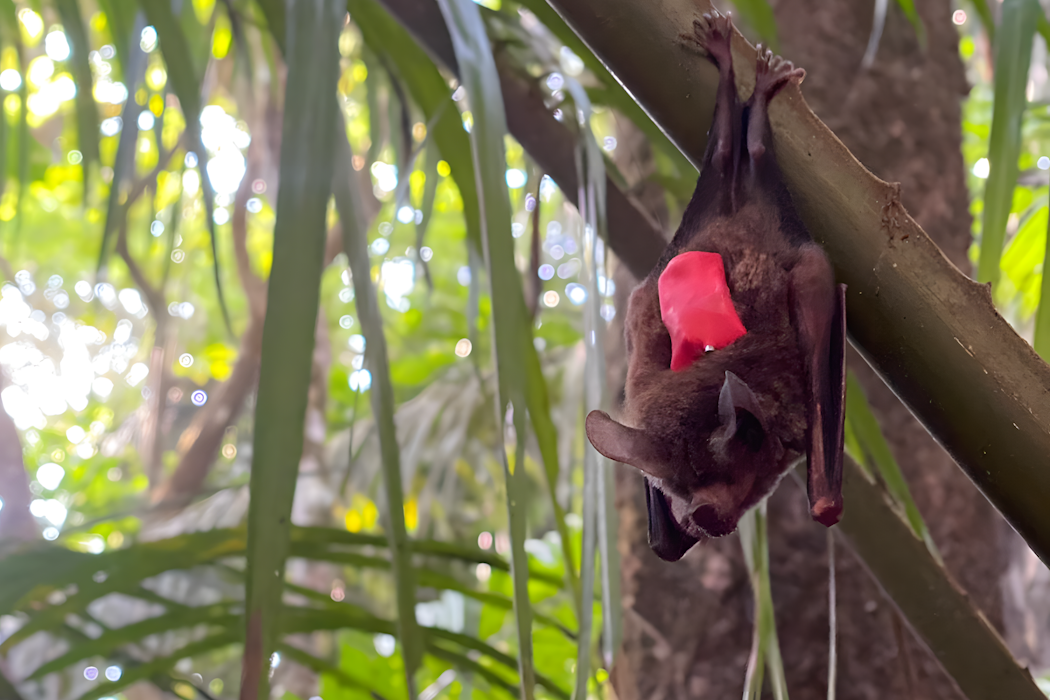
A fringe-lipped bat carries a sound-and-movement biologging tag. Leonie Baier, CC BY-SA

Deep into the Panamanian night, the forest hums with sound. Chirping insects form a steady backdrop, rain softly trickles from leaves. Somewhere above a stream, frogs call into the darkness.

But I am not there to see this scene.

It’s already passed. What I hold now is a small, mud-smeared biologger, no larger than a Lego brick. This tag recorded the sounds of the previous night.

Three people wearing headlamps seated on the ground tagging bats at night.
Deep in the jungle of Soberanía National Park, researchers Gregg Cohen, Leonie Baier and Sebastian Mortensen process fringe-lipped bats under red-light headlamps. The nonintrusive light minimizes disturbance as the team weighs, measures and assesses each bat before tagging it.
Imran Razik, Smithsonian Tropical Research Institute, CC BY-SA

The evening before, my team and I had set nets outside the roosts – hollow trees or human-made structures such as tunnels or bunkers – where fringe-lipped bats (Trachops cirrhosus) sleep during the day. Under the faint glow of red headlamps, we weighed each bat we caught on its way out of the roost, checked its age and sex, and carefully glued a tiny tag to the fur between its shoulder blades.

When we released a tagged bat into the darkness, it vanished into the trees, carrying our recorder into the night.

The researchers carefully release the tagged bats into the night. Credit: Eric de Framond

Within a few days, the tags either fell off naturally or I gently removed them from recaptured bats with a quick trim of fur. Each biologger captured five to six hours of continuous sound and movement data – every flight, every attack, every crunch of prey bones between sharp teeth.

For the first time, I could follow a predator through the forest from its own point of view. And what those recordings revealed surprised me: Our fringe-lipped bats don’t simply grab the first thing they detect. Instead, they stalk the forest’s creatures with a patience and precision I hadn’t expected.

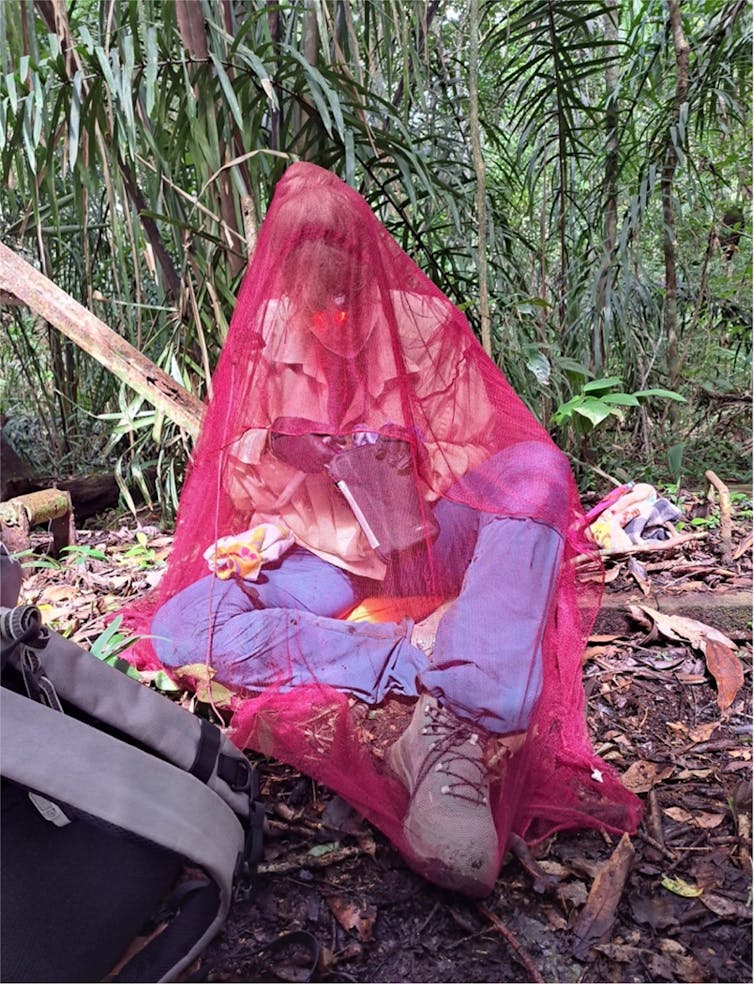
Person seated on forest floor wrapped in a mosquito net
Once a bat is recaptured, no chances are taken that it might fly off with its precious load – the biologger holding all the data – still attached. Here, Leonie Baier works under a mosquito net to safely remove the tag before releasing the bat, tag-free.
Eric de Framond, Smithsonian Tropical Research Institute, CC BY-SA

Tiny tags for tiny hunters

I’m a behavioral ecologist, and fringe-lipped bats have been part of my scientific life for years, through my work with animal behavior researcher Rachel Page at the Smithsonian Tropical Research Institute in Panama. In our recent study published in the journal Current Biology, we paired decades of field knowledge with miniature biologging technology, allowing us to accompany the bats through the night.

When I plug a tag into my laptop, I follow that journey in sound and movement. Through my headphones, I hear a familiar note. A túngara frog (Engystomops pustulosus) calls; that distinctive “whiiiiine-chuck-chuck” I know so well.

A túngara frog calls, looking for a mate. Credit: Leonie Baier

On my screen, the line charting the bat’s motions stirs: a tremor of movement, then a sharp burst of wingbeats. At the same time, the audio trace fills with a rapid series of ultrasonic echolocation calls, the staccato sound of a hunter steering through darkness. In my ears, a rush of air surges past the tiny microphone, then there’s a splash, more wingbeats, and finally the faint, wet crunching of teeth. A few minutes later, it’s over.

The bat has eaten the frog. I smile; we’ve studied this bat for so many years, the data matches what we have observed in the laboratory. But now, for the first time, I can hear how the hunt unfolds in the wild.

Biologger recording of a bat catching a frog from flight.
Leonie Baier434 KB (download)

I scroll further in my recording.

A new sequence begins, but this time there are no frog calls. No sound to guide a strike. Just a sudden rush of air, a violent rustling, and then the unmistakable sounds of a fight thrash through my headphones: wings flapping, claws scraping, and the harsh cries of a prey animal fighting to survive.

Biologger recording of a bat attacking its protesting prey.
Leonie Baier297 KB (download)

Eventually – silence.

For a long moment, I hear only the sounds of the forest. Then again, the beat of wings. The bat is flying once more. It lands. And then comes that telltale sound again – slow, steady and deliberate. The bat is eating its catch.

Five minutes pass. Ten. Twenty. The chewing stops. The motion trace falls flat. As the night drifts on, nothing moves. The bat has fallen asleep.

Much later, the silence breaks. A quick shudder, a few brief pulses of echolocation: The bat is awake again. But it doesn’t fly off. It starts chewing again. And again. In the end, I count a total of 84 minutes of chewing, spread out across several bouts. Whatever this tiny bat caught, it was nothing like the quick frog meal I’d heard before.

Size of predator usually matches size of prey

In the animal kingdom, size usually dictates strategy.

Large lions, wolves and polar bears chase prey nearly their own size, at enormous costs: hours of stalking, bursts of sprinting and long fasts between meals. Their energy reserves let them weather failure after failure until finally a single successful kill restores the balance.

Small predators live by different rules. The tiny bodies of weasels, shrews and bats burn energy so fast that skipping even one meal can mean starvation. For bats, the demands of powered flight push those costs even higher. So they hunt small, abundant prey: quick, low-cost meals that keep the metabolic fire burning.

On average, the bats we tracked made around seven attacks per night and succeeded roughly half the time. Hearing that more-than-one-hour-long chewing episode recorded on the biologger left me astonished. Was this individual bat just an exceptionally slow eater? Or had it taken down something very large?

In the flight cage, a fringe-lipped bat (Trachops cirrhosus) feeds on a túngara frog. Under controlled conditions, researchers can observe its feeding behavior in detail: The bat holds its prey in its jaws, braced by one or both thumb claws, and methodically gnaws until only the gallbladder is left uneaten. Credit: Joseph See, Smithsonian Tropical Research Institute

To find out, I turned to a feeding experiment I had run in captivity, where I measured how long bats chewed prey of known weights. That calibration allowed me to translate chewing time in the wild into meal size. I discovered that most prey weighed around 2 grams, about 7% of a bat’s body mass. But some meals were far larger, reaching up to 30 grams – nearly the bat’s own weight.

How can a creature so small, with so little energy to spare, afford to hunt like a lion?

Listening to dinner

Our bats’ style of hunting is close to that of lions or polar bears, but the efficiency of their hunts sets the bats apart from any large predator. After leaving the roost at dusk, they spent just over five minutes flying in total before making their first attack. So rather than spending the whole night in search on the wing, they flew only about 11% of the time – less than half an hour over five hours of recording.

How could they find their meals so quickly? The answer lies in their extraordinary ears.

Fringe-lipped bats are masters of acoustic espionage. Instead of using echolocation alone to detect their prey, they eavesdrop on the sounds that frogs and other animals make. A túngara frog’s distinctive “tuuuuungara,” for example, carries through the forest and serves as a perfect beacon for a hungry bat.

Trachops splashing while catching a tungara frog from a pond
The fringe-lipped bat (Trachops cirrhosus) splashes while catching a túngara frog from a pond in the rainforest in Panama.
Grant Maslowski, CC BY-SA

Our recordings show that attacks were eight to 12 times more likely when frog calls were present. Strikes launched from flight clustered near loud choruses, while nearly all attacks from perches occurred in silence.

The bats have a dual ambush strategy. They launch strikes from the air when prey are advertising themselves. When the forest falls quiet, they hang almost motionless from branches to listen for subtler cues, sweeping the scene with their large ears before swooping down onto their prey.

By alternating between active flight and patient perch hunting, they minimize effort and maximize success.

Learning to thrive in a changing world

Fringe-lipped bats have solved the small-predator dilemma by hunting large prey – such as frogs, lizards, birds or rodents – with remarkably little effort.

But not every bat we tracked was equally efficient. Adults tackled a wider range of prey, while juveniles focused only on smaller, more manageable meals – likely smaller frogs, grasshoppers and dragonflies. This variation suggests that experience plays a major role.

Fringe-lipped bats are long-lived – some over 14 years – and have exceptional memories. They can learn new prey sounds by trial and error, or even by observing other bats. Over a lifetime, a bat refines its strategy, becoming more selective in its choice of prey. In this way, it seems that its hunting success is not just a product of anatomy or instinct – it’s also a story of cognitive evolution.

The bats’ success, however, depends on a thriving forest. As amphibians face global declines from disease, habitat loss and climate change, the bats’ longevity gives them some time to respond and learn, offering hope that these extraordinary predators can persist even as ecosystems change – if we work to keep their forests alive.

Extreme hunting efficiency in a carnivorous bat.

The Conversation

Leonie Baier has received funding from the European Union’s Horizon 2020 research and innovation
program (Marie Skłodowska-Curie Actions) and the Smithsonian Tropical Research Institute.

ref. Tiny recording backpacks reveal bats’ surprising hunting strategy – https://theconversation.com/tiny-recording-backpacks-reveal-bats-surprising-hunting-strategy-271996

Nanoparticles and artificial intelligence can help researchers detect pollutants in water, soil and blood

Source: The Conversation – USA (2) – By Andres B. Sanchez Alvarado, Ph.D. Candidate in Chemistry, Rice University

Nanoparticles on a glass slide amplify the sensitivity of a microscope to detect trace amounts of hazardous pollutants. Brandon Martin/Rice University

Across the U.S., hundreds of sites on land or in lakes and rivers are heavily contaminated with hazardous waste produced by human activity. Many of these places, designated as Superfund sites by the Environmental Protection Agency, can be found in Houston, Texas, the city where my colleagues and I live and work.

Hazardous contaminants present at these sites that can increase the risk of cancer – such as polycyclic aromatic hydrocarbons, or PAHs – are pervasive in soil and water. Detecting these contaminants is only the first step to cleaning them up and keeping the environment safe.

The EPA’s standard methods for analyzing water samples from a well, for example, involve expensive techniques that must be carried out in a separate location, taking weeks.

Our chemistry research group develops new methods that are more accessible and portable to detect toxic pollutants in soil, water and even blood.

My colleagues and I use machine learning methods to detect individual compounds in mixtures without separating them and to automatically identify those compounds by comparing them to a digital database. With machine learning we can streamline analysis of a contaminated site, detecting hazardous pollutants faster and on-site, for more efficient environmental monitoring.

Nanomaterials are extra sensitive

Imagine trying to look at the end of a strand of your hair head on. You would barely see the width of the tiny filament. Now try to imagine a material that is 1,000 times smaller than the width of that hair strand. You wouldn’t see anything at all. My research uses microscopic objects known as nanoparticles that are about that size.

These nanoparticles interact with light in unique ways – kind of like how a magnifying glass focuses sunlight. Any substances near the nanoparticles are exposed to this focused light. We take advantage of this property by shining a beam of infrared light on the nanoparticles, so the substances around them absorb the intense light and generate a signal. We can detect the signal with a spectrophotometer: an instrument that measures the amount of light of a specific frequency.

Any toxic pollutant near the nanoparticles will absorb more of that infrared light than it normally would, enhancing the signal that we can measure. This process occurs only when the pollutant is close to the nanoparticles’ surface. But even the smallest concentrations of these pollutants can be detected using the nanoparticles’ enhancement, if they’re nearby.

In our laboratory, I make the nanoparticles using solutions of metal salts. I then dissolve them in a liquid to make an ink, which I then paint onto glass microscope plates. After the ink dries, I am left with nanoparticles packed together on the surface of the glass, like beads on a diamond painting kit.

A gloved hand holding a tube containing reddish-green liquid.
Nanoparticle ‘ink’ used for sample preparation shows the special way these nanomaterials interact with light. From a certain angle the liquid looks red, and from another, green.
Brandon Martin/Rice University

Once the nanoparticle painting is ready, I add a drop of contaminated water on top of the tinted glass and let it dry again. During this process, the contaminant molecules stick to the nanoparticles. Once dry, I slide the glass inside a spectrophotometer and measure the light absorbed and emitted by the pollutants on the nanoparticles.

The specific frequencies of light that a compound absorbs and emits are like a signature. Each contaminant will have a different signature that we can use to identify them in the water.

A diagram showing light, indicated by a wavy arrow, entering a cluster of nanoparticles and being amplified by molecules on the particles' surface
A schematic representation of the nanoparticles on a glass slide, as they are irradiated by infrared light. The molecules stuck to the particles’ surface amplify the light they can absorb, making even trace amounts of a compound detectable.
Andres B. Sanchez Alvarado

Machine learning simplifies the analysis

Sometimes, the contaminated water contains a mix of many different compounds, which complicates the analysis. Each compound will absorb light, and they might absorb similar wavelengths. To prevent this interference, scientists usually need to use sophisticated techniques to physically separate out each compound. These techniques can be time-consuming, so our team wanted to figure out how to circumvent this step.

We partnered with computer scientists who have been designing tailored algorithms that use machine learning. These programs take the data from our measurements and find patterns so subtle that even the most skilled analyst would miss them.

The left photos shows a gloved hand holding a jar full of water, the right shows a gloved hand holding a small tube of clear liquid.
Researchers first sample water or soil from a site. Then they analyze the sample using the combination of spectroscopy and machine learning to identify any pollutants present.
Brandon Martin from Rice University

These methods can simplify the data and extract the most significant characteristics from each compound. These distinctive characteristics help the computer distinguish the individual compounds present in a mixture, bypassing any physical separation stage in the analysis. Computer scientists can make these algorithms so sophisticated that we don’t even need to train the machine before analyzing a sample.

We can use our nanoparticles to measure water or soil polluted with a toxic contaminant, feed the data into the algorithms, and the machine will find the most important features and match them to a reference database. This analysis takes only a few hours, making it at least twice as fast as standard methods.

However, our method is far from perfect. One of the biggest challenges we face is optimizing the nanoparticles’ composition for different classes of contaminants. It can take different nanoparticles to enhance the detection of different pollutants. We also have to tweak the algorithm to look more closely for different signatures in the data.

This method could screen a site for broad classes of contaminants that are similar in chemical structure. Subsequently, in the future a specific type of nanoparticle and a more refined model could be used to identify each specific pollutant molecule.

Streamlined analysis can get the job done

Analyzing contaminants in the environment helps detect the presence of hazardous pollutants, and doing so efficiently can prevent exposure to people. The techniques our group uses to detect contaminants and analyze the data have been used in the field with portable instrumentation by other researchers. These portable instruments are still cheaper than those required for standard techniques.

Currently, our team is exploring the use of these machine learning-enhanced methods in different environmental contexts. We’ve analyzed other types of samples, such as water and air from contaminated sites. We are working on expanding the scope of analysis to a wider range of hazardous pollutants. We also collaborate with toxicologists and environmental engineers in the Texas Medical Center, with the goal of transferring this technology as an alternative method for environmental and public health agencies.

To that end, we’ve filed a patent for our method that combines spectroscopy and machine learning to analyze complex samples. While our team is not currently pursuing commercialization of this technology, it is a possibility down the road.

Still, detection is not the end for environmental safety. After a hazardous pollutant has been identified, a site must be investigated to decide how to clean it up. Our motivation is to streamline the process of detecting and identifying contaminants. The faster we can detect a hazardous substance, the faster we can prevent future emissions and begin cleanups.

The Conversation

Andres B. Sanchez Alvarado participated in research into combining spectroscopy and ML to analyze complex samples, which has a patent pending.

ref. Nanoparticles and artificial intelligence can help researchers detect pollutants in water, soil and blood – https://theconversation.com/nanoparticles-and-artificial-intelligence-can-help-researchers-detect-pollutants-in-water-soil-and-blood-271149

How the Seattle Seahawks’ sale will score a touchdown for charity 8 years after Paul Allen’s death

Source: The Conversation – USA (2) – By Reid Kress Weisbord, Distinguished Professor of Law and Judge Norma Shapiro Scholar, Rutgers University – Newark

Paul Allen, wearing a gray jacket, salutes the crowd during a celebration of the Seattle Seahawks’ Super Bowl victory in 2014. AP Photo/Ted S. Warren

When Microsoft co-founder Paul Allen died on Oct. 15, 2018, he left behind an estimated US$26 billion that he wanted to largely leave to charity.

Allen died at 65 of septic shock after a yearslong cancer battle. He’s back in the news because his estate is finally selling an asset that represents nearly a quarter of his fortune: the Seattle Seahawks football team, which he bought in 1997 for roughly $200 million.

The sale of the 2014 and 2026 Super Bowl champions could fetch more than $6.5 billion – a potentially record-breaking sum.

Allen never married and he had no children. His sister, businesswoman Jody Allen, is his estate’s trustee and executor. She’s now overseeing the Seahawks’ sale.

As law professors who study the transfer of property after death, we can explain why it often takes a long time for complex estates to settle following the death of ultrawealthy people.

Settling the estates of billionaires

When most people die, the distribution of any wealth they leave to their heirs or charitable causes can be relatively straightforward.

If all goes well, the process will take a few years at most. Homes, vehicles, bank accounts and retirement assets can usually be relatively quickly sold or transferred to members of the family or friends of the deceased.

When people hear that an estate is still being sorted out years after someone’s death, they often assume that big disputes have interfered with the settlement process.

Indeed, high-profile celebrity estates, including those that celebrity musicians such Prince and Aretha Franklin left behind, have been delayed by legal battles.

But delays are common even without conflicts, particularly when an estate is very large or complex.

Similar to sprawling empires

As you might imagine, billionaires’ estates are different. They tend to be more like sprawling business empires than what your beloved aunt left behind when she died. Multibillion-dollar estates usually take many years to unwind because they involve complex assets that are hard to assess and sell.

Some of Allen’s holdings, for example, were patents, which often complicate estate administration because intellectual property rights can be difficult to value for tax purposes.

Although the contents of Allen’s will were made public in 2018, the specifics of his estate plan remain confidential.

That’s because he used a private family office to manage his wealth – and he left all of his property owned at death to a private trust.

The specific terms of that trust aren’t publicly known, but his family foundation continues to support charitable causes tied to the arts, the environment and the engagement of young people in civic life.

An ecstatic woman holds a shiny trophy aloft while a man behind her pumps his fist into the air.
Jody Allen, the sister of the Seattle Seahawks’ late owner Paul Allen, lifts the Vince Lombardi Trophy as she celebrates with head coach Mike Macdonald after the Seattle Seahawks won their second Super Bowl in 2026.
Josh Edelson/AFP via Getty Images

Unwinding unusual assets

Sports teams, while clearly valuable, are infrequently sold. That makes them some of the hardest assets to get rid of after an owner’s death.

Jody Allen, as her brother’s executor and trustee, has a legal obligation to sell the team for as much money as possible, which requires careful timing and good business judgment when appraising the asset’s fair market value.

She managed the sale of another sports franchise Allen owned, the NBA’s Portland Trail Blazers, in 2025. The reportedly $4.25 billion deal brought the estate revenue that’s also slated for charity. The timing of the Seahawks’ pending sale – shortly after their latest Super Bowl win – is most likely intended to maximize the amount of money the estate will collect from the eventual buyer.

But some of the National Football League’s rules can complicate a team’s sale.

Other team owners and league officials, for example, must approve any change of ownership. Approval requires the support of more than three-quarters of the league’s other owners.

The NFL also requires all teams to submit a succession plan that explains what will happen if their owner dies to reduce the chance of any disruption that could arise from uncertainty of ownership.

Bulking up his endowment

Once the sale does go through, the money could end up in the foundation Paul Allen co-founded.

Allen donated more than $2 billion during his lifetime to support a wide range of causes primarily tied to medical research, education, the arts and the environment.

Like many ultrawealthy donors, he gave through his own foundation, now called Allen Family Philanthropies.

Six years after his death, it had a roughly $1.4 billion endowment and made more than $62 million in grants annually. Jody Allen, who co-founded Allen Family Philanthropies with her late brother, serves as its board chair and president.

The sale of the Trail Blazers, like the upcoming sale of the Seattle Seahawks, may make his foundation far bigger – leading to even more charitable gifts for years to come.

The Conversation

The authors do not work for, consult, own shares in or receive funding from any company or organization that would benefit from this article, and have disclosed no relevant affiliations beyond their academic appointment.

ref. How the Seattle Seahawks’ sale will score a touchdown for charity 8 years after Paul Allen’s death – https://theconversation.com/how-the-seattle-seahawks-sale-will-score-a-touchdown-for-charity-8-years-after-paul-allens-death-276577

Contre le tabagisme, l’alcoolisme, l’insécurité routière… le marketing social en santé est plus efficace que la communication

Source: The Conversation – France in French (3) – By Karine Gallopel-Morvan, professeur santé publique, École des hautes études en santé publique (EHESP)

Le succès de campagnes de marketing social, comme le « Mois sans tabac », dont l’efficacité a été évaluée scientifiquement, montre comment cette stratégie peut se révéler payante pour déclencher des changements de comportements bénéfiques pour la santé. La restructuration annoncée de Santé publique France, qui met en œuvre les campagnes de prévention en santé, pourrait conduire à un recentrage vers la communication, au détriment du marketing social qui a pourtant fait ses preuves.


De nombreux pays s’appuient sur la démarche du marketing social pour élaborer des campagnes de prévention dont le but est de changer les comportements de santé. En France, cette mission est principalement assurée par Santé publique France, l’agence nationale de santé publique, dont un des rôles est d’« améliorer et protéger la santé des populations ».

Santé publique France intervient dans des domaines aussi variés que les déterminants de santé (tabac, alcool, drogues, nutrition, environnement, etc.), les maladies infectieuses (Covid-19, grippe…), la santé sexuelle, la santé mentale, les pathologies chroniques comme les cancers, le diabète, etc. L’agence a pleinement intégré le marketing social dès sa création, en 2016.

A l’époque, ce positionnement avait suscité des débats, notamment quant à sa valeur ajoutée par rapport aux campagnes de communication « classiques » qui avaient été mobilisées par le passé. Ce choix stratégique a pourtant permis à Santé publique France de développer des interventions de prévention plus efficaces pour déclencher des changements de comportement.

Depuis, d’autres acteurs, associatifs et publics, ont recours au marketing social. Par exemple, depuis 2020, le « Défi de janvier » (Dry January) vise à questionner individuellement et collectivement notre rapport à l’alcool et changer nos habitudes de consommation pour inciter à un changement de comportement vis-à-vis de ce produit. Cette initiative, qui connaît un succès croissant, est portée par un collectif d’associations. Elle a lieu tous les ans sans l’appui des pouvoirs publics.

Le marketing social : des techniques de marketing commercial appliquées à la santé

L’association des deux termes, « marketing » et « social », est née en 1971. Le marketing social consiste ainsi à transposer certaines techniques du marketing commercial à des programmes sociaux et de santé, dans l’objectif d’en améliorer l’efficacité en matière de changement de comportements.

Son principe fondamental repose sur une connaissance approfondie des publics cibles, afin d’adapter les interventions à leurs caractéristiques, leurs besoins et leurs contraintes. Cette compréhension s’appuie à la fois sur des enquêtes et les apports de la littérature scientifique, afin d’identifier les déterminants des comportements de santé et leurs leviers de modification.

Le marketing social prend également en compte l’environnement dans lequel s’inscrit l’intervention, notamment les facteurs concurrents du comportement promu, comme le marketing des industries du tabac, de l’alcool ou de l’alimentation ultratransformée. Ces pratiques commerciales “concourrentes” à la santé sont connues sous le terme de « déterminants commerciaux de la santé ». Le but sera ici de bloquer la publicité de ces firmes (avec des régulations et interdictions), ou d’apposer des avertissements sanitaires sur les publicités et packagings afin de contrer les messages marketing attractifs.

Le marketing social repose par ailleurs sur une segmentation des populations, donnant lieu à des programmes différenciés selon les spécificités des individus : âge, genre, environnement social, ancrage communautaire, niveau de littératie (niveaux de lecture, d’écriture et de compréhension des textes), etc.

« Mois sans tabac »,« Défi de janvier » et autres marques sociales

Si la campagne de marketing social est amenée à durer, il est opportun qu’elle s’appuie sur une marque qui aide à la mémoriser, à se l’approprier et à l’apprécier : « Mois sans tabac », le « Défi de janvier », ou encore Sam de la Sécurité routière sont des marques sociales connues de toutes et tous.

Sam, le conducteur engagé est une marque sociale de la Sécurité routière (Securite-routiere.gouv.fr).

Chaque programme est ensuite décliné opérationnellement pour chaque cible, autour d’objectifs de changement de comportement, et mis en œuvre selon le « modèle des 5 c » :

  • le comportement à adopter (par exemple, arrêter de fumer) ;

  • des aides et solutions proposées pour réduire les coûts et freins à l’adoption de ce comportement (applications, préservatifs gratuits ou à faible coût…) ;

  • une capacité d’accès aisée aux aides et comportements (rendez-vous rapide pour un dépistage, éthylotests disponibles dans les bars…) ;

  • une communication créative qui mobilise des canaux variés (médias, réseaux sociaux, etc.) ;

  • des collaborations avec des acteurs proches des publics bénéficiaires (associations, éducateurs, professionnels de santé) pour assurer la diffusion de l’intervention.

Enfin, toute campagne de marketing social s’inscrit dans une logique d’évaluation, afin de vérifier que les objectifs souhaités ont bien été atteints au regard des moyens mobilisés (évaluations de processus, d’impact et médicoéconomiques).

Marketing social et communication : une différence fondamentale

Ainsi, si la communication est nécessaire pour dérouler une campagne de marketing social (un des 5C), elle n’est pas suffisante. C’est la conclusion de nombreuses études ayant analysé l’efficacité des interventions élaborées selon les principes du marketing social et qui se déroulaient dans des contextes et milieux variés (lutte contre le tabagisme, l’alcoolisme ou les drogues illicites ; promotion de l’activité physique et de la nutrition à l’école, en entreprise, etc.) puis sur des cibles différentes (population défavorisée, adolescents, professionnels de santé, grand public, etc.).

Les chercheurs sont arrivés à la conclusion suivante : si les campagnes de communication peuvent agir sur les connaissances, les représentations, les normes, ou encore si elles informent sur l’existence d’un service, elles ne déclenchent pas, à elles seules, des changements de comportement si les autres composantes du marketing social n’y sont pas associées.

L’exemple emblématique du « Mois sans tabac »

L’exemple de la campagne annuelle « Mois sans tabac » lancée en 2016 par Santé publique France et adaptée de la campagne britannique Stoptober est illustratif de l’intérêt du marketing social. Cette intervention inédite en France en a intégré tous les ingrédients pour inviter les fumeurs à faire une tentative d’arrêt du tabac pendant 30 jours, en novembre, et optimiser ainsi leurs chances d’arrêter durablement.

Elle s’est basée sur les modèles théoriques de changement de comportements (théorie de la contagion), une connaissance des parties prenantes et de la cible visée, une prise en compte de la « concurrence » (l’industrie du tabac), une segmentation réfléchie (campagne ciblant les fumeurs quotidiens souhaitant arrêter de fumer, âgés de 18 à 64 ans et les plus vulnérables).

De plus, cette campagne s’appuie sur une proposition comportementale atteignable (arrêter de fumer pendant un « mois »), une marque chaleureuse et conviviale ainsi que des aides et services accessibles facilement et gratuitement ou à un prix très faible (site Internet, coaching personnalisé, numéro de téléphone, kit pour arrêter…).

L’accent est mis sur les bénéfices de l’arrêt. Puis, des collaborateurs et partenaires assurent la diffusion de la campagne et de ses services vers les lieux de vie des fumeurs (associations, pharmacies, entreprises, etc.). Enfin, une campagne de communication est diffusée dans les médias et sur les réseaux sociaux.

Cette combinaison s’est révélée bénéfique puisque les évaluations quasi continues de la campagne « Mois sans tabac » ont montré son efficacité pour inciter les Français à arrêter de fumer, bien plus que les précédentes campagnes qui se basaient essentiellement sur la communication.

« Mois sans tabac » a ainsi joué un rôle dans l’augmentation des tentatives d’arrêt du tabac (les éditions 2018 et 2019 auraient chacune généré environ 50 0000 tentatives), ainsi que sur l’arrêt du tabac à plus long terme. De plus, l’OCDE a estimé que si elle était maintenue sur la période 2023-2050, cette campagne permettrait d’économiser en moyenne 7 euros par an en dépenses de santé pour 1 euro investi.

Renoncer au marketing social : un retour en arrière pour la santé publique

Dix ans après sa création, la restructuration de Santé publique France annoncée par le gouvernement en janvier 2026 pourrait conduire à un abandon du marketing social au profit d’un « recentrage stratégique » sur la communication, qui serait désormais pilotée par le ministère de la santé et l’Assurance-maladie. Les pouvoirs publics justifient cette évolution par la volonté d’« offrir aux citoyens des messages plus clairs » et « une meilleure efficacité ».

Penser que le recentrage sur la communication et l’abandon du marketing social pourrait être aussi efficace et efficient n’est pas fondé, ni sur le plan scientifique, ni sur le plan empirique. Il faut alors se questionner les réels motifs qui poussent à cette décision : coupe budgétaire, volonté de reprise en main du contenu des messages au détriment des données probantes et des évaluations de campagnes, influence des lobbys ?

L’avenir nous le dira, mais cette évolution pourrait s’opérer au détriment de l’efficacité des politiques de prévention et, in fine, de la santé des Français.

The Conversation

Karine Gallopel-Morvan a reçu des financements de l’INCa, l’IRESP, JApreventNCDs, le Fonds de lutte contre les addictions, la Ligue contre le cancer, Ramsay fondation, l’ARS Bretagne

Ancien Directeur général de Santé publique France 2016-2019

Sylvain Gautier est vice-président de la Société Française de Santé Publique (SFSP) et membre du Comité national de lutte contre le tabagisme (CNCT). Il est président du Conseil national professionnel de santé publique (CNP-SP) et membre du Collège universitaire des enseignants de santé publique (CUESP).

ref. Contre le tabagisme, l’alcoolisme, l’insécurité routière… le marketing social en santé est plus efficace que la communication – https://theconversation.com/contre-le-tabagisme-lalcoolisme-linsecurite-routiere-le-marketing-social-en-sante-est-plus-efficace-que-la-communication-276408

Voici Epiaceratherium itjilik, le rhinocéros qui a vécu dans l’Arctique

Source: The Conversation – in French – By Danielle Fraser, Head & Research scientist, Palaeobiology, Canadian Museum of Nature & Adjunct Research Professor, Department of Biology, Carleton University

Les paléontologues du Musée canadien de la nature ont récemment étudié le fossile d’un rhinocéros. Ce qui est fascinant, c’est que ses restes ont été découverts sur l’île Devon, dans l’Arctique canadien.

Les mammifères, qui peuplent aujourd’hui presque tous les coins de la Terre, sont arrivés en Asie, en Europe et en Amérique du Nord par trois voies : le détroit de Béring et deux voies dans l’Atlantique Nord.

La plus connue d’entre elles, le pont continental de Béring, a permis le passage des premiers humains vers l’Amérique du Nord, il y a environ 20 000 ans, et a façonné la génétique des populations d’animaux, comme les ours, les lions et les chevaux.

Les deux autres routes, moins connues, traversaient l’Atlantique Nord : l’une partait de la péninsule scandinave vers le Svalbard et le Groenland, et l’autre de l’Écosse vers l’Islande, puis le Groenland et l’Arctique canadien.

Généralement, on considère que les animaux terrestres n’ont pas pu traverser l’Atlantique Nord durant l’Éocène inférieur, il y a environ 50 millions d’années, à une époque où le climat terrestre était plus chaud.

Les restes du rhinocéros arctique fournissent toutefois des preuves indiquant que les mammifères terrestres ont pu traverser l’Atlantique Nord en empruntant des ponts terrestres gelés bien plus récemment que l’Éocène inférieur.

Un rhinocéros dans l’Arctique

Danielle Fraser présente les recherches de son équipe sur le rhinocéros arctique. (Musée canadien de la nature).

Cette nouvelle espèce de rhinocéros a été découverte à partir d’un spécimen presque complet trouvé au site de Haughton, sur l’île Devon, au Nunavut. Il s’agit de sédiments lacustres formés dans un cratère d’impact d’astéroïde qui remonterait au début du Miocène, il y a environ 23 millions d’années.

Les sédiments du cratère Haughton ont permis de préserver des plantes, des mammifères et des oiseaux. La plupart des ossements du rhinocéros ont été récoltés dans les années 1980 par la paléontologue Mary Dawson et son équipe, puis d’autres éléments ont été prélevés par Natalia Rybczynski, Marisa Gilbert et leur équipe au cours des années 2010.

Le rhinocéros n’avait pas de corne, ce qui est courant chez les espèces de rhinocéros disparues. Il se distingue toutefois par des caractéristiques propres à des espèces beaucoup plus anciennes, comme des dents semblables à celles d’espèces datant de plusieurs millions d’années. Il présente également un cinquième orteil sur la patte avant, ce qui est rare chez les rhinocéros.

Une comparaison anatomique et une analyse évolutive suggèrent que le spécimen appartient à un genre existant, Epiaceratherium, que l’on a trouvé uniquement en Europe et en Asie occidentale. Pour nommer la nouvelle espèce, l’équipe a consulté Jarloo Kiguktak, un aîné d’Aujuittuq (Grise Fiord), la communauté autochtone la plus proche du cratère Haughton. Ensemble, ils l’ont baptisée Epiaceratherium itjilik. Itjilik, qui signifie « gel » ou « givré » en inuktitut, a été choisi en hommage à l’environnement arctique où le spécimen a été découvert.

Le plus surprenant est que l’analyse évolutive de l’équipe a montré qu’E. itjilik ressemble le plus à l’espèce européenne d’Epiaceratherium. Cela suggère que ses ancêtres auraient traversé l’Atlantique Nord pour passer de l’Europe à l’Amérique du Nord vers la fin de l’Éocène, il y a entre 38 et 33 millions d’années.

Des analyses biogéographiques ont par ailleurs révélé un nombre étonnamment élevé de traversées de l’Atlantique Nord par des rhinocéros, directement entre l’Europe et l’Amérique du Nord, dont certaines remontent à environ 20 millions d’années. Alors que la découverte d’une traversée aussi récente de l’Atlantique Nord était souvent considérée comme improbable, de nouvelles preuves géologiques proposent une toute autre histoire.

Comment les rhinocéros sont-ils arrivés dans l’Arctique ?

Aujourd’hui, plusieurs étendues d’eau larges et profondes empêchent les animaux terrestres de passer de l’Europe à l’Amérique du Nord. Les îles Féroé, l’Islande et le Groenland sont séparés par le chenal du banc des Féroé, le chenal Féroé-Shetland et le détroit du Danemark. Entre la péninsule scandinave, le Svalbard et le Groenland, on trouve la mer de Barents et le détroit de Fram. Les animaux terrestres auraient pu traverser au moins l’une de ces zones jusqu’au début de l’Éocène, il y a environ 50 millions d’années.

Cependant, des études récentes dressent un tableau plus complexe des changements géologiques dans cette région. Les estimations de la date de formation des différents chenaux qui séparent aujourd’hui les masses terrestres présentent une grande variabilité.

Une modélisation mathématique suggère qu’il y a encore 2,7 millions d’années, une région montagneuse aurait relié le Svalbard à l’Europe du Nord. De nouvelles données indiquent également que le détroit de Fram était étroit et peu profond jusqu’au début du Miocène, il y a environ 23 millions d’années. Le chenal Féroé-Shetland s’est probablement ouvert il y a entre 50 et 34 millions d’années, tandis que le chenal Féroé-Islande [JG1]et le détroit du Danemark auraient été submergés plus tard, il y a entre 34 et 10 millions d’années.

Cela suggère que les rhinocéros auraient pu marcher sur la terre ferme pendant au moins une partie de leur traversée de l’Atlantique Nord. Ils ont peut-être nagé sur de courtes distances entre les masses continentales, mais l’équipe a émis l’hypothèse que la glace marine saisonnière aurait pu faciliter leur déplacement.

La glace saisonnière

Il y a plus de 47 millions d’années, l’océan Arctique et les régions environnantes étaient libres de glace toute l’année. Des échantillons prélevés par carottage dans cette région (boue, sable et matière organique) contiennent des traces de débris transportés par la glace au cours de l’Éocène moyen, il y a entre 47 et 38 millions d’années, ce qui indique la présence de glace saisonnière.

Une autre carotte océanique, prélevée entre le Groenland et le Svalbard, recèle des débris transportés par la glace provenant de toute la région arctique, et datant de 48 à 26 millions d’années. Il apparaît donc que les animaux terrestres auraient pu traverser l’Atlantique Nord en empruntant des routes formées sur la terre ferme et sur la glace saisonnière.

Les fossiles de vertébrés provenant des îles qui composaient autrefois les ponts terrestres de l’Atlantique Nord sont extrêmement rares. Une grande partie de ces ponts étant aujourd’hui submergée, les preuves directes de la façon dont les animaux se sont répandus à travers l’Atlantique Nord pourraient avoir disparu.

Les études biogéographiques, comme celle menée par l’équipe du Musée canadien de la nature, montrent à quel point les découvertes arctiques bouleversent nos connaissances sur l’évolution des mammifères. Elles nous aident à mieux comprendre comment les animaux se sont déplacés sur notre planète.

La Conversation Canada

Danielle Fraser a reçu un financement du Conseil de recherches en sciences naturelles et en génie du Canada (CRSNG RGPIN-2018-05305). Natalia Rybczynski, coauteure de l’étude mentionnée dans cet article, a reçu un financement de la Fondation W. Garfield Weston. Mary Dawson, coauteure de l’étude, a reçu un financement de National Geographic pour ses travaux sur le terrain.

ref. Voici Epiaceratherium itjilik, le rhinocéros qui a vécu dans l’Arctique – https://theconversation.com/voici-epiaceratherium-itjilik-le-rhinoceros-qui-a-vecu-dans-larctique-274913

Le discours sur l’état de l’Union de Trump, ou la perversion des « mythes américains »

Source: The Conversation – in French – By Jérôme Viala-Gaudefroy, Spécialiste de la politique américaine, Sciences Po

Le discours sur l’état de l’Union est censé exposer les priorités d’un président devant le Congrès et le pays. En 2026, Donald Trump en a fait tout autre chose : moins une feuille de route qu’un récit de restauration nationale, où se mêlent triomphe personnel, mythologie nationale et mise à l’épreuve publique des loyautés partisanes.


Le discours annuel sur l’état de l’Union est l’un des grands moments institutionnels de la vie politique états-unienne. En principe, le président, devant l’ensemble des membres du Congrès, y expose ses priorités, justifie ses choix, annonce des mesures et tente de convaincre au-delà de son camp. Le 24 février 2026, Donald Trump a bien respecté le décor constitutionnel. Mais il a bien moins présenté un programme ou un agenda législatif que mis en scène un récit de restauration nationale centré sur sa personne. Il s’agit d’ailleurs du discours l’état de l’Union qui contient le moins de propositions programmatiques depuis cinquante ans, selon The Economist.

Dès les premières lignes, le ton est donné : « notre nation est de retour », puis « c’est l’âge d’or de l’Amérique ». Le discours ouvre donc sur l’annonce d’un retour à la grandeur. Trump n’est pas un chef de gouvernement décrivant des lignes politiques, il est le sauveur d’une nation qui était en perdition. Il affirme avoir hérité d’« une nation en crise », affligée par « une économie stagnante », « des frontières grandes ouvertes » et « des guerres et le chaos partout dans le monde ». Un an plus tard, affirme-t-il, tout aurait changé grâce à la « transformation sans précédent » et au « revirement historique » qu’il aurait impulsés. Dans son discours, la politique n’est pas racontée comme gestion, compromis ou promesse, mais comme retournement quasi miraculeux de l’histoire.

Une jérémiade trumpienne

Pour comprendre ce récit, il faut se pencher sur la structure profonde du discours (écrit par ses conseillers Ross Worthington et Vince Haley). Il emploie un schéma ancien de la rhétorique politique états-unienne : celui d’une nation dévoyée, menacée, puis ramenée sur le bon chemin. C’est la structure classique de la jérémiade issue des sermons basés sur la figure biblique de Jérémie, puis reprise par les puritains de Nouvelle-Angleterre : la chute, le redressement, puis la destinée retrouvée.

Le premier temps est celui de la déchéance. Trump ne se contente pas d’évoquer des difficultés : il construit un imaginaire de crise totale. La frontière serait le point de passage d’une « invasion », le crime incontrôlé, l’économie humiliée, le monde livré au chaos. La nation n’aurait pas simplement traversé une période difficile ; elle aurait été, jusqu’à son retour à la Maison Blanche, « à l’agonie ».

Le second temps est celui du sauvetage. « Aujourd’hui, notre frontière est sécurisée », proclame-t-il ; « notre esprit est restauré » ; « l’Amérique est à nouveau respectée ». Tout le vocabulaire du discours renvoie à la renaissance : retour, restauration, rétablissement, fierté retrouvée. L’idée n’est pas seulement qu’un changement de majorité a eu lieu, mais qu’un ordre perdu a été rétabli.

Le troisième temps est celui de la destinée. Trump relie explicitement son mandat au 250e anniversaire de l’indépendance, à « l’esprit de 1776 », puis conclut que « notre destin est écrit par la main de la Providence ». Cette tonalité religieuse n’a rien d’exceptionnel dans ce type d’allocution, tant les présidents états-uniens inscrivent souvent la nation dans une mission historique sous le regard de Dieu. Mais, chez Trump, elle sert aussi à suggérer que son retour au pouvoir s’inscrit lui-même dans cette destinée.

En réalité, Trump capte les grands mythes nationaux pour les mettre au service de sa propre personne. La foi, la grandeur « américaine » ou la mission historique des États-Unis ne servent plus à rassembler autour d’un destin commun : elles servent à ériger le président en sauveur indispensable, comme lorsqu’il déclare, n’hésitant pas à parler de lui-même à la troisième personne : « La seule chose qui se dresse aujourd’hui entre les États-Uniens et une frontière totalement ouverte, c’est le président Donald J. Trump. »

Un spectacle de loyauté

Le discours sur l’état de l’Union n’est jamais seulement un texte : c’est aussi une mise en scène. Depuis Ronald Reagan, les invités dans les tribunes, les récits individuels, les pauses et les réactions de la salle sont utilisés comme incarnation d’un mini-récit moral : victime innocente, héros ordinaire, mère endeuillée, vétéran exemplaire. C’est une succession de scènes émotionnelles dans une logique dramaturgique.

Le moment le plus révélateur est sans doute celui où Trump lance aux parlementaires : « Si vous êtes d’accord avec cette affirmation, levez-vous et montrez votre soutien. » L’affirmation est formulée de manière à piéger l’opposition : « Le premier devoir du gouvernement américain est de protéger les citoyens américains, pas les immigrés illégaux. » Si ses adversaires se lèvent, ils valident son récit. S’ils restent assis, il peut les présenter comme hostiles à la protection des citoyens.

On est là au cœur d’une rhétorique du test de loyauté. Lorsqu’il lance aux démocrates restés assis qu’« ils devraient avoir honte », puis les qualifie un peu plus loin de « fous », Trump ne cherche pas seulement à les discréditer ; il met en scène une opposition morale entre, d’un côté, les patriotes et, de l’autre, ceux qu’il présente comme les traîtres et les ennemis du bon sens. Le Congrès n’apparaît plus comme un lieu de délibération entre adversaires légitimes, mais comme une scène où l’opposition est sommée de se révéler publiquement.

Une seule intrigue, quel que soit le sujet

L’une des clés du discours est qu’il raconte finalement toujours la même histoire, quel que soit le thème abordé.

Immigration, économie, sécurité, politique étrangère : tout est réorganisé autour d’une même matrice morale. Le pays aurait été trahi, exposé, affaibli ; des ennemis clairement identifiables en auraient profité et lui seul aurait la capacité de restaurer la grandeur de l’Amérique. Une grande partie de ce récit repose pourtant sur des affirmations fausses, exagérées ou trompeuses. Ces distorsions brouillent le débat public et fabriquent une perception altérée du réel. Peu importe puisqu’il s’agit moins d’établir des faits que de consolider une intrigue simple, dramatique et politiquement efficace.

Sur l’immigration, cette logique est particulièrement visible. Trump parle d’« invasion à la frontière », associe les « immigrés illégaux » au crime, au fentanyl et à la violence, puis relie cette question à celle des élections en demandant des mesures destinées à empêcher les « personnes non autorisées » de voter dans les « élections américaines sacrées ». La frontière, la citoyenneté et l’intégrité électorale fusionnent ainsi dans un même récit de protection du corps national.

L’économie obéit à la même logique. Trump ne se présente pas comme un pédagogue expliquant des mécanismes ou des contraintes, mais comme celui qui aurait remis l’Amérique debout. Les prix « s’effondrent », les revenus « augmentent rapidement », le pays serait redevenu « le plus attractif du monde ». Là encore, la technicité – et la réalité des faits – importe moins que l’image du redressement.

La politique étrangère, enfin, est aussi abordée selon cette approche. Lorsqu’il parle de l’Iran, de l’OTAN, de l’Ukraine, du Venezuela ou des cartels latino-américains de la drogue, Trump développe moins une doctrine cohérente qu’un imaginaire de puissance. La formule la plus révélatrice est sans doute « la paix par la force ». L’international devient ainsi le théâtre où se mesure la crédibilité du chef.

Une religion civique personnalisée

Le dernier trait marquant du discours est la place accordée au religieux et au providentialisme. Trump se félicite d’« un immense renouveau de la religion, de la foi, du christianisme et de la croyance en Dieu ». Il appelle aussi à réaffirmer que « l’Amérique est une nation sous Dieu ». Puis il pousse encore plus loin cette logique en déclarant que, « quand Dieu a besoin d’une nation pour accomplir ses miracles, il sait exactement à qui s’adresser », et que « notre destin est écrit par la main de la Providence ».


À lire aussi :
« Make Religion Great Again » : la place de la religion dans l’État trumpien


Ces formules ne sont pas de simples ornements pieux. Elles donnent au récit politique une intensité quasi sacrée. Trump s’inscrit ici dans la tradition états-unienne de la religion civile, où la nation est investie d’une mission historique. Mais il en accentue la dimension partisane et personnelle : ce registre sert moins à universaliser le consensus qu’à souder un camp et à suggérer que le redressement national passe par un leadership incarné.

Au fond, ce discours dit quelque chose de plus large sur le trumpisme en 2026. Il ne rompt pas avec la tradition des grands mythes présidentiels états-uniens ; il les transforme. Il reprend les thèmes les plus classiques – la nation trahie, la renaissance, la Providence, 1776, la mission, la grandeur – mais les réorganise autour d’une figure de sauveur plus personnelle, plus spectaculaire et plus conflictuelle que chez ses prédécesseurs.

Le discours sur l’état de l’Union cesse alors d’être un simple bilan institutionnel. Il devient un rite de restauration nationale – et, en même temps, un test public de loyauté.

The Conversation

Jérôme Viala-Gaudefroy ne travaille pas, ne conseille pas, ne possède pas de parts, ne reçoit pas de fonds d’une organisation qui pourrait tirer profit de cet article, et n’a déclaré aucune autre affiliation que son organisme de recherche.

ref. Le discours sur l’état de l’Union de Trump, ou la perversion des « mythes américains » – https://theconversation.com/le-discours-sur-letat-de-lunion-de-trump-ou-la-perversion-des-mythes-americains-277132

Syrie : une nouvelle fois, les Kurdes abandonnés par leurs alliés régionaux et par les Occidentaux

Source: The Conversation – in French – By Pierre Firode, Professeur agrégé de géographie, membre du Laboratoire interdisciplinaire sur les mutations des espaces économiques et politiques Paris-Saclay (LIMEEP-PS) et du laboratoire Médiations (Sorbonne Université), Sorbonne Université

Les forces kurdes ont perdu énormément de terrain face à l’avancée de celles de Damas. Le nouveau régime syrien a su habilement manœuvrer pour mettre fin au projet kurde du Rojava, en passe d’être totalement anéanti à la grande satisfaction de la Turquie. Les Kurdes irakiens et turcs ne se risquent pas à secourir leurs compatriotes de Syrie. Tout cela se passe dans l’indifférence des Occidentaux, qui s’étaient pourtant largement appuyés sur les Kurdes syriens durant la lutte contre Daech…


Considérées depuis leur création en 2015 comme un acteur puissant en Syrie, les milices kurdes des Forces démocratiques syriennes (FDS) ont dernièrement vu leur influence s’étioler. Depuis le début du mois de janvier 2026, leurs positions s’effondrent avec une rapidité qui étonne les observateurs. Après leur avoir repris Alep, la grande ville du nord-ouest du pays, le 11 janvier, les troupes loyalistes syriennes du gouvernement central dirigé par Ahmed al-Charaa ont imposé aux FDS de se retirer de toutes leurs positions situées sur l’Euphrate, le 17 janvier.

Depuis, rien n’arrête la progression des troupes de Damas, qui ont récupéré toute la province de Deir-es-Zor et la majorité de la province d’Hassaké.

Les FDS étaient autrefois maîtresses d’un tiers du territoire syrien, le Rojava, rebaptisé en 2018 Administration autonome du nord-est de la Syrie (AANES), région particulièrement riche en pétrole. Leur emprise a été réduite à peau de chagrin : elles ne contrôlent plus que la poche de Kobané, la ville de Hassaké et leur fief historique dans le nord-est du pays autour de la ville de Qamechli.

En position de force, le président syrien exige par le cessez-le-feu du 20 janvier 2026 l’absorption totale des milices kurdes dans l’armée syrienne ainsi que l’intégration totale de l’AANES dans un État syrien centralisé et autoritaire : on voit donc mal à ce stade ce qui pourrait empêcher la disparition imminente du Rojava. Comment un acteur apparemment aussi influent que les FDS a-t-il pu s’effondrer aussi rapidement ? Et peut-on espérer une issue plus favorable pour le Rojava que la pure et simple absorption par l’État central syrien ?

Un Rojava dépourvu de sanctuaire

Le facteur le plus évident et pourtant le moins mis en valeur par la presse pouvant expliquer l’incapacité des FDS à tenir leur position tient aux spécificités géographiques du nord-est de la Syrie.

L’essentiel du Rojava est traversé par la Jéziré (Jazira en arabe), une vaste plaine ouverte aride sans aucun réel obstacle topographique ou hydrographique le long duquel construire une ligne de défense. La défense du Rojava reposait sur la « coupure humide » de l’Euphrate, dont la largeur et le débit importants rendaient difficile la progression des troupes syriennes. Les positions kurdes le long du fleuve constituaient autant de verrous qui ont sauté depuis l’accord du 20 janvier avec le pouvoir syrien.

Entre l’Euphrate et la rivière Khabour, aucun obstacle ne peut freiner la progression des troupes syriennes. D’autant que la rivière Khabour, à l’image de tout le bassin hydrographique de l’Euphrate, s’écoule du nord au sud dans la région, et ne peut donc ni entraver l’avancée de troupes syriennes remontant la rivière depuis le sud, ni empêcher une éventuelle avancée turque depuis le nord.

Ensuite, contrairement à leurs homologues irakiens, les Kurdes syriens ne peuvent compter sur aucun massif montagneux pouvant leur servir de refuge. Or, on sait à quel point les sanctuaires montagneux ont joué un rôle important dans les insurrections kurdes contre l’État central irakien (la République d’Irak issue du coup d’État d’Abbdel Karim Kassem). L’armée irakienne avait échoué à soumettre les montagnes de Cheekha Dar en 1961 dans le Kurdistan irakien, contribuant ainsi à la constitution d’un sanctuaire de guérilla endémique dans la région d’Erbil. De même, l’insurrection de 1991 contre le régime de Saddam Hussein parvient à soustraire ces régions montagneuses au contrôle de l’État.

Privées de sanctuaires naturels, les milices kurdes syriennes pourraient concentrer leurs défenses autour des centres urbains de Kobané, d’Hassaké et de Qamichli pour repousser les forces syriennes. Cependant, ces villes risquent de se retrouver rapidement assiégées et condamnées à la reddition — et ce, d’autant plus vite qu’elles comportent d’importantes populations arabes qui pourraient se soulever contre les Kurdes. Les territoires du Rojava abritent en effet une forte minorité arabe, dans un contexte régional marqué par le réveil du nationalisme arabe.


Pierre Firode sera l’un des intervenants au webinaire « Face aux bouleversements du monde : quels espoirs pour la paix ? » que nous organiserons le 10 mars prochain à 18h, en coopération avec le Forum mondial Normandie pour la paix, et qui portera aussi bien sur la situation au Proche-Orient que sur la diplomatie par la force de Donald Trump et les mobilisations de la Gen Z de par le monde. Inscription gratuite ici.


La composante arabe des FDS a massivement fait défection depuis mi-janvier, ce qui explique la rapidité de la conquête rapide par l’armée syrienne de la province de Deir-ez-Zor et de toute la vallée de l’Euphrate. En plus du nationalisme arabe parfois nourri par le ressentiment anti-kurde, le régime syrien peut s’appuyer sur le soutien des cheikhs, les chefs de tribu arabes soucieux de réintégrer une Syrie unifiée et arabe.

À cet égard, Al-Charaa se place dans la continuité de sa gestion de la bande d’Idlib de 2017 à 2024 où son groupe, Hayat Tahrir al-Cham, avait pris le soin d’associer les cheikhs à la gouvernance du territoire. Si l’on considère que le Rojava forme une mosaïque où les Arabes et les Kurdes s’entremêlent, on comprend que les Kurdes ne disposent pas de véritables sanctuaires à la différence de l’Irak ce qui rend la défense du Rojava difficile, pour ne pas dire impossible.

Cette défection des tribus arabes a poussé les Kurdes à rechercher un accord avec Damas et aboutit aux accords du 31 janvier par lesquels les forces kurdes abandonnent leur projet d’un Rojava autonome (c’est-à-dire leur contrôle sur l’administration et les ressources des territoires du nord-est du pays) et se voient en échange absorbées par l’armée syrienne.

Un Rojava isolé sur le plan diplomatique

L’autre faiblesse stratégique structurelle du Rojava tient à son isolement diplomatique complet, tant à l’échelle régionale qu’internationale. Les FDS ne peuvent pas s’appuyer sur leurs voisins kurdes irakiens. En effet, le gouvernement régional du Kurdistan irakien autonome (GRK) s’engage depuis les années 2010 dans un processus de rapprochement avec Ankara lui permettant d’exporter son pétrole via la Turquie et de se développer grâce aux investissements turcs tout en disposant d’un allié face à l’État central irakien.

En retour, le GRK se doit de renoncer à l’envoi d’armes et de combattants au PKK en Turquie ainsi qu’aux FDS en Syrie. Le Kurdistan irakien pourrait en effet jouer le rôle de sanctuaire transfrontalier pour les Kurdes de Syrie qui profiteraient alors de l’effet refuge de la frontière irako-syrienne pour échapper aux offensives de Damas. Mais cela suppose un soutien du GRK ; or ce dernier ne prendra certainement pas le risque de franchir les lignes rouges fixées par Ankara et de renoncer aux fruits d’une décennie de rapprochement et de réconciliation avec la Turquie.

L’isolement du Rojava se constate aussi à l’échelle internationale où les soutiens historiques des Kurdes, américains et européens, semblent avoir abandonné leurs anciens alliés dans la lutte contre l’État islamique. À cet égard, on peut souligner les efforts diplomatiques du président syrien pour isoler les Kurdes de leurs alliés occidentaux. En s’impliquant dans la lutte contre l’État islamique aux côtés des Américains, Al-Charaa entend devenir le nouveau partenaire des États-Unis dans la guerre contre le terrorisme dans la région, fonction jusqu’alors dévolue aux Kurdes.

Ce transfert de la lutte contre Daech des Kurdes vers Damas rend le soutien des États-Unis aux Kurdes caduc. Dans cette optique, Al-Charaa essaie d’apparaître comme un partenaire fiable des États-Unis en acceptant le transfert des prisonniers de l’EI vers l’Irak ou en s’impliquant dans la sécurisation des camps abritant les familles d’anciens combattants de l’EI, comme celui d’Al Hol.

Le président syrien est aussi soucieux de ne pas franchir les lignes rouges européennes en matière de droit humanitaire international, comme le montre l’ouverture récente d’un corridor humanitaire pour venir en aide aux civils de Kobané. Al-Charaa connaît la charge symbolique de la ville, qui représente aux yeux des sociétés européennes le combat kurde contre Daech en 2014, et veut éviter la mobilisation médiatique qu’entraînerait un drame humanitaire dans cette ville.

Kurdes abandonnés, Occidentaux discrédités

Ainsi, les caractéristiques géographiques tant physiques qu’humaines expliquent la grande précarité dans laquelle se retrouve actuellement le Rojava. Encerclées, condamnées à protéger un territoire indéfendable, les FDS ne peuvent compter ni sur le soutien de leurs homologues irakiens, ni sur celui des puissances occidentales, qui ont pourtant beaucoup contribué à la construction du Rojava.

Comme en 2019 lors de l’opération turque Source de Paix, le sort des Kurdes de Syrie pourrait être sacrifié sur l’autel de la Realpolitik, qui incite à privilégier l’entente avec les puissances régionales comme la Turquie ou la Syrie au détriment du respect du droit des peuples et du droit humanitaire international.

Cette approche, partagée par la Maison Blanche et en partie par l’Union européenne, saborde pourtant la crédibilité et l’implantation des puissances occidentales au Moyen-Orient qui, en abandonnant leurs alliés historiques comme les Kurdes pour des partenaires de circonstance, contribuent au recul des valeurs démocratiques dans le monde.

The Conversation

Pierre Firode ne travaille pas, ne conseille pas, ne possède pas de parts, ne reçoit pas de fonds d’une organisation qui pourrait tirer profit de cet article, et n’a déclaré aucune autre affiliation que son organisme de recherche.

ref. Syrie : une nouvelle fois, les Kurdes abandonnés par leurs alliés régionaux et par les Occidentaux – https://theconversation.com/syrie-une-nouvelle-fois-les-kurdes-abandonnes-par-leurs-allies-regionaux-et-par-les-occidentaux-274329