

Source: French to English Tester Published on: 2026-05-12
Source: The Conversation – in French– By Yann Bruna, Associate Professor of Sociology, University of Paris Nanterre
While many voices are rising today against judgments on appearance and dominant body standards, fatphobia persists, deepening vulnerabilities and causing self-censorship. Frameworks of empowerment, social networks are also sources of violence. An overview with the first results of the “Fatness Online” survey.
As shown by the sociology of the body, morphologies are part of classification systems that naturalize thesocial hierarchies. Thus, thinness appears as a“corporeal capital”for women and the middle classes seeking or defending their position, while size functions as a stigma, referring to a“disease of the will”, a lack of discipline and disqualified lifestyles.
However, the rise of “body positivity” contributes to blurring these hierarchies. Today mainly carried by online content creators, this movement values marginalized bodies anddenounces fatphobia.
To what extent do these discourses of self-acceptance and criticism of dominant body norms coexist with the strong sensitivity to others’ remarks? To what extent does this sensitivity to the discourse of peers, loved ones, and medical staff conflict with the limited legitimacy granted to these very same others?
To answer this question, we rely on the analysis of the first results ofthe quantitative survey “Online Size”. It was administered to 850 individuals living in metropolitan France who had, for a very large majority, been confronted with remarks about their weight or body shape during their lives.
Declared independence in the face of judgments, vulnerability incorporated
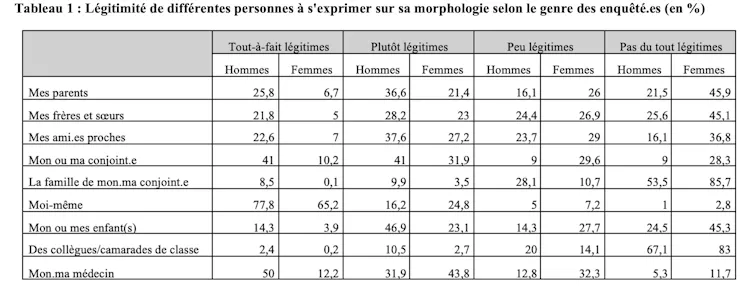
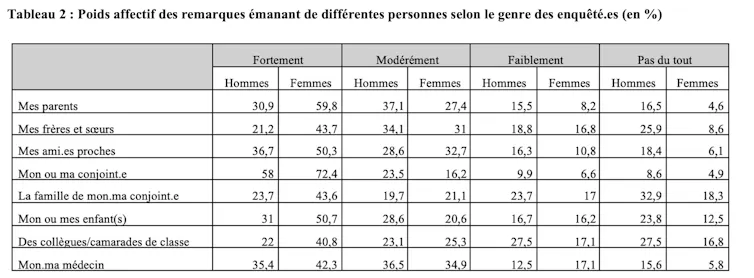
Our results confirm a paradox already documented inour previous qualitative researchA: the respondents overwhelmingly affirm that the only fully legitimate word about their body is their own, even more so among women (table 1). But, at the same time, they express a strong sensitivity to the remarks of all the proposed figures, including those considered little or even not at all legitimate (table 2).
Provided by the author
Provided by the author
This tension can be understood as the effect of a dual process. On one hand, the spread of discourses of self-acceptance and, more broadly, a growing normativity of authenticity and online self-expression encourages claiming control over the definition of one’s body. On the other hand, the persistence of embodied power relations gives parental, conjugal, and medical words a strong symbolic effectiveness, even when their legitimacy is explicitly challenged.
Gender differences reinforce this result: women are more socialized to think of themselves as being judged on their appearance. But they are also more numerous in equipping themselves with online resources to take back control of the narrative about their bodies. Men are less often the targets ofexplicit remarks about their weight. Our survey adds that they are less likely to say they are affected by these potential remarks, and that they are less present in digital spaces of politicization of the scale.
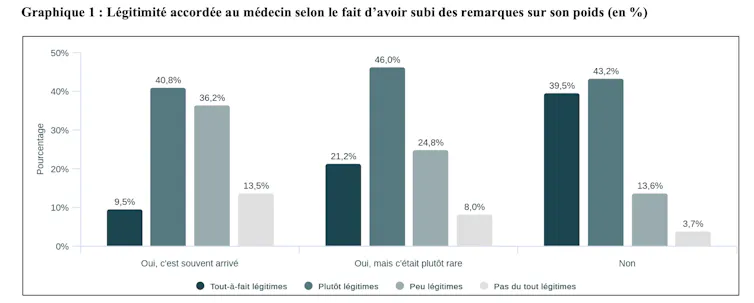
The recurrence of remarks about weight also plays a major role in the legitimacy granted to the doctor, as shown in the graph below.
Provided by the author
To go further, it should be noted that executives and higher education graduates more strongly question the legitimacy of doctors. But they declare themselves more affected than others by remarks about their bodies coming from these people with high symbolic capital. On their side, employees/workers are more willing to recognize the legitimacy of these same figures while saying they are less affected by their remarks.
Discursive autonomy is therefore both a value and a capital. It is easier to declare oneself as the only legitimate person to speak about one’s own body when one has the necessary resources to face the institutionalizations of judgments (medical, professional, familial).
Accepting the size or accepting one’s size? Socially distributed receptions
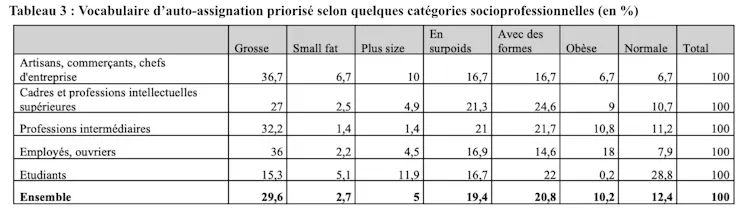
Data on self-identification invite us to distinguish the modes of self-presentation according to, at least in part, belonging to different social categories. For example, students distance themselves from pathologizing vocabulary (“obese”, 0.2%) and more often adopt a more committed Anglophone terminology (“small fat”, “plus size”), while a significant proportion of them define themselves as “normal” (28.8%). More concerned with the body “that should be,” managers and intermediate professions are more likely to speak of “having curves” or “being overweight” (table 3).
Provided by the author
Continuing on, the individuals with the highest cultural capital are also more likely to follow accounts that theorize fatphobia and to arm themselves with arguments to contest the medicalization of weight. Above all, at the moment of subscribing, they do not pay attention to the same elements. 17.9% of the most educated explain that the fact that an influencer cites sources in their content is essential to gain their support, compared to 3.8% among those without diplomas.
The survey also shows that people with higher education degrees are more likely to say that they sometimes have difficulty finding larger bodies “pretty” (48.9% for those with a Master’s degree or equivalent, compared to 11% for people without a diploma), which indicates the persistence of the dominant aesthetic, even among those who criticize or even fight it in theory.
At the other end, employees, workers, and less-educated people more often use the term “obesity,” which is medically constructed, use activist labels less, and appropriate scientific resources conveyed by influencers less. They find themselves more confined within a pathologization of weight “which should be there, but they do not have,” poorly equipped to contest expert discourse while maintaining more conflictual relationships with medical authority.
The possibility of transforming stigma into a claimable identity is therefore unevenly distributed. In this sense, “body positivism” and online movements fighting against fatphobia do not mechanically produce a “democratization” of self-acceptance: they seem to offer additional resources to those who already have capital to mobilize them, while others remain more assigned to an individualized and more irreversible experience of “weight problem.”
The ambivalence of digital spaces as sites of resistance
The investigation also allows us to nuance the image of social media networks as mere amplifiers of violence or as frameworks for emancipation. On the one hand, they appear as informed and protective spaces of mutual support: more than half of the respondents use them to listen to affected individuals and to gather information on the size, while a large majority join private groups, filter content, block or report aggressive accounts. A large portion of respondents explain that they build their own “filter bubble,” where exposure to symbolic violence is reduced and where thewords of the “experts by belonging”, that is to say here content creators, is privileged.
On the other hand, these same networks represent devices of self-governance: men and women differ with a much stronger will among the former to embark on a weight loss journey, while the latter rather wish to come to accept their own bodies:
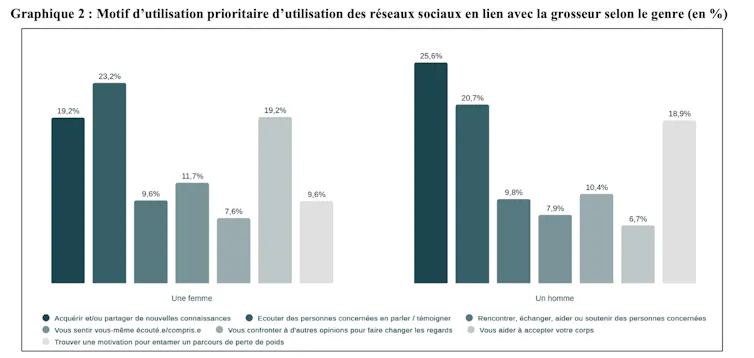
Provided by the author
Many respondents also describe feeds “under tension” where “body positive” content coexists with fitness, diet, and “body goals” content, while photo retouching practices (showing oneself “at one’s best” on public profiles, adjusting appearance according to the context—CV, dating apps, family) reveal a constant adjustment of self-visibility in anticipation of others’ views. Once again, it is the women surveyed who report having refrained from posting photos of themselves online more than men (51% versus 41.4%).
In short, digital spaces certainly allow for the reshaping of perspectives, but this reshaping operates based on preexisting inequalities: they offer opportunities for acceptance and resistance which are themselves crossed by gender and class relations. It is precisely in this in-between – between the promise of online emancipation and the persistence of material and symbolic constraints offline – that the contemporary experience of size unfolds.

To carry out this investigation, Yann Bruna received research funding from the MSH Mondes (University Paris-Nanterre).
–ref. On the Internet, a “permanent trial” of size despite the discourse on self-acceptance –https://theconversation.com/on-the-internet-a-permanent-judgment-of-body-size-despite-discourses-on-self-acceptance-281173