

Source: French to English Tester Published on: 2026-05-11
Source: The Conversation – in French– By Cyril Crevoisier, Researcher at CNRS, space observation of the climate, École polytechnique
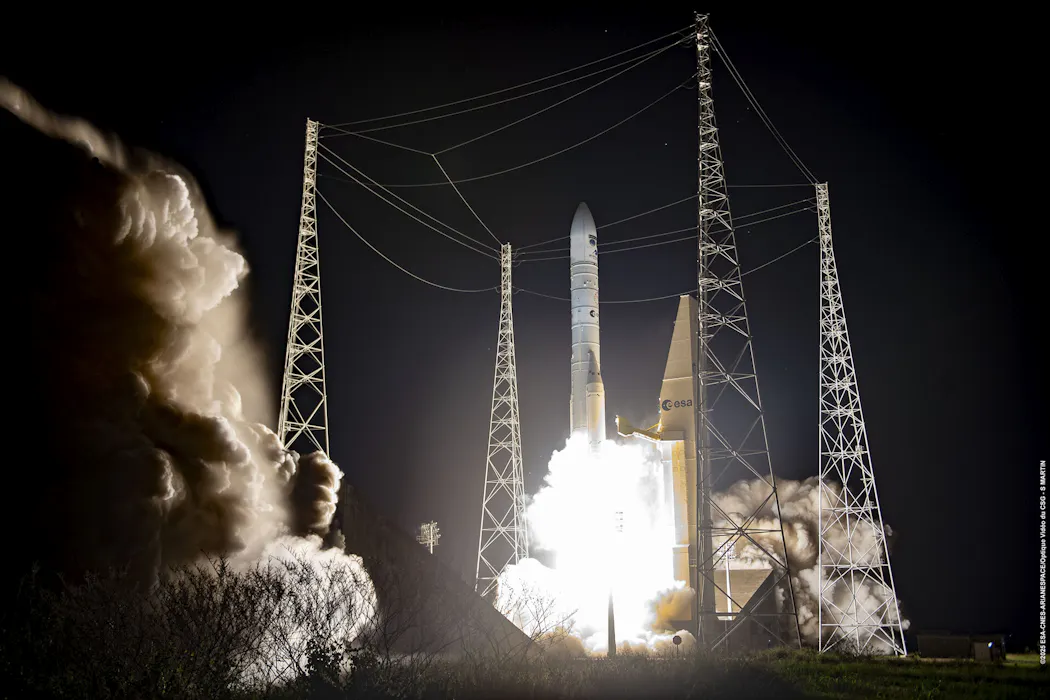
The European satellite Metop-SG-A1 was launched from the Kourou base aboard Ariane 6 on August 12, 2025, and the first data were distributed to the scientific community on May 4. On board, no fewer than six instruments dedicated to observing the Earth’s atmosphere, including the flagship mission IASI-New Generation (IASI-NG) from CNES.
At a time when climate data is at risk, this new generation of instruments will monitor the evolution of the Earth’s atmosphere for over 20 years and serve as the international reference for infrared vertical sounding of our atmosphere.
—
Satellites are a major component of the study and observation of the Earth. They provide global-scale observations necessary to better understand and predict the planet’s evolution, and to distinguish human-induced effects from those related to the Earth’s natural variability. Over the past three decades, satellite observations have enabled continuous monitoring of the state of the Earth’s atmosphere. Current space instruments thus feed weather forecasting models, contribute to climate assessment, and monitor rapid changes in atmospheric composition.
The missionIASI(for “Infrared Atmospheric Sounding Interferometer”) occupies an essential place in this field because it allows mapping the atmosphere and its composition in 3D. IASI has now accumulated more than eighteen years of observations thanks to the combination of three identical instruments launched on three successive satellites between 2006 and 2018. The last two units are still in operation.
In order to ensure the long-term continuity of these observations, CNES and EUMETSAT (the European agency responsible for satellite monitoring of climate and meteorology) have started the development of the IASI-NG mission.
Twice as precise and twice as efficient as its predecessors, IASI-NG will provide for 20 new years a better description of the structure of the atmosphere (temperature, humidity, atmospheric gases), especially in the first kilometers of the atmosphere, which is essential for making good weather forecasts, studying air quality, and surface gas emissions.
Atmospheric sounding in the infrared: a French center of excellence
Developed by CNES in collaboration with EUMETSAT, the IASI instrument measures the spectrum of infrared radiation emitted by the Earth. This varies according to temperature and gases present in the atmosphere, and it is its analysis that allows mapping the atmosphere in 3D and thus visualizing heat or cold waves, desert dust clouds, or pollution plumes, for example.
IASI is a key element of the global atmospheric monitoring system. Itcontributes individually more than any other space instrumentTo the accuracy of 24-hour global weather forecasts. Its observations thus represent45% of the data usedto make forecasts in the Météo-France system.
Moreover, thanks to IASI, the scientific community has demonstrated thepossibility to observe more than thirty atmospheric components, including gases that had never been observed from space before, such as ammonia.
IASI also allows measuring thesulfur dioxide concentrationsemitted by volcanic eruptions, which contribute tosurveillance networkwhich alerts airlines in case of an eruption.
Finally, IASI allows to measure theevolution of sixteen essential climatic variables to monitor climate changeÂ: greenhouse gases, clouds, aerosols.
IASI is thus a key contributor to European servicesCopernicus, the European program for integrated environmental monitoring based on in situ monitoring networks, satellite observation, and the implementation of numerical models. In recognition of its exceptional instrumental performance,IASI has been chosen as an international referencefor the measurements in the infrared by the World Meteorological Organization, against which all other space missions of the same type must calibrate.
The objectives of IASI-NG
The IASI-NG mission aims to significantly improve the performance of IASI. It is carried on the European satellitesMetop-SG-Aincluding three launches planned from 2025 to 2039.
Thus, by combining IASI and IASI-NG, forty years of observation of terrestrial infrared radiation will be available to study the evolution of the atmosphere on a climatic scale.
Furthermore, thanks to its enhanced instrumental performance, IASI-NG will provide a better description of temperature and humidity, particularly in the first kilometers of the atmosphere, which is essential for making accurate weather forecasts. Thus, for example, IASI-NG will improve storm forecasting in terms of location and tracking, as well as in terms of precipitation levels.
While the operational IASI instruments already detect more than 30 different gas molecules (greenhouse gases, ammonia, ozone, carbon monoxide), IASI-NG will further enrich this catalog, while better observing the lower layers of the atmosphere, which is essential for better predicting pollution episodes or desert dust uplift.
Finally, IASI-NG will allow for a better understanding of the vertical positioning of these different atmospheric components (gases, particles), which will make it possible to better constrain atmospheric transport models that are the basis of weather forecasting models and climate models.
A technological innovation for a world first
IASI and IASI-NG measure the spectrum of infrared radiation emitted by the Earth-atmosphere system. Using digital signal processing algorithms, the spectra are interpreted in terms of geophysical variables (temperature, gas concentration).
When designing a new instrument, it is necessary to find a compromise between different instrumental parameters — for example, having a better-resolved spectrum with improved frequency sampling increases the noise associated with the measurement. The challenge is therefore to optimize the choice of instrumental parameters in order to improve the vertical resolution and the accuracy of the soundings.
For IASI-NG, an improvement by a factor of two in spectral resolution and radiometric noise compared to IASI was chosen. To achieve this, the solution is to increase the instrument’s field of view. But the instrument then receives radiation at a high incidence angle relative to its axis, which distorts the measured spectrum.
The design of IASI-NG therefore required technological innovation to compensate for these “field effects”: the creation of aMertz interferometer. This concept is being deployed for the first time in the context of a space mission. The central interferometric mechanism is particularly innovative and has been patented by CNES and Airbus Defence and Space, the project manager of the instrument.
Since its launch into orbit, IASI-NG has been measuring more than 1.3 million infrared spectra per day, over land and sea, day and night, with a reception delay by meteorological forecasting centers and research laboratories of less than 120 minutes. After a standard “calibration/validation” phase, during which CNES ensured proper technical functioning and final adjustments, the distribution of IASI observations to the scientific community began in early April.
More than just a continuation of IASI, the enhanced and innovative performance of IASI-NG will make it an asset for atmospheric sciences for the coming decades in three major areas: numerical weather prediction, atmospheric composition, and climate study.

Cyril Crevoisier has received project funding and research grants from the National Research Agency, the National Center for Space Studies, the European Space Agency, and the European Space Agency for Meteorological Satellites.
Adrien Deschamps works at CNES, which is responsible for the development of IASI-NG and managed its project management.
–ref. IASI-NG, the new three-in-one mission for the study of the Earth’s atmosphere –https://theconversation.com/iasi-ng-the-new-three-in-one-mission-for-the-study-of-the Earth’s atmosphere-262373