

Source: French to English Tester Published on: 2026-05-11
Source: The Conversation – in French– By Jessica Ragazzini, Associate Researcher, University of Strasbourg; University of Quebec in Outaouais (UQO)

By proposing an archaeology of the imaginaries of the body-machine – from ancient myths to feminist, queer, afrofuturist, and crip practices – the bookArts and Cyborgs. Thoughts and imaginaries of body-machinestraces the aesthetic and political uses of hybridization, while situating contemporary controversies related to artificial intelligence within a long history of anthropomorphic artifacts.
For several years, artificial intelligence (AI) has been attracting growing attention, both in artistic practices and academic work. Two attitudes tend to structure, sometimes in a caricatural way, the debates surrounding it: on the one hand, it arouses enthusiasm for new forms of interaction and co-production between humans and machines; on the other hand, it provokes great concern about the risks of impoverishing interpretations of the world, standardizing forms, and reifying the living.
In both cases, the supposed proximity of a machine whose “intelligence” would be comparable to that of a human being, or even likely to surpass it, is at the heart of the polarization. Yet, this fascination and the fears it carries do not arise ex nihilo. Indeed, since Antiquity, artificial creations, anthropomorphic figures, and creation narratives have been privileged reflections that test the limits of the living and allow for rethinking the definition of the human being.
In this context, the workArts and Cyborgs. Thoughts and imaginaries of machine-bodies offers a synthesis of the long history of fascination with anthropomorphic objects and bodies. This project traces an artistic, philosophical, and curatorial genealogy of the hybridization between flesh and technology, a central representation in both contemporary and past culture. Rejecting the idea of an exhaustive inventory, this publication presents continuities and breaks in order to provide conceptual tools to situate current forms within an older and more complex network of references.
A boundary figure
Forged in 1960 by scientistsNathan S. Kline and Manfred E. Clynes, the term “cyborg” refers to a cybernetic organism capable of adapting the human body to the conditions of extraterrestrial life. Beyond this technoscientific origin, the cyborg imagination quickly took shape as a construction of the relationship to oneself and to worlds as a limiting-figure, within which the divisions between organism and artifact, autonomy and control, vulnerability and power are reenacted.
Reinvested by struggles and social movements from1970s, the figure of the cyborg helps to destabilize binary categories, particularly those of gender, and to question the regimes of normalization that organize social and societal relations.
This critical fertility is decisively theorized by the philosopher and biologist Donna Haraway in herCyborg Manifestoin which the cyborg appears as a political paradigm that challenges power logics based on naturalized oppositions (body/object, living/machine, nature/culture). In this sense, it opens a speculative and prospective horizon that leads to considering possible futures where the very categories by which we describe humanity and non-humanity are reconfigured, in an unstable in-between between biology and technology.
Escaping social and symbolic norms
If contemporary culture attributes to the cyborg a myriad of sometimes competing or even contradictory definitions, these are part of a broader history of representations of the human figure. Since Antiquity, narratives such as the story ofPygmalionor that of the Hermaphrodite displace boundaries considered stable between being and matter (the animated stone), between masculine and feminine, between fabrication and engendering, showing the complexity of modes of existence that ultimately escape fixed and stereotyped classifications. Over the centuries, such myths have multiplied, becoming narrative matrices through which artists have been able to imagine forms that abolish or challenge the social and symbolic norms of their time.
At the same time, philosophy has developed conceptual frameworks aimed at specifying what distinguishes the human being from the non-human, but also what connects them, such as agency, sensitivity, language, technique, etc. Current controversies related to AI—particularly when generative systems produce images or sounds from preexisting corpora—thus reactivate old questions: do these productions constitute a form of creation analogous to that of an artist drawing on a cultural background? Are the two types of productions radically opposed due to the generative program’s lack of human subjectivity? These debates recall those voiced during the advent of photography, which already revealed fears about the misuse of a realistically produced image indirectly created by the human being.
Considering societal transformations
Thus, while photography is now widely recognized as a full-fledged artistic medium, its history reminds us that visual technologies are never neutral. At the beginning of the 20th centuryeIn the century, the often patriarchal use of photography by certain futurist and surrealist artists contrasts with the experiments ofHannah Höchor ofClaude Cahun, which make it a tool for destabilizing identities, gender norms, and systems of representation.
In a comparable manner, the contemporary technological hybridization through which the cyborg figure takes form in theFeminist works and queerconstitutes a critical counterpoint to the massive circulation on social networks of AI images perpetuating sexist and anti-LGBTQI2A+ stereotypes.
In these practices, the cyborg figure is not reduced to a science fiction iconography, it becomes a device of thought to consider societal transformations, overturn bodily hierarchies and imagine other possible norms. This is also what the artists showpro-futuristswhich articulate politically engaged speculation or even theartists cripwhose body perceived today as disabled, could tomorrow be equipped with a superpowered mechanism that would transform it into a new bodily ideal to achieve.
Making room for error
The cyborg body opens up a horizon of “superhuman” or “superbiological” capacities. However, it simultaneously remains exposed to flaws, incompatibilities, and malfunctions inherent to technical devices and to the vulnerabilities of the flesh. In artistic practices, these incidents constitute heuristic materials that highlight the infrastructures, norms, and ideologies inscribed in our contemporary world. Theglitch, the bug or the failure can then be claimed as aesthetic motives, breaking with the imperatives of optimization, fluidity, and hyperproductivity that often accompany the technocapitalist imaginary of technoscientific progress.
Making room for error means opening up a field of possible futures where alteration becomes desirable, precisely because it introduces indeterminacy that evades any attempt at human or technological control. This gesture reconfigures the historical narratives of inventive success and human genius; it opens breaches in the linear stories of progress by disrupting its chronological timeline. Dysfunctions thus appear as critical levers for thinking about history differently through its gaps, silences, repetitions, or itsdisturbing accelerations.
Opening the field of possibilities
The interest of cyborg imagery lies in its polysemy and the possible antagonism of its uses; these figures can both perpetuate fantasies of mastery and support policies of emancipation. This is why they require a contextualized reading, attentive both to the symbols mobilized, to contemporary issues, and to speculative dimensions that open the door to futures as pessimistic as they are optimistic. In this sense, the workArts and Cyborgs. Thoughts and imaginaries of machine-bodiesaims to propose a history of non-hegemonic imaginaries. By combining archaeology of forms, discourse analysis, and attention to curatorial practices, it paves the way for new research on the ways in which bodies – real, represented, or fictionalized – become sites of a reconfiguration of sensitivities, nomenclatures, powers, and possibilities.
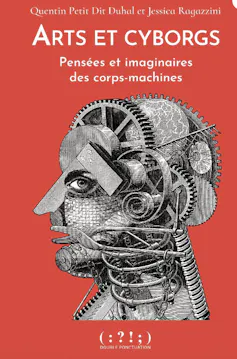
Arts and Cyborgs. Thoughts and imaginaries of machine-bodieswas published by Double Punctuation editions.

The authors do not work for, do not advise, do not hold shares in, and do not receive funds from any organization that could benefit from this article, and have declared no other affiliation than their research institution.
–ref. The cyborg, this machine-body that invites us to explore the history and future of hybridizations –https://theconversation.com/the-cyborg-this-machine-body-that-invites-us-to-explore-the-history-and-future-of-hybridizations-281085