

Source: French to English Tester Published on: 2026-05-10
Source: The Conversation – France (in French)– By Tom van Laer, Professor of Persuasive Language and Storytelling, SKEMA Business School
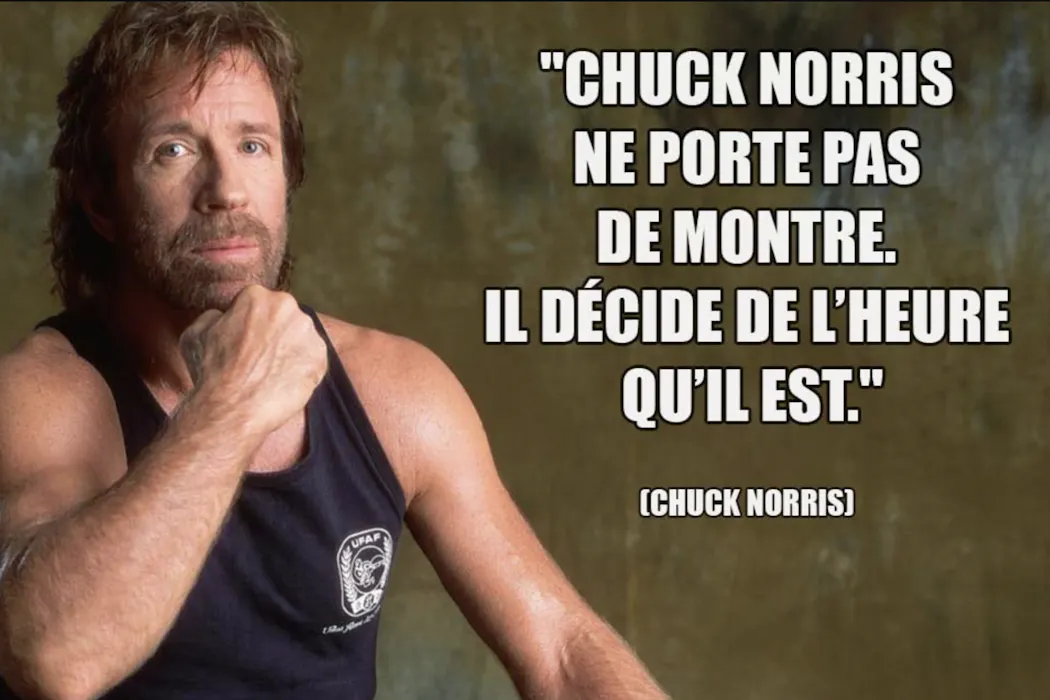
The “Chuck Norris Facts,” those absurd jokes about the comedian, circulating on the Net for about twenty years, tell the moment when the public began to create his fame themselves.
“Chuck Norris doesn’t sleep. He waits.”
“Chuck Norris can divide by zero.”
What are called “Chuck Norris Facts”invaded the Internet in the mid-2000s, turning a somewhat cheesy action movie actor into a mythical figure. But behind the humor lies a deeper transformation, because with this viral format, celebrity has changed in nature. Chuck Norris certainly did not invent memes, but the appropriation of his image helped reinvent celebrity in the meme era.
As a reminder, a meme is an image, a video, or a humorous text widely shared on the Internet and subject to numerous variations.Research showsthat they work particularly well when relying on already heavily coded figures. With his superhuman strength, invincibility, absolute seriousness on screen, Norris embodies a ready-to-use exaggeration: it was enough to push these traits to the absurd to create a perfect meme.
Before the Internet, Chuck Norris was a traditional celebrity: martial arts champion, actor, then star of the seriesWalker, Texas Ranger, broadcast in France from 1995 to 2012 and rebroadcast many times since. The rigid, masculine, and even caricatural image of the actor (who embodied, according to an article ofWorldpublishedafter the disappearance of the actor last March, “the domineering white male of the Reagan era”) makes him an archetype of the Hollywood star system. And it is precisely this image that will make him meme-compatible.
The toxic masculinity that he conveys throughhis/her/their political stancesbecomes the subject of schoolboy jokes but somewhat ambivalent ones, which both allow this archetype to be celebrated while also undermining it.
Also to read:
Memes have become essential in politics. What effects do they have?
The same “Chuck Norris” are created by anonymous internet users, notably on forums, such asSomething Awful, around 2005. They take a simple structure – “Chuck Norris can…” – and extend it indefinitely. Very quickly, the character escapes his original habitat and becomes a collective myth.
The engine of the “Chuck Norris Facts”
The success of these very ones relies on a simple mechanism:
-
a short sentence,
-
a reproducible structure,
-
a permanent escalation.
Each joke must go further than the previous one. If Chuck Norris can beat Superman, the next one will say that he taught him to fly… then that he doesn’t even need to.
This operation corresponds to what we, communication researchers, callparticipatory culture. Fans already produced fanzines, parodies, or derivative storieslong beforedigital platforms. So, this participatory culture was not born with the Web. The Internet gave it a new impetus nonetheless: it made practices of appropriation, subversion, and collective creation that already existed in fan cultures simpler, faster, and more visible.
Within these cultures, audiences no longer just consume; they produce, transform, and disseminate content. The power of memes comes from the fact that they can be taken up by anyone, without any particular skill. Each joke thus follows a collective dynamic, deriving from a series of rebounds and variations, even if each time it is created by a different—and anonymous—author.
When the public reinvents celebrity
This phenomenon marks a break. In the traditional model, celebrity is produced vertically by the media, through promotional campaigns. The public is content to receive top-down information.
With the same ones, the logic is reversed. The audiences become co-producers, the content circulates thanks to their involvement, because they are actively shared and transformed.
Chuck Norris represents an emblematic case of this transformation. His image and fame have escaped the media to become participatory, adaptable, and uncontrollable.
“Chuck Norris Facts” appear at a precise moment: that of the Web of forums, email chains, blogs, and the first viral sites, just before the domination of the major social networks. They show that virality depends not only on technologies but on cultural formats adapted for sharing. At that time, thedoesn’t even need a photo or a videoA simple sentence is enough: “Chuck Norris does not sleep. He waits.”
This simplicity explains their massive spread.The webbecomes a form of public conversation, where everyone can participate. Chuck Norris thus embodies a transition from a centralized media culture to a distributed culture.
A notoriety that goes beyond the person
The case is all the more interesting because Chuck Norris is a “pre-Internet” celebrity. Unlike current influencers or stars, his appearances and statements were not designed to go viral. Yet, he becomes a digital icon. Gradually, the character created by the media surpasses the real person. He becomes an abstract figure, almost independent of the “real” Chuck Norris, like a double that has little to do with his life and roles.
But this detachment between the memetic character and the real person also produces a screen effect. Through the circulation of absurd jokes, Chuck Norris appears almost harmless. However, this playful image tends to overshadow his conservative political stances, notably his opposition to same-sex marriage. The paradox lies here: even when they mock him, memes help maintain his visibility and make his image likable.
Chuck Norris has moreover greatly benefited from this second fame. In 2009, he publishedThe Official Chuck Norris Fact Book, which gathers its favorite “facts”; in 2010, it publishedBlack Belt Patriotism: How to Reawaken America(Black belt of patriotism. How to awaken America, not translated into French), a conservative political essay that became a bestseller.
Memetic fame therefore does not only replace the old fame: it can also reactivate it, monetize it, and serve an ideological purpose.
Even today, these same memes continue to circulate. Like many figures who have become memes, Chuck Norris now exists in two forms: a real person and a collective cultural entity. In digital culture, celebrities become reusable materials.
“Chuck Norris Facts” on Instagram and TikTok
What happened with Chuck Norris is now omnipresent. Contemporary celebrities are constantly amplified, distorted, and remixed. Their image no longer entirely belongs to them.
The difference is that, today,this logic is integratedÂ: the contents are designed to be reused. In the mid-2000s, that was not yet the case. Chuck Norris represents the moment when this transformation occurred spontaneously.
Basically, the “Chuck Norris Facts” tell a story of a power shift. The power to define celebrity no longer belongs solely to the media. It is shared with the public, at a time when being famous is no longer enough. Now one must be referenced, parodied, remixed, digested by the collective.

Tom van Laer does not work for, advise, hold shares in, or receive funds from any organization that could benefit from this article, and has declared no other affiliation than his research institution.
–ref. How the same ones about Chuck Norris reinvented celebrity –https://theconversation.com/how-chuck-norris-memes-reinvented-celebrity-279783