

Source: French to English Tester Published on: 2026-05-06
Source: The Conversation – in French– By Sylvie Ratté, Professor in Software Engineering and IT, École de technologie supérieure (ÉTS)
Language analysis allows early identification of signs of cognitive decline. An ongoing project could transform the management of Alzheimer’s disease.
To improve early detection of this neurodegenerative diseasewhich affects one third of people aged 80 and over in Canada, my research team and I, at ÉTS, are seeking to develop an innovative method based on artificial intelligence (AI). Our approach, non-invasive and accessible, relies on the analysis of patients’ language.
This article is part of our series The Grey Revolution.La Conversation offers you an analysis of all aspects of the impact of the aging of the large cohort of boomers on our society. Ways of housing, working, consuming culture, eating, traveling, healthcare, living… Discover with us the ongoing and upcoming upheavals.
Language as an indicator of cognitive disorders
One of the first signs of Alzheimer’s diseaseis the subtle modification of language. People may, for example, have difficulty finding their words, use pronouns instead of nouns, or pause frequently. The expression of their ideas is less dense.
A first study on the subjectconducted a manual analysis of autobiographical writings by elderly nuns in their twenties. She concluded that the density of expressed ideas was a good predictor of Alzheimer’s disease,even if the disease appeared 50 years later.
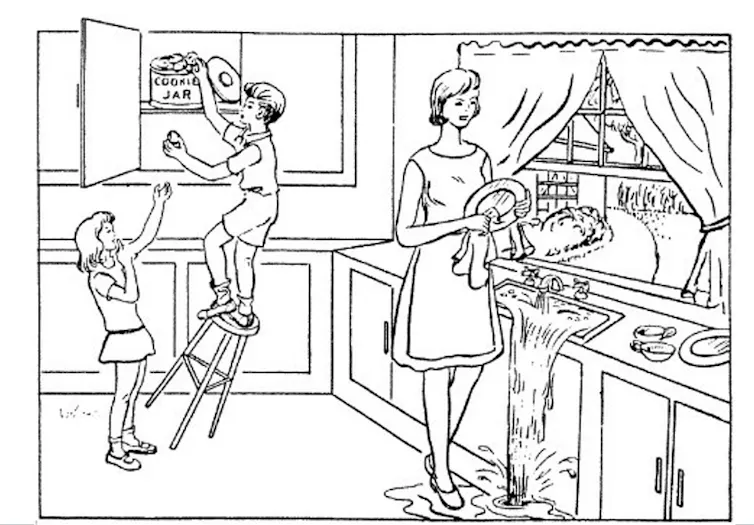
The tool we designed analyzes these linguistic cues with a simple test: image description. This test is part of the diagnostic toolBDAE (Boston Diagnostic Aphasia Examination)). It consists of asking the patient to describe an image. This test allows the evaluation of various aspects of spoken language. The following figure presents one of the images used.
CC BY-NC
This approach allows us to measure lexical richness, syntactic complexity, and hesitation markers, all of which are early signs of cognitive decline.
Our work shows that by analyzing subtle changes in speech structure, we can identify up to 85% of patients with Alzheimer’s, even at a very early stage.
An alternative to traditional clinical tools
Unlike classical diagnostic methods, which often rely on cognitive tests (which notably include image description tests)or heavy and costly imaging techniques, our approach enables accessible detection and frequent monitoring.
Currently, clinical image description tests require a manual evaluation of patient responses, which is time-consuming and inaccurate. Clinicians must transcribe patients’ responses word for word, which is an almost impossible task in a hospital setting.
With our technology, we automate this step and extract hundreds of language features to refine the analysis.
Our process not only allows for the detection of the disease, but also for tracking its progression and analyzing the effect of treatments. Our tools can measure patients’ progress over time, which is essential for evaluating the effectiveness of treatments.
Technical and ethical challenges to overcome
Despite promising advances, the integration of AI in the medical field still poses challenges.
One of the major challenges is the acceptability by health professionals and patients. It is necessarynot only prove the effectiveness of these tools, but also reassureregarding the protection of personal data and the ethics of their use.
Furthermore, language analysis relies on algorithms that must be trained on representative databases. We must ensure that our model works for people from different linguistic and sociocultural backgrounds. As part of our research, we make sure to collect diverse data in Canada as well as in Ecuador and Mexico.
A classic program (or software) operates based on a logical process in which a set of instructions chain together to process input data in order to produce an output result.
AI uses data differently: it uses it to detect recurring patterns. The process is similar for another AI that would detect other types of problems. Only the data changes. If this data is not varied enough, the AI will stick to this reality, which can lead to cultural or linguistic biases and harm the reliability of the diagnoses.
Thus, in one of our experiments, the AI was not adapted to the fact that at a certain time, women often wore aprons in the kitchen. Although this word proves to be very relevant for evaluating the quality of descriptions, the AI had eliminated this word because it did not appear frequently enough.
The other problem encountered concerns the quality of the intermediate AI used to transform the speech signal into written text (transcriptions). The AI that performs this transformation is less effective for French (and more specifically Quebec and Canadian spoken French overall) and even less so for Spanish.
A technology with multiple applications
The implications of this research go beyond Alzheimer’s disease. We are also working on aphasia, which affects communication, both in comprehension and language. This condition can be the result of a stroke or a traumatic brain injury.
Our research team is also exploring the use of these tools for non-verbal autistic children, who often learn language differently. For example, we have found that some of these children acquire a language through exposure to videos on YouTube, which opens new avenues of exploration into language learning.
This work is part of a broader perspective aimed at better understanding the links between language and cognition. Artificial intelligence allows us to extract a quantity of information that humans could not analyze on a large scale. The ultimate goal is to develop tools adapted to the needs of clinicians and patients, to improve their quality of life.
A future where AI and health converge
The integration of this technology into medical practices could revolutionize the management of cognitive disorders. Our goal is to make these tools accessible to everyone, without requiring sophisticated equipment.
This approach could thus allow for early detection and more personalized monitoring, benefiting millions of patients worldwide.
Already thousands of subscribers to the newsletter ofThe Conversation. And you? Subscribe to our newsletter for freenewsletterto better understand the major contemporary issues.
By combining AI and cognitive sciences, our research team is paving the way for more predictive medicine, better adapted to patients’ needs and more effective in the fight against neurodegenerative diseases.
Although we are still at the beginning of this technological revolution, the current advances already show considerable potential. By making these tools accessible, we hope to transform the way we approach the diagnosis and monitoring of language disorders.
In parallel, our team is already working on new collaborations with medical institutions to test these technologies in clinical settings.
We hope that eventually, our tools can be integrated directly into care protocols, in order to offer more precise monitoring tailored to the individual needs of patients.

Sylvie Ratté received funding from NSERC and MITACS.
–ref. An innovative method to detect Alzheimer’s early, thanks to language analysis and AI –https://theconversation.com/an-innovative-method-to-detect-Alzheimer-s-early-through-language-analysis-and-ai-254338