

Source: French to English Tester Published on: 2026-06-10
Source: The Conversation – France in French (2)– By Rémi Vaucher, Teacher-Researcher, EPITA
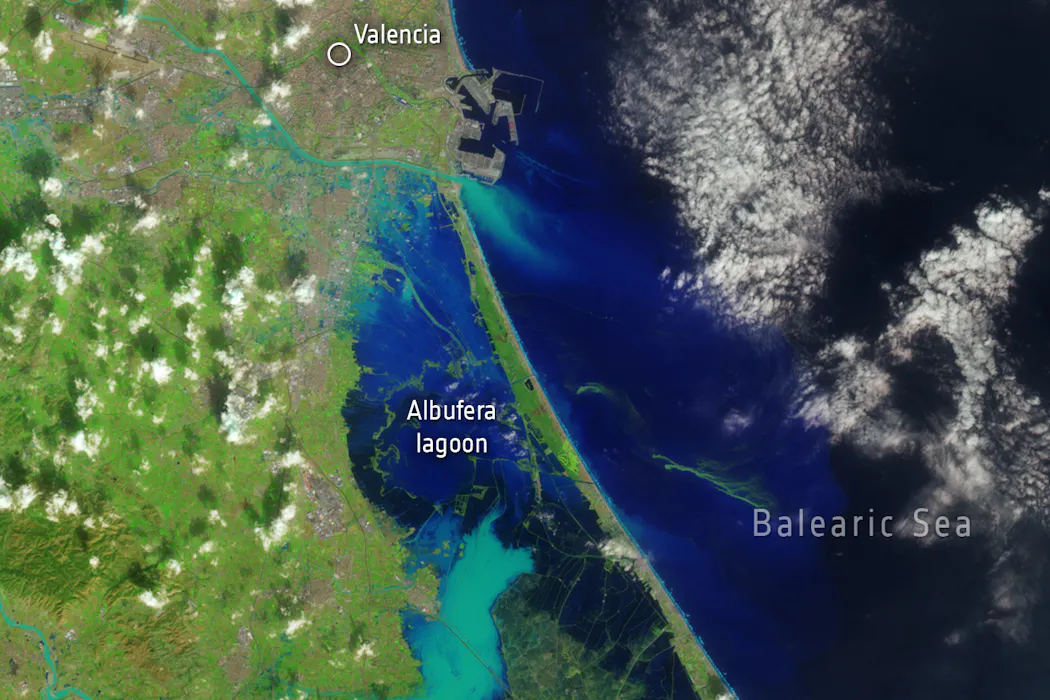
Time is the enemy of statisticians. Even in the era of AI systems, a meteorological model based solely on past data and statistical principles can have difficulties correctly predicting future rainfall amounts in the context of climate change — simply because the situation is evolving.
We have all seen the terrible images ofSpanish floods of October 2024. With more than 200 deaths, this event has become the deadliest incident to have occurred in Spain since the1962 floods.
Some might be surprised by the lack of preparation while artificial intelligence (AI) methods are spreading. As an example, the European modelECMFW, used by Météo France, has recently integrated an AI model (named AIFS) to improve its performance.
With all the recent methods in meteorology and climatology, linked to the deployment of AI, why could the floods in Valencia not be anticipated?
Statistics in the service of climatology
Before getting to the heart of the matter, I would like to clarify a crucial point: I am not a climatologist and do not claim to be one. Therefore, I will not go into detail about meteorological phenomena that I do not master enough.
On the other hand, I am well acquainted with the study of temporal data. And the question of the predictability of this meteorological phenomenon will allow me to explain to you a statistical problem on which research is still working: thedata drift(in English,data drift).
First of all, this climatic event must be somewhat formalized.
Firstly, this is not an event that happens every four mornings. This type of occurrence remains statistically rare: we will therefore use the term “rare event” or “extreme event.”
Secondly, the 2024 Spanish floods are a rare event among rare events. Explanation: the inhabitants of the Cévennes are well familiar with these heavy rains under the name of “Cévennes episodes” These Cevennes episodes are part of what is called theMediterranean episodes. The“DANA”The 2024 Spanish [episode] is a typical example of a Mediterranean episode: it is exactly the same phenomenon as the Cévennes episodes,and so also “rare”, but not localized in the Cévennes.
Finally, let’s talk a bit about what we call “data distribution.” Data distribution, at least in this case, is the probability that an event (a rainy episode in our case) occurs, that it has a given intensity, that it has a given duration, etc. For example:
-
If it is September 15th, it is much more likely that it will rain tomorrow in Brest (Finistère) than in Nice (Alpes-Maritimes): the probability of the “rain” event in Brest is much higher than that of the same event in Nice.
-
If it does rain in Brest tomorrow, it is very unlikely that this rain will be of very high intensity. At the same time, if it rains in Nice tomorrow, the possibility that it is a Mediterranean episode is higher than in Brest. It is therefore more likely to have heavy rain in Nice, “knowing that it will rain tomorrow,” than in Brest.
It is impossible to know this perfectlydistribution, that is to say the probability that it will rain a given amount at a given place at a given exact moment. On the other hand, scientists have a number of tools that allow them to learn to predict events.

Rémi Vaucher,Provided by the author
Learning to predict events
These tools are mostly invented by statisticians. They look at past data and try to reproduce its behavior in order to predict future data.
For example, for the subject that interests us: the cities around the Mediterranean basin need to be able to predict extreme episodes, particularly the amount of water (in millimeters), in order to plan the implementation ofexceptional arrangements(for example, SMS alerts warning residents of a risk of rain or flooding).
For this, we will have all the meteorological readings (temperature, atmospheric pressure, wind speed, wind direction, etc.) at several geographic points around the area concerned.
By teaching an algorithm to use current day data to predict the probability of occurrence of a Mediterranean episode for the next two or three days—and, if an episode is considered, the amount of expected precipitation—the administration can use other models (physical, statistical) to forecast flood risks in specific areas of the locality.
Distribution shift and climate change
Unfortunately, with climate change, the climatechange. For a statistician, this sentence means: “A model trained on the past, can it still accurately predict tomorrow’s rainfall?”
The figure below shows us, month by month since 2008, how the maximum rainfall evolves at a meteorological station near Valencia (Spain). We can observe fluctuating maximum values, but the maximums remain below 200 millimeters accumulated over two days.

Rémi Vaucher, with data from AEMET (Spanish Meteorological Agency),Provided by the author
Now, let’s assume we are training a model to predict the total rainfall over the next two days using this data: we provide it with plenty of indicators on day J, and we want the total rainfall for days J+1 and J+2. It is intuitive to think that the model will never exceed a value of 200 millimeters, and this intuition is realistic: after all, why would it? Statistical models are not made to think about new things; they are made to replicate learned behavior present in the data, which could have (statistically) already occurred in the past.
Let’s now analyze the rest of the data.
If we had used our model trained on data from 2007-2023 to predict the rainfall for October 16 and 17, 2024, we would have… certainly failed miserably. More precisely, the model would have underestimated the amount of rain (which can cause municipalities to have a false sense of security).
These recent figures clearly show that the floods in Valence in 2024 were such an extreme event that it became unpredictable. To better illustrate this point, the following figure shows, around a city where Cévenol episodes are more frequent, the progressive increase in the intensity of these events. This is what is called a “shift in the distribution.”

Rémi Vaucher,Provided by the author
Time: the statistician’s ancient enemy
This phenomenon of temporal shifting does not apply only to climatology, but it is particularly crucial there in view of the victims caused in recent years. Inhealth, many factors influence the data. For example, the sources of pollution, the number of vaccinated people, the number of smokers, etc., are likely to evolve over time. In digital technology, recommendation systems on content platforms must succeedTo adapt to fashion trends.
Finally, the distribution shift is not limited to temporal evolutions. For example, do the results of a neuroscientific study on students in the United States remain valid when applied to forty-year-olds in India?
In summary, the (temporal) evolution of certain factors, such as populations or climate, represents real challenges for statisticians. As far as meteorology is concerned, there are so-called systems“hybrids”, that is to say which combine an understanding of the system’s physics with statistics on past data. This hybridization improves forecasting performance, but themodels still remain, for the moment, struggling with extreme weather events.

Rémi Vaucher does not work for, advise, hold shares in, or receive funds from any organization that could benefit from this article, and has declared no affiliation other than his research institute.
–ref. Could the Spanish floods of 2024 have been predicted? The problem of data drift illustrated by climatology –https://theconversation.com/could-the-2024-spanish-floods-have-been-predicted-the-problem-of-data-drift-illustrated-by-climatology-280312