

Source: French to English Tester Published on: 2026-04-28
Source: The Conversation – in French– By Julia Le Noë, Research Officer in Environmental Sciences, Research Institute for Development (IRD)
Can agroecology be generalized without losing productivity? Research conducted for more than ten years allows us to answer affirmatively. They identify three levers guaranteeing sufficient yields without chemical fertilizers.
Organic farming is often criticized for its lower yields compared to so-called conventional farming. An irreducible yield gap of about 30% on average would condemn it to be only a niche solution for wealthy classes. Our work over the past ten years shows that this is not the case. To understand why, a brief detour through the nitrogen cycle and its history is necessary.
The nitrogen cycle in brief
Nitrogen is an essential element for all life on earth: it is, after water and carbon, the most abundant element in living organisms, particularly in proteins and genetic material. But in soils and aquatic environments (outside living organisms), it is found in much smaller quantities, essentially in the form of nitrate and ammonium, the two forms directly usable by plants. The scarcity of nitrogen in soils explains why this element has long been the main limiting factor for plant growth in agriculture.
Yet nitrogen makes up 78% of the atmosphere, but it exists there in the form of dinitrogen, an inert gas that is practically unusable by plants with one notable exception: legumes (lentils, beans, peas, alfalfa, clover…) which are capable of assimilating this atmospheric dinitrogen and thus making it available in the soils for the other plants that follow them.
A historical detour: from structural scarcity to the destructive abundance of nitrogen
Nitrogen limitation has long been contained by a close coupling between production and consumption. Thus, urine and excrement rich in nitrogen from livestock and, to a lesser extent, human populations have allowed the supply of organic fertilizers to soils in the form of manure and slurry. In Europe, throughout the 18th centurye, 19eEarly 20th centuryeIn this century, the introduction of legumes into crop rotations has also enabled a dual organic intensification: these plants enriched the soils with nitrogen and also produced fodder, thereby allowing an increase in livestock density, and consequently, in manure inputs.
At the beginning of the 20th centuryeFor a century and even more after the Second World War, an invention came to revolutionize all this. It is the invention of the Haber-Bosch process (1909/1913), which allows for the synthesis of mineral fertilizers (nitrate and ammonium) from the nitrogen in the air. This process was first used for the manufacture of explosives during the two world wars, then for making industrial fertilizers that allow breaking free from the complementarity between livestock and crop farming. This is what happened in the industrial countries of the North and, more recently, in some countries of the South that experienced the “green revolution,” which thus were able to massively increase their food production through the widespread use of chemical fertilizers.
This evolution, however, has several drawbacks. It leads to a loss of nitrogen use efficiency because the more nitrogen is supplied, the smaller the fraction used by plants, and the greater the losses to the environment. Moreover, fertilizer production is very energy-intensive and is accompanied by greenhouse gas emissions.
Finally, the use of fertilizers allows the development of intensive livestock systems and specialized, decoupled crops. At the global level, this results in 40% of cultivated arable land (excluding natural pastures, savannas, steppes, and other semi-natural agricultural areas) beingdevoted to livestock feeding. Furthermore, territories highly specialized in livestock or large-scale crops generate structural nitrogen surpluses. These surpluses of manure and slurry contaminate aquatic systems with nitrate (causing problems in water potabilization, biodiversity, and eutrophication) and increase ammonia emissions (with harmful effects on the respiratory system) and nitrous oxide emissions (a powerful greenhouse gas, about 300 times more active than carbon dioxide). Agriculture on a global scale is thus today responsible for approximately athird of greenhouse gas emissionsand constitutes the main disrupting factor ofbiogeochemical cycles of nitrogen and phosphorus.
Organic farming: back to the future?
It is in this context that, since the 1970s, and even more so since the early 2000s, organic farming has appeared as a counter-model to this chemical agriculture, based on fossil energies and the industrialization of agriculture.
In its specifications, organic farming bans chemical fertilizers and pesticides. So, lower yields and a return to the past?
Far from it. Because organic farming relies on a deep understanding of how ecosystems function. It is based on long rotations (in Europe they last on average fromfive to eight years for a complete cycle), integrating several legumes into the crop cycle. Even more, our studies have shown that, for equivalent total nitrogen inputs, organic farming systems produce as much,At the scale of crop rotation, conventional systems. This therefore shows that organic farming can be ecologically intensified. But how and in what context?

Provided by the author
What levers for an agro-ecological transition?
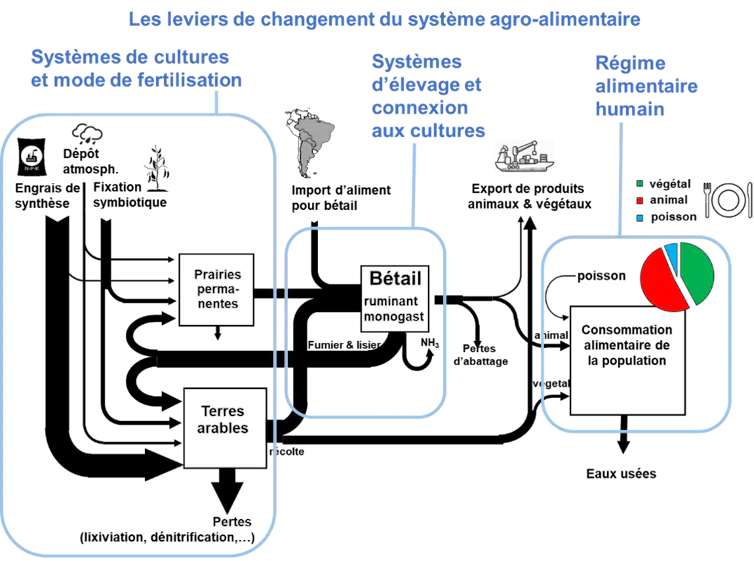
Our research work has identified, tested, and validated three main levers to feed the population in 2050 at different scales, without increasing the cultivated land area. All are closely or remotely linked to the nitrogen cycle. It is here that the systemic vision of agroecology can be beneficial, by broadening the consideration to the entire agri-food system (Figure 2).
The first lever consists of a 16% reduction in daily protein intake, inagreement with health recommendations. According to these same recommendations, a 50% reduction in the consumption of meat and dairy products is explored with an increase in the share of plant-based products. We have sometimes testedmore radical options, vegan or vegetarian on an exploratory basis.
The second lever lies in reconnecting livestock and crop systems, freeing them from the importation of animal feed. This reconnection facilitates the recycling of manure and livestock effluents to cultivated lands, thereby reducing dependence on synthetic nitrogen fertilizers. An additional option, explored in some scenarios, concerns the recycling of human urine, further strengthening the circularity of nutrient flows.
Finally, the third lever involves long rotations incorporating nitrogen-fixing legumes and the absence of the use of nitrogen fertilizers and mineral phosphate fertilizers.
Provided by the author
The exploration of different possible combinations of the three main levers of change that we have considered highlights thepredominant role of the dietas a condition for the implementation and success of the other two levers.
The lower the demand for animal productsthe more room there is to deploy agroecological systems. Dietary changes indeed allow reducing the needs of the human population and especially those of livestock. The reconnection of livestock farming and crops leads to locally meeting the needs of the livestock.The vast majority of territories in France and Europe could thus be self-sufficient both for human and animal consumption.
Immediate environmental benefits, everywhere
In all contexts where these scenarios have been developed, at the global level inEurope, inFrance, inAustria, or inChina, our results show a halving of aquatic and atmospheric pollution by nitrogen, as well as greenhouse gas emissions.
The effects of the widespread adoption of agroecology would therefore be beneficial for the environment. The reduction in nitrogen fertilization is also accompanied by a marked increase in nitrogen use efficiency, that is to say, the fraction of inputs effectively useful for production,which increases from 59% to 76% in the European case.
At the global scale, our scenarios show that these levers are effective everywhere and that these changesdo not endanger global food security. With a fair diet, without food inequalities between countries of the world, the introduction of legumes, and the reconnection of livestock farming and crops, most regions of the world would remain surplus without chemical fertilizers and could largely meet the needs of deficit regions such as the Maghreb, Japan, and the Middle East.
Points of vigilance
Our simulations nevertheless show points of caution concerning, for example, theorganic carbon storage. Indeed, the reduction of livestock and total nitrogen fertilization could lead to a decrease in livestock effluents, agricultural production, and consequently, the input of crop residues (straw, roots),which decreases the storage of organic carbon in soils. Experimental work conducted at Inrae, however,shown significantly higher organic carbon storage in soils cultivated with organic farming versus conventional farming, which indicates that we may have underestimated some inputs of organic matter, notably root-derived, in our modeling exercises. Nonetheless, there remains a halving of greenhouse gas emissions and nitrogen losses to aquatic systems.
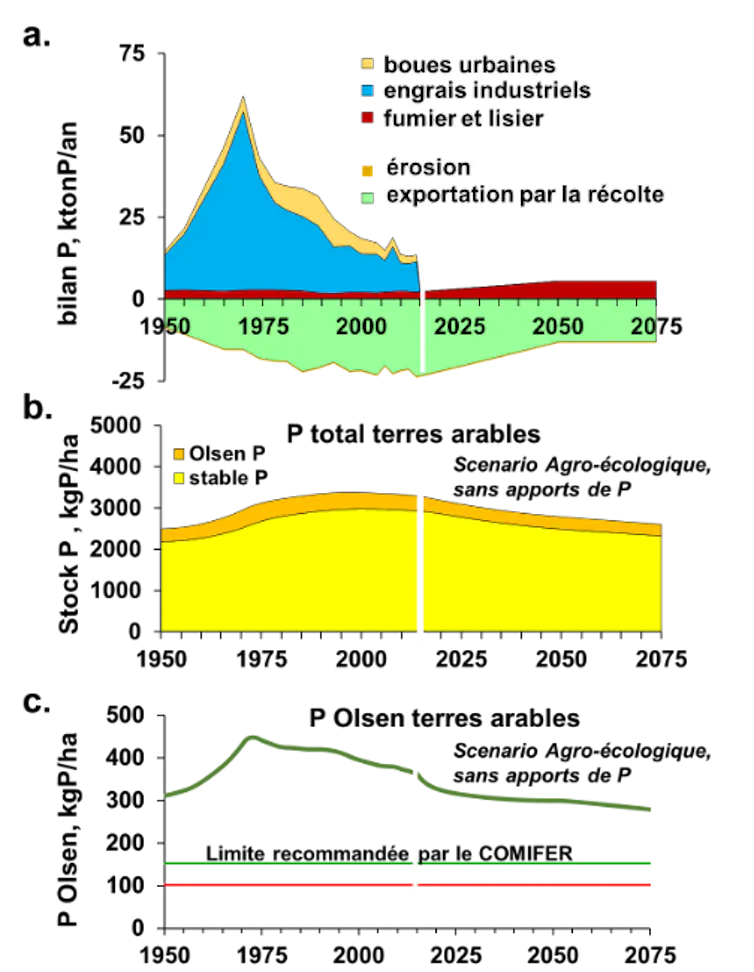
Another question concerns a possible phosphorus deficiency if phosphorus fertilizer is omitted and it is provided only through manure recycling?At a minimumfor the case of France at the scale of its territories, there existphosphorus stocks in soilswhich would make it possible to do without any industrial phosphate fertilizer input for at least 50 years. Indeed, French agriculture has made disproportionate use of mineral phosphorus fertilizers (mainly imported from the Maghreb – Morocco and Tunisia in particular) between the 1960s and 1990, leading to a considerable enrichment of soils with phosphorus. This colonial legacy therefore offers usable reserves while implementing changes.
Provided by the author
Pessimism of the intellect, optimism of the will
Our work thus shows that agroecological systems have the technical potential to reconcile food production with a significant improvement in environmental performance in very diverse contexts. So why hasn’t the agroecological transition already taken place?
Undoubtedly the problem lies elsewhere, notably in the socioeconomic logic of the upstream-downstream chains in which agriculture is embedded, in the working conditions and remuneration of farmers, and in the political influence over public action acquired by the actors who control these sectors.
However, this socioeconomic context is also an additional incentive to inspire new hopes,all the more soin the current situation of energy war and soaring input prices. This is precisely the meaning to be given to the exploration of possible futures through scientific approaches, leaving imagination all the space it deserves.

Julia Le Noë received funding for the SLAM-B projects (ANR-22-PEXF-0003), PREFALIM (ANR-23-PEXF-0004) from the exploratory PEPR FairCarboN and benefited from state aid managed by the National Research Agency under France 2030 with the reference ANR. She also benefited from funding for the MOBIDYC project (ANR-23-ERCB-0006-0) managed by the National Research Agency.
Gilles Billen received funding from the PIREN-Seine program, a public research program on water quality and agriculture in the Seine Basin (https://www.piren-seine.fr/).
Josette Garnier received funding from the interdisciplinary program PIREN-Seine (https://www.piren-seine.fr/)
–ref. How to generalize agroecology? –https://theconversation.com/how-to-generalize-agroecology-280841