

Source: French to English Tester Published on: 2026-04-27
Source: The Conversation – France in French (2)– By Alexandre Desparmet, PhD student in Marine Biology, National Museum of Natural History (MNHN)
Humans as well as many living species need oxygen to live. Yet this molecule is chemically dangerous; it causes what is called “oxidative stress” (a deterioration of the constituents of our cells such as proteins or DNA). It is therefore necessary to be able to use it, but also to protect oneself from it. A new study sheds light on these processes in microalgae.
The relationship between life and oxygen is far from simple. To understand it, one must go back to the origins of life on Earth, in the Archaean era (between -4 billion and -2.5 billion years ago). The oceans already existed, but the atmosphere contained very little, or even no, free oxygen.
Some bacteria were already performing a so-called anoxygenic photosynthesis which, unlike that of current plants and algae, does not release oxygen but produces sulfur compounds.
About 2.4 billion years ago, a major turning point occurred: theGreat Oxygenation. Oxygen begins to accumulate in the atmosphere thanks to the activity of photosynthetic bacteria (cyanobacteria) capable of carrying out oxygenic photosynthesis, the same process used today by plants and algae.
This accumulation of oxygen profoundly transforms the biosphere. For the first time, an extremely reactive molecule is produced in large quantities by living organisms. Oxygen can oxidize and damage the cellular structures of organisms that are not adapted to it. Life then faces a paradox: having to deal with a molecule that it produces itself but which poses a danger to the majority of existing life forms.
This transition causes a major biological crisis. Many anaerobic species are pushed towards oxygen-poor environments, such as sediments or marine depths. At the same time, some lineages develop mechanisms capable of neutralizing oxygen, then using it as an energy source. Oxygenic respiration, much more efficient than anaerobic metabolisms, thus allows the emergence of more complex life forms.

Cédric Hubas,CC BY
The oxygen paradox
Although often associated with life, oxygen remains chemically dangerous and can cause what is called oxidative stress. Indeed, oxygen can generatereactive oxygen species(ROS) – superoxide, hydrogen peroxide, or hydroxyl radical – capable of damaging proteins, lipids, and DNA.
All aerobic organisms (including humans) therefore possess enzymatic systems that can neutralize these molecules: superoxide dismutases, catalases, or peroxidases. Without these defense mechanisms, oxygen would quickly be lethal. Modern life thus relies on a delicate balance: using oxygen to produce energy while limiting its toxic effects.
Long considered only as harmful by-products involved in aging or certain diseases, ROS are now recognized as signaling molecules participating inregulation of numerous cellular processes(cell proliferation or regulation of certain genes for example). Their exact role, however, remains largely unexplored.
Oxidative stress in natural environments
Oxidative stress does not only concern human organisms: it affects all living beings. It occurs when the production of ROS exceeds the cell’s defense capacities. This phenomenon is particularly pronounced in environments subjected to strong variations in physical or chemical conditions.
These extreme environments such as the Dead Sea, the Sahara Desert, or certain high-altitude deserts receiving strong solar radiation, have very salty, very dry, or highly irradiated conditions, butnevertheless shelter an astonishing biodiversity. Specialized organisms, called extremophiles, thrive there thanks to remarkable physiological adaptations. The notion of an extreme environment therefore always depends on the organism considered.
Even more familiar environments can impose significant constraints. Our coastal zones, for example, experience rapid fluctuations in light. The light intensity varies greatly throughout the day, which directly influences photosynthetic activity.
Photosynthetic organisms are particularly exposed to this problem because the capture of light energy promotes the formation of reactive oxygen species. Thus, while light is essential for photosynthesis, an excess of light energy can disrupt the cellular balance and promote the formation of ROS. Organisms must therefore harness light while protecting themselves from its potentially toxic effects.
The adaptations of microalgae to daily variations in light
Diatoms, microalgae very abundant in marine sediments, have developed several strategies to cope with these light variations. Protective pigments, notably xanthophylls, limit the formation of free radicals. The cells can alsomodify the organization of their photosynthetic apparatusin order to optimize light capture while reducing damage.
These microalgae also possess photoreceptors capable of detecting light variations and triggering rapid physiological responses, such as the activation of photoprotection mechanisms or the expression of certain genes.
One of their most remarkable adaptations is their vertical migration in the sediment. When the light is moderate, the diatoms rise to the surface to maximize photosynthesis. When the intensity becomes too strong, they sink slightly into the sediment, as if to put themselves in the shade. These movements are synchronized by an internal circadian clock that allows them to anticipate day-night cycles.
ERO and diatoms: a dialogue more complex than previously thought
Recent worksuggest that reactive oxygen species could play a more active role than previously thought. Beyond their potentially toxic nature, they could act as signals triggering certain behavioral responses.
Our latest studyshows that the EROs participate notably in the control of the vertical migration of diatoms, whereas it was previously thought that these migrations mainly served to limit their production and accumulation at the cellular level.
Two mechanisms therefore seem to combine: migration reduces exposure to conditions that generate ROS, but these same molecules could also act as signals triggering the response when their concentration exceeds a certain threshold.
This system would thus function as a genuine internal monitoring device. Variations in oxidative stress quickly reflect environmental changes and allow cells to adjust their physiological and behavioral responses.
Since diatoms are highly diverse and widely distributed on a global scale, it is likely that these capacities for detection, information processing, and response implementation vary according to species and environmental context. This diversity gives diatoms a strong ability to adapt, playing an essential role in their survival.
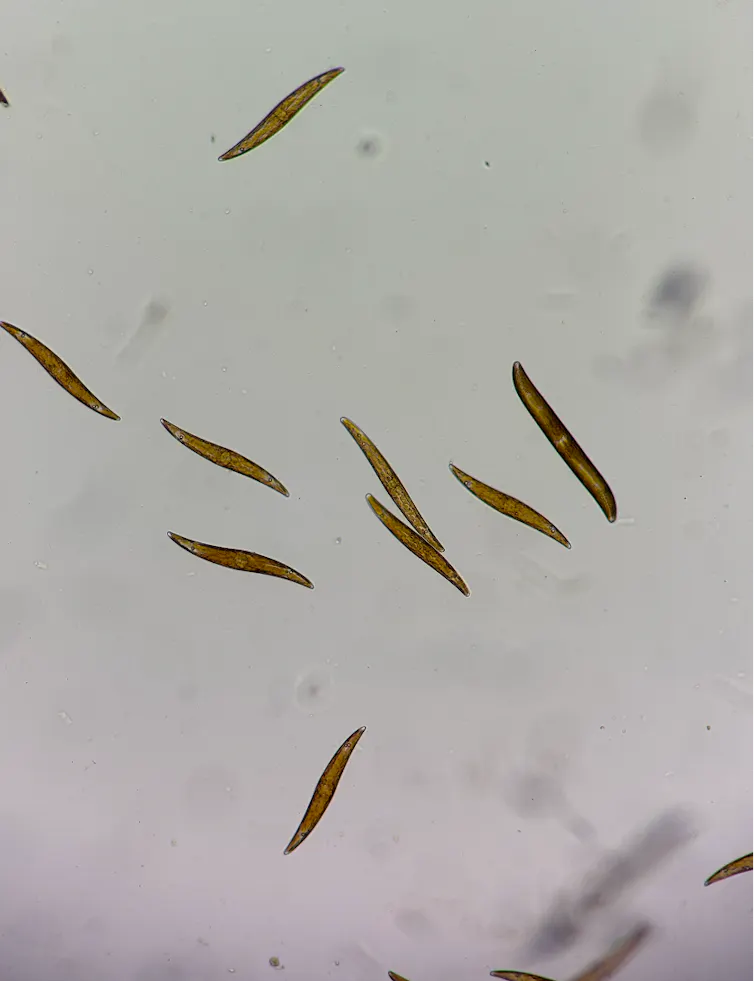
Alexandre Desparmet,Provided by the author
This work shows, through a striking example, that living organisms have not only learned to defend themselves against oxygen and its toxic derivatives: they have also learned to use them. Oxygenated metabolic waste products, once considered solely dangerous for cells, can become true biological tools.
This reminds us that the role of ROS remains complex and still largely unknown. Far from being mere stress agents, they now appear as ambivalent molecules: subtle messengers integrated into fine mechanisms of communication, cellular adaptation, and environmental perception, particularly in diatoms.
And as is often the case in science, these discoveries mainly open up new questions… which still remain to be explored.
We thank the DIVONA doctoral school, the Concarneau marine station (Finistère), and the BOREA laboratory.

Alexandre Desparmet received funding from the Ocean Institute of the Sorbonne University Alliance.
Cédric Hubas received funding from the Ocean Institute of the Sorbonne University Alliance.
–ref. Oxygen, this paradoxical molecule, base of life and deadly poison: how microorganisms cope with it –https://theconversation.com/loxygene-cette-molecule-paradoxale-base-de-la-vie-et-poison-mortel-comment-les-microorganismes-y-font-face-278706