

Source: French to English Tester Published on: 2026-04-27
Source: The Conversation – France (in French)– By Olivier Dubourdieu, Researcher-teacher on mineral resources and transitions, Mines Paris – PSL
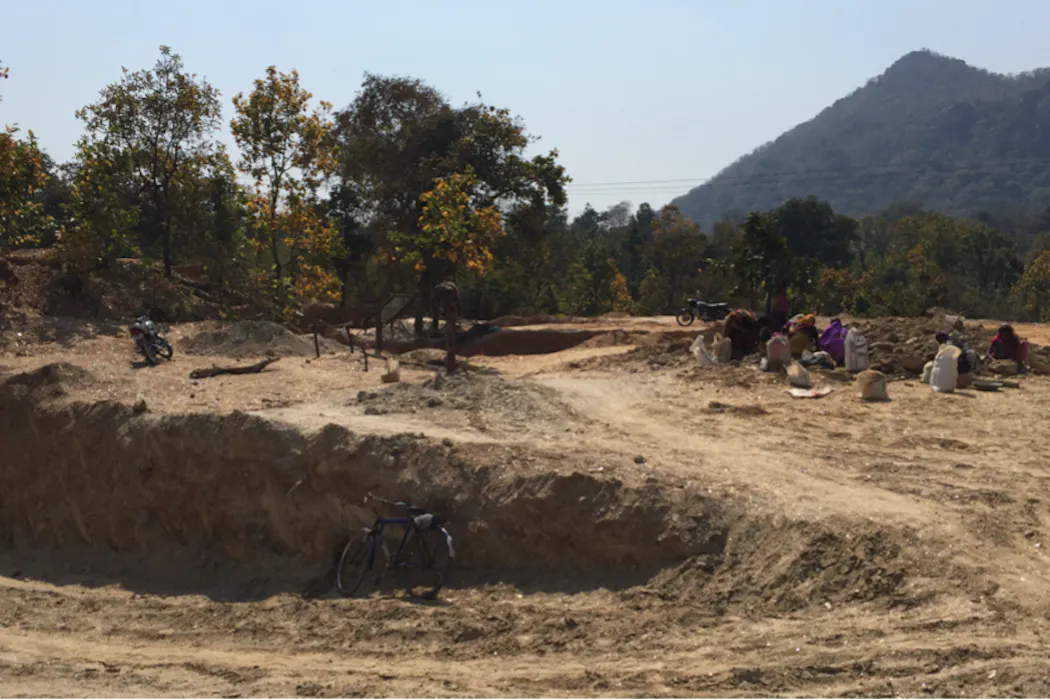
How to reconcile environment and economic development? The case of mica mining in India illustrates the difficulties in balancing these two aspects when vulnerable populations depend on the economic resources of mining. Supporting small-scale artisanal mines could be a solution, at least under certain conditions.
Electric vehicle batteries, automotive paints, eyeshadows… these everyday objects have one thing in common. They all contain a discrete yet strategic family of minerals:mica. Although relatively unknown, mica is omnipresent in modern industrial economies.
Due to its electrical and thermal properties, it is a common insulator in electronics. It can be found both in hair dryers and inelectric vehicles. Its physical characteristics also make it a basis for certain pigments used in industrial paints as well as many cosmetic products. This makes it a key mineral, both for the decarbonization of the economy and for the development of digital technology.
Mica deposits exist worldwide, but Bihar and Jharkhand, two states in northeastern India, account for nearly 20% of global production. Mica extraction there is currently largely artisanal and small-scale, often located in forest areas.
This double challenge of energy and digital transition also corresponds to that of environmental transition, in particular the fight against deforestation. How to reconcile environmental preservation and the maintenance of an economic activity essential for the survival of vulnerable populations? This article outlines a response, based onmy thesis work.
Mines and Men
India is one of the world’s leading producers of mica, with approximately100,000 tonnesexported every year.75% of this productioncomes from two states in the northeast of the country located in forested areas: Jharkhand and Bihar. It should be noted that the official figures from the Indian Bureau of Mines (IBM) do not include mica production from these two states (as in 2021 for example. Indeed, this is mostly linked to informal artisanal and small-scale mines, not yet recognized by the Indian state, and largely illegal since the 1980s for the reasons explained in the following paragraphs.
In these two states, mica mining began at the end of the 19th century. The mining industry then developed there in two stages:
-
Until the 1980s, mica mining was legal, regulated by the local legislation of the state of Bihar – which was indeed split into two in 2000 to form the current states of Bihar and Jharkhand.
-
Then, in 1980, the adoption ofForest Conservation Actby the Indian central government marks a turning point that results in the official deindustrialization of mica mining. But in fact, the activity did not really stop: it continued informally, further increasing the social vulnerability of the miners.
Let’s start with the first period, a kind of “golden age” of the mica mining industry in India. Historical writings, such asthis 1951 bookorthe one from 1995) describe relatively well-managed industrial mining operations, where workers have access to protective equipment (wearing helmets and safety shoes), with semi-mechanical extraction means.
The mining industry is then seen as a source of economic prosperity, particularly for the urban centers of Giridih and Koderma. However, working conditions are far from idyllic: some workers are farmers seeking additional income and work in the mine without having been adequately trained, while others suffer from respiratory illnesses…
This moment is marked by what can be called “resource conversion” whereby the forest is “converted” into mineral resources. It must be understood that deforestation here is not the product of illegal exploitation but the result of an implicit compromise: accepting a certain environmental degradation in exchange for essential income for marginalized rural communities.
The second period begins in 1980 after the adoption ofForest Conservation Act, where the national priority is now to protect the forests. The mining of mica then becomes mostly illegal and is thus part of the informal economy. It is either practiced by individual artisanal miners or in semi-industrial mines, where theliving and working conditionsareprecarious. For example, recurrent musculoskeletal diseases,child labor, regular collapses of the tunnels… There are no official statistics, but the ban seems to have had negative effects on the working conditions and the health of the workers, with the sites becoming more difficult to access for organizations wishing to support the mining artisans in improving their living and working conditions.
Constrained to operate informally, artisanal miners find themselves marginalized in several ways: economically, legally, and socially. They are not in a strong position to negotiate the price of the mica they sell and thus suffer from aweak position in the value chain.
The police services of the states of Bihar and Jharkhand regularly conduct raids to stop mining operations and seize illegally mined mica. These operations seem to have only a limited impact on slowing down mica extraction. On the other hand, they have a real effect on the mining artisans as they contribute to villainizing them, even though mica extraction has become their main source of income.
Also to read:
Should mines be reopened in France and Europe in the name of economic sovereignty?
Two successive conversion movements
The recent history of mica in India thus reveals two successive dynamics of conversion: a first phase of conversion from forest to mineral resource, in the name of economic development, followed by a phase of reconversion of mining areas back to forest, driven by environmental protection objectives.
These two movements have a common point: they produce deep territorial and human effects that do not fully integrate the needs and adaptation capacities of local communities. For artisanal miners, it is about maintaining an economic activity despite its illegality and its impact on the forest. This tension has repercussions for other actors.
For the states, particularly those of Bihar and Jharkhand, mica extraction also includes a dual political dimension. Firstly, because the voices of the 300,000 people involved in mica extraction represent a significant electoral issue, but also insofar as the law aimed at forest conservation emanates from the federal government, while local development issues fall under the states.
For actors downstream in the mica value chains, such as cosmetics or automotive brands for example, this situation raises new questions. The issue is to know what these actors want to prioritize: the economic development of marginalized populations or the protection of the environment?
Through their choice of suppliers and engagement on the ground with mining artisan communities, downstream companies influence the local dynamics of resource conversion. One of the key issues is legal: some of these companies must comply withrequirements of regulationsin terms ofduty of care, like theOmnibus Directive I of the European Union, for example). The risk is finally reputational: how to justify sourcing raw materials from artisanal mines while claiming to protect forest resources?
Also to read:
Responsible Policies and European Directive: How the Duty of Vigilance is Introducing Itself in Large Companies
Formalize small-scale artisanal mines
Faced with this situation, a new approach emerged several decades ago: the formalization of small-scale artisanal mines, that is, among other things, the recognition of artisanal miners as legitimate actors in value chains. This recognition is accompanied by support programs to improve social and environmental practices, working conditions, and to reduce the number of accidents and combat child labor.
It is in this spirit that was created, in 2017, theResponsible Mica Initiative(RMI), an initiative bringing together major players in the mica value chain, including industrialists, but also NGOs aiming to make these value chains more sustainable, equitable, and responsible. The RMI thus fosters solutions by consensus, and considers the formalization of artisanal mica mines in all its dimensions: technical, administrative, legal, social, and economic.
Specifically, the RMI has already undertaken several actions, such as the structuring of minors into cooperatives, the definition ofresponsible production standards, or the implementation of audits and support programs for compliance.
As envisaged by the RMI, the formalization of artisanal mica mines thus aims to rebalance power relations within value chains, for the benefit of the mining artisans and their living environment.
Environmental-development arbitration at the heart of a negotiation space
The example of mica mining extraction in India shows that environmental policies sometimes produce perverse effects. In seeking to protect forests, they further weaken communities, without eliminating the practices they aimed to regulate.
Resolving the resulting tensions requires the mobilization of all stakeholders, which implies the existence of a negotiation space. On this basis, the stakeholders can then build a common vision and implement it through collective actions.
But such a dynamic can only emerge if the negotiation space is also a space of trust, which allows for addressing and resolving governance issues in value chains. This is precisely what projects like the Responsible Mica Initiative seek to establish, by creating the conditions for a structured dialogue between actors with divergent interests.

Olivier Dubourdieu worked for the Responsible Mica Initiative between 2019 and 2024.
–ref. Between the environment and the local economy, must one choose? The case of mica mining in India –https://theconversation.com/between-environment-and-local-economy-do-we-have-to-choose-the-case-of-mica-mining-in-india-279378