

Source: French to English Tester Published on: 2026-04-20
Source: The Conversation – in French– By Isabelle Chaboud, Senior Professor of Financial Analysis, Audit and Risk Management – Program Director for the MSc Fashion Design & Luxury Management – Head of the MBA specialization “Brand & Luxury Management”, GEM
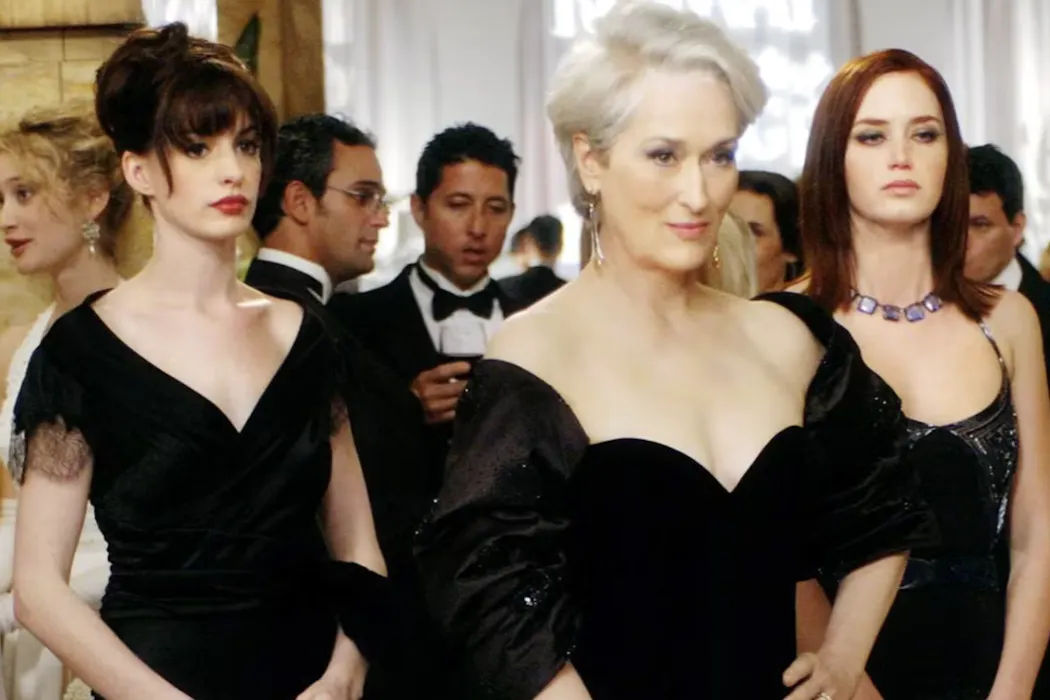
From its origins, cinema has used costume to anchor the story in a historical-social reality. But starting from the 1960s, clothing goes beyond its illustrative function to become a narrative and symbolic tool.
Audrey Hepburn’s black dress inDiamonds on the couch(Blake Edwards, 1961), signedHubert de Givenchy, is a striking example of the moment when clothing gained a whole new dimension on screen. This satin sheath dress, with minimalist cutouts in the back, embodies timeless elegance and enshrines the alliance between haute couture and the seventh art. The scene immortalized in front of Tiffany’s windows elevates the “little black dress,” popularized by Coco Chanel in the 1920s, to the rank of an icon and makes it a symbol of unparalleled elegance.
As for the dress worn by the heroine, it will become one of the most expensive costumes in the history of cinema. The only sold copy will be auctioned608,000 euros at auction in 2006.
The golden age of collaborations
The 1980s mark a decisive turning point with the arrival of Giorgio Armani, whose minimalist and deconstructed silhouettes redefine masculine and feminine elegance. It is by creating the wardrobe of Richard Gere inAmerican Gigolo(Paul Schrader, 1980) that Armani becomes known to the American public. His suits, clean and sophisticated, become his visual signature and launch a fashion that remains influential to this day. The Milanese couturier then multiplies notable collaborations: he dresses Kevin Costner, Sean Connery, and Robert De Niro inthe Incorruptibles(Brian De Palma, 1987), Lauren Bacall inA Star for Two(Jim Kaufman, 1991), then again Kevin Costner inBodyguard(Mick Jackson, 1992). These appearances help to forge the image of an Armani style synonymous with discreet power and timeless elegance.
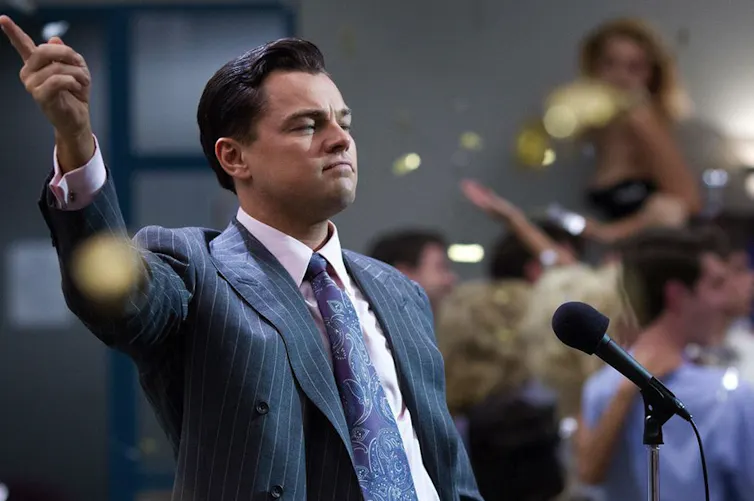
This privileged relationship between Armani and Hollywood continues with George Clooney and Brad Pitt inOcean’s Thirteen(Steven Soderbergh, 2007) for which he will design the outfits just as he did for Tom Cruise inMission Impossible 4(Brad Bird, 2011), or those of Leonardo DiCaprio inThe Wolf of Wall Street(Martin Scorsese, 2013), where the character Jordan Belfort wears three-piece suits that symbolize his rise and excess. These collaborations illustrate how fashion can serve storytelling, enhance the credibility of characters, and anchor the viewer in a specific era or social environment.
Allociné
Fashion as a catalyst for metamorphosis
Clothing, in cinema, is a vehicle for transformation. Researchershave studied this processThroughPretty Woman(Garry Marshall, 1990). The film modernly reprises the archetypal theme of transformation present in three classic tales:Cinderella,PygmalionandBeauty and the Beast. Vivian Ward, played by Julia Roberts, a street woman depicted as naive but charming, transforms through her outfits, shifting from a marginal image to a sophisticated elegance that allows her to capture the attention of Edward Lewis, a wealthy businessman played by Richard Gere. Researchers emphasize thatPretty Womanreflects a society in transition, where personal identity is increasingly shaped by image and style. The polka dot dresses, the white dress and black hat worn on Rodeo Drive, as well as the red evening gown at the opera, become symbols of this transformation, popularizing trends that will mark American fashion in the 1990s.
When fashion shapes ambition and professional identity
InThe Devil Wears Prada(David Frankel, 2006), adapted from the novel by Lauren Weisberger, fashion is not just an accessory, but an instrument of power and transformation. Andrea Sachs, a young freshly graduated journalist played by Anne Hathaway, becomes the assistant to Miranda Priestly, the tyrannical editor-in-chief of the magazineRunway(portrayed by Meryl Streep).
Initially mocked for her lack of style, Andrea undergoes a fashion metamorphosis that strengthens her self-confidence. The white coat, green blazer, pleated skirt, and thigh-high black Chanel boots become visual markers of her evolution, illustrating how adopting fashion codes can open the doors of a ruthless professional world. Twenty years later, the release of the second installment raises a central question: Will Andrea be able to assert herself more strongly against Miranda and the other ambitious women in the industry, notably by adopting pieces borrowed from the masculine wardrobe? What new silhouettes will emerge as symbols of this rivalry and this quest for emancipation?
From product placement to trend creation
Cinema and series, by showcasing luxury brands, have become major marketing levers. The 2000s, withSex and the City, systematize this practice, turning the screens into showcases for Manolo Blahnik, Dolce & Gabbana, Prada, or Gucci.Sunita Kumar’s research(2017) confirm that product placement in films is an excellent strategy to increase brand awareness and to easily reach a customer segment.
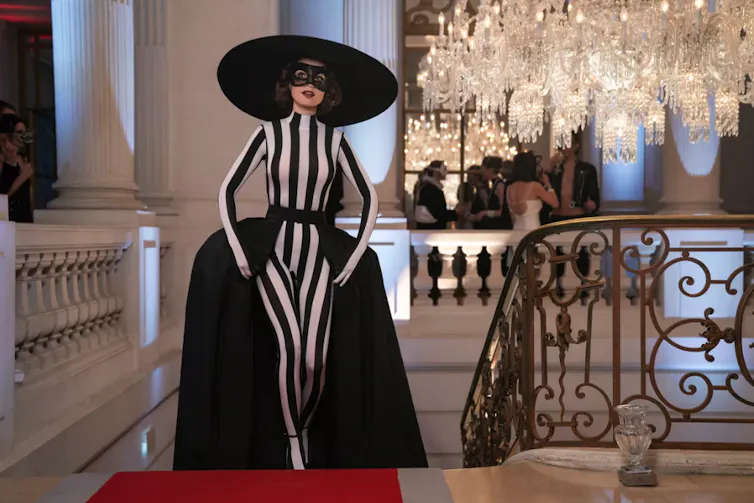
In aluxury market estimated at over 1.5 trillion euros in 2024with nearly 25% of American clients, it is no surprise that productions from across the Atlantic are so prized by brands. However, the balance remains fragile: between narrative congruence and advertising saturation, brands must avoid falling into caricature, as inEmily in Paris, where the repeated exposure to luxury products sometimes borders on parody theater. Despite this, some more discreet appearances like that ofbags produced by a company from Isère in season 5 of the series, led to a surge in orders, proving the direct impact of these placements.
Allociné
When fashion becomes the main character
The seriesLove Story(2024), which traces the relationship between Carolyn Bessette and John F. Kennedy Jr from the 1990s to their tragic disappearance in 1999, offers a striking illustration of fashion’s influence on screen. Although the series primarily explores the psychological dimension of this iconic couple, Carolyn Bessette’s outfits hold a central place. Her minimalist, refined, and elegant style becomes a character in its own right, celebrated under the name “Carolyn Bessette Style.” Social media seized on the phenomenon, with a surge in searches for 1990s pieces and the hashtag #CBK. Second-hand sales platforms saw their vintage clothing sales soar, while Calvin Klein, an emblematic brand of that era, benefited from an unprecedented renewed interest.
This success demonstrates that fashion, when integrated with subtlety and relevance, can transcend its role as an accessory to become a genuine vector of identification and aspiration. The placement of luxury brands has no persuasive effectonly when it fits into a coherent narrative context.Love Storyis proof of it: by associating Carolyn Bessette’s style with an era, an aesthetic, and an emotion, the series managed to create a cultural phenomenon far beyond mere product placement.
Fashion on screen, between social mirror and lever of influence
The cinematic costume, initially a simple accessory, has established itself as a universal language, reflecting and anticipating societal changes. It now transcends its narrative function to become a tool for identity transformation and an essential marketing lever. In the digital age, where the boundaries between fiction and reality are blurred, luxury brands and the seventh art maintain a symbiotic relationship: one offers a stage, the other a story. This alliance, between artistic creation and commercial strategy, continues to captivate the collective imagination, while questioning the limits of increasingly intense exposure. Do viewers, in search of identification and authenticity, still see in these narratives a promise of personal metamorphosis?
Influencers are now pushing fashion creators towards film production to reinvent their storytelling, control their image, and reach audiences seeking meaning: the long love and marketing story between fashion and cinema is far from running out of steam, but it is constantly reinventing itself.

Isabelle Chaboud does not work for, advise, hold shares in, or receive funds from any organization that could benefit from this article, and has declared no other affiliation than her research institution.
–ref. Between fashion and cinema, a long love story… and marketing –https://theconversation.com/entre-la-mode-et-le-cinema-une-longue-histoire-damour-et-de-marketing-280379