

Source: French to English Tester Published on: 2026-04-08
Source: The Conversation – France in French (2)– By Vera Moerbeek, PhD student in physics, National Center for Scientific Research (CNRS); University of Perpignan Via Domitia
Solar energy is associated with intermittency problems because it only generates electricity when the sun is shining. Some photovoltaic devices could allow the storage of solar radiation in the form of heat, then recover the energy in the form of electricity.
It has become common to see solar panels on the roofs of houses and sheds, thanks to the drop in the price of silicon cells and their compact size. However, solar energy is intermittent, like many other types of renewable energy. During periods of maximum production, such as sunny summer days, the electricity grid is saturated with energy, while during periods of low production, such as evenings and winter, supply decreases even as demand is highest. That is why, in order to guarantee the availability of energy on demand, storage solutions must be integrated into the grid.
The most widely used technology for grid-scale energy storage is pumped hydroelectric storage, but the number of favorable sites inFranceis limited and already extensively exploited due to geographical constraints.
Another common technology is the electrochemical battery: the most common example is lithium-ion batteries used in mobile phones and cars. On a larger scale, companies, for example Enedis,begin to invest in large battery parks to support the electrical grid. The dominant technology for these very large batteries is lithium iron phosphate technology.
Largely for this reason, the International Energy Agency (IEA) in a recent report forecasts a 42% growth in lithium demand in 2040 compared to 2020. However, lithium extraction raises somegeopolitical and humanitarian issues. Recently, thepossibility of opening a mine in Allierhas intensified the debate in France: if these mines have negative impacts on drinking water, biodiversity, and soils, can we really argue that they would help us towards a sustainable future?
Can we store energy differently and ensure the stability of the electrical grid?
Thermal storage: an alternative to electrochemical batteries
Hydroelectric dams and electrochemical batteries are not the only solution for energy storage. An alternative is thermal storage, where energy is stored in the form of heat.
This is for example the principle ofsolar water heaters. On a larger scale, thermal storage is especially applied in combination with concentrated solar power (CSP) plants, such asCrescent Dunes Solar Energy Projectin the United States or theAndasol Solar Power Stationin Spain. However, CSP remains a marginal technology, as these large plants require a very significant initial investment and maintenance costs are high.
In this type of installation, the first step is the conversion of solar energy into heat using large mirrors – either parabolic or small, flat, and sun-tracking – that concentrate solar radiation to heat a fluid (conventionally molten salt). The heat is converted into electricity during the second step, where the heat stored in the fluid drives a turbine.
Unfortunately, the conversion of heat into useful energy, such as electricity, is particularly difficult: the conversion efficiency is fundamentally limited by what is called “the Carnot law.” For example: at 300 °C, the theoretical maximum efficiency is about 50%, which means the actual efficiency is even lower. In comparison, the efficiency of lithium-ion batteries, which do not go through the “heat” stage, can exceed 90%.
“Hijacking” photovoltaic cells to convert heat radiation into electricity
But there is another way to convert heat into electricity: by using the radiation emitted by any hot object (which depends on the temperature).

Vera Moerbeek,Provided by the author
While traditional photovoltaic cells seen on roofs and in solar farms convert the solar radiation itself, the idea of what is called thethermophotovoltaic systems(abbreviated PV) is to capture the infrared radiation emitted by any heated object – which therefore stores energy in the form of heat – and convert it into electricity.
For example, silicon melts at 1,414 °C and graphite can be heated to more than 2,000 °C. These materials then emit infrared radiation, which can be collected thanks to special photovoltaic cells (such as cells made ofindium gallium arsenide). At such temperatures, the Carnot limit is pushed up to 83% and 87% respectively. In practice, theexperiments conducted at MIT, in the United States, have demonstrated an effectiveness of more than 40%.
Vera Moerbeek,Provided by the author
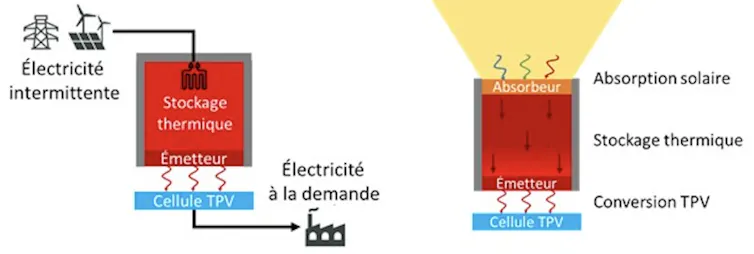
Different thermophotovoltaic devices
The most mature system to date does not use solar radiation to heat the storage medium,but simply electricity. It is therefore similar to a lithium-ion battery, but performs successive energy conversions “electricity → heat → electricity” instead of “electricity → chemical energy → electricity.” Such devices promise to be competitive inbecause of their relatively low costsand today are beginning to bemarketedAt the industrial scale.
It would be even more interesting toheat the storage medium directly with solar radiation, as with the conventional CSP, so that the system becomes a source of non-intermittent renewable energy.

Vera Moerbeek,Provided by the author
For this reason,wehave realized thefirst experimental prototypeof this device, whose storage medium is heated using concentrated solar radiation, thus following a “solar → heat → electricity” conversion. An important advantage of our device is that it could be cost-effective at a much smaller scale than current CSP systems, due to the replacement of the turbine with thermophotovoltaic (TPV) cells.
However, the overall efficiency of this new type of thermal battery (sun → heat → electricity) — including the efficiency of the thermophotovoltaic cells themselves (for the final conversion of heat into electricity) — still needs to be improved in the laboratory, so that this technology becomes more competitive.

Vera Moerbeek received funding from the doctoral school “energy and environment” (ED305).
–ref. A new path to store solar energy… and supply electricity when the sun is absent –https://theconversation.com/a-new-pathway-to-store-solar-energy-and-supply-electricity-when-the-sun-is-absent-279710