

Source: French to English Tester Published on: 2026-04-07
Source: The Conversation – in French– By Tristan Boursier, Doctor in Political Science, Sciences Po; University of Quebec in Outaouais (UQO)
The annual report of the High Council for Equality between Women and Men, recently published, identifies a “masculinist threat.” But what exactly does this phenomenon encompass? How can these politically structured discourses serve as an entry point to more radical positions, even to far-right movements?
According to historian Christine Bard, masculinism refers to amovement claiming to defend the interests of men within a society that would have become gynocentric, either led and dominated by women.
This is therefore not a mere criticism of feminism, but a questioning of the pursuit of equality itself, perceived as a threat. The results of thesurvey, published by the High Council for Equality between Women and Men (HCE), are unequivocal: 60% of men believe that feminists have exaggerated demands and would like to have more power than their fellow citizens. These statements are based on masculinist victimization rhetoric: men would be in“crisis”Because of women’s emancipation movements – an argument found in the majority of anti-feminist spaces, both online and offline.
According to thisreport, the rise of masculinist discourse would constitute a new form of contemporary antifeminism, particularly prevalent on social networks.
Antifeminism is not (just) sexism: it is a political worldview
While sexism valorizes behaviors that conform to traditional gender roles, misogyny is expressed through explicit hostility towards women who do not meet these expectations. It functions as the repressive arm of patriarchy and manifests itself in the form of insults, actions, or any will to keep women in a subordinate position.
Antifeminism politicizes this hostility: it is a counter-political movement that openly opposeson the advances of women’s rights.
Antifeminist ideas generally rely on biologically deterministic arguments. For example, some masculinist rhetoric resorts to so-called “benevolent” sexism, presenting women as weak and in need of protection.Conversely, other communities such as theincels(contraction ofinvoluntary celibates, in English, or involuntary celibates) are men who attribute their lack of sexual or emotional relationships to the diabolical, mercenary, and manipulative nature of women.
On digital platforms, the term “manosphere” is used as an umbrella category that refers to a variety of antifeminist actors: theincels, thePick-Up Artists(seduction coaches) who promised men techniques to win over women, TheMGTOW(Men Going Their Own Way, men following their own path) who want to secede from women, etc.
From seduction to hatred: the radicalization of masculinist communities
Currently, we would be in aneo-manospherewhere the groups that originally composed it become more and more radicalized. Ameta-analysisof 430 recent scientific publications shows that, since the late 2010s, the “manosphere” has undergone several major transformations: migration to new platforms such as TikTok and Telegram, the rise in prominence of very visible influencers (manfluencers), intensification of monetization, and increased overlap with other extremist ideologies.
Internally, theThe composition of the groups has also evolved. Older communities, such as thePick-Up Artists, have seen their influence decline in favor ofincels.Quantitative studiesbased on the analysis of forums and the Reddit and Telegram platforms show that, between 2016 and 2022, the “spacesincels“have gained in centrality after the closure of certain forums, but also in virulence in the expressed statements (more calls for violence, nihilistic rhetoric, and links to far-right content). The “manosphere” therefore does not just gain followers, its discourse isradicalizealso.
The central role of influencers and digital platforms
The dissemination of male chauvinist speeches ismassive since the late 2010s thanks to viral spreadof certain digital content, such as those produced by the British influencerAndrew Tatewho held simultaneously12 billion views before the closure of his TikTok account.
In France, the most popular influencers (like Alex Hitchens or Stéphane Édouard) cap at 1.5 million views on their most popular YouTube videos. This massification is now part of a digital ecosystem structured by the specific logics of the platforms.
In 2024, astudyrevealed that it took only 26 minutes for a user to be suggested masculinist content on TikTok and YouTube Shorts. This rapid exposure is not accidental: it results from algorithmic systems that favor content generating the most engagement (viaclicks, shares, and comments).
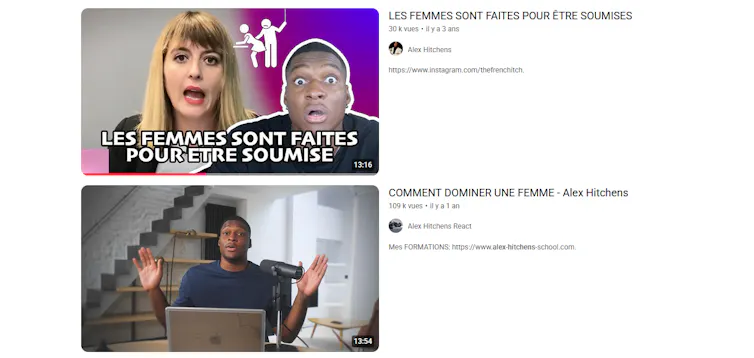
YouTube screenshot
The youngest are particularly affected. According to thedigital barometer 2026, 90% of 13–17 year olds regularly use social networks and spend on average nearly three hours per day on them. However, the latest report from the HCE establishes a link between the use of certain platforms — notably TikTok and X — and higher levels of hostile sexism. Young men, explicitly targeted by this content, are thus among the audiences most receptive to antifeminist rhetoric.
Resentment and profit, the ingredients of the masculinist economic model
These speeches rely on particularly effective emotional mechanisms inthe attention economyA: anger, resentment, fear of downward social mobility, feeling of injustice. The most polarizing, aggressive, and provocative content is what circulates best. Verbal violence is therefore not a marginal excess but a resource that captures attention,strengthens the visibility of creatorsand in return feeds the economic models of platforms based on data collection and engagement monetization.
By claiming that men would be in difficulty in a society that has become hostile, certain influencers create a demand to which they then offer monetizable responses: content, training, coaching. This economic dimension, although secondary, contributes to thesustainability and professionalization of these discourses. The most emblematic example is that of Andrew Tate who, before his ban in 2022, claimed more than 100,000 subscribers to his platform “Hustler’s University”, charged 99 dollars per month – a model likely to generate several million dollars monthly according to estimates reported by theBBC.
Masculinism, the cement of the radical right
Men’s rights speeches largely overflow beyond the “manosphere.” They seem to constitute entry points to other radical speeches, such as thewhite supremacism, and have been linked to violent acts in some cases. The 2018 Toronto attack, claimed in the name of a “rebellionincel” or the Isla Vista shooting in 2014 in the United States highlighted the link between radicalized misogyny and political violence. Misogyny constitutes arecurring leitmotifin several contemporary extremist manifestos.
Masculinists also play aunifying roleA: by presenting feminism as a common adversary, they allow very different groups (nationalists, identitarians, religious conservatives, or libertarians) to come together around the same fight, even if they do not share the rest of their program. Masculinism thus acts as aminimal political languagebased on resentment, which facilitates the formation of reactionary coalitions and offers the far right a means to intervene in a renewed way on social issues on which it was previously unconvincing (education, family, sexuality, sexual crimes, equality policies).
Fighting masculinism, a democratic challenge
Rather than outright rejecting feminism, some actorstake back ownershipfrom now on his vocabulary to turn it against him, like the Nemesis collective which claims to be of a“identity feminism”. An unthinkable turnaround at the beginning of the 2000s, when the far right was content to discredit feminist demands; and which illustrates the ability of masculinism to serve as a point of convergence within heterogeneous reactionary coalitions.
The rise of masculinist discourse is not an isolated phenomenon, but the symptom of a broader transformation that is reconfiguring political and digital spaces by shifting the boundaries of what is publicly acceptable. As highlighted in the HCE report, the problem is not limited to a technical issue: it involves both better regulation of platforms, preventive actions, and strengthening digital education.

Tristan Boursier received funding from the Interdisciplinary Research Center on Diversity and Democracy (CRIDAQ).
Océane Corbin is a member of the Laboratory on Communication and Digital Technology (LabCMO), as well as the research project on antifeminism. She is funded by the Quebec Research Funds (FRQ).
–ref. Masculinism, a springboard towards reactionary ideologies –https://theconversation.com/le-masculinisme-un-tremplin-vers-des-ideologies-reactionnaires-276882