

Source: French to English Tester Published on: 2026-04-07
Source: The Conversation – in French– By Albane Buriel, Associate lecturer, Université Rennes 2
The war in Iran is causing a major humanitarian crisis, worsening existing vulnerabilities in several countries. Supply chain disruptions and rising costs are making aid delivery more difficult, while massive displacements, infrastructure destruction, and food insecurity are intensifying throughout the region. The crisis has global repercussions, further weakens the humanitarian system, and underscores the need for a diplomatic rather than a military solution.
One month after the start of the joint attack by the United States and Israel against Iran, the conflict far exceeds the military sphere. It transforms a regional crisis into an interconnected humanitarian shock, disrupting the delivery of aid, food markets, and living conditions for millions of civilians. In a context of ongoing access constraints and limited funding, humanitarian operations are under severe strain, while violence intensifies and spreads across multiple fronts.
Structural vulnerabilities already at work
The region is already marked by prolonged crises, fragile economies, and a strong dependence on imports. What we observe is not so much the emergence of a new crisis, but the acceleration of existing vulnerabilities.
Yemen is heavily dependent on food imports: any increase in fuel costs immediately affects prices.Oxfam warns about the situationIn Africa: about 18 million people suffer from food insecurity, in a context where the humanitarian plan was only 28% funded in 2025. In this already critical context,the involvement of the Houthis in the conflictcould further exacerbate the humanitarian situation.
In Afghanistan, 17.4 million people are in acute food insecurity, according to theWorld Food Programme. In Sudan, violence and massive displacements continue, in one of the most severe humanitarian crises in the world. Levels of hunger reach, in some areas, thresholds close to famine.
In these contexts, health and supply systems are already operating under strain. The current war acts as a multiplier of vulnerabilities. In economies heavily dependent on imports, any regional disruption can have immediate effects on markets and access to food.
The delivery of aid, the invisible heart of the crisis
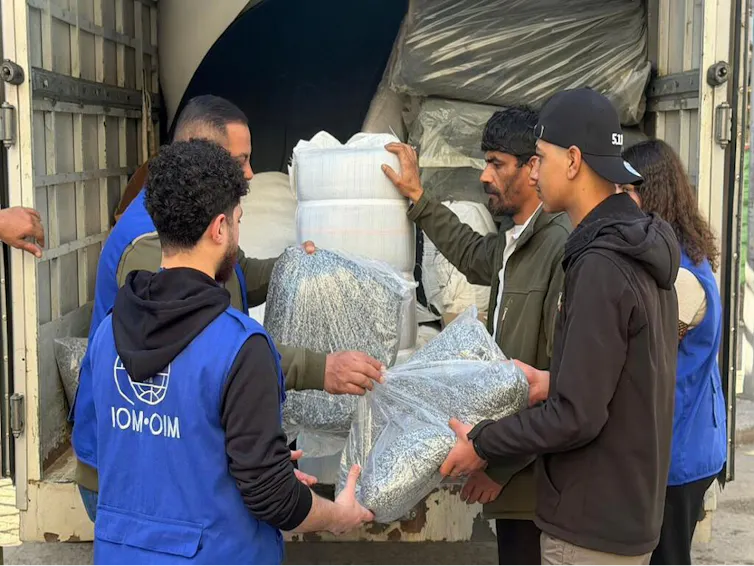
The delivery of humanitarian aid relies on complex logistical chains, dependent on trade routes, energy costs, and regional stability. However, these balances are now profoundly disrupted. The disruptions of supply chains around the Strait of Hormuz, through which about 20% of the world’s oil passes, exacerbate this rise in energy prices, and, by extension, those of foodstuffs.The International Federation of Red Cross alertson the increase in fuel, transport and freight costs, on the closure of certain routes, and on the lengthening of delays.
International Organization for Migration (IOM)
Humanitarian actors therefore have to bypass certain areas, use longer routes, and manage increasing uncertainty about delivery times. Specifically, transporting food, medicine, or essential supplies becomes longer, more costly, and sometimes riskier, forcing organizations to make trade-offs, reduce some distributions, or prioritize the most critical situations.
On the ground, crises that follow one another
The effects of the war are spreading on a regional scale. Millions of people have fled their homes in Iran and Lebanon, while attacks on civilian, energy, health, or water infrastructure are depriving already vulnerable populations of electricity, water, healthcare, and heating. In more than a dozen countries, populations remain exposed to direct or indirect threats linked to the escalation.
Needs are increasing very rapidly, even as the capacity to meet them is decreasing. Behind these dynamics, there are very concrete realities: displaced families, children out of school, patients who cannot access care, households struggling to feed themselves.
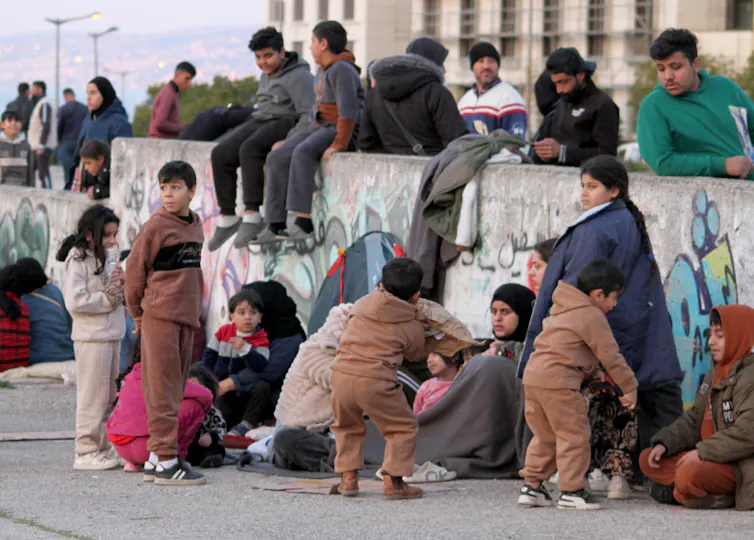
In Lebanon, the situation is particularly critical. More than one million people have been displaced, or 1 in 5 inhabitants. Shelters are saturated, schools requisitioned, andat least 54 health centers and 5 hospitals have closed.
In some shelters, several families share the same room, with limited access to water, electricity, and adequate sanitary facilities. Fuel shortages also affect the operation of hospitals and essential services.According to UNRWA, the Palestinian refugees, already in a situation of great precariousness, see their dependence on aid increase in a context where its delivery becomes increasingly difficult.
UNICEF/UNI956430
In Iran, between 600,000 and 1 million households, that is up to 3.2 million people,have been relocated inside the country. These massive displacements disrupt living conditions and increase pressure on reception areas. The destruction of infrastructure, notably energy-related, causes power outages, difficulties in access to water and healthcare, as well as increased health risks, particularly related to pollution and the degradation of services. The refugees already present, especially theAfghans, are even more exposed.
In Syria, the arrival of more than 190,000 people fleeing Lebanon, with nearly half of them being children, puts a system already weakened by more than a decade of conflict and a fragile economic recovery under strain. These crises no longer simply add up: they reinforce each other. The populations flee both the war and the collapse of their living conditions.
In the Palestinian territories, humanitarian access remains severely constrained. In Gaza, dependence on a very limited number of crossing points, such as Kerem Shalom, makes the delivery of aid particularly difficult. In the West Bank, new movement restrictions, military operations, and the intensification of violence, particularly by settlers, hinder access to healthcare, work, and education, exacerbating aalready extremely fragile situation.
According tothe NGO Save the Children, more than 52 million children in the Middle East have their schooling disrupted while exposure to violence and repeated displacement causes lasting effects on their mental health.
Beyond the region, a global crisis of vulnerabilities
The effects of this escalation go far beyond the Middle East. What is emerging is a global crisis of humanitarian vulnerabilities, whose repercussions extend well beyond the conflict zones. Developing countries in Asia and Africa, particularly dependent on imports and already exposed to economic and climatic shocks, are likely to be the hardest hit.
Added to this are disruptions in fertilizer markets, essential for agricultural production, which could sustainably affect yields and increase the risks of food insecurity in many regions of the world, notably in East Africa and the Sahel.
According to the World Food Programme, up to 45 million additional people could fall into acute food insecurity if the escalation continues.
A crisis of the humanitarian system… and of international law
This crisis comes at a time when the humanitarian system is already under great strain. Needs are increasing, while funding is decreasing, forcing organizations to reduce their activities. The disengagement, even partial, of certain donors, notably the United States, further widens the gap between needs and response capacities.
At the same time, the modalities of the conflicts contribute to worsening the situation. Attacks against civilians, infrastructure, and humanitarian actors, as well as restrictions on humanitarian access, reflect a tangible erosion of international humanitarian law. This dual movement – dwindling resources and weakening norms – produces a form of structural violence, where the very capacity to protect populations is thwarted.
In this context, a peacebuilding-centered approach appears essential. Neither military escalation nor solely managing the emergency humanitarian response can sustainably address the crisis. This approach is based on de-escalation, the protection of civilians, and the reconstruction of durable political frameworks. As recalled by theUnited Nations spokesperson, Stéphane Dujarric, “there simply is no military solution to this conflict” and all parties must prioritize the diplomatic channels available to them. Far from being naive, this approach is now a necessity.
More than a month after the start of the escalation, the humanitarian crisis is no longer an indirect consequence of the conflict: it now constitutes one of its main fronts.

Albane Buriel does not work for, advise, own shares in, nor receive funds from any organization that could benefit from this article, and has declared no other affiliation than her research organization.
–ref. Middle East: how the war turns a regional crisis into a major humanitarian emergency –https://theconversation.com/middle-east-how-the-war-is-transforming-a-regional-crisis-into-a-major-humanitarian-emergency-279530