

Source: French to English Tester Published on: 2026-04-07
Source: The Conversation – in French– By Benyamin Shajari, Professor of Supply Chain Management, Excelia
When the Strait of Hormuz closes, everyone watches the price of oil. That is understandable, but it misses the point. What is cracking today in the Persian Gulf is the entire commercial architecture of a region and, this time, it doesn’t look like a parenthesis. Will Saudi Arabia emerge as the big winner?
When we talk about the blockade of the Strait of Hormuz, we first think of oil and the energy crisis. The real shift is elsewhere.
The war mainly shows that a major trade route can become unusable almost overnight. When a route closes, it is not always enough to simply choose another one. Sometimes it is necessary to rethink the entire organization of trade, from ports to land routes, including warehouses, customs, and delivery times.
In aclassic disturbance, companies often know how to improvise. But these adjustments require a minimum ofvisibility. This crisis leaves no time forto adapt to the margin. Troubleshooting solutions adapted to short or local crises are no longer sufficient when uncertainty becomes permanent. It is no longer just a matter of withstanding a shock, but of radically changing trade routes.
Who will be the losers and winners of these new routes in the Persian Gulf?
No port is safe
Theport of SalalahOman illustrates the situation well. Located outside the Strait of Hormuz, it could serve as a fallback for ships waiting in theGulf of Oman.
TheIranian attacks at the end of March 2026have shown that a port considered safe can also become a target. The blockade of Hormuz disrupts the economic logic. Companies are looking not only for the fastest or cheapest route, but also the most sustainable. A solution can be effective for a few days and then become unusable. Companies must therefore constantly adapt in the face of continuous instability.
Saudi Arabia as a regional pivot
In this context, Saudi Arabia appears as a central player. For several years, the kingdom has wanted to become a major logistics platform between Asia, Europe, and Africa. This ambition is at the heart of its national transport and logistics strategy andVision 2030.
Under normal circumstances, this type of project is a long-term endeavor. In times of war, it takes on immediate value.
If the Persian Gulf becomes too risky, the idea is to be able to channel more traffic through the Red Sea, then redistribute it inland across the peninsula via road to logistics zones and, perhaps tomorrow, by rail. The project ofSaudi LandbridgeAt 7 billion euros, which must connect the port of Jeddah (in the west) to the port of Dammam (in the east) via Riyadh over a distance of 1,500 kilometers, takes on new importance here.
The road takes over
Since these infrastructures are not built quickly, private actors have already deployed transitional solutions.CMA-CGMuses a land bridge under customs supervision from Jeddah followed by road transport to several countries of the Persian Gulf.MSCdischarge at the nearest safe port and applies an additional cost of 800 dollars (693.98 euros) per container. The reorganization is therefore already underway.
The real challenge is here. The country that will matter tomorrow will not only be the one that has good ports, but the one that knows how to quickly connect its ports, its roads, its warehouses, and its procedures. In a crisis such as the closure of the Strait of Hormuz, logistical performance depends less on an isolated infrastructure than on the ability to hold an entire system together.

Wikimedia,CC BY-NC
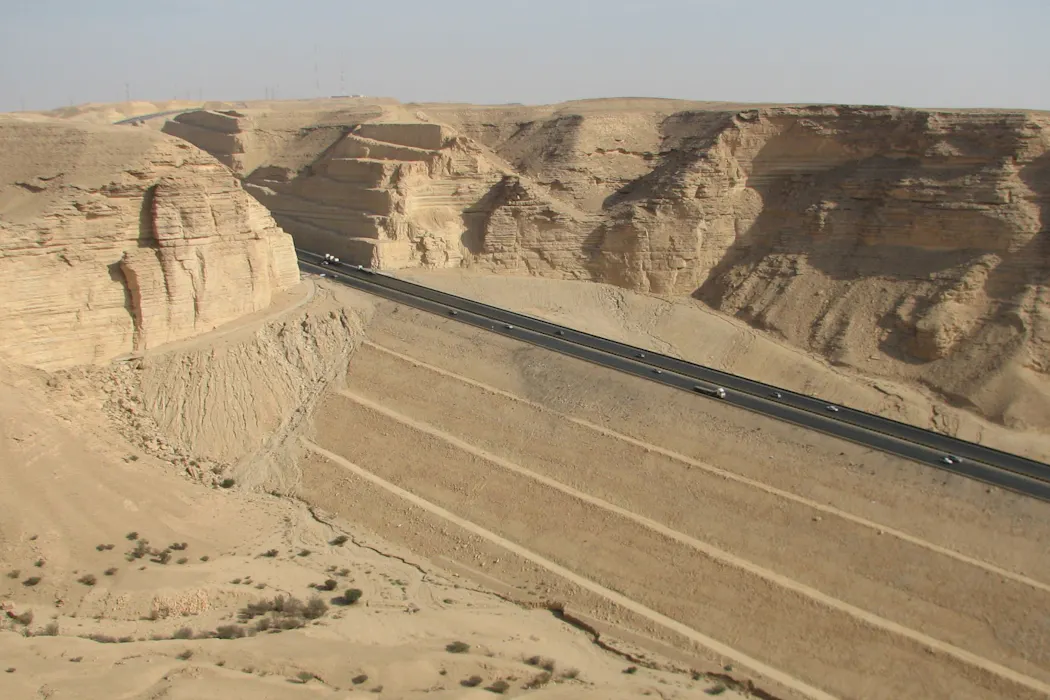
The importance of Saudi infrastructure is explained in this context. The Landbridge project connecting the Red Sea to the Persian Gulf contributes to this, but the kingdom’s asset already rests on its size, position, and land network. The axis between Jeddah and Dammam, structured by theHighwayAt 40 and connected to theHighwayAt 95, offers rare logistical depth. While several Persian Gulf countries see their maritime access weakened, this land continuity becomes strategic and could make Saudi Arabia a regional bypass pivot.
Innovation accelerator
This shift towards new routes requires atechnological modernizationaccelerated. Managing multimodal corridors combining substitute maritime freight and land transport over long distances, such as between Jeddah and Riyadh, requires suitable logistics capabilities. This includes transshipment platforms, road axes capable of handling heavy truck traffic, refrigerated warehouses, dry storage areas, as well as refueling stations. TheSaudi actorsare not all yet at this level, despite the efforts related to Vision 2030.
Digitalization becomes central with dematerialized customs, real-time tracking of flows, the use of artificial intelligence andthe Internet of Things, as well as close coordination between ports, carriers, and warehouses spread across several countries. All of this is developing urgently. This constraint accelerates innovation by reducing decision times and promoting cooperation. The Saudi actors investing in these capacities will not simply come out relieved to have survived thecrisis. They will emerge structurally more competitive, endowed with rare logistical expertise in an arid and desert environment and with infrastructures calibrated for volumes that their rivals cannot yet absorb.

GranTotufo/Shutterstock
New logistics corridors
The conflict leads to a redistribution of competitive advantages in the region. Saudi Arabia is no longer limited to its hydrocarbons and could become the architect of a logistics network over which it controls the key nodes. This transformation was not planned. It is the direct product of a crisis that forced a reconfiguration too profound to be reversible. The reorganization remains fragile, however. The more the kingdom becomes an essential corridor, the more its roads, ports, and hubs become targets.
War therefore reinforces his centrality while exposing him. In a context where evenOman, Iran’s long-time ally, has not been spared, a returnTo the previous situationseems unlikely. The challenge now is to identify logistical corridors capable of remaining open long enough to become sustainable.

Benyamin Shajari does not work for, advise, hold shares in, receive funds from any organization that could benefit from this article, and has declared no other affiliations than his research institution.
–ref. With the war, the highways and railways of the Persian Gulf take over from the sea –https://theconversation.com/with-the-war-the-highways-and-railways-of-the-persian-gulf_take_over_from_the_sea-278339