

Source: French to English Tester Published on: 2026-04-03
Source: The Conversation – France (in French)– By Andrew Garin, Associate Professor of Economics, Carnegie Mellon University
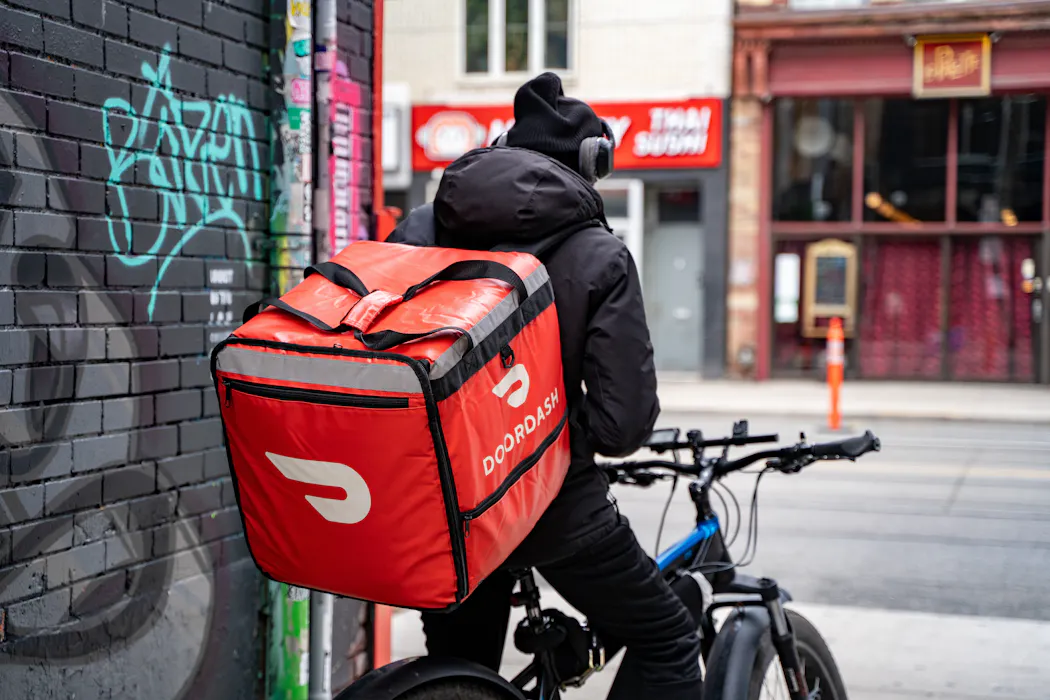
By raising the minimum pay for platform delivery workers, Seattle wanted to improve their working conditions. But in an open market where anyone can become a delivery person, the gains were absorbed by competition and the decrease in orders.
If you have already ordered food via Deliveroo or Uber Eats, you may have noticed that the person whoyou deliver is not an employee. They are workers of the “gig economy”: independents whoaccept delivery tasks via an application, are paid per ride and do not benefit from guaranteed hours, social benefits, or protections related to a minimum wage.
In several cities, political leaders have attempted to change this situation.
Seattle offers a good example. In January 2024, the city implemented a law requiring delivery apps topay drivers a minimum payment for each assignment: a remuneration combining a minimum rate per minute and per mile, which sets afloor of about 5 dollars per delivery (4.34 euros).
The goal was simple: to ensure that the people who bring you your lunch can earn a proper living. We arelabor economists and researchers in economicsand we have extensively studiedthe rise of the gig economyas well as the previous policies aimed atbring greater economic security to workers in unstable jobs. We wanted to understand how new regulations of the platform economy, like the one implemented in Seattle, were concretely translated on the ground.
By studying the evolution of delivery drivers’ incomes after the implementation of this rule regarding payment in Seattle, we found that, despite a base pay per delivery that roughly doubled,their total monthly income has barely changed. The competition among delivery workers to get orders has intensified, while customers placed fewer orders and left lower tips after the measure was implemented. In the end, these combined effects almost completely negated all the expected gains.
No change in monthly income
To understand the effects of this policy, we useddetailed data from Gridwise, an application that platform workers use to track their earnings across multiple delivery and ride-hailing apps. This gave us a particularly comprehensive view of what delivery workers were actually earning across all the platforms they used.
We compared the evolution of the incomes of delivery workers who mainly worked in Seattle before the law came into effect with that of delivery workers operating in other regions of the state of Washington (northwest United States), where nothing had changed. By tracking these two groups during the months before and after the implementation of the measure, we were able to isolate the effect of this policy from broader trends affecting all delivery workers.
The base pay per delivery in Seattle has increased from about 5 dollars to over 12 dollars (10.42 euros), as planned. But this base salary only represents part of the income. Tips generally constitute thelargest part of the income of delivery workers working for platforms, because customers generally leave a tip of 10% to 20% of the price of their meal.
After the law came into effect, tips dropped sharply. Delivery apps passed their cost increases on to consumers inadding new fees. DoorDash (NDT: one of the global leaders in meal delivery, notably the owner of Deliveroo) thus added about 5 dollars (4.34 euros) of “regulatory response fees” to orders placed in Seattle, and customers reacted by leaving smaller tips.
Some platforms have gone further: Uber Eats evenremoved the option allowing Seattle customers to leave a tipat the time of payment. The decrease in tips thus canceled out more than a third of the increase in the base salary.
The other major change is that delivery workers started making fewer deliveries. From the second month following the implementation of the measure, Seattle delivery workers who were regularly active on the apps before the reform made about 20% to 30% fewer monthly deliveries than they would have made without this policy.
Important fact: these delivery workers did not leave the platforms. They continued to log in and work roughly the same number of hours. But they simply received fewer delivery offers.
What were the delivery drivers doing with all that extra time spent on the app? Our data shows that they were spending a greater part of it waiting.
The proportion of time spent on the app actually devoted to paid deliveries has significantly decreased. The waiting times between two tasks have increased by about five minutes, almost double compared to the period before the reform. And the delivery drivers traveled longer distances between two runs, suggesting that they were actively heading towards areas rich in restaurants to find their next delivery, consuming more gasoline without being compensated for these additional kilometers.
If you put these elements together – higher pay per delivery, but fewer deliveries and lower tips – the effects almost completely cancel each other out. After a slight increase in the first month, monthly income returned to its pre-reform level.
Why these labor markets are different
To understand what happened, it is necessary to reflect on how platform-based delivery markets differ from traditional employment. In a classic job, raising the minimum wage creates a fairly clear dividing line: employees who keep their positions earn more, while others may find it more difficult to find work if companies reduce their staff.
In platform-based delivery in the United States, this separation does not exist. There is neither hiring nor firing: anyone can download the application and start looking for deliveries. Deliveries are distributed among all connected individuals, and there is no clear boundary between having a job and not having one.
When pay per delivery increases, platform work becomes more attractive, which draws new delivery workers to the market. At the same time, higher costs related to delivery workers’ pay are passed on to consumers in the form of higher delivery prices, which can lead to fewer orders and lower tips. More delivery workers competing for a reduced number of deliveries also means longer waiting times between assignments.
This process continues until the increase in piece-rate pay is fully offset by the lengthening of unpaid work periods.
Our data confirm this mechanism. While the number of deliveries made by couriers already present in Seattle has sharply declined, new entrants have arrived. Within three months, the newcomers were making the majority of deliveries in the city.
What this means for the future
There is little doubt that the low earnings of platform workers constitute a real problem. The momentum that led to the law adopted in Seattle reflects legitimate concerns. But our findings also suggest that attempts to directly regulate platform workers’ pay per task will not easily resolve this issue.
As long as anyone can join the platform and start competing for deliveries, the guarantee of higher pay per delivery will attract more couriers, until this advantage is absorbed by the lengthening of waiting times between assignments.
Other cities and states are following this path
To truly increase revenue, it might be necessary to limit the number of active delivery people – a system comparable totaxi licenses used in certain citiesin order to guarantee high incomes for drivers.
But establishing barriers to entry would call into question the flexibility that attracts many people to platform work. The behavior of platforms also plays a role: if applications restore normal tipping features in the future rather than strategically discouraging them – whichNew York and certain other jurisdictions now require– the situation of delivery workers could improve somewhat. However, it may be that there is no solution that preserves all the advantages of the current system while guaranteeing higher incomes.
Despite this, several American citiesare considering similar regulations.
New York has implementedits own minimum wage for couriers working via applicationsAt the end of 2023. City councils and state legislators in Chicago, Colorado, Minnesota, and elsewhere have proposed similar protections.
Seattle’s experience suggests, however, that all cities should proceed with caution and be aware of the limitations of what regulations based on per-task remuneration can really achieve when the door remains open to the arrival of new workers.

To purchase access to the data used in this study, Brian K. Kovak received funding from the Block Center for Technology and Society at Carnegie Mellon University.
Andrew Garin and Yuan An do not work for, advise, own shares, or receive funds from any organization that could benefit from this article, and have declared no other affiliation than their academic position.
–ref. Why doubling the remuneration of delivery workers did not increase their incomes in Seattle –https://theconversation.com/why-doubling-the-pay-of-delivery-workers-did-not-increase-their-income-in-seattle-279583