

Source: French to English Tester Published on: 2026-04-02
Source: The Conversation – in French– By Elora Chatain, PhD student, Inrae
Lake Geneva, a Franco-Swiss lake, has never been so clear, but this is not necessarily good news for the largest lake in Western Europe. Behind this postcard-perfect appearance hides a silent invasion: that of the quagga mussel, which massively filters the water, risking profound disruption of the lake’s balance. Some fish species could be threatened, but so could human activities: this species also, indeed, colonizes the pipelines that provide water supply.
Since 2015, the water of Lake Geneva, a border lake between France and Switzerland, has been gradually becoming crystal clear. A boon for swimmers: perfect visibility, turquoise reflections… a slight air of the Maldives right in the heart of Europe!
But behind this appealing postcard lies a troubling question: is water that is too clear necessarily a sign of good ecological health? Because this dramatic change here is not due to a natural miracle, but largely to the silent action of a tiny bivalve barely two centimeters long: the quagga mussel.
And although this new transparency may seem trivial, even delightful, it is actually the visible symptom of a deep upheaval. Because beneath the surface of Lake Geneva,the lake’s balance is being redefinedaround a long-established invader. This could eventually lead to the decline of phytoplankton and the fish that depend on it, as well as algal blooms.
Up to two liters of filtered water per day… per mussel!
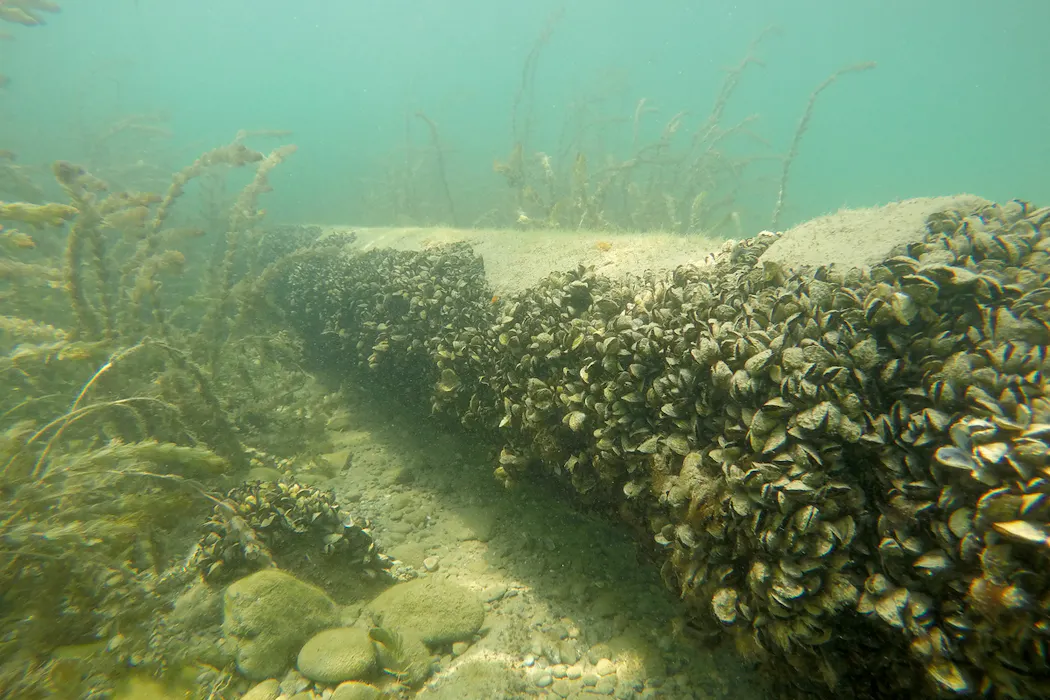
Discreet, this mussel filters water with formidable efficiency: up totwo liters of filtered water per day and per mold. At first glance, it seems insignificant, almost trivial. But multiply this number by the number of individuals, on average, 4,000 individuals per square meter, and you get a biological filtration machine of dizzying power.
Today, it is a silent army that carpets the bottom of Lake Geneva and other lakes in Europe and around the world, profoundly transforming their functioning. In an ecosystem, no change of such magnitude can be neutral. This massive filtration disrupts biological balances and seriously complicates the management of the lake.

LÉXPLORE, Sébastien Lavanchy
Scientific nameDreissena rostriformis bugensis, the quagga mussel is ainvasive exotic species. She was not born in Lake Geneva.
Originating from estuaries of the Pontocaspian basin and more precisely from the Dnieper delta in Ukraine, she traveled despite herself – or rather thanks to and because of us. Transported in the ballast waters of ships or attached to the hulls of boats, she crossed continents and oceans, colonizing theGreat Lakes of North America since 1988, long before reaching the European lakes. It is morphologically and ecologically close to the zebra mussel (Dreissena polymorpha), another well-known invasive species, but the quagga appears to have an even greater capacity for adaptation.

S. Jacquet,Provided by the author
It is estimated that theLéman was affectedin 2015, the nearby lake ofBourget in 2017. Since 2022, the species has also been reportedin Lake Garda, first occurrence south of the Alps. Its presence in Lake Maggiore is now strongly suspectedFollowing the detection of his DNA.
Capable of establishing itself permanently, reproducing rapidly, and dispersing on a large scale, the quagga mussel does not merely add itself to the ecosystem:she redraws it. It threatens local species, alters biological balances, and directly impacts certain human activities.
Also to read:
Behind biological invasions, a silent reshaping of ecosystems
An ideal ecological niche for the invader
This invasion, however, began quietly. In 2015, a first individual was observed at the Riva-Gare station, in the canton of Vaud in Switzerland. Ten years later, the observation is striking: the bottom of Lake Geneva is covered with a veritable carpet of mussels (up to18,000 individuals per square meter), with a presence observed at depths greater than 150 meters, well beyond what humans can easily explore.
This rapid expansion of the quagga mussel in Lake Geneva is explained by abundant food, favorable currents, and the absence of natural predators. All conditions are met for a lightning-fast colonization.
All the more so as the species does not seem to be hindered by the extreme environmental constraints. High pressure, total darkness, low temperatures? That does not seem to pose a problem for it. Individuals have been observedAt 250 meters depth, some reaching surprising ages: over ten years, where its average lifespan is rather two or three years near the coast.
How do they manage to survive in such conditions? Can they reproduce there? At what rate? So many questions to which several research teamsare trying today to respond.
A threat to drinking water production

Silvan Rossbacher/EAWAG
The quagga mussel is not picky: it settles on all types of substrates. Various sediments, pebbles, rocks… Even soft bottoms of mud, silt, and sand seem to suit it. However, it does not limit itself to natural environments.
It attaches itself to all available underwater surfaces, including artificial structures. Strainers, pipes, and water intake pipes, especially those intended for drinking water production, become preferred substrates. Ultimately, these infrastructures can bepartially or totally obstructed, compromising the water supply.
The actors concerned then have no other choice but to intervene: repeated cleanings, cleaning of the installations, adding filters to prevent the suction of mussels… All these are essential but costly measures. The presence of the quagga mussel thus results in asignificant additional economic cost, paid directly by the managers and indirectly by the community.
A time bomb?
But the damage caused by the quagga mussel is not limited to a simple invasion of space. Its way of life, seemingly discreet, acts like an ecological time bomb for the lake.

Provided by the author
Because the quagga mussel is a fearsomely effective filter-feeding organism. Constantly,summer and winter, it sucks in water from the lake and extracts plankton through its gills. This is far from a minor detail.
Phytoplankton, the plant component of plankton, constitutes the very foundation of lake life: without it, the entire classic food chain is shaken. Indeed, phytoplankton feeds zooplankton (the animal component of plankton, whose smallest representatives can also be ingested by the mussel). However, the fry, these barely hatched fish, depend directly on the abundance of zooplankton to survive.
The example of the North American Great Lakes is conclusive. There, the massive arrival of the quagga mussel causedthe collapse of populations ofwhitefish(or cored) , an emblematic fishwhich is the economic pillar of fisheries, both at the local level and in large, deep, temperate and cold lakes in general: a social and ecological disaster.
So far, Lake Geneva has not yet experienced such a scenario. But history has already shown us how it can end.
When “too clean” water becomes a problem
By filtering phytoplankton on a very large scale, quagga mussels make the water clearer and therefore more transparent. At first glance, this may seem positive, almost a tourist attraction. However, this unusual clarityalso profoundly disrupts the ecosystem.
Clearer water indeed allows light to penetrate more deeply, stimulating the growth ofmacrophytes, these rooted aquatic plants. These plants, producers of oxygen, nursery and breeding areas for fish, constitute an important component of lake functioning.
But plants and phytoplankton compete and vie for the same nutrients. Result: the more macrophytes proliferate, the more they deprive phytoplankton of resources, further accelerating its decline.
This vicious circle, known as the negative feedback loop, sustains itself and locks the system into a new equilibrium far less favorable to the lake’s original biodiversity and to its pelagic functioning, that is, in the water column. This is referred to asbenthificationlakes (see box below).
What is benthification?
- Benthification is the process by which the energy and biomass of an aquatic ecosystem are transferred from the water column to the bottom (benthic zone).
- In lakes invaded by the quagga mussel, this phenomenon is amplified by its strong filtration capacity. By pumping phytoplankton and suspended particles, the mussel clarifies the water and transfers organic matter to the sediments in the form of feces and pseudofeces. This accumulation enriches the bottom, modifies nutrient cycles (notably phosphorus), and can promote the development of benthic algae and bacteria.
- The issues are ecological and socio-economic: transformation of trophic networks, decline of planktonic species and fish dependent on zooplankton, proliferation of filamentous or toxic algae, and alteration of coastal habitats. The benthification linked to the quagga mussel thus illustrates a profound and lasting reorganization of lake functioning.
Also to read:
In the ocean, how plankton adapted to its turbulent environment
So, why not simply eliminate the quagga mussel?
The answer is simple and brutal: because it is already too late and the colonization of the mollusk is almost complete. Imagining its complete eradication from Lake Geneva is now a matter of fiction, and trying to do so could risk causing an even more serious ecological disaster.
The only realistic option now is to learn to live with this species, as is often the case with exotic species, betterunderstand its ecophysiology, to observe the adaptation of ecosystems, and above all, to prevent history from repeating itself elsewhere. This involves simple but crucial actions: thoroughly rinsing boat hulls, diving equipment, and recreational gear before moving from one lake or watercourse to another.
For while the quagga mussel has already won the battle of Lake Geneva, the war against its spread is not yet lost for other lakes. And it remains to study and test all available approaches to help conserve the native species of Lake Geneva, notably by working on habitat restoration.

Jean-Nicolas Beisel received funding from the ANR (QUALAG project for the period 2025-2029).
Stéphan Jacquet received funding from the ANR (QUALAG project for the period 2025-2029)
Elora Chatain and Théo Gonin do not work for, advise, own shares in, receive funds from any organization that could benefit from this article, and have declared no other affiliations than their university position.
–ref. The clear water of Lake Geneva, good news or symptom of an invasion? The case of the quagga mussel –https://theconversation.com/the-clear-water-of-lake-geneva-good-news-or-symptom-of-invasion-the-case-of-the-quagga-mussel-278611