

Source: French to English Tester Published on: 2026-07-04
Source: The Conversation – in French– By R. Grant Gilmore III, Director, Historic Preservation and Community Planning Program, College of Charleston
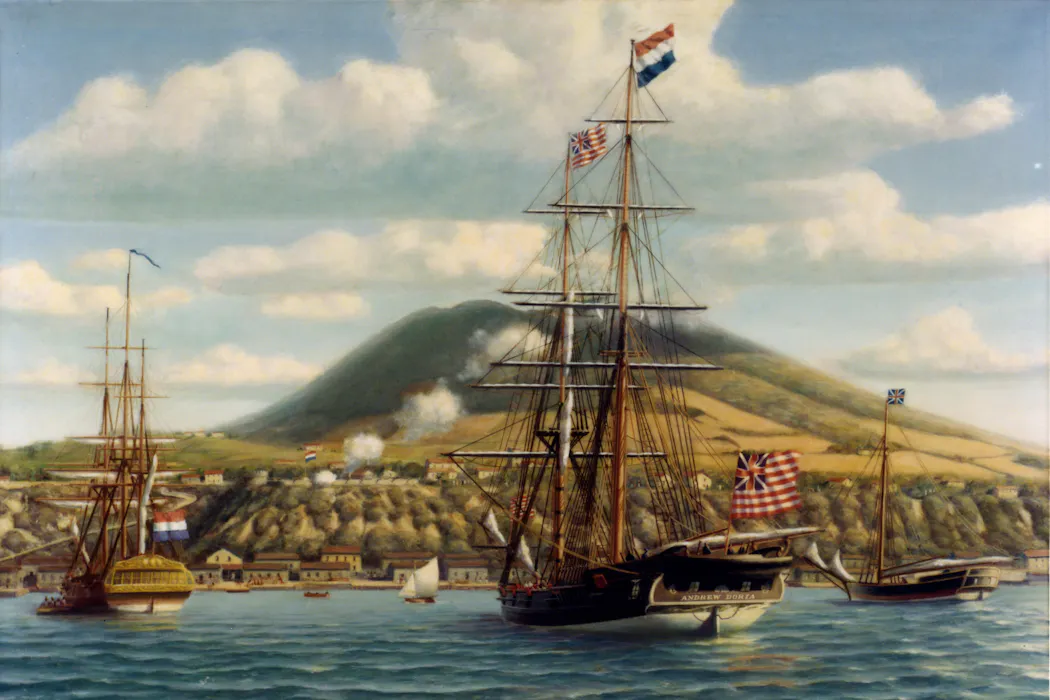
Painting by Phillips Melville, USMC via Wikimedia Commons
In the 18th century, Saint-Eustache was one of the largest commercial centers of the Atlantic. Its status as a free port allowed the American insurgents to bypass the British blockade and obtain the essential resources for their independence.
The American Revolution is often told as the heroic epic of thirteen colonies rising up against a powerful empire and winning their independence, with the help of France.
The reality is, however, more complex. As the 250th anniversary of the United States’ independence approaches, it is useful to remember that the military victory did not rely solely on courage and ideals, but also on commerce, credit, shipping, and access to military supplies.
The center of this trade was not found in the thirteen colonies, but in the southern part of loyalist Florida,in the Greater Caribbean. This is where the heart of the Atlantic economy developed, driven bythe insatiable appetite for sugar, which had spread throughout Europe at the end of the 18th century. Jamaica alone producedas much wealth as all thirteen colonies combined.
Caribbean economies were based on the labor of enslaved people, international trade, and supplies from around the world to keep the sugar flowing and to maximize the tax revenues of European colonial powers. Much of this support passed through a small Dutch island in the eastern Caribbean, now little known to most Americans:Saint-Eustache.
A small island with a huge role
I amarchaeologistand, for eight years at the beginning of my career, I lived in Saint-Eustache, where I was an island archaeologist and founding director of theSt. Eustatius Center for Archaeological Research.
Barely larger than 8 square miles (about 21 square kilometers), Saint-Eustache – orStatia, as its inhabitants call it – is located to the northwest of Saint Kitts and Nevis. Without this tiny island, the American continental army might have lacked weapons, gunpowder, and other supplies essential for its survival.
The importance of Statia lies primarily in its geography. The island rises abruptly from the deep blue waters of the Atlantic and the Caribbean Sea. Its dormant volcano, called the Quill, dominates the entire southern part of the island.
Unlike other higher Caribbean islands, Statia did not receive enough rainfall to be particularly conducive tothe intensive cultivation of sugarcane. It therefore held less interest for the great sugar powers of the 18th century, particularly Great Britain and France.
While Statia had few advantages for plantations, it excelled as a commercial port. Oranje Bay, on the west coast of the island, offered one of the deepest and safest coastal anchorages in the Americas. Large merchant ships could approach the shore, unload their cargo, and then quickly depart after being reloaded.
Along the bay stretched a lively waterfront, lined with warehouses, shops, and commercial houses. In the middle of the 18th century, this narrow coastal strip had become one of the main commercial centers of the Atlantic world.
An imperialism based on trade
The Dutchsettled in Saint-Eustache in the 1630s, roughly at the time when they were developing the colony of New Amsterdam, the current city of New York. Dutch merchants, families, and investors operated within a vast Atlantic network connecting Europe, Africa, the Caribbean, and North America. These commercial ties promoted trust, credit, and opportunities over very long distances.
In the 17th and 18th centuries, the European empires sought tocontrol colonial trade through mercantilism. The colonies were supposed to enrich the metropolis by supplying raw materials and purchasing manufactured goods through approved trade circuits. Taxes, customs duties, and trade restrictions benefited imperial governments and merchants but raised the cost of living for colonists, traders, and planters.
The British settlers of North America poorly tolerated these restrictions, but Dutch traders were willing to help them circumvent them. For generations, Dutch ships carried goods across the Atlantic, often offering products toprices lower than those that British merchants could legally charge.
The archaeological discoveries made at sites such as the Pope’s Creek plantation in Virginia, home of the Washington family, attest tothe presence of Dutch ceramics, of earthenware pipes and yellow bricks. Long before the Revolution, Dutch trade was already deeply integrated into the life of the colonies.
“The warehouse of the world”
In 1754, the Dutch West India Company requested the government of the United Provinces to make Oranjestad, the capital of Saint Eustatius, a free port. Their request was accepted. The result was spectacular: goods could transit through the island with very few restrictions and without the heavy taxes in force elsewhere. The authorities derived their revenue from the rental of land, warehouses, and dwellings, rather than taxing each cargo.
Merchants from across the Atlantic world quickly seized this opportunity. Ships arrived loaded with textiles, tools, foodstuffs, weapons, luxury goods, and raw materials. They also transported captive Africans, forcibly deported as part of the transatlantic trade, then sold, held, forced to work, and subjected to violence. Enslaved individuals and their descendants were essential not only to the island’s plantations but also to homes, docks, warehouses, and commercial networks that powered this economy.
Saint-Eustache became, according to a phrase often associated with the island, “the warehouse of the world.” In today’s terms, it functioned as an Amazon logistics center for the Atlantic of the 18th century. This prosperity was nonetheless basedlargely on slaveryand on the power relations that allowed imperial trade to prosper.
This success did not go unnoticed byAdam Smith, often considered the father of economics, even of capitalism. In his 1776 work,The Wealth of Nations, Smith contributed to making economics a modern discipline. Although he never went to Saint Eustache, he mentions the island there, which in his eyes was a concrete example of what freer trade could produce: prosperity, speed, variety, and commercial dynamism.
The same system that made the island wealthy also made it a threat to the imperial powers. Great Britain and France based their power on tightly controlled colonial trade, but Saint Eustatius demonstrated what could be achieved when goods circulated with fewer constraints. The island also showed that merchants, credit networks, and ship-owning families could shake empires without firing a single shot.

SV Zanshin via Wikimedia Commons,CC BY-NC-SA
When the American colonies declared their independence in 1776,they were desperately in need of military equipment. The Continental Congress knew that ideals alone would not be enough to defeat Great Britain. The future United States needed muskets, cannons, ammunition, uniforms, cloth, provisions, and credit.
Saint-Eustache was ideally located to provide them with all that.
The island’s merchants maintainedfor a long time links with North America, and several of the Founding Fathers were well acquainted with these networks. Alexander Hamilton, whogrew up in the Caribbean, spent his youth in the world of maritime trade, accounting, and credit. His family had ties to the region, and Caribbean trade helped shape his understanding of finance and power.
Saint-Eustache quickly becamea real lifeline for the American Revolution. American representatives supplied themselves there with equipment before shipping it to the colonies. The cargoes arrived from Europe in Statia, then were forwarded to North America. Weapons and gunpowder, impossible to obtain through official channels, could be bought in this Dutch free port.
The first greeting
In November 1776, a seemingly modest but historic event took place in the bay of Oranje. The American brigAndrew Doriaarrived with on board a copy of the Declaration of Independence and flying theContinental Colors, the ancestor of the star-spangled banner. In accordance with maritime customs, the American ship fired a salute. Fort Oranje responded with a salvo from its cannons.
This exchange went down in history under the name of“first greeting”. Many historians see it as the first official recognition of American independence by a foreign power. The gesture was brief, but its significance considerable: by responding to this salvo, Saint-Eustache publicly acknowledged the flag and the authority of the new United States.
Great Britain immediately understood the importance of this act. The island was not just a simple commercial outpost: it contributed to supporting the rebellion. In the following years, a large part of the gunpowder, ammunition, fabrics, and other supplies that allowed the American war effort to continue passed through the warehouses and the port of Statia.
The story of Saint-Eustache reminds us that a revolution is not won solely by the strength of ideas. The American Revolution certainly relied on farmers, soldiers, diplomats, and political thinkers, but also on merchants, sailors, warehouses… and credit.
Without Saint-Eustatius, without Dutch commerce, and without access to a free port in the Caribbean, the United States might not have survived long enough to celebrate even the smallest anniversary of their independence. The American Revolution was certainly a struggle for political independence, but also a fight for control of trade. And in this battle, a tiny island helped change the course of world history.

R. Grant Gilmore III does not work for, advise, own shares in, receive funds from any organization that could benefit from this article, and has declared no other affiliation than his research institution.
–ref. How a tiny Caribbean island made the independence of the United States possible –https://theconversation.com/how-a-tiny-caribbean-island-made-the-independence-of-the-united-states-possible-286670