

Source: The Conversation – France in French (3) [1]
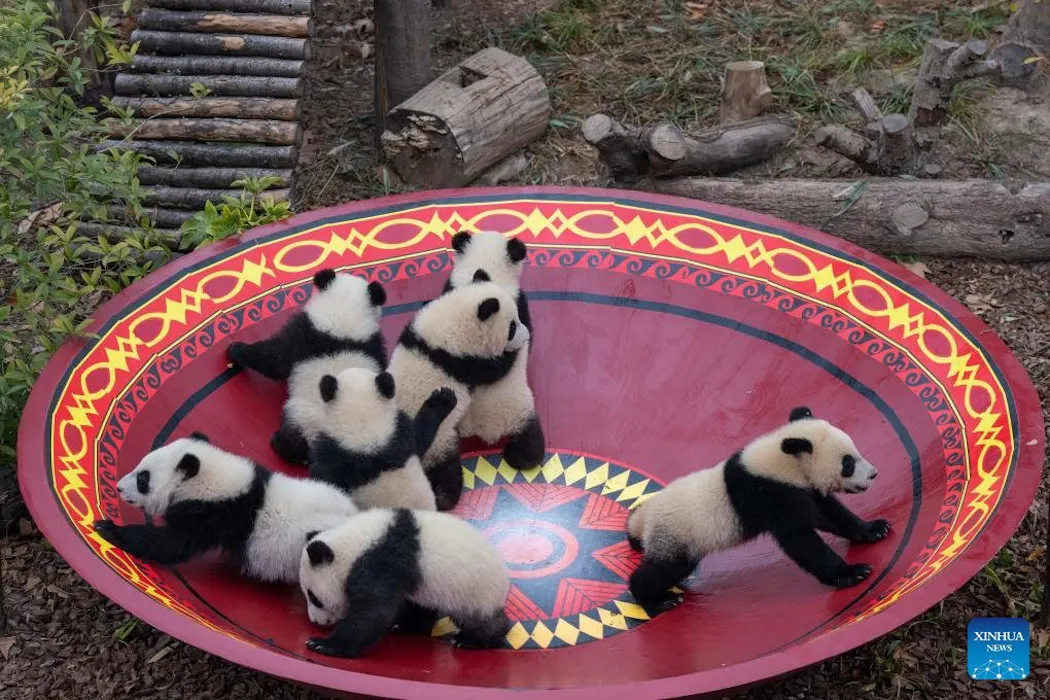
Animal belatedly discovered by the West, the giant panda has become over the decades a symbol skillfully constructed by Beijing, much more political than cultural. The diplomatic sequence at the end of 2025 — marked by the departure of the pandas from Beauval and the presidential visit to China — reminded the general public of the importance of this mascot. On social networks, China uses the emotional power of the panda to weave affectionate ties with the global audience. A digital charm operation whose effectiveness relies on a universal psychological trigger, that of tenderness in the face of juvenile traits.
At the end of 2025, pandas unexpectedly became one of the visible subjects of French media and diplomatic life. This attention was primarily linked to the departure of the pair Huan Huan and Yuan Zi, the two giant pandas who had lived for thirteen years at the Beauval Zoo before returning to China on November 25, 2025. Motivated notably by Huan Huan’s health condition, their return to Chengdu sparked astrong emotion : farewell ceremonies, nostalgic reports, fan videos, and affectionate messages on social networks recalled that these animals had become real celebrities in France and symbols of the Franco-Chinese relationship.
A few days later, Emmanuel Macron’s state visit to China, from December 3 to 5, brought pandas back to the center of the diplomatic narrative. In Chengdu,Brigitte Macron has found Yuan Meng again, the first panda born in France in 2019, of whom she is the godmother. At the same time, China announced a new cycle of cooperation with France around the giant panda, with the scheduled arrival of a new couple in Beauval in 2027.
Behind this seemingly endearing sequence lies a central question of international communication: how can an animal simply perceived as cute, harmless, and universally lovable become a strategic resource for public diplomacy and influence, particularly digital?
A political symbol reinvented by history
Contrary to a widely held belief today, the giant panda has not always occupied a central place in the Chinese political imagination. References to this animal remain relatively rare in Chinese historical and literary records, and its discovery by the Western world dates back only to 1869, when the French missionary Armand David proposed itfirst scientific description.
It is only in the 20th centuryeIt is in the century that the panda gains increasing international visibility, before gradually being invested with a political and diplomatic function. The first diplomatic uses of the panda date back to the Republic of China during the Second World War. A founding episode occurred in 1941, when the nationalist regime led by the Kuomintang wished to thank the American government for its support to China in the war of resistance against the Japanese invasion. Madame Chiang Kai-shek then organized the sending of two giant pandas to the United States,Pan Dee and Pan Dah. The choice of these animals as diplomatic gifts is explained in particular by thepopularity they had already acquired among the American publicFollowing their introduction in the West by Harkness and Tangier-Smith in the 1930s and 1940s.
The People’s Republic of China, established in 1949, will inherit this legacy by incorporating it into a broader ideological project.
In the 1950s, zoological and paleontological research dedicated to the panda was mobilized to illustrate the principles of“dialectical materialism”, promote a socialist conception of science and contribute to theconstruction of national symbols rooted in Chinese territory. The panda thus appears less as an age-old cultural symbol than as a relatively recent political construct, associated with the scientific, national, and diplomatic legitimization of the regime.
Since the 1950s, panda diplomacy—which is part of Maoist people’s diplomacy strategy—has been gradually implemented by Beijing. Originally, this Chinese animal diplomacy aims to offer or lease giant pandas to partner countries to symbolize friendship and cooperation. Panda diplomacy became popular after President Richard Nixon’s visit to China in 1972: Mao Zedong’s government then sent a pair of pandas as state gifts to the United States to symbolize the thaw in Sino-American relations.
Giant pandas quickly became media stars because of their endearing teddy bear-like appearance and clumsy behavior. Since then, panda diplomacy has gradually transformed into a form of public diplomacy.In the Chinese style.
Starting from the 2010s, the Chinese authorities implemented a policy inviting companies to “go abroad (go out, ‘going out’, that is to say, seeking to expand into foreign countries. In this context, Chinese media have received substantial subsidies to internationalize their journalistic and communication practices.
The implementation of this policy was greatly facilitated by the early rise of the digitization of public diplomacy in China. This quickly made the panda an emblematic media animal. As the ultimate symbol of kindness, the panda embodies the calm and friendly image that Beijing intends to project on the international stage, particularly through social networks.
Neoteny, the biological spring of an influence strategy
The success of the panda as a star of Chinese public diplomacy is not only due to its rarity as a national treasure of China; it mainly emanates from its image. Indeed, the physical characteristics of the panda correspond to what is described as traits considered ascute. According to the ethologistKonrad Lorenz, these cute traits correspond to aneotony(kindchenschema), a term that designates a set of juvenile physical characteristics that trigger a positive emotional reaction in humans towards what is perceived as cute or endearing.
Ceneotony schememanifests through physical characteristics such as a high and bulging forehead, a disproportionately large head, a rounded face, large eyes, full cheeks, as well as short or thick limbs. When these elements are activated, these so-called triggerssupernaturalcould activate,to maintain and strengthen a feeling of tenderness and affection in humans.
Finally, this neoteny would also promote the triggering of innate mechanisms, such as those involving the expression of emotions and, in adults,protect beings considered weak and juvenile. In this context, althoughpotentially dangerous, the panda embodies a highly endearing figure: its round face, the black circles around its eyes, its clumsy appearance and awkward movements all help shape a tender and harmless image.
The panda, the benevolent face of China
In this context, a series of investigations into the panda’s digital diplomacy has been conducted since 2019 (seehere,here,hereor elsehere. The objective is to study how the authorities in Beijing use the Twitter accounts (currently X) of their national media, including the news agencyXinhua, the newspaperPeople’s Dailyor even the TV channel CGTN to stage panda diplomacy.
This series of empirical investigations leads to an enlightening conclusion. Far from being trivial and innocent, the content published by Beijing on Twitter on the theme of the panda carries a deeply politicized dimension within the framework of Chinese digital diplomacy. Based on a detailed analysis of the discourse and visual content of all collected tweets, we have highlighted a dual strategic objective of these panda-related contents, which appear purely playful and innocuous.
First of all, they serve the purpose of subtly spreading the official Chinese discourse on the international stage. Whenever a diplomatic event involving a panda occurs — for example, the birth of a baby panda in a foreign zoo or the celebration of a rented panda’s birthday abroad, etc. — Chinese media take the opportunity to reiterate Beijing’s political messages. These either concern Sino-foreign friendship and win-win cooperation, or…role of China as a benevolent power and defender of peace. A typical tweet of this type of politicized message is to associate an endearing photo of a panda with a comment highlighting the good relations between China and such and such a country, or with a statement from a Chinese leader on international cooperation.
Then, these tweets about pandas aim toaccumulate goodwill for China. Thanks to its universal appeal, the panda has become a particularly effective vector of positive emotion. Chinese media fully exploit this vein by massively publishing on Twitter endearing photos, amusing videos, or animated moving images (gifs) of playful pandas. These visual contents help increase China’s attractiveness through strategic placement of images accompanied by a narrative presenting the country in a positive light (for example, “Giant pandas delight visitors from around the world at the Chengdu base”). In other words, thanks to this living mascot, China seeks to implement astrategy ofnation brandingplayful.
As we have statedelsewhere, “The universal image of the panda helps Beijing overcome the enormous difficulties of language, politics, and culture” in [its international communication]. Even without understanding Chinese or having particular affinities with China, internet users can be touched by a tender video or image of a panda and, unconsciously, associate this positive feeling with the image of China itself. It is a gentle and “apolitical” way of influencing perceptions.
This work was carried out within the framework of the PubDiplo project, co-funded by the National Research Agency (ANR) and the Research Grants Council (RGC) of Hong Kong (References: ANR-25-CE41-4061/RGC-A-HKBU203/25).

This work was carried out within the framework of the PubDiplo project, co-financed by the National Research Agency (ANR) and the Research Grants Council (RGC) of Hong Kong (references: ANR-25-CE41-4061 / RGC-A-HKBU203/25).