

Source: Radio New Zealand (world)
For two years a young Sonny Rollins practiced in solitude on a windswept New York bridge, setting him on the path to become one of the giants of jazz.
Saxophonist Sonny Rollins died, aged of 95, his publicist says.
Rollins had recorded the confidently titled Saxophone Colossus album in 1956. But the saxophonist remained wracked with self-doubt.
So, in the summer of 1959, he began to play on the windswept pedestrian walkway of New York’s Williamsburg Bridge. Initially a place where he could avoid disturbing his pregnant neighbour, the walkway became the site of endless practice.
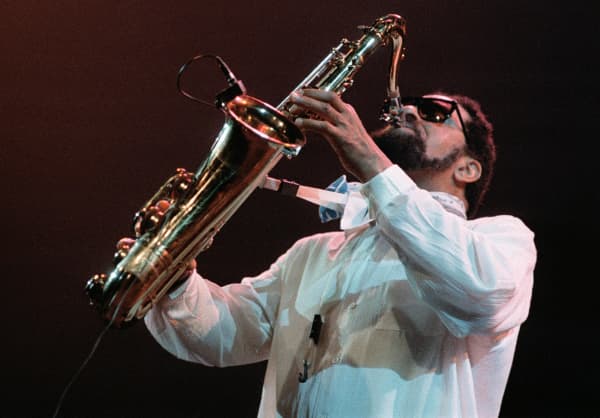
Tenor saxophonist Sonny Rollins in concert, 1987.
Listen to Sonny Rollins in conversation with Kim Hill in 2011.
“What made me withdraw and go to the bridge was how I felt about my own playing,” Rollins told the Guardian in 2022. “I knew I was dissatisfied.”
He ended up spending more than two years there, often for 14 or 15 hours a day.
“Of course, sometimes I’d come down to go to the bathroom, or I’d go to a bar I liked where I might have a cognac,” he said. “But then I’d go right back up.”
The resulting record, The Bridge, was not a complete break from his previous style but took his soloing and improvisation to a new level. A review in the Jazz Journal at the time said Rollins was able “to extract the last ounce of meaning from a particular phrase taken from the melody of the song”.
The record also set him on a course to becoming one of the most acclaimed performers of his generation, alongside John Coltrane and Wayne Shorter.
Rollins died at his home in Woodstock, New York, according to a statement released on Monday.
Born on September 7, 1930, Walter Theodore Rollins grew up in Harlem surrounded by music.
Both his brother and sister studied violin and piano. Pianist Fats Waller lived in the neighbourhood. Sonny, as he was known from an early age, recalled how he instinctively knew that Waller’s music was right for him “like a baby getting a bottle or something,” he told PBS.
His idol, saxophonist Coleman Hawkins, lived nearby, too.
On his way to school, Rollins walked past the Cotton Club and the Savoy Ballroom, both venues at the heart of the New York jazz world. “I was just immersed in it from the beginning really,” he said.
A child prodigy, Rollins was influenced by saxophonist Charlie Parker and mentored by pianist Thelonious Monk. Early opportunities came calling in the late 1950s when he played with leading jazz artists such as Art Blakey, Bud Powell and Miles Davis.
He wrote some of Davis’ best-known early pieces, including ‘Oleo’ and ‘Airegin’.
Saxophone Colossus included the calypso-inspired St Thomas, starting a long association with the music beloved by his parents, who hailed from the US Virgin Islands.
Rollins’ often marathon, hard-blowing solos earned him a reputation as the greatest jazz saxophone improviser.
He told PBS he would go on stage with his mind blank and no plan for his solos beyond an awareness of the structure of the piece. “Improvising on it, that I leave completely to the forces,” he said. “Sometimes I’m surprised by what comes out.”
Rollins also innovated by using his sax as a rhythm section instrument.
Albums included the soundtrack to the film Alfie, and East Broadway Run Down, both recorded in 1966.
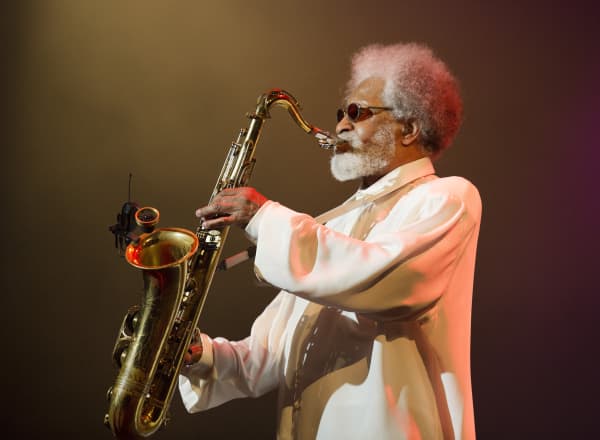
Sonny Rollins performing at the Dutch jazz festival North Sea Jazz 2010.
His devil-may-care compositions for Alfie captured the mood of that movie as successfully as Davis’ haunting music had done for Louis Malle’s Elevator to the Gallows eight years earlier.
Things could have turned out very differently for Rollins. In 1950 he was arrested for armed robbery and spent 10 months in jail.
“In retrospect, it was the first of my sabbaticals! Unlike the others, it wasn’t self-imposed. But it was a learning place,” Rollins told Uncut magazine.
“The prison was a brutal place, but fortunately I was involved in the music, and I largely avoided the brutality.”
In 1952, he was re-arrested for breaking the terms of his parole by using heroin, a habit he later swapped for an exercise regime and yoga practice, shunning the all-night partying that destroyed the careers of so many other musicians.
During another sabbatical, starting in 1969, he spent time in Japan and India including a spell in a monastery before reappearing in the early 1970s to make more records.
Lucille, whom he married in 1965, acted as his manager. The couple stayed together until her death in 2004. They had no children.
Rollins recorded more than 60 albums as a leader. He performed with bands including the Rolling Stones, providing improvisations to three tracks on their 1981 album Tattoo You.
But he later told The New York Times that he did not relate to their music, which he felt was “just derivative of Black blues”.
After winning two Grammy awards from the National Academy of Recording Arts and Sciences, as well as a Lifetime Achievement Award from that same institution, a respiratory illness forced him to stop playing. He retired in 2014.
Rollins was aware of his place as the last surviving giant of the era of jazz led by Parker, Monk and Coltrane.
“I’m the last guy but in a way I’m not, because when I’m gone my music is going to be here,” he told PBS in 2011. “We’re all still here, we’re all still here.”
Marlon Williams plays hits and breaks hearts at emotional Auckland show
“It’s nice not touring an album, this is like being a tribute artist to myself,” Marlon Williams tells the audience on the first night of his final tour.
A century on from Miles Davis’s birth, his legacy still shapes jazz
This week marks 100 years since the birth of one of jazz’s biggest names and greatest innovators, from bebop, to cool to fusion, Davis never stopped evolving.
Sparks show why they’re your favourite band’s favourite band
For a band that’s been making hit records for over 50 years, Sparks still feel a little bit underrated.
‘Absolute madness’ – How costume rock duo Angine de Poitrine are breaking the internet
French Canadian duo Angine de Poitrine are riding a wave of interest after a video of their live performance exploded in popularity, aided by a comical reaction by many on YouTube struggling to understand how their music is made.
Other sections:
• Ngā papa whakaata/Screens
• Āhua noho/Lifestyle
• Whanaungatanga/Relationships